
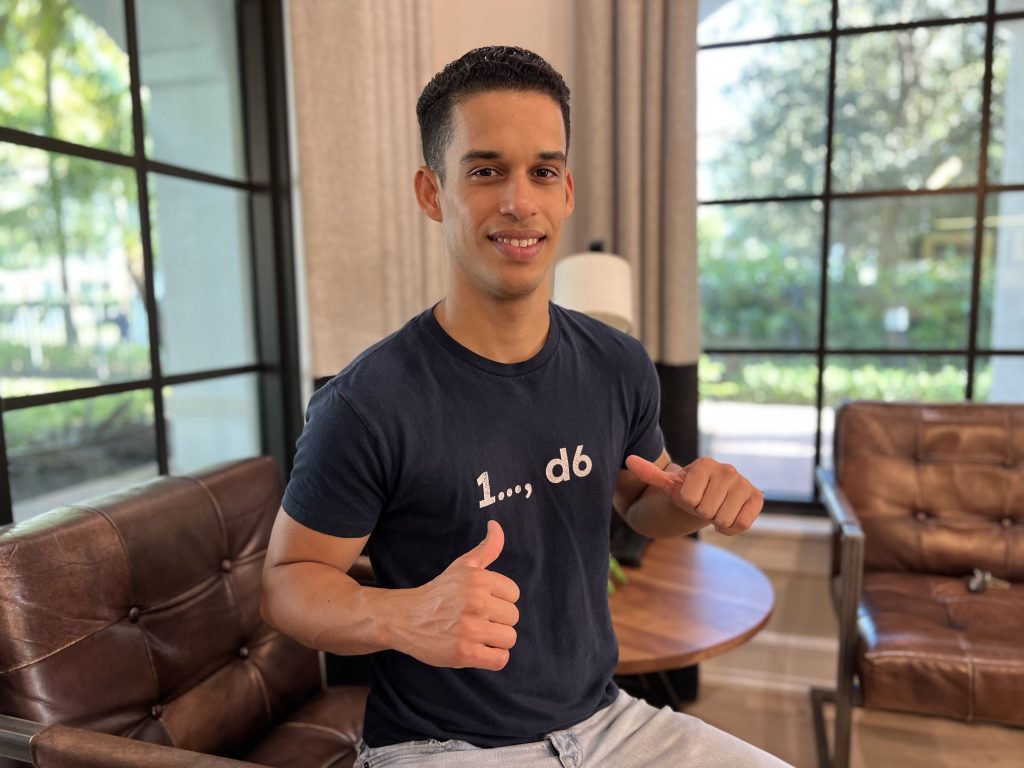

Early in his coaching career, NM Robert Ramirez worked with two gifted young students. Eager to accelerate their growth, he encouraged them to play up in tougher sections instead of remaining in their age group. One of the students, still a third grader, found himself competing against high school seniors. While he played well, the lack of immediate trophies eventually dampened his enthusiasm and he drifted away from chess. Looking back, Ramirez sees this experience as a turning point in his philosophy: while ambition is important, the real key is to keep the game fun and let growth come naturally.
Balancing competitiveness and care has since become a defining trait in his coaching. It helped Ramirez become the winner of Chess.com’s inaugural CoachChamps 2025. His strongest student, reflecting on their month of preparation together, summed it up perfectly: “Thanks a lot to Robert. He’s a great coach, he’s very supporting, he didn’t put any pressure on me, we had a good communication, I think he really improved my game.”
This thoughtful, human-centered approach also matches his warm personality, which is something that shines through not only in his coaching but also in his popular videos and courses. As both a coach and content creator, Ramirez brings an engaging style that makes chess accessible to players of all ages.
Such a style reflects a deep understanding that chess is more than a sport or competition. For Ramirez, it is a vehicle for personal development. And whether his students get medals or simply walk away with a stronger mindset, he sees every journey as a success. “What I love the most about coaching is the human connection—interacting with people of all ages and levels, and helping them see progress in their game,” he says.
In this edition of Coach’s Corner, the Miami-based master talks about the lessons from his 15-year experience as a chess trainer and shares great tips:
What is your chess coaching philosophy?
My coaching philosophy is simple: keep it clear, keep it practical, and enjoy the process. In chess, there’s often a temptation to focus on memorizing endless theoretical lines, especially in the openings. But I prefer a different approach. I encourage my students to play systems they truly understand—the moves, the ideas behind them, and the purpose of each step. That understanding alone is usually enough to transition smoothly from the opening into the middle game.
Once in the middle game, I emphasize building a strong foundation in tactics, strategy, and positional play. From there, it’s about flexibility—knowing when to go for an attack on the king if the opportunity arises, and also being comfortable if the game slows down into something quieter or more positional. Sometimes simplifying the position is the best strategy, and that’s perfectly fine.
When it comes to endgames, I focus on core fundamentals. Instead of trying to memorize entire endgame books, I teach the most important principles and techniques that can be applied again and again. Ultimately, I want my students to rely on solid general principles rather than rote memorization.
At the same time, I recognize that every student is different. Part of my philosophy is staying flexible and adapting to each player’s needs, learning style, and goals. No two students are the same, and my job is to guide them in the way that works best for them.

Suppose a player has only 3 hours a week for chess training. How should they spend their time?
Well, the first thing I’d say is they should quit their job, drop out of school, and ditch their family so they can have more time for chess… just kidding!
In all seriousness, how you use your time really depends on your level. But for most players who only have about three hours a week, I’d recommend a balanced approach:
- 40% on tactics — This could mean pattern recognition, calculation, or visualization exercises, depending on your current stage. Tactics are the foundation of improvement, so they should always be a priority.
- 40% on playing games — Try to include longer time controls to practice deep thinking, but also sprinkle in some shorter games to get comfortable managing the clock and making decisions under pressure.
- 10–15% on strategy, endgames, and positional play — Even just a little time here will pay off in the long run, especially if you focus on fundamental ideas.
- 5–10% on openings — While I don’t like students to obsess over openings, it’s important to review your games systematically. If you notice repeated struggles in the opening, take the time to understand why, make notes, and gradually build a solid repertoire.
The key is consistency. Even with just three hours a week, if you split your time wisely and stick to the plan, you’ll see steady progress.
What is the biggest factor for improvement for players under 1200 (Chess.com)? Under 2000?
For players under 1200 on Chess.com, the biggest factor is simple: tactics, tactics, tactics. At this level, the games are often decided by basic patterns—forks, pins, skewers, and simple two-move combinations. If you can spot these consistently, you’ll immediately start winning more games. The other key is learning to convert your advantage. Many players get ahead, but a few moves later, they give it back. Once you’re up material, focus on simplifying the position—trade pieces when it makes sense, steer the game toward a clean endgame, and don’t give your opponent counterplay.
For players around 2000 on Chess.com, the focus shifts. By the time you’re 1700–1800, most opponents already know their openings and are solid with tactics. That’s why many players plateau at this level without understanding why. The answer is the endgame. Strong endgame fundamentals become the difference-maker at this stage. If you can reach an endgame and consistently outplay your opponents there, you’ll have the edge needed to break through that 2000 barrier.

What is your preferred way to improve at openings? What’s the approach to chess openings that you try to teach your students?
When it comes to openings, my approach is very hands-on and student-centered. I usually start by sitting down with the student and showing them a few different options. For example, if they’re looking for an opening as Black, I’ll say: “Here’s what you could do against 1.e4, and here’s what you could do against 1.d4.” Then I show them some sample games so they can get a feel for the types of positions each opening creates.
From there, the student chooses one that feels right to them. I encourage them to try it out and have fun with it first, without worrying too much about memorizing theory. If it seems to fit their style and personality, then we go deeper into the main ideas and gradually layer in more theory. But if they don’t like it? No problem—we move on and find something else.
That’s important, because I believe an opening should match your personality. If you’re naturally a calm, positional player, you won’t enjoy forcing yourself into wild, tactical gambits. And if you’re aggressive and thrive on complications, you won’t feel at home in a quiet, solid system. The goal is to play something you connect with.
Once a student settles on an opening, then it’s time to go deeper: study the ideas, get familiar with the key lines, maybe invest in a book or course, and gradually build a repertoire. Finally, the most important step is practice. Play games, test the opening, review any lines that give you trouble, and refine it over time. That’s how you truly master an opening.
What is your preferred way to improve at the endgame?
When it comes to the endgame, I believe in starting with a solid foundation. The most important ones to master first are king and pawn endgames and rook endgames, since these are by far the most common positions you’ll encounter in real games. If you’re comfortable there, you’ll already have a big edge over many players.
Once you have that base, I always recommend the classic book 100 Endgames You Must Know. It’s an excellent resource for building knowledge step by step. From there, it’s all about practice. Go to your favorite chess platform, choose endgame exercises, and just play through them—again and again. The repetition builds confidence and helps you internalize patterns.
Improving at endgames doesn’t need to feel like a chore. If you approach it as a fun challenge, you’ll not only sharpen your technique but also gain the confidence that, no matter how the game simplifies, you’ll know what to do.

Is there anything else you would like to share with ambitious chess improvers?
My advice—both for coaches and ambitious players—is to keep an open mind. Training and discipline are absolutely important if you want to reach your goals in chess, but it’s just as important to remember that there’s more to life than the game itself.
Chess can teach you incredible lessons about patience, problem-solving, and resilience, but don’t let it consume everything. Explore different experiences, enjoy life, and bring that balance back to the board. Often, the players who grow the most are the ones who learn to love the journey, not just the results.
At the end of the day, chess should be something that enriches your life—not something that takes away from it. If you keep that perspective, improvement will follow, and the process will be far more rewarding.
Chessable courses by NM Robert Ramirez
With a predilection for hypermodern openings, Ramirez has built courses around systems that emphasize ideas over memorization.
His debut course, Counterblow: A Complete Fighting Repertoire for Beginners, introduces players to the King’s Indian and the Pirc defenses. The latter carried him from novice at 12 years old, to National Master. The course was so well-received that it was shortlisted for Chessable Course of The Year and Best Beginner Course in 2023.
Ramirez followed up with First Strike: The Fighting Stonewall Attack for Beginners, where he applies the same philosophy: one system versus anything. Both courses reflect his fighting style of chess, which is both accessible and compelling for beginners.
And he just published Chess Strategy: Simplified, which is on introductory sale until November 5, 2025.
Check out his author page!