

Tournament Information
The FIDE World Cup is one of the most prestigious events on the chess calendar. It is the largest knockout tournament and awards three Candidates spots to the first three finishers. 206 players are playing the tournament, with each round only growing in intensity. The time control is 90+30 for the first 40 moves, with an extra 30 minutes after move 40. Matches are played in sets of two: first, a classical portion of 2 games. If the result remains tied, the players play 15+10 games, then, if still tied, 10+10 games, then 5+3, then 3+2, and finally, if still tied, a deciding Armageddon game.
Watch and replay all the games in our broadcast.
Pairings for the Finals
The finals will be played between GM Wei Yi and GM Javokhir Sindarov. The third place match between GM Andrey Esipenko and GM Nodirbek Yakubboev will be highly anticipated because the winner will qualify to the 2026 FIDE Candidates, while the fourth place finisher will not.
Overview
GM Andrey Esipenko had better positions in both of his classical games against GM Wei Yi, but Wei defended well and forced the match to head into tiebreaks. There, Wei was slightly better in the first 15+10 game, but ultimately could not convert. In the second game, Wei found himself in a lost endgame, but Esipenko, in mutual time pressure, failed to find the correct response, and later on even hung a rook, handing the match win to Wei Yi.
GM Javokhir Sindarov’s match against GM Nodirbek Yakubboev was less tense as after two quiet games in the classical, Sindarov dominated the 15+10 tiebreaks with first a brilliant positional, endgame win, then a draw in a tactical game where only he had the chances.
Interviews
Make sure to check out all of our interviews from the World Cup on our YouTube channel! All our interviews from the semifinals are also embedded throughout this article.
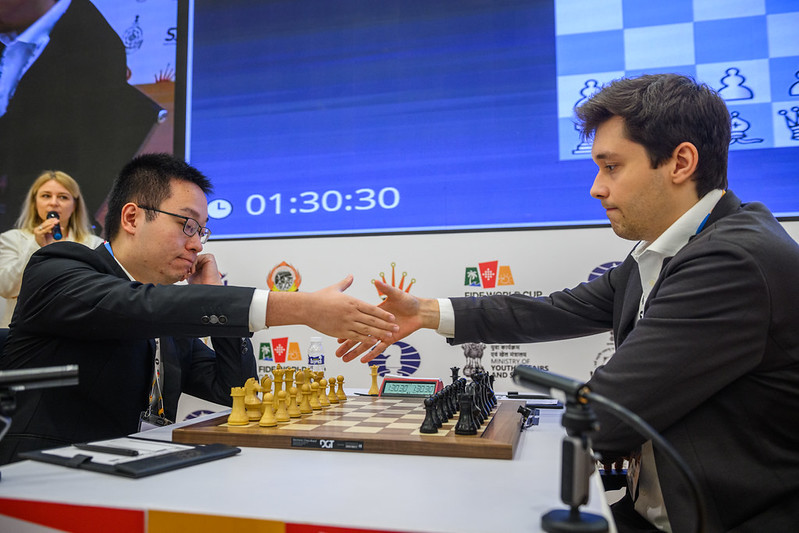
GM Wei Yi vs. GM Andrey Esipenko, Wei Yi Survives Scare With a Win
GM Wei Yi vs. GM Andrey Esipenko; Photo: Michał Walusza / FIDE
Classical Portion, Esipenko Applies Pressure
Game 1
GM Andrey Esipenko came up with the first surprise of the match as he played the French Defense, an opening he seldom plays. After GM Wei Yi’s principled and classical treatment with 3. Nc3, Esipenko took on e4, 3…dxe4, initiating the Rubinstein variation of the French Defense — a drawish variation where Black has little winning chances. Wei was clearly caught off guard, however, and Esipenko was barely spending any time in the opening, while Wei had spent over ten minutes by move 9. Then, in an act of what seemed to be over-the-board inspiration, Wei uncorked 10. h4!?, a strong pawn push that aims to gain space and preempt White’s attack on the kingside.
https://lichess.org/study/embed/DwPApVNX/L6HKkOz6#19
Owing to the solid nature of the Rubinstein, however, extreme precision was required for Wei to keep any semblance of an advantage; just on move 12, after a couple of minutes of thought, Wei lost his advantage after 12. Kb1?!. Esipenko proceeded to capture White’s bishop pair, and after further weakening pawn moves by Wei, Esipenko’s advantage could not be denied. With Wei’s time pressure looming, Esipenko’s chances to win the game were evidently high, but with just eight minutes on the clock, Wei calculated a brilliant line that forced a draw. Esipenko’s last chance to play on was with 27…Qf5, aiming to transition into an endgame where only he could be better. However, taking the free pawn with 27…Qxh5 was difficult to reject; the absolutely stunning 28. Bxa6!! drawing resource was indeed very difficult to spot from afar.
https://lichess.org/study/embed/DwPApVNX/L6HKkOz6#55
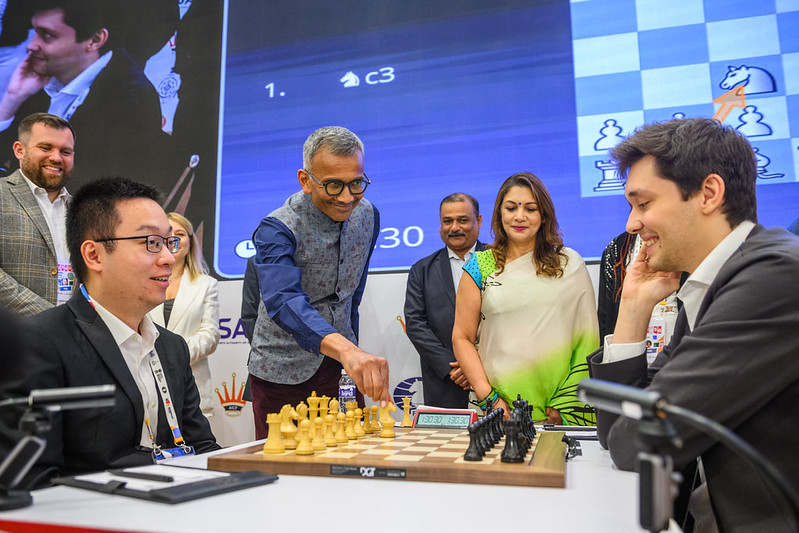 GM Wei Yi vs. GM Andrey Esipenko; Photo: Michał Walusza / FIDE
Game 2
Esipenko once again found himself to be on the better side of the opening as his 7. Bf4 against Wei’s Petrov must have also taken Wei aback. While Wei’s setup was sound, there were some minor improvements along the way that could have made his defensive task far easier. After Esipenko managed to win the bishop pair, Wei’s position looked rather delicate, and Esipenko’s logical and easy-to-find moves kept up the pressure against Wei.
https://lichess.org/study/embed/sUYGd4NL/W0OmdX47#23
The remainder of the game had several twists and turns, with nuances built on subtleties, but, Wei found a good defensive setup, lining up Alekhine’s gun and trading off pieces, forcing repetition in short order.
https://lichess.org/study/embed/sUYGd4NL/W0OmdX47#52
Rapid Portion, 15+10, Wei Yi Nabs a Rook With a Backward Knight Move
Game 1
Esipenko once again wanted to debate the Petrov with Wei, choosing the same line as White. It was Wei, however, who deviated, playing 8…Bf5 instead of 8…Be6. The improvement seemed to work out well as Wei was ready for Esipenko’s 10. h3, with threats of expansion on the kingside. Wei himself chose a very thematic idea, expanding with a6-b5 on the queenside, and was able to get in Na5, threatening to get rid of White’s bishop pair advantage.
https://lichess.org/study/embed/SDOEWNnt/zqR2nBZX#30
The only move to keep the bishops on the board, 16. Bd5, was met with the powerful 16…c6!, which eventually tactically forces one bishop off the board. The position on move 22 may have been equal, but it was in fact Black who was starting to gain traction. While Esipenko comfortably held the draw, Wei could have played more incisive moves to keep his advantage, but it was clear that Wei was content with the draw and wanted to try to win with the White pieces against Esipenko.
https://lichess.org/study/embed/SDOEWNnt/zqR2nBZX#44
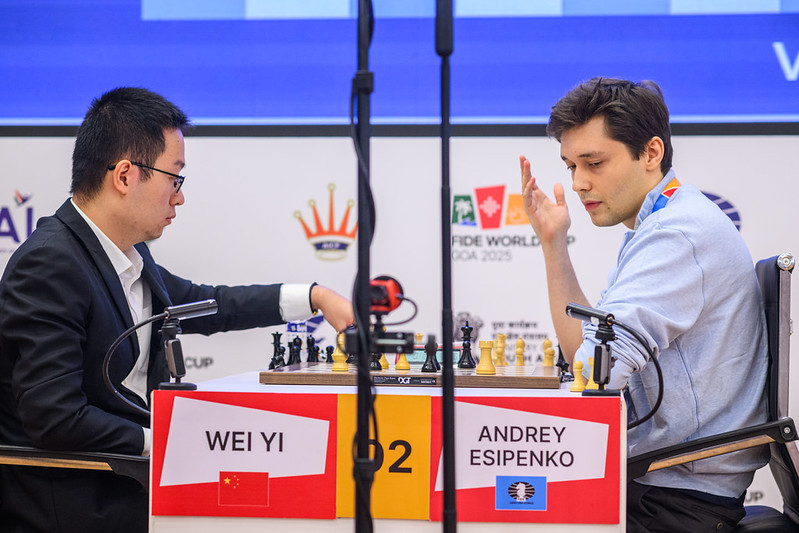 GM Andrey Esipenko vs. GM Wei Yi; Photo: Michał Walusza / FIDE
Game 2
The popular Italian Opening at the top level has become quite the signal that both sides want a complicated, maneuvering fight, and this game did not change the narrative. As White and Black transferred their queenside knights to the kingside, it looked clear that White’s attempts to gain an advantage were futile as Esipenko’s 19…d5! opened up the center and threatened equality. White retained a space advantage and the better prospects in an endgame, however, so it was not all smooth sailing for Esipenko. Wei, though, perhaps forced matters too much, and the tides started shifting as Esipenko’s pieces began to infiltrate.
https://lichess.org/study/embed/WbJALkI5/OLNp4hln#88
Just as it seemed as if Wei was about to get knocked out of the finals, Esipenko failed to find the refutation of 55. Rh7?. One move later, in mutual time pressure, he blundered a rook to a backward knight move, ending this tense match abruptly.
https://lichess.org/study/embed/WbJALkI5/OLNp4hln#112
Instead, with 56…Ne1+, Esipenko could still have been on the better side of a draw. For example, 57. Kc4 Re2 58. Nd5+ Kc6!, and now 59. Rxc7+? would be a near-blunder because of 59…Kd6!, when Black is better.
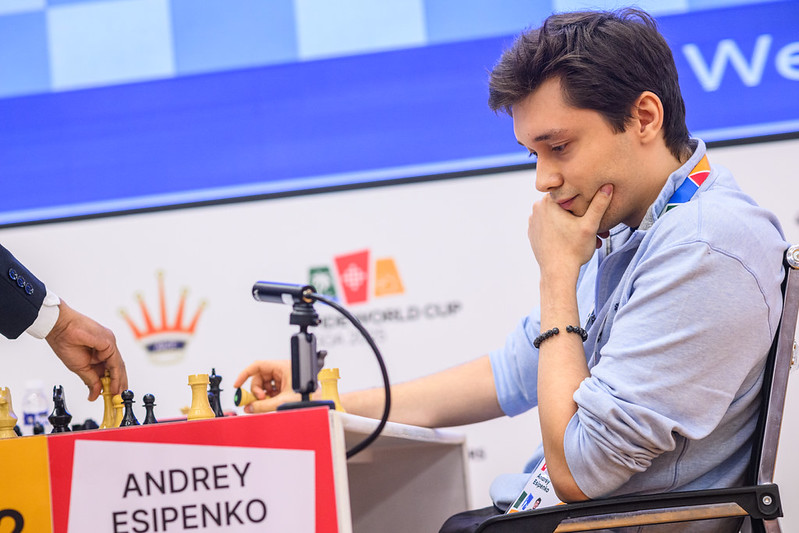 GM Andrey Esipenko; Photo: Michał Walusza / FIDE
Watch our interview with GM Wei Yi:
GM Javokhir Sindarov vs. GM Nodirbek Yakubboev, Sindarov Plays Positionally and Tactically
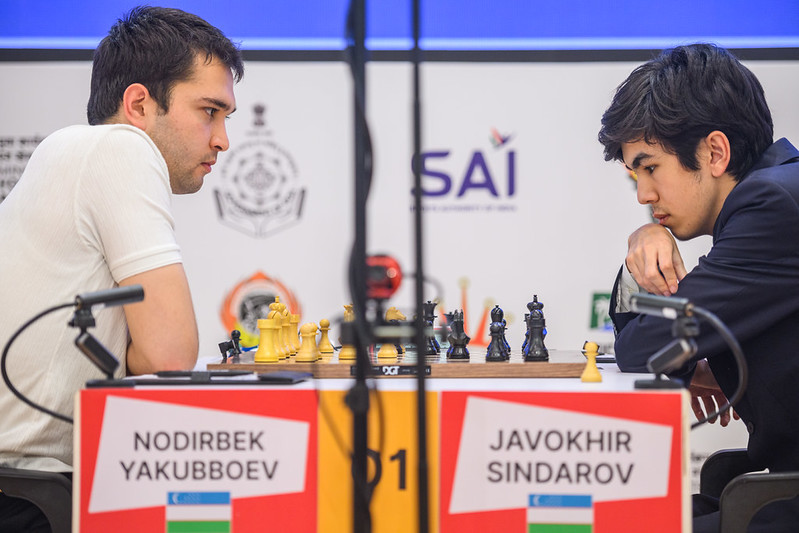 GM Nodirbek Yakubboev vs. GM Javokhir Sindarov; Photo: Michał Walusza / FIDE
Classical Portion, Sindarov Misses One Minor Chance
Game 1
GM Nodirbek Yakubboev’s early surprise in the Semi-Slav Defense, 5. Qd3, did not yield the intended effect as GM Javokhir Sindarov spent no time in replying with a very objectively correct and liquidating line.
https://lichess.org/study/embed/DwPApVNX/GbXzepOB#9
As the queens and two sets of minor pieces were traded off the board, it looked clear that the game was about to be drawn. Yakubboev had a symbolic advantage for a short while, but it was obvious that it would be almost impossible to even pretend to be creating winning chances, so a draw was agreed on the 30th move.
https://lichess.org/study/embed/DwPApVNX/GbXzepOB#60
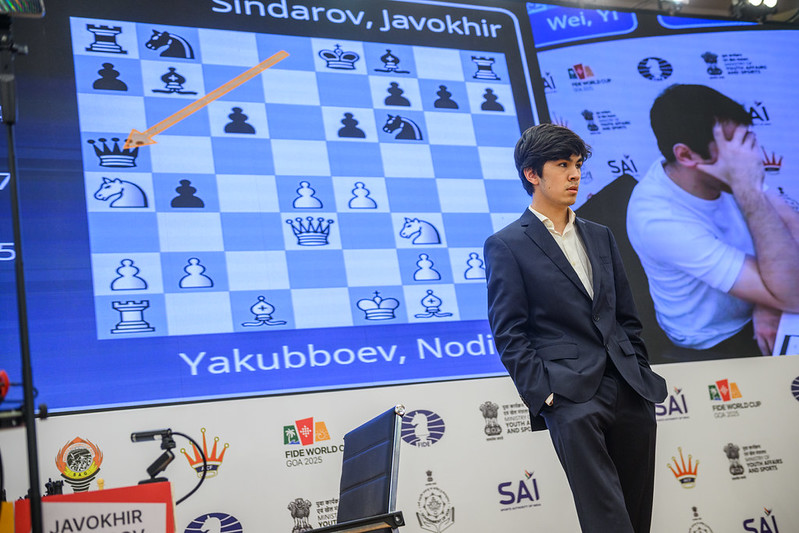 GM Javokhir Sindarov; Photo: Michał Walusza / FIDE
Game 2
If one were to look at the position on move 17, they would be under the assumption that the game was a very quiet affair. While such an assessment is correct about the game’s second half, the opening phase was actually marked by a very intriguing moment. Sindarov’s 10. Qh5 was of course fine, but, in fact, there was a much more devious way to ask Black important questions in the opening; funnily enough, the sequence also featured a later Qh5.
https://lichess.org/study/embed/sUYGd4NL/AgJvnWew#18
The innocuous-looking 10. Qe2+!, which probably deserves another exclamation mark, would have forced Black to make tough decisions and find some difficult moves. The point of 10. Qe2+ is the counterintuitive piece sacrifice, which can be seen in the line 10…Qe7 11. Qh5!! cxb5 12. Bg5!, with 12…Qd6 13. Rfe1+ Kf8 14. b4 Qg6 15. Qe2 Kg8 16. bxc5 h6 17. Bf4 being one very forcing line. Black would have to find the more accurate 10…Qe6, or the unfortunate retreating move, 10…Be7, to have a more playable position, but White can still prolong the game and pose Black issues to solve. Alas, after Sindarov’s 10. Qh5, the players found a quick path to equality, and the picturesque position on move 31 cemented what was a rather correctly played draw.
https://lichess.org/study/embed/sUYGd4NL/AgJvnWew#61
Rapid Portion, 15+10, Sindarov Dominates
Game 1
The players repeated the Semi-Slav Defense, but Yakubboev played the absolute mainline of the position, 5. Bg5. Owing to the time spent, both players were clearly well-prepared, arriving at a novel position on move 11 where White gives up the bishop pair for a strong pawn in the center. Sindarov did well to play around said pawn, though, and after Yakubboev decided to win back the bishop pair, it was Black who had the better chances in the resulting knight vs. bishop position.
https://lichess.org/study/embed/SDOEWNnt/sCkmsbrG#37
After Yakubboev defended his now weak e5-pawn with f4, White’s position was starting to amass weaknesses. Sindarov’s decision to allow White to trade off his bishop for Black’s knight proved to be wise as the resulting rook endgame turned out even worse for White, who was facing an aesthetically pleasing quartet of Black queenside pawns. White’s e3-pawn was just too weak, and Yakubboev’s position collapsed swiftly.
https://lichess.org/study/embed/SDOEWNnt/sCkmsbrG#78
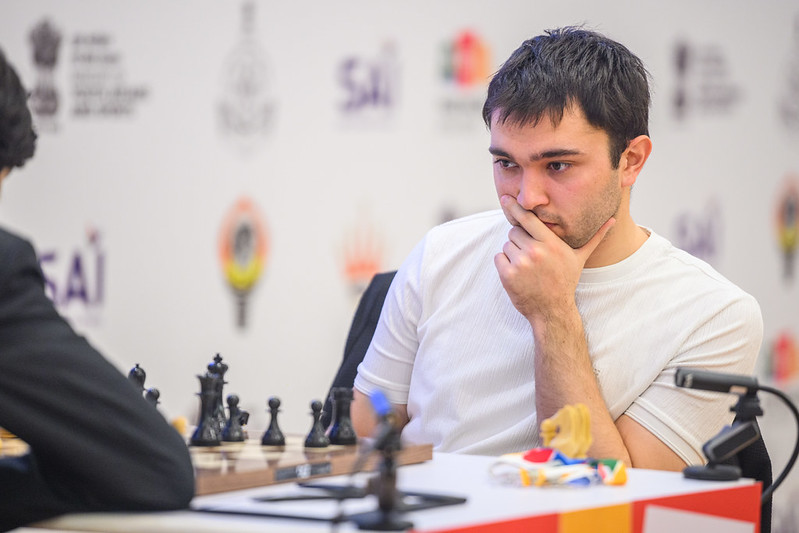 GM Nodirbek Yakubboev; Photo: Michał Walusza / FIDE
Game 2
Needing to win, Yakubboev essayed the Sicilian Defense against Sindarov’s 1. e4. It was Sindarov who had the winning chances, however, as he was never in any real trouble and even had a winning position at several points in the game. As almost any Sicilian game, though, the game remained highly complicated, and while it seemed as if Sindarov picking up the exchange with 16. Bxh8 would soon proclaim his victory, the game was far from over.
https://lichess.org/study/embed/WbJALkI5/Pd4flfVb#31
Yakubboev’s 16…d5!! was a nice find, but Sindarov was alert and found one of the better moves in the position, if not the best move, 17. Rh3!. With 18. Nd5!?, it became evident Sindarov wanted to trade as many pieces as possible, and his wish was granted as a pair of minor pieces and the queens were off the board.
https://lichess.org/study/embed/WbJALkI5/Pd4flfVb#46
Nevertheless, Black’s kingside pawns were rather annoying for White, so Sindarov still had to be precise. 24. b3! was a lovely touch, and with Black almost losing his kingside pawns, Sindarov was close to winning the game. A draw, of course, was enough to qualify, so 29. Rxg2!, while objectively not the best move, liquidated pieces and forced an equal endgame on the board. Sindarov did not have any issue holding the resulting position.
https://lichess.org/study/embed/WbJALkI5/Pd4flfVb#57
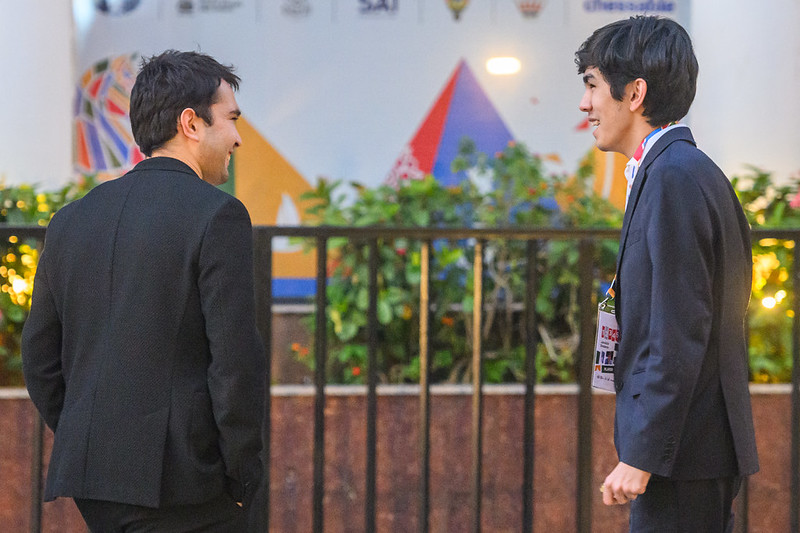 GM Nodirbek Yakubboev and GM Javokhir Sindarov are compatriots and teammates; Photo: Michał Walusza / FIDE