
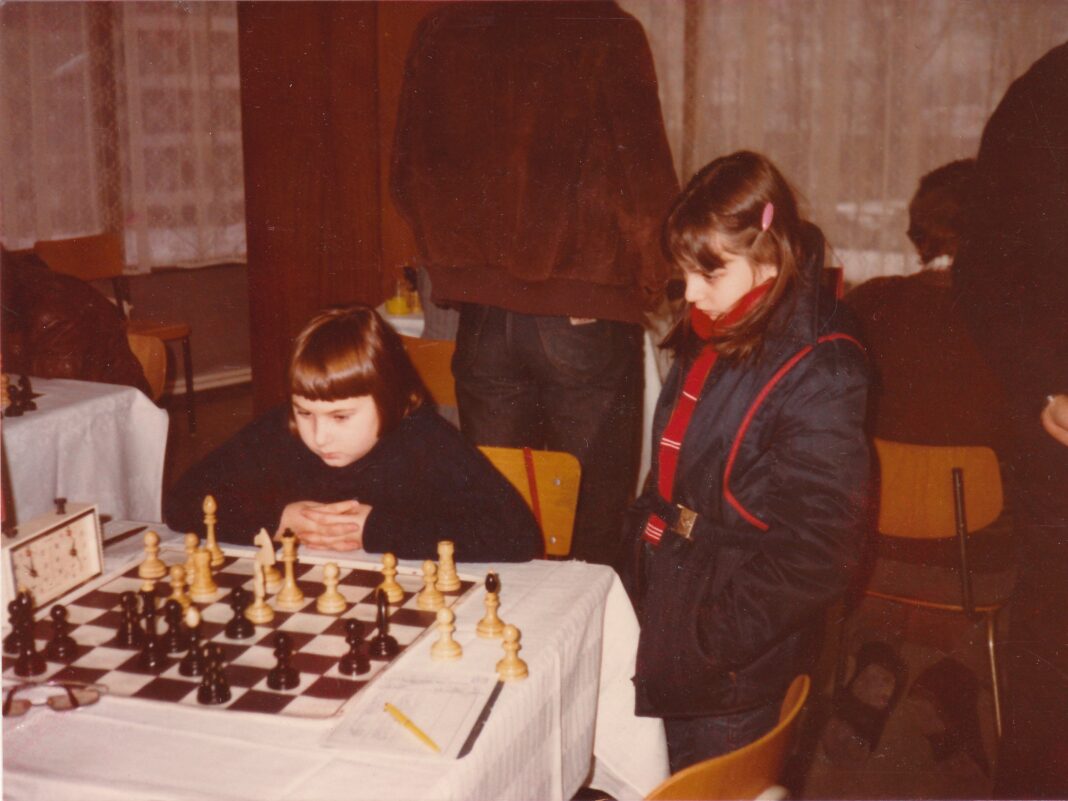

GM Judit Polgar’s extraordinary career is in the global spotlight as Netflix released its new documentary, Queen of Chess, on Friday, February 6. The 94-minute film is available to stream today on the platform for its more than 300 million subscribers worldwide, bringing one of chess’s most remarkable stories to a wider audience.
Queen of Chess had its world premiere on January 27 at the Sundance Film Festival, the largest film festival in the United States, marking the latest high-profile debut for the award-winning director Rory Kennedy. Today, it is also available to the rest of the world on Netflix.
The documentary combines extensive archival material from famous tournaments (the 1988 Chess Olympiad in Thessaloniki, the Hungarian Championship 1991, Linares 1994, and many others) with personal family footage and modern interviews, offering a fascinating look at the barriers Polgar had to overcome to reach the top.
Expectations have been high ahead of the release, coming five years after the chess world experienced an unprecedented surge in interest following the debut of The Queen’s Gambit. The Netflix hit series drove record sign-ups on Chess.com, boosted sales of chess sets worldwide, and pushed chess firmly into the spotlight.
While Queen of Chess is unlikely to spark a phenomenon of that scale, it comes at a moment when the chess audience is broader than ever, and it could help introduce a new generation to one of the game’s greatest icons.
“My hope is that people feel inspired—and that their eyes are opened to one of the great untold sports stories. Even if you don’t play chess, this is a story about resilience, determination, and breaking barriers, and I hope it will appeal to a broad audience,” Kennedy said.
Even if you don’t play chess, this is a story about resilience, determination, and breaking barriers, and I hope it will appeal to a broad audience.
—Rory Kennedy director of “Queen of Chess”
The documentary traces Polgar’s incredible rise from communist-era Hungary, where she emerged as perhaps the greatest prodigy chess has ever produced. In 1989, at the age of 12, and after years of training under her eccentric father who wanted to prove that geniuses could be made, she had already become the world’s top-rated female player.
At 15, she shattered Bobby Fischer’s legendary record to become the youngest grandmaster in history, and she later cemented her place among the game’s elite as the first—and still only—woman to break into the world’s top 10 overall.
Queen of Chess features interviews with Judit herself, her parents, Laszlo and Klara, her sisters, Susan and Sofia, and her husband, Gusztav Font. Also featured in Queen of Chess are GM Maurice Ashley, IMs Jovanka Houska and Anna Rudolf, along with Dirk Jan ten Geuzendam, Editor in Chief of New in Chess magazine—and most notably, GM Garry Kasparov.
Polgar’s clashes with the 13th world champion are a red thread in the documentary, starting with their first meeting in 1994, when Polgar, as a 17-year-old rising star, participated in the Linares supertournament in Spain for the first time.

The film revisits the infamous touch-move controversy from their encounter in the fourth round, in which Kasparov was caught on camera retracting a move, an episode heavily debated in the chess world.
A couple of early critical responses have been mostly positive, with reviewers highlighting Polgar’s achievements and the film’s accessibility to non-chess audiences. RogerEbert.com awarded it 3/4 stars, concluding that “Queen of Chess gives a champion her flowers.”
Collider gave it 7/10, calling it “fascinating” and saying that the documentary “always keeps your attention and celebrates a remarkable woman whose amazing story deserves to be told.” The reviewer also praised Polgar’s presence on screen, both in archival footage and in the later interviews.
There’s a refreshing lack of arrogance to Polgar that characterizes so many other chess players, but make no mistake, she’s the furthest thing from meek and weak.

One review was more critical. ScreenRant described Queen of Chess as “unremarkable” and “very Netflixian,” arguing that it doesn’t explore the tension of the game, “…nor the lifetime of sexual discrimination Polgar has faced with nearly enough rigor.”
Still, Kennedy hopes the documentary resonates beyond chess, saying: “The world feels pretty dark right now. I think there’s something important about telling a true story that’s hopeful, inspiring, and ultimately uplifting. My hope is that Queen of Chess resonates with people who may be struggling in their own lives and reminds them that change—and greatness—can come from the most unexpected places.”
Whether Queen of Chess becomes a hit remains to be seen, but Judit Polgar’s story has always been one worth telling to the world.