
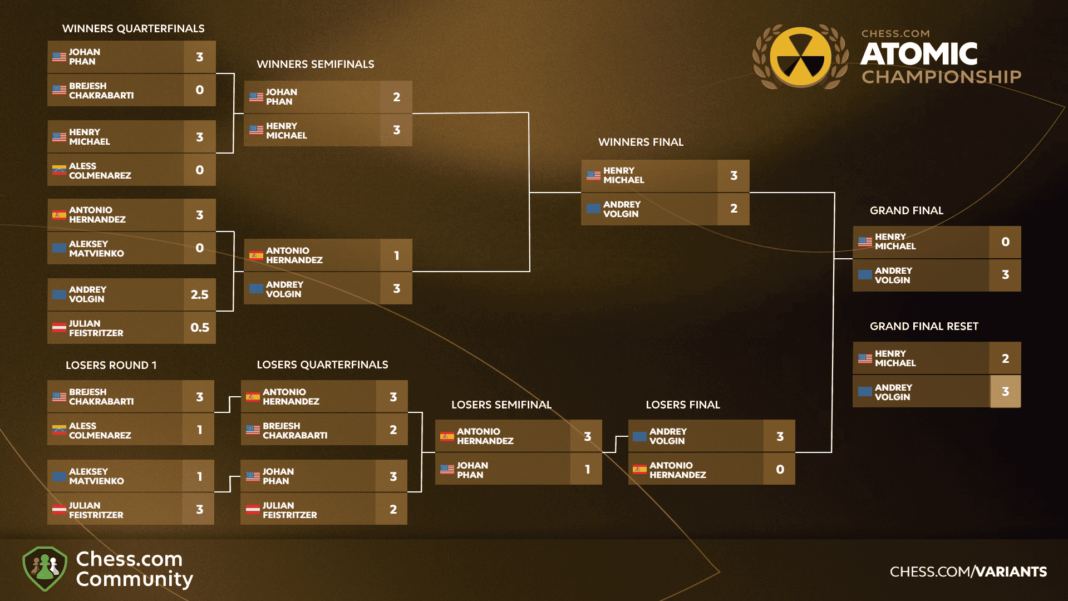

Andrey Volgin defeated Henry Michael through the Final Reset route to win the eight-player final of the Chess.com Atomic Chess Championship 2026. Michael defeated Volgin in a fight between the two untitled players in the Winners Final of the double-elimination bracket but then lost to him in both the Grand Final and the Grand Final Reset held on March 6. On the previous two days, eight players had advanced to the finals from as many Qualifiers.
The Atomic Championship is part of the Chess.com Community Championships, open to all members of the official Chess.com Community Club, with a first prize of $750 and a total prize fund of $2,500.
Bracket
Atomic Chess
Atomic Chess has fascinating rules and methods of play, which make it a player’s delight if you have the mindset to try different variants of chess. To understand this “creative” version, one has to look at how seriously the participants strive to improve their prowess in variants. And, to feed their appetites, there are forums and groups to help them improve their skills at this variant, named colorfully like “Atomic Chess Theory” and the like. It is quite interesting to see topics such as “What endgame should I learn/know” and “Creating a proper Atomic study.” Fascinating worlds!
Qualifiers
From the eight Qualifiers on March 4-5, winners advanced to the Knockout Final on March 6. All matches were determined by the best of four games.
| Tournament | Winner | Username | Score |
| Qualifier 1 | Johan Phan | johannfan | 101 |
| Qualifier 2 | Antonio Hernandez | GMonubense | 89 |
| Qualifier 3 | Andrey Volgin | Grevozin | 93 |
| Qualifier 4 | Henry Michael | scenry1 | 116 |
| Qualifier 5 | Aless Colmenarez | venequioo | 114 |
| Qualifier 6 | Julian Feistritzer | NeoArcturus | 104 |
| Qualifier 7 | Aleksey Matvienko | lesha2002 | 120 |
| Qualifier 8 | FM Brejesh Chakrabarti | goldenbuzzer | 107 |
Eight-Player Final
We were initially treated to an amazing spectacle in the game between FM Brejesh Chakrabarti and Johan Phan that had two unusual arrays of pawns mutually staring at each other from close quarters.
Later in the game, Phan achieved a draw by cornering the black king on h1 with his own king and was just moving his king perpetually with Kg1-g2-g1, which is actually a draw in Atomic Chess. To add to Black’s misery, he even lost on time in this colorful position.
It was obvious that the event was going to be fun to watch.
Then in the Winners Semifinals, we were treated to another clever conclusion when Henry Michael took down Phan’s king in a pretty way.
Michael’s 18.Bf7 is the winning move that forced resignation, as White is threatening 19.Bxe6 which will “explode” the black king on an adjacent square. If Black moves 18…Kf8, then the winning move would be 19.Nxg7—once again the black king is exploded thanks to the white knight’s capture of the black pawn on g7. Understanding the nuance behind Black’s resignation, commentator GM Benjamin Bok exclaimed, “Hmmm. You see, I am learning, slowly but surely!”
Another innovative operation occurred in the Losers round one between Chakrabarti and Aless Colmenarez, when White found a catchy way to win in what looked like a normal Atomic draw.
Chasing the white king around, the black king seemed to have caught it in the familiar “bear hug” of an Atomic Chess draw. But White found an amazing way to end the game with 44.Qxh4! which wins, as the white queen explodes along with the black king and the pawn, thus ending the game. Note that the radius of explosion wouldn’t bother the white king that is off the perimeter.
As the tournament progressed, Michael and Volgin met in the Winners Final. The following picturesque finish enabled Michael to win the crucial match in the tiebreak with a 3-2 score.
Black played 29…Qg2!, and the queen cannot be captured and prevented from destroying the white king on the next move. Michael thus won the Winners Final with a score of 3-2 with this victory.
Next Volgin moved to the Losers Bracket where he defeated Antonio Hernandez 3-0 in the Losers Final in the following dramatic game.
After Black played 21…Qb7+, a win is possible in Atomic Chess with just the queen on the diagonal even without a bishop being added for a battery. After 22.Rf3 gxf3, White resigned, as there is no defense against 23…Qg2 and then the defeat of the white king. After winning the Losers Final, Volgin got another shot at the title and faced Michael again in the Grand Final.
Grand Final: Michael 0-3 Volgin
This was a well-contested final, with the second game bringing out a beautiful finish.
In spite of his material deficit, Volgin began a curious attack with just his lone rook, pushing the white king all the way from g1 to f5, and finished the game with the impressive 25…Nf8!!, which sets up a mate with the unavoidable 26…Rf4+. Volgin went on to win the Grand Final with a clean 3-0 score.
Grand Final Reset: Michael 2-3 Volgin
Since Michael had won the Winners Final, a Grand Final Reset was needed, and the contestants fought one more final match to determine the winner. The match was tied at 2-2 in regulation time and once again went to a tiebreaker fifth game.
Volgin found a commanding concept, using the rules of Atomic Chess to “trap” the opponent’s rook in the corner on a8.
A remarkable idea! Volgin indeed went on to win the game, suppressing the black rook’s activity and finally winning the crucial tiebreak game and the title.
The Atomic Chess Championship is part of the 2026 Chess.com Community Championships, and the event was open to all members of the Chess.com Community Club. The winners of eight Qualifiers played in a double-elimination Knockout bracket to decide the best Atomic Chess player on Chess.com. The event featured a $2,500 prize fund.
Previous coverage: