


Over more than 45 years of professional activity connected with FIDE, I had the opportunity to meet and work closely with many fascinating people, particularly those involved in education, culture and high performance.
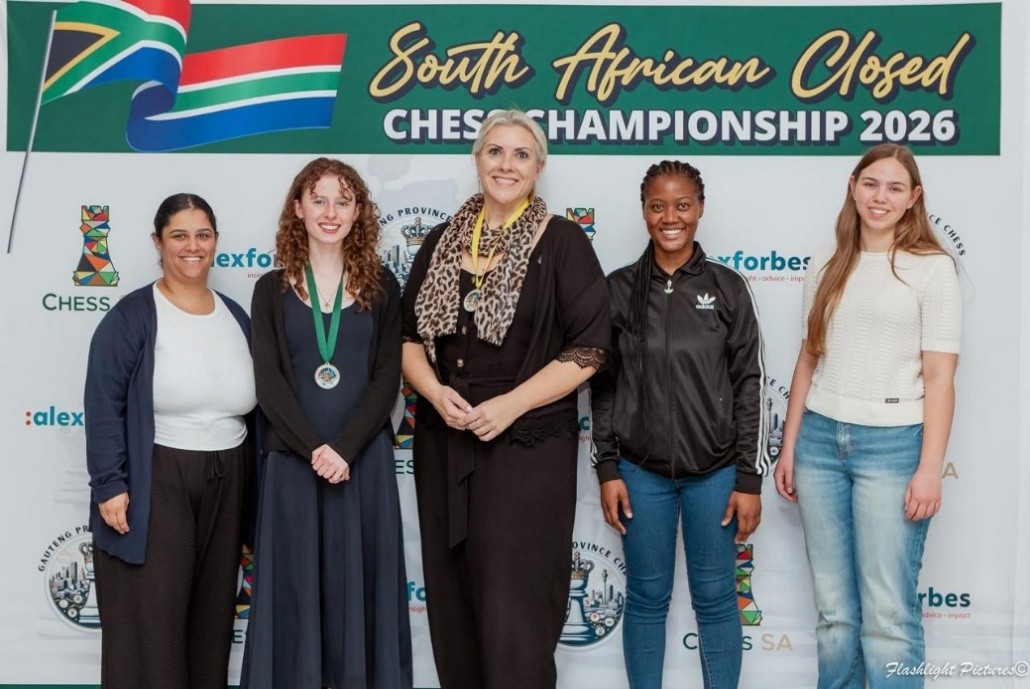
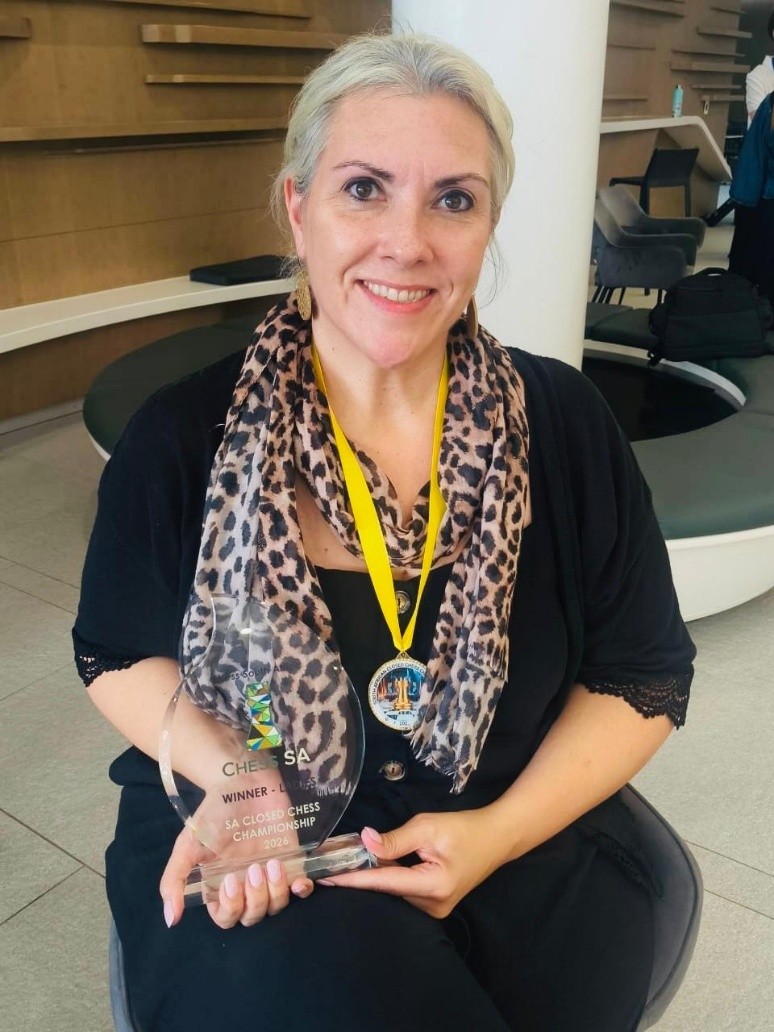
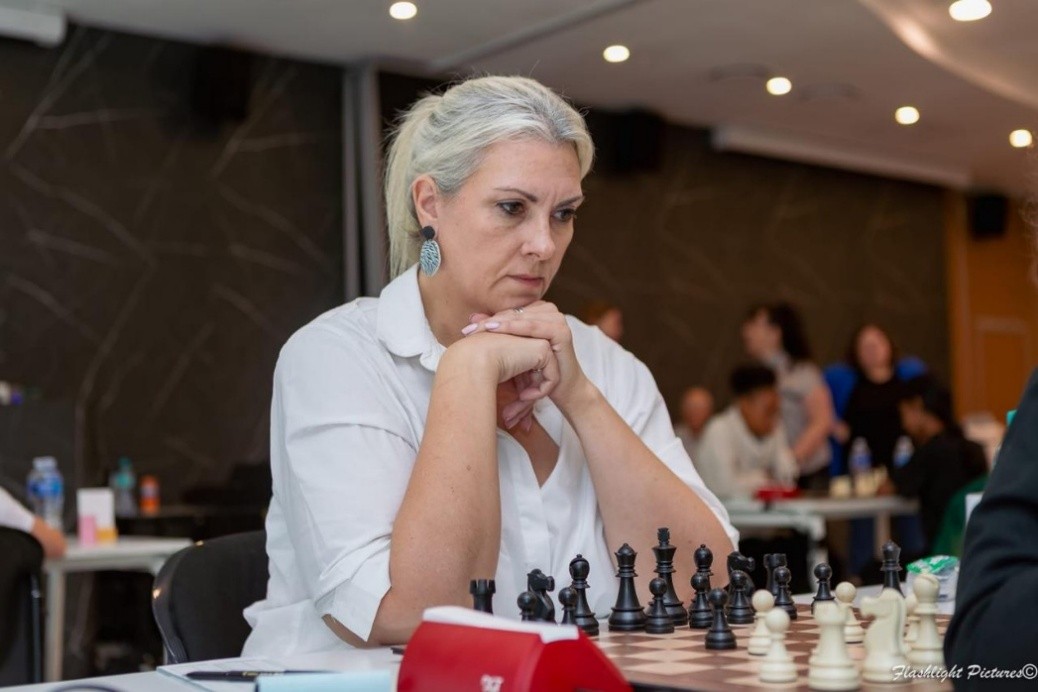
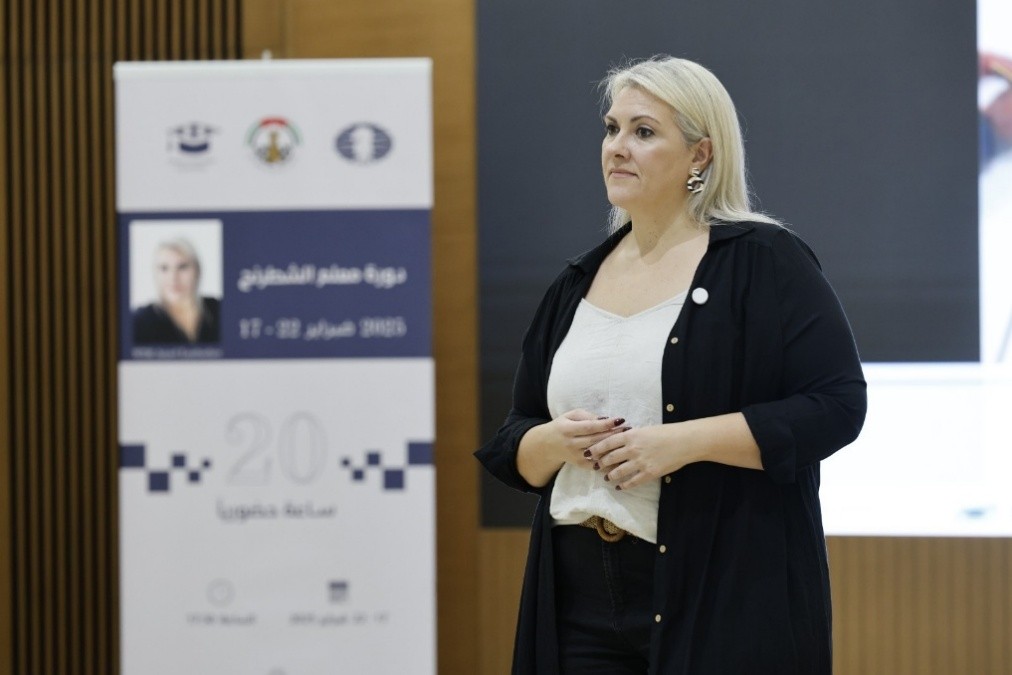
On this occasion, I am delighted to introduce one of the leading figures in educational chess in Africa and, since 2018, a colleague at the FIDE Commission for Chess in Education: Anzel Laubscher, Woman International Master, Senior Lead Instructor and practicing barrister, specialising in Human Rights and Sports Law.
With Anzel, we had the honour of sharing several of the Commission’s most important activities in different parts of the world, including Batumi, Chennai and Budapest, among others.
Born on 6 January 1978 in Cape Town, South Africa, her main areas of interest and work include chess in education, teacher training and the design of educational materials and courses. She loves food and coffee. One of her favourites dishes is braai – the Afrikaans word for barbecue. And she notes that she drinks coffee to protect everyone from herself.
Finally, she describes herself as the human slave of a male cat called Lexi. “Yes, I know it’s a girl’s name, but there’s a perfectly valid story behind it”.
In conversation with Anzel Laubscher
Uvencio Blanco: What are your most treasured memories or lessons from your parents, and how has their legacy – especially that of your artistic mother – influenced the person you are today?
Anzel Lauibscher: Ah, talking about my parents need an entire PhD dissertation! I will try to keep in to the word limit though… I lost both my parents already, my dad at the age of 21 and my mom at the age of 31. I had the most amazing parents and even though I lost them at relatively early stages in my life, they both created memories and life lessons to last a lifetime in that period. I want to tell you about the impact of both.
My dad had a business mind and was extremely funny. His sense of humour was simply out of this world! He was sharp and funny in a very quick and natural way. My mom was the artistic and “heart person”. She was caring and would give her last to those who need it.
I learned the game of chess at the age of 9, by accident. I tried to get out of cross-country running by pretending to be able to play chess. My dad noticed what I was doing (without me realising it) and I had to go back to chess class for two weeks to keep up the cover-up. The chess coach then told my dad that I am talented and wanted to enter me for a tournament the following weekend. I am inherently extremely competitive and immediately visualized the bling-bling (medals and trophies).
I agreed to play and to my absolute horror scored 1/7 in my first tournament. I won the game because my opponent didn’t show up (won by default). Losing so many games was horrible, and I hated the game with everything in me. I threw my best Oscar-performance with tears and slamming on the dash on our way back home. I told my dad this game is stupid, and I never want to play it ever again, and it should actually be banned in the entire world (yes, the logic of a 9-year-old who is competitive and couldn’t win a game). My dad made a deal with me that he will allow me to quit chess if I can win two games in the next tournament.
I took the offer and went to the school library to find every chess book available. I read like a maniac the following two weeks. I mean, I had to improve to quit… I played in the next tournament and won enough games to make the provincial team! The rest is history! I often wonder what my life would’ve been like if my dad allowed me that day to quit.
My mom was the creative and artistic one. I got a little bit of this for words and beautiful things. But my brother got a whole lot of this with his music and art. The thing about artistic people is that they need space to evolve in, and they do not like being boxed. This is something I got from her. As chess players, we don’t only think outside the box (lateral thinking), we don’t even see the box! My mom always opened her heart and our home for people – this was her space for creativity as well. Creativity produces vulnerability. My mom always loved deeply and compassionately. This I inherited from her. Without vulnerability, you restrict your own growth.
What does growing up in Cape Town mean to you, and how is that reflected in your professional identity?
I grew up in Bloemfontein, which is a smaller town in the middle of South Africa. I was born in Cape Town, and my parents moved to Bloemfontein when I was four years old. Back in the early 80s, Bloemfontein was an Afrikaans farmers community which was very much constrained by the apartheid regime. My parents were very liberal and did not support the apartheid regime at all. When we moved to Bloemfontein, my dad told my nanny that she must only speak Sotho to me. This is one of the eleven official languages in South Africa (Afrikaans, English and nine more languages).
When I went to primary school at age six, I could speak Afrikaans (my home language) and Sotho fluently. This helped me a lot in life. Speaking a language is not only about words and grammar, but also culture and traditions. I called Mary ngono (which means grandma) and still have contact with her today. She outlived both my parents and is extremely proud of the woman I became, and obviously often check on me to ensure that I am still on the right track.
A few weeks ago, we had a video call, and she said: “Anzie, when are you going to find a real job? Your dad wanted you to become a lawyer, and you did. Now he is shaking his head and saying: this child always gets her way, now she is playing games for a living”.
You are an inveterate traveller. You love travelling, meeting new people, and exploring different cultures and traditions. Have you found any place where the local culture has a unique connection to chess?
I simply love the chess vibe in Spain. I often try to escape the South African winter and go to Spain for a series of tournaments during July/ August. The options are endless, and I very often extend my stay because I get invites to following tournaments while playing in an event. I also enjoy the chess culture in India, especially the support for players and international players. The only reason I limit my playing time in India is because I only have so much rating to lose… The Indian youngsters have a rating buffet when the foreigners play there.
Something that truly calms you and helps you refocus is colouring.
I’m a complete pencil snob and could give you an entire lecture on which ones are the best and why. My mom was extremely artistic, but I can’t draw at all – I can’t even trace a stick figure! But somehow I love colouring and trying out new techniques from time to time.
Music from the 80s and 90s is your favourite. If you had to choose one song that describes your approach to life, both in chess and in your professional work, which would it be, and why?
Eye of the Tiger.
What is your favourite book or author that has no relation to chess or law, and why would you recommend it?
I am a sucker for romance and love a soppy love story, especially when it is connected to the history of a specific location. I believe in supporting local authors and want to mention Helena Hugo in this case. She writes the typical “boy meets girl and other girl meets same boy and boy is confused” kind of novels, but they are based on the history of South Africa during the Anglo-Boer War. She is hilarious, and I often end up with tears in my eyes, which are caused by a mixture of sadness and comedy.
If you could have a conversation with any historical figure – whether from chess or another field – who would you choose and what would you ask them?
Nelson Mandela. I had four opportunities to meet him in the past, but on all four occasions I was selected to represent South Africa internationally and couldn’t use the opportunity. I have two things that I would like to ask him.
One is pertaining to his incarceration on Robben Island. I came across very interesting archives about chess being played on the island by the prisoners. The archives show evidence of the first tournament requested by the inmates. There were no arbiters, and they approached the court for an order to appoint judges as the arbiters. They explained the rules, and it was very entertaining to note that they clearly indicated that en passant will not apply. The way it was phrased is quite precious, to be honest.
I would also like to ask him about his opinion on the impact of our Human Rights system 31 years post-apartheid, what the government could have done differently to have a better outcome. Our Human Rights system is one of the best in the world, on paper… When I did my master’s degree in law at UCT, one of my subjects was Human Rights. We were 26 students in the class and only three of them were South African. The other 23 were from all over the world. Some universities send their top students and government officials to attend the course to equip themselves for incorporation in their own countries. The main problem in South Africa is the implementation and enforcement of the legislation. This challenge is created by various aspects, but in my opinion the top two are a lack of resources and the mindset. This is purely my personal and subjective opinion. I would’ve loved to have a discussion with Nelson Mandela on his opinion in this regard.
How has your background in Law and Human Rights shaped your approach to using chess as an educational tool?
Chess as an educational tool can serve as an equaliser in the classroom. Students learn in different ways and have different abilities. Chess creates the platform for children to acquire 21st century academic and life skills in a comfortable and inclusive environment. It allows the educator to meet the student where he/she is.
The following principles are linked and shaped by my passion for Human Rights: The child that we teach chess to today will not be a chess player for the rest of his/her life, but they will be human beings. We are shaping human beings first, and then chess players. We often must treat people differently in order to treat them equally. This brings us back to the principle of “meet your learners where they are at”.
How does a mediator intervene in conflicts that arise within competitive chess?
When it comes to chess in education (and actually any sport where children are involved for that matter), it is important to remember that the child we are dealing with at that moment of conflict will not be a chess player for the rest of his/her life, but will be a human being for the rest of his or her life. The way we deal with conflict situations might have a far-reaching impact on a child’s life. This is where mediation skills come in handy and protects the trust relationship between educator and student when the educator does not have to make a decisive and often one-sided decision. We encourage players to resolve their own disputes by using the coin of truth.
As a lawyer specialising in sports law, what is your view on cognitive doping in chess?
Well… I have my own personal cognitive doping… I use AI in all my games: Anzel Intelligence. On a serious note, though, anything that can enhance performance in an unfair way which is not needed for diagnosed medical conditions are inappropriate and wrong. I wish parents especially will consider the long-term medical effect the medication can have. I am not convinced that it is worth the possible medal or rating points.
What legal reforms do you consider urgent to ensure fairness and justice in both school-level and federated sport?
I have a very strong and extensive opinion on this issue but will restrict myself to three main points for this interview. Sport cannot remain a legal “exception zone” where ;children have fewer rights:
- Children in sport are uniquely vulnerable to abuse, coercion and silencing, especially where performance pressure exists.
- Voluntary codes are insufficient.
Urgent reforms:
- Mandatory safeguarding legislation for all school and federated sports bodies. Compulsory background checks for coaches, officials and volunteers.
- Independent child-protection officers outside the school/federation hierarchy.
- Clear whistleblower protections for athletes, parents and staff.
Athletes have weaker protections:
- Learners are often punished without procedural fairness, harming educational futures.
- Athletes may face career-ending sanctions without access to fair tribunals, often forced into expensive arbitration systems such as the Court of Arbitration for Sport.
Urgent reforms:
- Statutory minimum standards for disciplinary hearings.
- Separation of roles (investigator ≠ prosecutor ≠ adjudicator).
- Independent appeal mechanisms, not internal “rubber-stamp” committees.
Institutions police themselves:
- Many federations operate with concentrated power, enabling favouritism, corruption and intimidation.
Urgent reforms:
- Term limits for federation executives.
- Mandatory conflict-of-interest disclosure laws.
- Independent ethics committees with real enforcement power.
- Public access to key governance documents (transparency laws).
My personal values and standards stand for righteousness, and it saddens me to see the unfairness often created by corruption and power-hungry individuals. Chess suffers, player suffer and opportunities are missed.
In this video course, Grandmaster Ivan Sokolov explores one of the most intriguing and under-examined areas of modern chess: reversed opening systems, focusing on the Reversed Grünfeld and the Reversed Dutch. At first glance, these two systems seem unrelated. However, they share a common strategic challenge: the value of tempi, structure, and psychology when familiar openings are played with colours reversed. Drawing on his long professional experience, Sokolov explains why these positions are far more subtle than they appear and why traditional engine evaluations often fail to capture their true complexity.
Free sample video: Introduction
Free sample video: Larsen’s b4 Plan vs Reversed Stonewall Setups: Larsen – Spassky
Do you believe chess should have its own legal framework or receive recognition from UNESCO as Intangible Cultural Heritage of Humanity?
Recognition by UNESCO under the Intangible Cultural Heritage of Humanity framework would be both symbolically and practically valuable for chess and especially for chess in education. Some of the motivations in this regard:
- Universal cultural transmission: Chess has been passed across centuries, cultures, languages, and political systems.
- Educational value: It supports critical thinking, ethics, patience and respect – values UNESCO already promotes.
- Non-commercial heritage: Unlike professional sport alone, chess exists in homes, schools, parks, prisons and communities.
- Cultural neutrality: It belongs to humanity, not to any single nation, ideology or economic class. A chess-specific legal regime could fragment regulation across countries, increase bureaucracy and/or create jurisdictional conflicts. Creating a dedicated legal framework only for chess would likely be unnecessary and even counterproductive. International regulation is already handled by FIDE and national federations.
What is urgently needed instead is the following:
- Better integration of chess into education policy. Starting as a professional development course for teachers will only require policy changes, which are easier to acquire than legislative changes, which will be required for curriculum changes.
- Clear safeguarding and disciplinary standards. There are existing policies and procedures, but they need to be age-appropriate and child-relevant. Many of the chess rules and regulations are aimed at adults and not introduced in a proper manner for children. An integral part of maintain safeguarding and disciplinary standards, is having them “workshopped” or explained in an appropriate way to those who are expected to adhere to them.
- Stronger good-governance and dispute-resolution mechanisms.
- Recognition of chess as both sport and cultural practice in law, without isolating it. This approach respects chess as more than a sport, without over-legalizing something that thrives precisely because of its openness and universality.
UNESCO recognition is strongly justified and overdue! As you can see, I have a very strong view on this and if you don’t stop me I will end up with an entire lecture and precise argument and forget that I am not in court, but busy with an interview! I get carried away easily with these matters.
How important is teacher training to the success of chess in education programmes?
I will refer to a slogan we often use: “When you reach a child, you reach a family. When you reach a family, you reach a community. Once you reach a community, you can change a nation”. Chess can improve the lives of so many communities and nations through the creation of smart nations. This impacts on the labour forces and family lives, etc. At the core of the slogan above is the child. The most prominent and constant individual in any child’s life is a teacher. Therefore, training the teacher will start the process of changing a nation.
You are a co-author of the Teacher Preparation course (leading to the School Instructor title), of the course leading to the Lead School Instructor title, and a member of the football governance committee in South Africa. So, what is the most important principle you seek to instils in instructors so that they become true mentors rather than merely coaches?
Meet your students where they are.
Your work in developing courses like the Lead School Instructor training is fundamental. Could you share an anecdote about a moment when you witnessed the direct impact of this kind of training on the life of an educator or student?
In general, the Lead School Instructor course is well received by people who have been involved with adult learning before and those who haven’t. I received feedback from a number of participants who are involved in lecturing at university, and the general comment is: “I will definitely adapt my approach and methodology in my lectures. This can be fun for me too, as the lecturer”.
My favourite story stems from an in-person Preparation of Teachers course, which I would like to share. I presented the course in a specific country to teachers who were completely new to chess. It was a four-day course where they entered the course without even knowing the number of squares on the chessboard, and after four days walked out knowing all the basic rules of chess (including special moves) and know how to teach it. At the end of the course, a grade-two teacher came to me (with tears in her eyes) and said: “Anzel, I have been a grade-two teacher for four decades (she already deserves a free pass to heaven for this!). I am counting down the weeks to my retirement – I am tired! But after this course I feel like I have a new inspiration to teach and only starting my teaching career now!” She sent me a message a few months ago and said that she applied for a postponement of her retirement and started a chess club already. Her words: “I thought I was done teaching, but after the PoT course I realized that I am not done changing lives. I have a purpose to fulfil still”.
You describe yourself as dynamic and passionate. How do you inject that energy into the design of educational material to make it engaging and effective for young chess learners?
My main objective is to make it fun and exciting for the educator to follow. Excited educator = efficient education. Let’s be honest, as adults, we also love to learn by playing and having fun. The educator feeds off the energy of the learners. I strive to create a learning environment where the educator will experience and create the enthusiasm of the learners.
What role does technology – such as online platforms – play in your vision for the future of chess education, especially in regions with limited access to resources?
My first reaction is unfortunately not to embrace the benefits, but the concerns. My concerns are two-fold: safeguarding and AI.
Chess has the amazing benefit of a variety of online resources to aid the teaching process, but unfortunately, it also poses an extremely high risk. As a human rights advocate, my voice shouts extremely loud against paedophilia and any other invasive threats such as bullying and even fraud. Do you know how many parents have been hacked by fraudsters who logged into devices with kids playing chess on their parents’ devices?
On the other hand, we have AI. If AI is being used for a quick answer or solution, it might affect the learning process if the metacognitive reflection is omitted in the process.
In a world full of digital distractions, how do you keep chess relevant for younger generations and present it as a powerful learning tool?
Funny enough, but in my experience, the kids prefer to have physical time at the board. Yes, they enjoy and lean towards online resources, but the natural human inclination leans towards physical contact and in-person teaching. It has a massive difference in energy distribution for the teachers and the learner. Never underestimate this! If you make it fun in the classroom with real-time fun and games, the kids will come back for more.
FRITZ 20 is more than just a chess engine – it is a training revolution for ambitious players and professionals. Whether you are taking your first steps into the world of serious chess training, or already playing at tournament level, FRITZ 20 will help you train more efficiently, intelligently and individually than ever before.
ChessBase 18 program only: ChessBase is a personal, stand-alone chess database that has become the standard throughout the world. Everyone uses ChessBase, from the World Champion to the amateur next door. It is the program of choice for anyone who loves the game and wants to know more about it. Start your personal success story with ChessBase and enjoy the game even more.
What has been the greatest challenge you’ve faced in developing curricula and training coaches across eleven different sports for the South African Olympic Committee, and how did you overcome them?
Some of the biggest challenges were that I am not from the specific sport. In chess and netball I was well-known, but all the other codes I was not known. Then suddenly you walk into a room and expect the coaches to listen to what you have to offer, and I mean really experienced coaches. I overcame this by delivering a programme that impressed them and using facilitation skills and methods that they could associate with and respect. The fact that I am an Advocate in law and represent South Africa in chess also contributed to their ability to at least listen to me.
Do you believe chess contributes to the empowerment of girls and women in traditionally patriarchal contexts?
In Africa, yes! We have the African proverb: When you teach a man, you teach an individual. When you teach a woman, you teach a nation. Women want to learn, with the objective to teach. Men respect that.
What strategies do you recommend for fostering a more inclusive chess culture, free of gender bias? For instance, how should federations approach the case of transgender men wishing to compete in women’s championships?
I prefer not to comment on this, please.
If you had to summarise the value of chess for human development in one sentence, what would it be?
Whether you think you can or not, you are right. Chess is for everyone who believes they can.
As one of the leading figures in the FIDE Education Commission, what do you consider to be the greatest challenges and opportunities in implementing school-based chess programmes on a global scale?
Challenges: Funding and awareness! Opportunities: A great product (Schools Instructor title course).
What was your most significant learning experience while collaborating with the FIDE Education Commission?
I am absolutely blessed by what I learned through the process and in the same breath, amazed and pleasantly surprised by my own abilities and ambitions. Whatever my dreams were three years ago, they have been tripled at least.
What is your vision for expanding chess in Africa – not just as a competitive sport, but as an educational and social tool?
My African Dream 2030: By the year 2030 every child in Africa should be exposed to chess at least once.
What differences have you observed between educational systems that have successfully integrated chess on a sustainable basis and those that have not?
In my experience, we managed to also build some bridges and form collaborations between federations and those on the ground via CIE. CIE created hope and aspirations in many federations.
Thank you for the dedication, time and energy you have devoted to this interview. Many thanks for your collaboration and for your contributions to the development of global educational chess.
In this video course, experts (Pelletier, Marin, Müller and Reeh) examine the games of Judit Polgar. Let them show you which openings Polgar chose to play, where her strength in middlegames were, or how she outplayed her opponents in the endgame.