
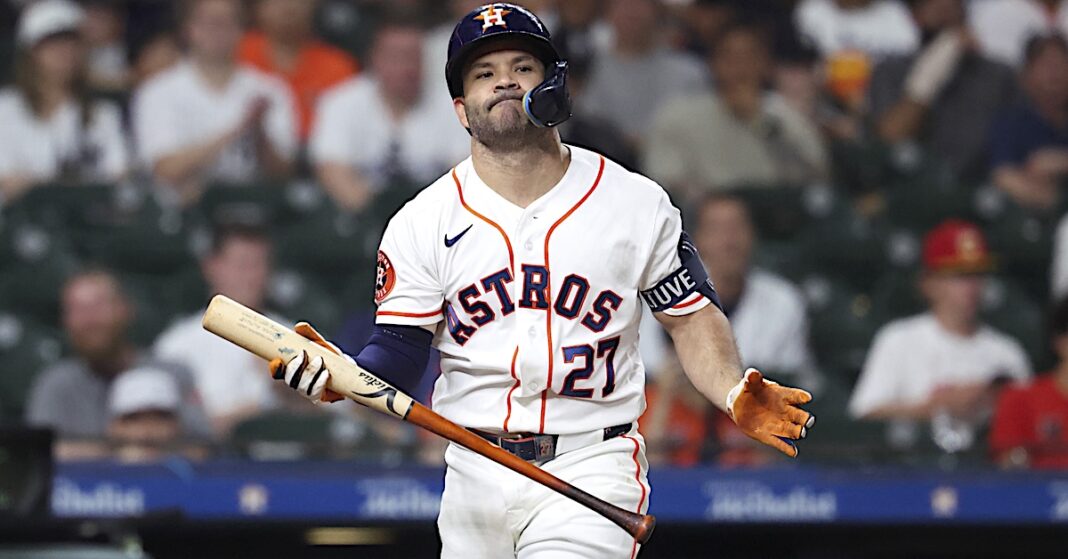

The Houston Astros have a knack for disappointing Aprils. Despite usually being projected as the favorite or second favorite in the AL West every year for the last decade, the last time the Astros didn’t have a losing record at some point in the second half of April was 2019. But year after year, they’ve tended to get a powerful second wind. Excluding 2020, for obvious reasons, they haven’t finished with fewer than 87 wins in a season since 2016; overall, Houston has the second-most wins in baseball since the start of the 2017 season. During those previous mediocre starts, the projections have stood by the Astros. This time… not so much.
To see the last time the Astros started this dreadfully, you don’t have to go back very far. In 2024, they hit their nadir after 26 games, at 7-19. I wrote then, as I do now, about the hole they were digging for themselves. Though it was still an uphill battle to come back in the AL West — they in fact did, handily — the projections never turned sour. ZiPS projected the Astros to win 88 games going into that season, and despite their 7-16 record at the time I wrote that article, the computer still thought they’d continue to win games at the previously predicted rate.
ZiPS Median Projected Standings – AL West (4/22/24)
| Team | W | L | GB | Pct | Div% | WC% | Playoff% | WS Win% | 80th | 20th |
|---|---|---|---|---|---|---|---|---|---|---|
| Texas Rangers | 86 | 76 | — | .531 | 41.0% | 18.3% | 59.3% | 5.1% | 94.1 | 79.2 |
| Seattle Mariners | 85 | 77 | 1 | .525 | 30.7% | 19.2% | 50.0% | 3.8% | 92.1 | 77.4 |
| Houston Astros | 83 | 79 | 3 | .512 | 23.1% | 17.9% | 41.0% | 3.5% | 90.3 | 75.2 |
| Los Angeles Angels | 75 | 87 | 11 | .463 | 5.1% | 7.1% | 12.2% | 0.4% | 82.3 | 67.3 |
| Oakland A’s | 61 | 101 | 25 | .377 | 0.1% | 0.1% | 0.2% | 0.0% | 68.6 | 53.6 |
SOURCE: Me
ZiPS does not have the same optimism that it had in 2024.
ZiPS Median Projected Standings – AL West (4/27/26)
| Team | W | L | GB | Pct | Div% | WC% | Playoff% | WS Win% | 80th | 20th |
|---|---|---|---|---|---|---|---|---|---|---|
| Seattle Mariners | 87 | 75 | — | .537 | 48.9% | 18.2% | 67.1% | 7.0% | 93.5 | 80.3 |
| Texas Rangers | 83 | 79 | 4 | .512 | 28.3% | 20.2% | 48.5% | 2.7% | 90.3 | 76.5 |
| Athletics | 79 | 83 | 8 | .488 | 15.8% | 15.6% | 31.3% | 0.9% | 87.0 | 72.5 |
| Houston Astros | 75 | 87 | 12 | .463 | 5.0% | 8.0% | 13.0% | 0.5% | 81.7 | 68.1 |
| Los Angeles Angels | 72 | 90 | 15 | .444 | 1.9% | 3.5% | 5.4% | 0.1% | 78.1 | 65.0 |
Source: Yeah, still me
This time around, ZiPS doesn’t even think Houston is a .500 team the rest of the way, let alone one that’ll end up close to its projected record in the preseason. The Astros had a relatively deep rotation in 2024, especially compared to today, and at the time, basically all of their starters were injured. But ZiPS thought enough pitching would filter back in over the coming weeks to get the team back on track. However, in 2026, ZiPS only loves one Houston pitcher, Hunter Brown, and just a few days ago, general manager Dana Brown said Brown won’t be back until June, and that’s if there are no setbacks.
Projecting the Astros to have a sub-.500 record isn’t something that ZiPS does often. While I don’t have rest-of-season projections for every calendar date ever, I do have monthly updates, and the last time they were projected to finish with a losing record was the 2015 preseason, when they had a 77-85 projection for the year. Pinpointing the actual date by running a few more simulations, the last time before 2026 that Houston was projected to be a losing team over the rest of a season was almost exactly 11 years ago, on April 26, 2015, when a win over the Oakland Athletics improved the team’s record to 10-7 and its rest-of-season projected winning percentage to .49927.
The 2026 Astros have been this bad even as their offense has performed extremely well. They lead the American League with 5.21 runs per game, and their 118 wRC+ ranks fourth in baseball, to go along with 5.7 WAR from their position players, also good for fourth in the majors. Considering this, the Astros shouldn’t bank on an offensive surge to turn their season around. Instead, if Houston is going to make up ground in the standings, its pitching is going to have to improve.
You Aren’t a FanGraphs Member
It looks like you aren’t yet a FanGraphs Member (or aren’t logged in). We aren’t mad, just disappointed.
We get it. You want to read this article. But before we let you get back to it, we’d like to point out a few of the good reasons why you should become a Member.
1. Ad Free viewing! We won’t bug you with this ad, or any other.
2. Unlimited articles! Non-Members only get to read 10 free articles a month. Members never get cut off.
3. Dark mode and Classic mode!
4. Custom player page dashboards! Choose the player cards you want, in the order you want them.
5. One-click data exports! Export our projections and leaderboards for your personal projects.
6. Remove the photos on the home page! (Honestly, this doesn’t sound so great to us, but some people wanted it, and we like to give our Members what they want.)
7. Even more Steamer projections! We have handedness, percentile, and context neutral projections available for Members only.
8. Get FanGraphs Walk-Off, a customized year end review! Find out exactly how you used FanGraphs this year, and how that compares to other Members. Don’t be a victim of FOMO.
9. A weekly mailbag column, exclusively for Members.
10. Help support FanGraphs and our entire staff! Our Members provide us with critical resources to improve the site and deliver new features!
We hope you’ll consider a Membership today, for yourself or as a gift! And we realize this has been an awfully long sales pitch, so we’ve also removed all the other ads in this article. We didn’t want to overdo it.
If you’ve ever had the misfortune to follow election night coverage, you might have seen the various news desks give benchmarks for a particular candidate to beat in counties or in states to be on target to win. I can do the same kind of thing with ZiPS, so I asked it to benchmark what ERAs Houston’s pitching staff would have to hit to give the team a 50% chance of making the playoffs.
ZiPS Rest-of-Season ERA Benchmarks – Houston Astros
TLDR: To be a coin flip to make the playoffs, if the offense performs as expected, the Astros need their pitching staff to collectively outperform their projected ERAs by about half a run per nine innings. This is true whether or not you use the ZiPS projections or the combined Steamer/ZiPS Depth Charts projections. Just to illustrate how hard that is for a team to do, I prorated the preseason 2025 ZiPS projected ERAs to the actual innings pitched, and compared those to the final team ERAs for that year.
ZiPS 2025 Team ERA Projections, Projected vs. Actual
| Team | Team ERA | Projected ZiPS ERA | Diff |
|---|---|---|---|
| Texas Rangers | 3.49 | 4.33 | -0.83 |
| Milwaukee Brewers | 3.59 | 4.07 | -0.48 |
| Cincinnati Reds | 3.86 | 4.35 | -0.48 |
| Kansas City Royals | 3.73 | 4.17 | -0.43 |
| Chicago White Sox | 4.28 | 4.63 | -0.35 |
| Pittsburgh Pirates | 3.76 | 4.09 | -0.33 |
| San Diego Padres | 3.64 | 3.91 | -0.26 |
| Chicago Cubs | 3.81 | 4.00 | -0.19 |
| Boston Red Sox | 3.72 | 3.91 | -0.19 |
| Cleveland Guardians | 3.70 | 3.88 | -0.18 |
| Philadelphia Phillies | 3.79 | 3.96 | -0.17 |
| New York Yankees | 3.91 | 4.01 | -0.11 |
| Houston Astros | 3.86 | 3.88 | -0.02 |
| Tampa Bay Rays | 3.94 | 3.94 | 0.00 |
| San Francisco Giants | 3.84 | 3.80 | 0.04 |
| New York Mets | 4.04 | 3.94 | 0.10 |
| Detroit Tigers | 3.97 | 3.85 | 0.13 |
| Los Angeles Dodgers | 3.95 | 3.81 | 0.14 |
| Seattle Mariners | 3.87 | 3.68 | 0.19 |
| Miami Marlins | 4.60 | 4.34 | 0.26 |
| St. Louis Cardinals | 4.30 | 4.04 | 0.26 |
| Toronto Blue Jays | 4.19 | 3.87 | 0.32 |
| Athletics | 4.71 | 4.28 | 0.43 |
| Los Angeles Angels | 4.89 | 4.44 | 0.45 |
| Baltimore Orioles | 4.62 | 4.00 | 0.62 |
| Minnesota Twins | 4.55 | 3.88 | 0.67 |
| Arizona Diamondbacks | 4.49 | 3.81 | 0.68 |
| Atlanta Braves | 4.36 | 3.65 | 0.71 |
| Washington Nationals | 5.35 | 4.55 | 0.80 |
| Colorado Rockies | 5.99 | 4.85 | 1.14 |
Only a single team, the Texas Rangers, outperformed its ERA projections by more than half a run. The Brewers and Reds came close, but they fell a bit further back when adjusting for the fact that ZiPS thought the league-wide ERA would be 0.12 higher than it actually was.
Now, consider the very real possibility that the Houston offense doesn’t merely perform as expected, but hits its 75th-percentile projection instead. The pitching would still have to beat its projections by 0.33 runs per game, meaning that even in a rosy scenario like this for the lineup, this team would still be an underdog.
On a fundamental level, the Astros need to find better pitchers from among the guys who aren’t currently envisioned by Depth Charts as contributors, and they need to find them right now. Ethan Pecko is the most interesting of the internal options, and as a fellow Towson native, I can’t help but root for him. He’s currently working back from thoracic outlet syndrome, and though he’s been very good on his minor league rehab assignment, he’s not likely to be up until later this summer. When he does return, he wouldn’t be enough by himself to fix this pitching staff, even if he had a Chase Burns-esque debut. AJ Blubaugh and Colton Gordon don’t project as instant game-changers, either. Houston would likely need to acquire some pitching, but from where? This has been an odd season so far, in that many of the worst teams (Astros, Red Sox, Mets, Phillies, Blue Jays, Royals) were expected to be contenders. That means there aren’t a lot of teams looking to be early sellers. But even if there were, these other underperforming clubs would likely be fierce competition for those players on the block.
Time is not on Houston’s side, in the short or long term. The short-term challenge is obvious, but the long-term one is nearly as daunting. The Astros are second in baseball in wRC+ from players over 30 years old (129), with Jose Altuve and Christian Walker both at ages when imminent decline is highly likely. Their two key offensive players in their 20s, Jeremy Peña and Yordan Alvarez, are free agents after 2027 and 2028, respectively. At the end of last season, our prospect team ranked Houston’s farm system 29th out of 30 teams. The best solution might be to do a bit of retooling, perhaps by trading anyone unsigned past this year. Then, assuming there’s a pre-lockout window to make some free agent signings as there was in 2021, absolutely blitz the top guys available with extremely generous one-year offers, with the hope that many of those players will want to get a second look at free agency in a hopefully normal winter after the 2027 season. But truth be told, this doesn’t really feel like something the Astros would do.
However it shakes out, this may be the most crucial period of Brown’s stint as GM. The Houston Astros are in a precarious position, and none of the options look particularly appealing. Some problems simply don’t have good solutions, and if they can’t conjure one up, we may be looking at the end of a moderately successfully dynasty in Houston.