
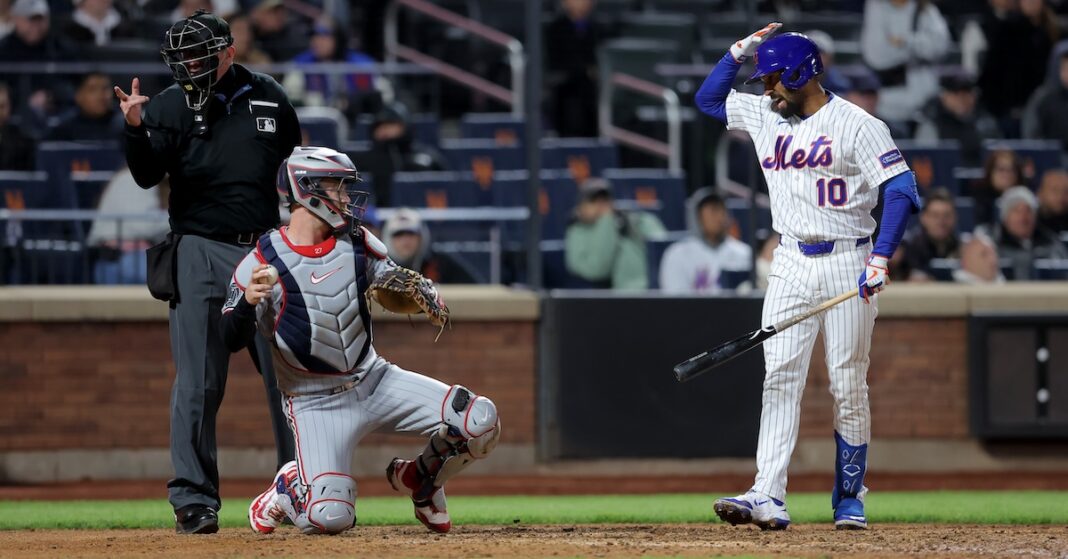

Major League Baseball’s rules have been in a constant state of flux during the 2020s, with the implementation of the extra-innings runner (the so-called Manfred Man), the universal designated hitter, the three-batter minimum, the pitch clock, the disengagement rule, larger bases, and the infield shift ban accompanying additional changes to roster sizes and the injured list. Most — but not all — of these rule changes have been aimed at livening the game up, with more action and fewer dead spots, and have generally favored offenses rather than pitchers. This year’s Big New Rule is the Automated Ball-Strike Challenge System, which has shaken up batters’ and pitchers’ understanding of the strike zone. With the month of April now behind us, it’s worth checking in on this season’s numbers, in part to see what kind of impact the ABS is having.
For starters, scoring levels are up, both relative to last year as whole and to the opening month, by which I mean April plus the handful of games in March that preceded it (a convention I’ll maintain throughout this article). In a vacuum, that would rate as a bit of a surprise, since temperatures are generally cooler in the opening weeks than in the summer months, reducing the extent to which fly balls carry, and thus scoring levels. On the other hand, pitchers tend not to throw as hard as they do later in the season, which would favor hitters, as well. Yet through the end of April, teams are scoring more runs per game than in all but one of the past five seasons’ opening months:
March/April Scoring, 2021–2026
| Season | Games | RS/G | Change | HR/G | Change | BB% | K% | AVG | OBP | SLG | wOBA |
|---|---|---|---|---|---|---|---|---|---|---|---|
| 2021 | 766 | 4.26 | — | 1.14 | — | 8.8% | 24.4% | .232 | .309 | .390 | .304 |
| 2022 | 634 | 4.03 | -5.2% | 0.91 | -20.7% | 8.9% | 23.0% | .231 | .307 | .369 | .298 |
| 2023 | 850 | 4.59 | +13.9% | 1.13 | +24.7% | 8.8% | 23.0% | .247 | .321 | .405 | .316 |
| 2024 | 904 | 4.38 | -4.6% | 1.02 | -9.8% | 8.7% | 22.5% | .240 | .314 | .385 | .306 |
| 2025 | 916 | 4.34 | -0.9% | 1.06 | +4.0% | 9.0% | 22.1% | .242 | .316 | .391 | .309 |
| 2026 | 936 | 4.51 | +3.9% | 1.07 | 1.1% | 9.6% | 22.2% | .243 | .323 | .393 | .320 |
I’ve included a bunch of numbers there to unpack, but first I’ll note that the timing of Opening Day influences the size of these samples. The 2021 season began on April 1, while the owners’ lockout delayed the start of the ’22 season until April 7. With the ensuing Collective Bargaining Agreement creating the need to shoehorn an additional round of playoffs into the schedule, Opening Day is now routinely a March thing, and it often begins with the baseball equivalent of an amuse-bouche. While all 30 teams kicked off play on March 30 in 2023, in ’24 a pair of games in Seoul on March 20–21 preceded the stateside Opening Day of March 28. The 2025 season began in similar fashion, with a pair of games in Tokyo on March 18–19 before everybody else got down to business on March 27. This year featured one game on March 25, with just about everybody else starting on March 26.
So yes, scoring is up nearly 4% relative to last season’s March/April stretch, but a more modest 1.5% relative to last year’s overall scoring level of 4.45 runs per game. This was the highest-scoring opening month since 2023. To find one higher than that, we only need to go back to 2019, when teams scored 4.62 runs per game, albeit under an increasingly outdated set of rules, but the last time before that when opening-month scoring exceeded 4.50 runs per game was 2010.
As you can see from the table, the league-wide batting average, slugging percentage, and home run rates have barely budged relative to last year, and aren’t as high as in 2023. Those changes don’t appear to be much to write home about, and contrary to years past, we haven’t heard much complaining about the makeup of the ball itself. According to the Statcast Drag Dashboard, which measures the estimated mean coefficient of drag (CD) of the baseball based on four-seam fastball trajectories, this year’s CD of 0.3513 is just an eyelash behind last year’s (0.3518); per the explainer at that page, that .0005 decrease would correspond to an increased carry of 0.25 feet on a ball with a 100-mph exit velocity — not nothing, but comparatively minimal. By contrast, the 2024 CDs ranged from 0.3411 to 0.3471; the difference between this year and the lowest CD (from 2021) would mean an increased carry of five feet.
The most notable change above, outside of the scoring level itself, is in the league-wide walk rate, which if it were maintained over the course of a full season would be the highest mark since 1951:
You Aren’t a FanGraphs Member
It looks like you aren’t yet a FanGraphs Member (or aren’t logged in). We aren’t mad, just disappointed.
We get it. You want to read this article. But before we let you get back to it, we’d like to point out a few of the good reasons why you should become a Member.
1. Ad Free viewing! We won’t bug you with this ad, or any other.
2. Unlimited articles! Non-Members only get to read 10 free articles a month. Members never get cut off.
3. Dark mode and Classic mode!
4. Custom player page dashboards! Choose the player cards you want, in the order you want them.
5. One-click data exports! Export our projections and leaderboards for your personal projects.
6. Remove the photos on the home page! (Honestly, this doesn’t sound so great to us, but some people wanted it, and we like to give our Members what they want.)
7. Even more Steamer projections! We have handedness, percentile, and context neutral projections available for Members only.
8. Get FanGraphs Walk-Off, a customized year end review! Find out exactly how you used FanGraphs this year, and how that compares to other Members. Don’t be a victim of FOMO.
9. A weekly mailbag column, exclusively for Members.
10. Help support FanGraphs and our entire staff! Our Members provide us with critical resources to improve the site and deliver new features!
We hope you’ll consider a Membership today, for yourself or as a gift! And we realize this has been an awfully long sales pitch, so we’ve also removed all the other ads in this article. We didn’t want to overdo it.
Highest League-wide Walk Rates Since 1947
| Season | BB% | K% | AVG | OBP | SLG | wOBA | HR/G | RS/G |
|---|---|---|---|---|---|---|---|---|
| 1949 | 10.42% | 9.31% | .263 | .344 | .384 | .344 | 0.69 | 4.61 |
| 1950 | 10.32% | 9.90% | .266 | .346 | .402 | .346 | 0.84 | 4.85 |
| 1948 | 9.85% | 8.09% | .264 | .340 | .379 | .340 | 0.58 | 4.63 |
| 1951 | 9.63% | 9.72% | .261 | .336 | .386 | .336 | 0.75 | 4.55 |
| 2026 | 9.62% | 22.17% | .243 | .323 | .393 | .320 | 1.07 | 4.51 |
| 2000 | 9.59% | 16.48% | .270 | .345 | .437 | .341 | 1.17 | 5.14 |
| 1947 | 9.54% | 8.05% | .262 | .337 | .376 | .337 | 0.58 | 4.50 |
| 1955 | 9.52% | 11.37% | .259 | .332 | .394 | .327 | 0.90 | 4.48 |
| 1954 | 9.45% | 10.69% | .261 | .333 | .390 | .333 | 0.78 | 4.38 |
| 1956 | 9.45% | 12.08% | .258 | .331 | .397 | .326 | 0.93 | 4.45 |
| 1999 | 9.43% | 16.41% | .271 | .345 | .434 | .341 | 1.14 | 5.08 |
| 1952 | 9.26% | 10.95% | .253 | .327 | .370 | .327 | 0.69 | 4.18 |
| 1970 | 9.19% | 14.98% | .254 | .326 | .385 | .319 | 0.88 | 4.34 |
| 2020 | 9.16% | 23.44% | .245 | .322 | .418 | .320 | 1.28 | 4.65 |
| 1953 | 9.10% | 10.70% | .264 | .336 | .397 | .336 | 0.84 | 4.61 |
| 1995 | 9.09% | 16.22% | .267 | .338 | .417 | .333 | 1.01 | 4.85 |
| 1996 | 9.08% | 16.53% | .270 | .340 | .427 | .335 | 1.09 | 5.04 |
| 1969 | 9.06% | 15.17% | .248 | .320 | .369 | .313 | 0.80 | 4.07 |
| 1961 | 9.03% | 13.64% | .258 | .328 | .399 | .324 | 0.95 | 4.53 |
| 1975 | 9.02% | 12.97% | .258 | .327 | .374 | .321 | 0.70 | 4.21 |
The only time in this millennium that the league-wide walk rate was at 9% or higher was in the shortened 2020 season, which we can rightfully dismiss. Before that, you have to dial back to 2000, the tail end of a six-season stretch — the start of a very high-offense era — in which walk rates reached 9% four times. Prior to that, they hadn’t reached 9% since 1975, and then only fleetingly. As you can see from the table, in the late 1940s and early ’50s, when walks were roughly as common as strikeouts, walk rates hovered close to 10%, even exceeding that benchmark a couple of times.
That said, in recent years we’ve seen March/April walk rates reach or exceed 9% several times — 10 from 2001–25, in fact — though again, none of them finished with a full-season rate at that level since we can’t include 2020:
March/April Walk Rates vs. Full Season Walk Rates
| Season | March/April | Full | Change |
|---|---|---|---|
| 2009 | 9.81% | 8.88% | -0.92% |
| 2026 | 9.62% | — | — |
| 2010 | 9.43% | 8.50% | -0.93% |
| 2008 | 9.36% | 8.71% | -0.65% |
| 2019 | 9.18% | 8.52% | -0.65% |
| 2007 | 9.07% | 8.52% | -0.55% |
| 2003 | 9.05% | 8.48% | -0.58% |
| 2004 | 9.05% | 8.60% | -0.45% |
| 2018 | 9.04% | 8.47% | -0.56% |
| 2006 | 9.02% | 8.43% | -0.59% |
| 2025 | 9.00% | 8.41% | -0.59% |
| 2002 | 8.98% | 8.71% | -0.28% |
| 2022 | 8.85% | 8.16% | -0.69% |
| 2021 | 8.85% | 8.69% | -0.16% |
| 2023 | 8.81% | 8.59% | -0.22% |
| 2001 | 8.80% | 8.45% | -0.35% |
| 2024 | 8.71% | 8.18% | -0.53% |
| 2017 | 8.66% | 8.54% | -0.11% |
| 2016 | 8.64% | 8.17% | -0.46% |
| 2011 | 8.58% | 8.11% | -0.47% |
| 2005 | 8.57% | 8.16% | -0.41% |
| 2014 | 8.31% | 7.62% | -0.69% |
| 2012 | 8.24% | 7.99% | -0.25% |
| 2013 | 8.19% | 7.92% | -0.27% |
| 2015 | 7.96% | 7.66% | -0.30% |
No March/April data for shortened 2020 season.
For that stretch, the median change from the opening month walk rate to the final one is -0.50%.
This year’s higher walk rate is likely attributable to the introduction of the ABS system, which has redefined the strike zone as a two-dimensional rectangle in the middle of the plate, with the top and bottom of the zones adjusted based on each individual batter’s height (53.5% of that height at the top, 27% at the bottom). As Ben Clemens estimated earlier this week, “The total area of the strike zone has declined, likely by between eight and 22 square inches, somewhere between 2% and 5% of the total strike zone area.” Seemingly a small change, but not nothing.
On April 22, ESPN’s Jeff Passan reported — with some alarm — that hitters were walking 9.9% of the time, and that batter swing rates were down 1.4 percentage points relative to last year. As illustrated above, the league-wide walk rate has come down since then, while swing rate has gone up, and if we break the data into week-long samples (with the March 25 Yankees-Giants opener tacked onto the first week), we see some evidence of batters and pitchers acclimating to the system:
March/April Plate Discipline, Walk and Strikeout Rates
| Start | PA | O-Swing% | Z-Swing% | Swing% | Zone% | BB% | K% |
|---|---|---|---|---|---|---|---|
| March 25–April 2 | 7,078 | 30.5% | 65.7% | 46.9% | 46.5% | 9.6% | 24.3% |
| April 3–April 9 | 7,150 | 28.7% | 64.4% | 45.5% | 46.9% | 10.3% | 22.2% |
| April 10–April 16 | 7,209 | 29.2% | 65.0% | 46.4% | 47.9% | 9.8% | 21.4% |
| April 17–April 23 | 7,282 | 29.3% | 65.2% | 46.3% | 47.4% | 9.2% | 21.5% |
| April 24–April 30 | 6,935 | 30.3% | 66.0% | 47.3% | 47.6% | 9.2% | 21.5% |
| 2025 March/April (ABS) | 34,394 | 27.7% | 66.0% | 46.9% | 50.2% | 9.0% | 22.1% |
| 2025 March/April (Legacy) | 34,394 | 27.9% | 64.6% | 46.9% | 51.8% | 9.0% | 22.1% |
First, note the two highlighted cells showing the walk rates of the past two weeks, which are still higher than normal but closer to more familiar territory. Second, observe that the zone rate is down roughly three or four points relative to last year, depending upon whether we measure the change relative to Statcast’s legacy setting, the system that it used to slice and dice the strike zone prior to this year, or the new, mathematically defined ABS setting. In the first week of the season, batters collectively swung at a rate matching last year’s opening month, which meant that they were chasing far more pitches, and as one result, strikeout rates were two points higher than in the opening month of last season. In the second week of the season, batters dialed back their swing rates, and their walk and strikeout rates converged. Since then, they’ve gradually increased their swing rates, with their walk rates falling back toward the higher end of normal while their strikeout rates remain closer to (but below) last year’s rate. The year-to-year gap in swing rate has shrunk from the 1.4-point decrease that Passan highlighted to a 0.5-point decrease rather quickly.
Here I should note that while walk rates are up, likely due to the smaller strike zone and the lower swing rates, pitchers and catchers are actually winning more challenges — that is, turning called balls back into strikes — than batters are. The overturn rate on challenges is 60% for pitchers and catchers (Statcast just groups them together as fielders) but just 46% for batters turning called strikes into balls. That still appears to be offset by the lower swing and zone rates.
In the grand scheme of things, the league-wide increase in walk rate itself might not be perceptible to the average fan, in that the per-game increase is 0.51 walks per team, meaning an extra walk per game between the two teams relative to last season, or a few extra walks per team per week. Pitchers are throwing slightly more pitches per plate appearance, and the extra walks amount to roughly an extra plate appearance per game between the two teams. Plate appearances themselves aren’t lasting much longer, which is to say that I don’t think it’s the ABS challenges themselves that are adding significant time; rather, it’s the walk rates. But it does all amount to an extra five minutes per game relative to last season, countering some of the effect of the 2023 introduction of the pitch clock. Here’s a comparison to some recent full-season numbers:
Per-Game Comparisons, 2021–26
| Season | Pitches/PA | PA/G | BB/G | BIP/G | Time/G | Time/9 Inn. | Minutes/PA |
|---|---|---|---|---|---|---|---|
| 2021 | 3.91 | 74.8 | 3.25 | 23.67 | 3:11 | 3:10 | 2.55 |
| 2022 | 3.89 | 74.9 | 3.06 | 24.41 | 3:06 | 3:03 | 2.48 |
| 2023 | 3.90 | 75.7 | 3.25 | 24.26 | 2:42 | 2:39 | 2.14 |
| 2024 | 3.89 | 75.1 | 3.07 | 24.35 | 2:38 | 2:36 | 2.12 |
| 2025 | 3.88 | 75.2 | 3.16 | 24.43 | 2:40 | 2:38 | 2.10 |
| 2026 | 3.91 | 76.1 | 3.67 | 24.33 | 2:45 | 2:42 | 2.13 |
Source: Baseball Reference
Even with more pitches per plate appearance than in 2022, the last season before the pitch clock was introduced, and more plate appearances per game, the plate appearances themselves are about 21 seconds shorter (0.35 minutes shorter) than in that season, and so games are 21 minutes shorter. That still looks like a big win.
So the extra walks are yielding more baserunners and thus more runs, though not such a dramatic increase in scoring that people are talking about juiced baseballs. Indeed, this year’s Statcast contact numbers aren’t dramatically different from last year’s March/April numbers, whether we consider all batted balls or just fly balls and line drives.
Statcast Comparison, March/April 2023–2026
| Season | BBE | EV | LA | Avg Dist | Brl% | HH% | AVG | xBA | SLG | xSLG | wOBA | xwOBA |
|---|---|---|---|---|---|---|---|---|---|---|---|---|
| 2023 | 21,526 | 89.0 | 12.3 | — | 8.2% | 39.2% | .247 | .244 | .405 | .417 | .316 | .322 |
| 2024 | 23,062 | 88.8 | 13.0 | — | 7.6% | 39.1% | .240 | .242 | .385 | .406 | .306 | .319 |
| 2025 | 23,344 | 89.3 | 13.1 | — | 8.6% | 40.5% | .242 | .242 | .391 | .407 | .309 | .317 |
| 2026 | 23,919 | 89.1 | 13.7 | — | 8.4% | 39.8% | .242 | .246 | .393 | .404 | .320 | .323 |
| 2023 | 10,725 | 93.1 | 27 | 284 | 16.4% | 49.2% | .451 | .443 | .860 | .888 | .537 | .551 |
| 2024 | 11,434 | 92.8 | 27 | 282 | 15.4% | 48.5% | .435 | .434 | .807 | .852 | .514 | .537 |
| 2025 | 11,650 | 93.3 | 27 | 282 | 17.2% | 50.0% | .430 | .428 | .813 | .849 | .514 | .532 |
| 2026 | 11,818 | 93.2 | 27 | 283 | 16.9% | 49.3% | .439 | .441 | .827 | .846 | .534 | .538 |
Source: Baseball Savant
Overall, hitters are producing slightly lower barrel and hard-hit rates relative to last season’s opening month. While they’ve produced a slightly higher slugging percentage on balls in the air, the percentage of line drives and fly balls has fallen from 49.9% last year to 49.4% this year — meaning fewer well-struck balls in the air. We’ll see what the warmer weather brings.
In the service of rounding up these numbers, I did check in on a couple more areas worth highlighting, at least in brief. For one thing, the average fastball velocity is on the rise, both in terms of four-seamers and sinkers:
Average Fastball Velocity Comparison, March/April vs. Full Season
| Season | March/April FA | Full FA | In-Season Change | March/April SI | Full SI | In-Season Change |
|---|---|---|---|---|---|---|
| 2022 | 93.6 | 93.8 | +0.2 | 92.8 | 93.3 | +0.5 |
| 2023 | 93.6 | 94.1 | +0.5 | 93.2 | 93.3 | +0.1 |
| 2024 | 93.9 | 94.2 | +0.3 | 93.0 | 93.3 | +0.3 |
| 2025 | 94.1 | 94.4 | +0.3 | 93.4 | 93.8 | +0.4 |
| 2026 | 94.5 | 94.5 | — | 93.9 | 93.9 | — |
FA = four-seam fastball, SI = Sinker
Four-seam velocity is up 0.4 mph relative to last March/April, while sinker velocity is up 0.5 mph, both the largest year-to-year jumps within this limited timeframe. Both velocities are already slightly ahead of last year’s full-season marks, and we should expect them to go higher based upon the clear in-season trends in the table. Some of this is happening because — stop me if you’ve heard this one before — starters aren’t working as deep into games, leaving a higher share of innings to relievers who don’t have to be as mindful of pitch counts. This year’s average start has lasted 5.09 innings, down from 5.20 last year, 5.24 in 2024, and 5.17 in ’23.
All of that is a story for another day. For now, I think we have much to chew on in understanding the extent to which the implementation of ABS is affecting offensive levels, and therefore game length. I do think this is far from a settled matter; on both sides of the ball, players’ acclimation to the new system will take time, and the effect of the new system on scoring could be influenced by the temperatures of the coming months, since we understand how variations in climate can affect the carry of the ball. But now that we’ve got a significant chunk of data to ponder, we shouldn’t be surprised if the new ABS system ends up providing offense with a bit of a goose relative to recent seasons.