
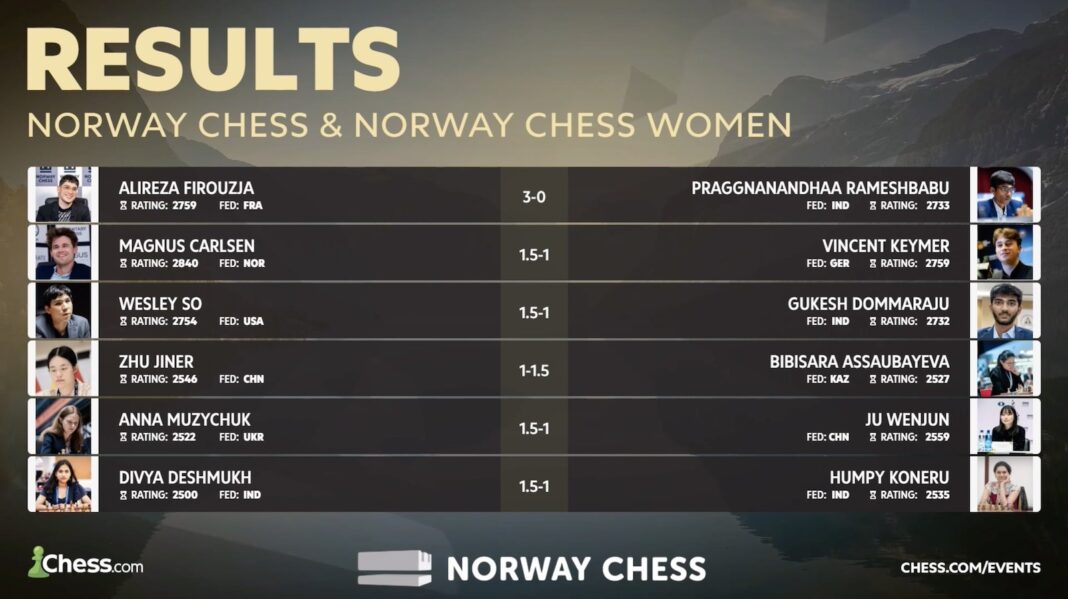

GM Alireza Firouzja scored the day’s only classical win, over GM Praggnanandhaa Rameshbabu, to open up a 3.5-point lead in Norway Chess 2026 with a perfect 6/6. GM Magnus Carlsen beat GM Vincent Keymer in armageddon, but that was little consolation for a huge miss in a chaotic classical game that could also have gone the way of the German star. World Champion Gukesh Dommaraju forced GM Wesley So into a queen sac but spoiled a win and lost in armageddon.
GM Bibisara Assaubayeva continues to lead Norway Chess Women 2026 after drawing a rollercoaster classical game against GM Zhu Jiner and winning the armageddon tiebreaker. Both other mini-matches went to armageddon as well, with GM Divya Deshmukh beating GM Koneru Humpy to land 1.5 points behind the leader, and GM Anna Muzychuk recovering from yesterday’s armageddon loss with a win over Women’s World Champion Ju Wenjun.
Round three starts Wednesday, May 27, at 11 a.m. ET / 17:00 CEST / 8:30 p.m. IST.
Firouzja’s second win in a row earned the only three points for a classical win in round two, with Carlsen, So, Assaubayeva, Muzychuk, and Divya scoring 1.5 points to their opponents’ single point after winning in armageddon.
Norway Chess Round 2 Results
Firouzja is guaranteed to be the sole leader after round three as well after opening up a 3.5-point lead over So and Gukesh, while Assaubayeva leads Divya by 1.5 points but can be caught in a single round by four of the remaining players.
Norway Chess Standings After Round 2

Norway Chess Round 2: Firouzja Leads As Rivals Suffer
As the time control approached it seemed all three classical games would end decisively, but in the end it was only Firouzja who clinched a hugely important classical win.
Firouzja 3-0 Praggnanandhaa

Firouzja had credited his round-one win over Carlsen to some great preparation by his second GM Ivan Cheparinov, but he laughed away the suggestion that preparation was behind the round-two win: “Not today, for sure! It was a decent game, but I don’t think the opening was something special.”
In fact at some point it seemed Praggnanandhaa might take over, but he lost his way, traded down into a bad endgame, and was smoothly dispatched by Firouzja. That’s our Game of the Day, which GM Rafael Leitao analyzes below.


It was suggested to Firouzja that he was actually being boosted by having to play with an ankle injury. He responded, “I don’t know if it’s a boost, but I’m trying to play chess. I have a lot of pain, but it’s something that keeps me focused—it makes me not think about pain.”
I’m trying to play chess. I have a lot of pain, but it’s something that keeps me focused—it makes me not think about pain.
—Alireza Firouzja
Firouzja certainly seemed to have found inner calm while his rivals were seeing games slip out of their control.
Firouzja chilling during Round 2! #NorwayChess pic.twitter.com/Cp4pyCFMJR
— chess24 (@chess24com) May 26, 2026
Firouzja is back in the top 10 on the live rating list after undoing most of the damage done by three losses in Bucharest.

Once again, it would be a tougher day for the world champion and the world number-one.
Carlsen 1.5-1 Keymer
The best player in chess is arguably Carlsen after a loss the day before, and there was no question he was going to go all-out to beat Keymer in classical chess. An enthralling struggle developed, full of unpredictable twists and unusual ideas.

It all began in the opening, when 9…a4 by Keymer was a new move, improving on the 9…g6 Gukesh had used on the way to beating Carlsen in rapid chess in Zagreb in 2025—a memorable game that sparked questions over whether the Carlsen era was over. Spoiler alert, it wasn’t, but back in Oslo it was another game that Carlsen had on his mind, Keymer’s win over GM Maxime Vachier-Lagrave in Bucharest.
Magnus: “This idea is inspired by the man himself, Vincent Keymer, and his game against Maxime from Bucharest last week, where in a Sicilian he maneuvered his knight to h3, and as he said himself, it stopped all the play on that file. I’m trying to do the same…”#NorwayChess pic.twitter.com/e5Y4AFpE13
— chess24 (@chess24com) May 26, 2026
Carlsen put the knight on a3 instead of h3, but that was far from the end of the story, as it then set off on a journey to a7.

At this point, the commentators couldn’t help but see the parallels to a famous game by 12th World Champion Anatoly Karpov.

Karpov had used the minor piece on a7 to clamp down on Black’s queenside while launching a winning assault on the other side of the board, but Carlsen instead found himself coming under attack, with Keymer’s h-pawn sowing confusion. In fact 25…h3! would have given Black a significant edge, and Carlsen realized it, which was why he was very happy to see 25…Qf6?! and be able to play 26.h3 himself.
That moment encouraged Carlsen to tell a dad joke in the confessional.
Magnus: “I think like a cow that’s ashamed of its body this game is just an udder embarrassment! I feel like every move we’re making is some kind of positional mistake…”#NorwayChess pic.twitter.com/Kiz5EV4OX4
— chess24 (@chess24com) May 26, 2026
Little did he know, however, that the “udder embarrassment” and mistakes were only beginning, with huge swings ahead.
What seemed likely to be the biggest moment was on move 31, when Carlsen had realized that 31…Ne6! was actually strong for Black—he thought it was probably a draw, but the computer gives it as close to winning for Keymer. Instead 31…Ne8? was played.

“31…Ne8 shocked me, that was just a blunder, and then I should of course win the game,” said Carlsen, but instead he twice blundered away his advantage, with Keymer pouncing on the second chance to exchange queens into a drawish endgame. For once, Carlsen couldn’t weave any magic and the game fizzled out into a draw.
It would take some processing.
Carlsen processing his missed win vs. Keymer!#NorwayChess pic.twitter.com/JgelJOifEj
— chess24 (@chess24com) May 26, 2026
Carlsen said of having to play armageddon: “It’s just a little bit demotivating at that point, but you’ve got to try and do your best, and if I get the game going at some point in the tournament then an extra half point might matter.”
Carlsen, with White, had 10 minutes to Keymer’s seven, but had to win on demand. This time he did, with the choice of going for a roughly equal endgame paying off when the German number-one blundered with 30…c3?.

The remaining match of round two was also eventful.
So 1.5-1 Gukesh
Wesley So said in a post-game interview, “First of all, it’s a great honor to play against the World Champion Gukesh, who is incredibly strong, incredibly young,” though shortly afterward he added, “I’m not sure how good he is, to be honest—maybe he’s much higher-rated than his rating should be at the moment.”

It wasn’t clear if he meant to say the opposite, but in any case, it was Gukesh who was pressing in the classical game, with So admitting, “it got real scary, real quick” of his opponent’s ambitious play. Gukesh was very close to winning, but it was never easy, with the point illustrated by So confessing that he’d simply blundered his bishop near the end, only to find that White holds with only moves.
In some ways 116 moves was short compared to the 144-move draw Gukesh had made in classical chess the day before, but this time he’d suffer in armageddon.
So won the opening battle, and summed up with, “I think I didn’t give him that many chances, and also his time management was very poor.” That was a fair assessment, though 21.Nf6? did potentially allow Gukesh to take over and get the draw he needed.

It was tricky, however, and Gukesh was four minutes behind on the clock, so that it proved only a brief diversion on the path to a win for So.

“The armageddon went very smoothly, the classical should be improved!” is how So summarized his day at the library.
Norway Chess Women Round 2: Assaubayeva Continues To Lead After Close Call
Zhu 1-1.5 Assaubayeva
Of all three draws in the classical portion, the encounter between Zhu and Assaubayeva featured the clearest missed chances. Zhu gained a crushing and decisive advantage with the white pieces, then lost control, and finally Assaubayeva missed a win herself at the end. The brawl surprisingly ended in a draw.

After the modest 4.e3 from Zhu, Assaubayeva played for an improved version of the Benoni Defense. As the commentators joked on the Chess24 channel, however, even a good Benoni is still a Benoni. For a long time, Zhu conducted the space advantage precisely, and finally nursed it to a winning advantage.
If we can point to one clear mistake, it was White’s 33.Rad1?. Starting with 34…Bh6!, Assaubayeva wriggled out, and after a queen trade she was suddenly better. Later, 53…Nxc4 would have been a direct win, but after Assaubayeva missed that, with some poetic justice, the game ended in a draw. Both players missed, but both also survived.
The armageddon game was even more chaotic. Assaubayeva, who won it in the end, said, “I just blundered everything that I can. First a piece, then a rook.” She pointed out that she was still upset about missing a win in the classical game when she started the tiebreaker, and also that she hasn’t played an armageddon game in three years.
27…Re7? allowed a one-move skewer, but as the Kazakh grandmaster said, “I was lucky that the position was sharp.” In truly miraculous fashion, she fought her way back into the game to win—with one rook less—though in the time scramble there were chances for both sides along the way.
Assaubayeva remains 1.5 points ahead of the field, but Divya is now her closest chaser.
Divya 1.5-1 Humpy

Divya’s 2.d3, followed by the aggressive 4.g4, signaled early on that this might be one of the most interesting opening debates of the day. In a confession during the game, she said that Humpy’s 7…Ng8 (a new move) was in her file, but that she couldn’t remember what to do. It was a move she didn’t spend enough time on before the game, but in hindsight thought was a very human response.
She said afterward, “I tried out an interesting opening, but okay, objectively not quite bad but a little bad for White… I didn’t really have anything in the end and she was the one pushing.”
She ditched 2.d3 in the armageddon that followed, and instead we got the Four Knights. Humpy equalized the opening comfortably, but Divya pointed to 18…dxe4? as the first mistake, and the engine agrees. Despite White’s doubled pawns looking ugly, Black’s weaknesses on the queenside (c6 and a5) were in fact much weaker.
There’s also the matter of mangos. Did she get to snack on them in round two, after missing the chance in round one? “I think it’s there, but I didn’t eat it today,” she said after laughing. “I was pretty busy in the game!”
Muzychuk 1.5-1 Ju

Coming back from an armageddon loss in the first round, Muzychuk made a solid draw in the classical game. Tania called it a “non-game,” as Muzychuk played a risk-free opening that was also free of any winning chances. No draw is allowed before move 30, and the game ended on move 31.
“It was kind of my strategy to have a calm classical game and then to try and play more actively in the armageddon,” said Muzychuk, who added that she wasn’t prepared to kill the game in all lines. But if she didn’t have an idea for an advantage, safety was the priority.
Ju repeated the same defense in the armageddon, but this time around Muzychuk—in a must-win situation—went for the dubious 5.Nxe5, a move she said she reserved for faster time controls. In a spiraling time scramble, Muzychuk sacrificed a piece with 27.Nxd6!? and was rewarded for her bravery. The game ended with a checkmate on the board.
“As a spectator, you get a lot of joy, but as a player, it’s crazy!” said Muzychuk after the game. Ju, who is 2.5 points behind the leader, can potentially make that up with a single classical win. She said, “I could have done better, but it’s armageddon, so it happens.”
As a spectator, you get a lot of joy, but as a player, it’s crazy!
—Anna Muzychuk
After starting with two Whites, Firouzja is Black vs. Gukesh in round three, while Praggnanandhaa-Carlsen is, unexpectedly, a battle between the two players in last place.
Assaubayeva will face her closest rival, Divya—and she has the white pieces. On the other two Women’s boards, however, it takes a single classical win to make a massive jump on the scoreboard. Anything is still possible.

NM Anthony Levin contributed to this report.
How to watch?
Norway Chess 2026 features Open and Women’s six-player tournaments for equal prize funds of 1,690,000 NOK (~$182k). It runs May 25 to June 5 in Oslo, with players facing their opponents twice at classical chess (120 minutes/40 moves, with a 10-second increment from move 41). The winner of a classical game gets three points, the loser, zero; after a draw, the players get one point and fight for another half-point in armageddon (10 minutes for White, seven for Black, who has draw odds).
Previous coverage: