
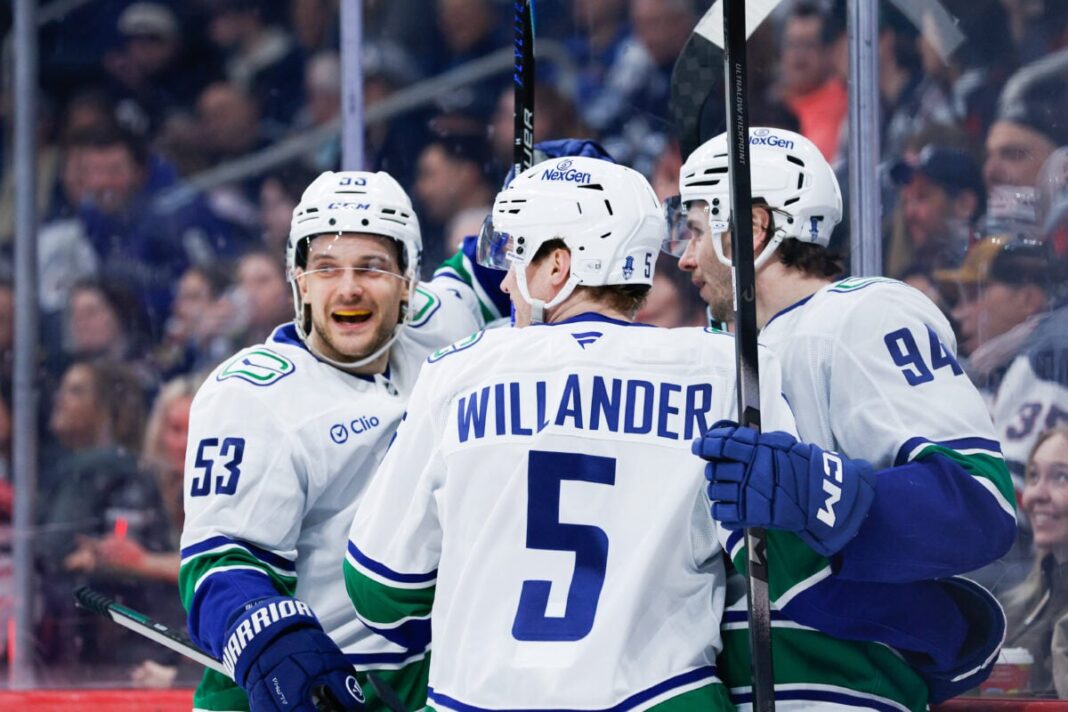

The Vancouver Canucks rebuild is more complicated than it seems on paper. The direction is obvious enough: get younger, get cheaper, and let time do the heavy lifting. In practice, that’s more difficult than it seems because the roster mix can be complicated.
How many veterans, even if they help establish the right culture, do you carry? How do you navigate the protection clauses in contracts? How do you work through the myriad of decisions that don’t have clean answers?
Specifically, how do you structure a team around players like Elias Pettersson, Brock Boeser, Thatcher Demko, and Filip Hronek? Do you allow them to define the team’s structure? How to build a supporting cast still raises questions about how quickly the next step is supposed to happen.
In this edition of Canucks News & Rumours, I want to address some of the complications I see the team facing.
The Canucks Veterans: Are They a Logjam or Helpful?
Every rebuilding or retooling team says it needs veterans. They’re supposed to stabilize young players, set standards, and bridge the gap between losing and learning. But there’s a point where “stability” starts to look like “stalling.”
Vancouver is hovering near that line. A player like Teddy Blueger brings experience and utility, but he also occupies a role that younger players can fill. Is he taking Jonathan Lekkerimäki’s ice time or stalling Aatu Räty’s development path?
(Terrence Lee-Imagn Images)
The uncomfortable truth is that veterans are only helpful if they are transitional. If they become permanent fixtures in a team that is trying to evolve around a core of Boeser, Pettersson, Hronek, and Demko, the rebuild slows down in ways that are harder to measure than wins and losses.
The No-Move Clause Problem
If there is a single quiet constraint shaping Vancouver’s future, it isn’t talent—it’s control. No-move clauses, modified trade protection, and veteran leverage don’t just limit transactions; they define what a roster can realistically become.
The Canucks have lived this in real time. Players like Pettersson and Demko are untouchable in practice, which is exactly how it should be for a core. The Canucks currently carry seven full no-move clauses across the roster, including Pettersson, Demko (whose clause kicks in July 1), Boeser, Jake DeBrusk, Hronek, Marcus Pettersson, and Kevin Lankinen. That’s a notably high number that significantly limits roster flexibility and trade options.
Together, these clauses narrow the range of possible moves. Even depth contracts (Blueger and Drew O’Connor) with modified protections can limit how flexible management actually is in reshaping the roster around that core. The strange tension is that the Canucks can identify what needs to change, but acting on it is another matter.
A retool or rebuild is supposed to be about acceleration or reset. Instead, the Canucks are often working around the edges of their own structure—negotiating not just with other teams but with the roster they already built.
Hronek, DeBrusk, and the Value Question
Few decisions capture Vancouver’s balancing act better than Filip Hronek. The team needs a stabilizing top-pair blueliner who can absorb minutes and allow development elsewhere. But he’s also exactly the kind of asset that could bring back a premium return if moved at the right time.
That same logic applies to Jake DeBrusk. A 25-goal scorer with streaky impact is either a core supporting piece or a valuable deadline-style asset. The question is not what he is, but what direction the team wants to prioritize.

(Timothy T. Ludwig-Imagn Images)
Even younger or ascending pieces like Drew O’Connor, Linus Karlsson, or Nils Höglander sit in this ecosystem. Each one has value, but value means different things depending on whether Vancouver is trying to stabilize, transition, or quietly reset.
The Cost of Staying Half-Changed
Personally, I still have a lot of optimism around the Canucks and the core they’ve built, and that shouldn’t get lost in the conversation. A group has players who give the team a solid foundation to build on, and there are clear signs of a roster that can evolve into something more competitive in short order. The direction is there, and the talent is real.
But optimism won’t translate into speed. The reality of how this roster is structured—through veteran commitments, trade protection, and the natural inertia of prior decisions—means change is likely to be gradual rather than immediate. That doesn’t mean the plan is wrong, only that the execution will probably be slower and more complicated than it looks on paper, with leadership having to navigate the difficult space between intention and practicality.
Free Newsletter
Get Vancouver Canucks coverage delivered to your inbox
In-depth analysis, breaking news, and insider takes – free.
Subscribe Free →