

Top prospects like Jesús Made and Leo De Vries are among the game’s most exciting potential call-ups this season, but most of the players who make the majors in the next couple of months won’t be in the same galaxy as those guys when it comes to their potential. Some may be fringe prospects, others former standouts who fell off team lists — some may have even already been labeled journeymen or organizational players. Nevertheless, a good number of them will contribute in the big leagues down the stretch. Some of last year’s impact rookies, like Caleb Durbin, Isaac Collins, Joey Cantillo, Justin Wrobleski, and Chad Patrick, weren’t Top 100 prospects — most would have struggled to make a Top 500 list. Yet their production mattered, and you can point to a dozen players like that every year.
We’re still a month away from the trade deadline, but relatively few top-tier players are available and the ones who are won’t come cheaply, meaning many teams will have to look internally as they work to improve their rosters. Below, I’ve chosen seven players, either fringe prospects or guys who’ve fallen off the big league radar, who have some combination of projection, performance, improvement, or a pressing team need that makes them intriguing over the rest of the 2026 season. Naturally, this leaves out top prospects like Kade Anderson, who I absolutely adore, and even pretty good ones, like James Tibbs III. Let’s dig a little deeper.
Zac Veen, Colorado Rockies
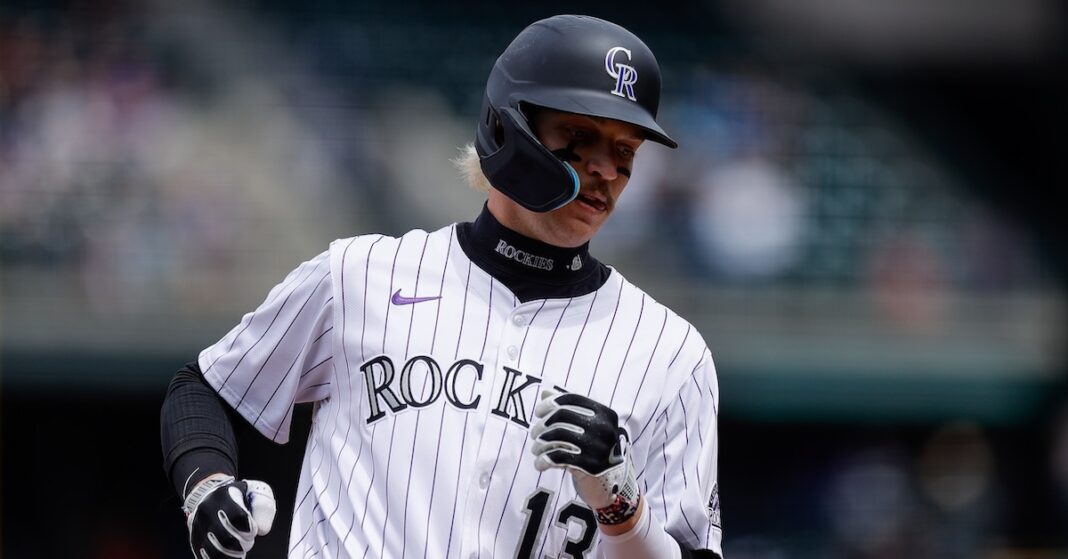
Along with Drew Romo, Zac Veen once looked like a key part of the future of the Colorado Rockies; back in 2022, he was one of our Top 50 prospects. Surgery on his wrist prematurely ended his 2023 season, and that, combined with his disappointing performance in the minors, dropped him from elite prospect territory. Unlike Romo, who ended up on waivers and has been with three organizations since departing Colorado, Veen remained with the Rockies, but he’s fallen to the no. 10-15 range among Rockies farmhands. He made a number of positive lifestyle changes this offseason, however, and perhaps spurred by that, his play is legitimately interesting this year. Veen has already nearly matched his career high in home runs (12 in 126 games in 2022) in just half the playing time and is also drawing more walks than ever before. Overall, ZiPS translates his minor league line as the 16th-best among minor league hitters this season (.280/.357/.466), nearly identical to his already-called-up teammate, Cole Carrigg. The Rockies have gotten better production from their outfield than they usually do, but I still think there’s an opportunity to get Veen some at-bats in Coors.
Mitch Bratt, Arizona Diamondbacks
Mitch Bratt was once considered a hot prospect among fans, or at least I think he was — I’ve gotten to the age where I’m confused by pop culture trends, but I vaguely recall hearing about something called Bratt Summer a few years ago. Now, there’s a chance I’m wrong about that, but while I don’t see Bratt having particularly high upside, we rank the Diamondbacks as having the no. 26 rotation in baseball over the rest of the season, so even a command-oriented no. 3 starter would be highly useful — with the Diamondbacks still playoff-adjacent at the moment, anything constituting pitching would be helpful. ZiPS projects Bratt for a 3.90 ERA in Arizona the rest of the season, and he can be a good bit worse than that and still represent a cheap upgrade for the team.
You Aren’t a FanGraphs Member
It looks like you aren’t yet a FanGraphs Member (or aren’t logged in). We aren’t mad, just disappointed.
We get it. You want to read this article. But before we let you get back to it, we’d like to point out a few of the good reasons why you should become a Member.
1. Ad Free viewing! We won’t bug you with this ad, or any other.
2. Unlimited articles! Non-Members only get to read 10 free articles a month. Members never get cut off.
3. Dark mode and Classic mode!
4. Custom player page dashboards! Choose the player cards you want, in the order you want them.
5. One-click data exports! Export our projections and leaderboards for your personal projects.
6. Remove the photos on the home page! (Honestly, this doesn’t sound so great to us, but some people wanted it, and we like to give our Members what they want.)
7. Even more Steamer projections! We have handedness, percentile, and context neutral projections available for Members only.
8. Get FanGraphs Walk-Off, a customized year end review! Find out exactly how you used FanGraphs this year, and how that compares to other Members. Don’t be a victim of FOMO.
9. A weekly mailbag column, exclusively for Members.
10. Help support FanGraphs and our entire staff! Our Members provide us with critical resources to improve the site and deliver new features!
We hope you’ll consider a Membership today, for yourself or as a gift! And we realize this has been an awfully long sales pitch, so we’ve also removed all the other ads in this article. We didn’t want to overdo it.
Christian Moore, Los Angeles Angels
Christian Moore is a former first-rounder, picked by the Angels in part because they believed that he wouldn’t need a lot of time in the minors. Turns out he did, as he hit for a rather underwhelming 82 wRC+ in Anaheim, though in fairness, he had only played 79 pro games before he debuted — even for a college bat, that isn’t much. Moore has shown real progress in 2026, however, and while his 74% contact rate isn’t great, it’s a significant bump up from the 65-69% he’d previously put up in both the minors and majors. His pitch selection has also improved considerably, resulting in nine home runs, already a career best. ZiPS translates his 2026 season to a .260/.376/.435 line, and while the computer is under no illusion that he would do that in the majors going forward, his 97 rest-of-season wRC+ projection is well ahead of the 83 projected before the season. Moore has been getting starts at third base and in left field in the minors, and his versatility could give him a second chance with Los Angeles, though that won’t be enough to make the Angels interesting.
Peyton Alford, Seattle Mariners
Back in January, Peyton Alford failed to make the main section of our Mariners Top Prospects List, only rating as an honorable mention. That’s hardly surprising, given that he’s a reliever who’s approaching 30, has command issues, and doesn’t throw 101. But he’s shown legitimate improvement in 2026. He’s never had a first-strike percentage above 50% before this season, and he’s over 60% combined at Double- and Triple-A this year, leading to by far his lowest walk rate as a professional. He’s still missing bats in the high minors as well, and lefties who can get some whiffs tend to eventually get a shot in the majors. Alford has had a reverse platoon split throughout his minor league career, so the fact that two of Seattle’s better relievers (Gabe Speier and José A. Ferrer) are also southpaws isn’t an insurmountable obstacle. Even if the Mariners can’t make use of him, Alford may represent a really fun throw-in for a trade soon.
Ben Malgeri, Detroit Tigers
If I had told you in the spring that I had taken time machine to the future and seen that the Tigers were fighting to stay out of last place in the AL Central after Tarik Skubal had missed significant time with an injury, you probably would have thought that Detroit’s pitching had fallen apart. And also that I was using a time machine in a particularly unambitious way. In fact, it’s been the offense that has been more of a problem for the Tigers, with the team’s outfielders combining for a 93 wRC+ despite a terrific season from Riley Greene. The designated hitters have been even worse, combining to hit an abysmal .215/.295/.324. Nobody’s going to think of Ben Malgeri as a future star, but Detroit needs bats, and Malgeri is a good contact hitter with a hard-hit rate just under 50% in the minors. ZiPS only projects a 101 wRC+ from Malgeri in the majors this year, but the 112 wRC+ against southpaws it forecasts could make him a highly useful role player on a team that’s currently short on productive lefty-mashers.
Wilian Bormie, Texas Rangers
This past spring, Wilian Bormie only ranked 33rd among Rangers prospects, with a 35+ FV grade. My colleague Brendan Gawlowski thought that there was potential for real improvement, and I would submit that that’s precisely what we’ve seen this year. Bormie has cut his walk rate down to under 10% after spending most of his minor league career in the 13-16% range, and has done so without losing a fastball that touches triple digits and racks up whiffs. Texas’ bullpen is rather lacking in pitchers with explosive fastballs, something they’re almost certainly aware of, or the hard-throwing Gavin Collyer would not have gotten a call-up while walking more than six batters a game in the high minors. The Rangers are currently only a half game out of a Wild Card spot, so an exciting reliever could have some serious value.
Kyle Nicolas, Baltimore Orioles
Kyle Nicolas throws a fastball in the high 90s and a slider that crests 90 mph, but he has yet to click in the majors thanks to absolutely dreadful control. The Orioles recently acquired him, and they have a good record with relievers like this, most notably Félix Bautista, which gives me hope that Nicolas could surprise in Baltimore. ZiPS thinks I’m delusional, projecting an ERA in the mid-to-high fours for the right-hander as a reliever, but he’s a guy who certainly looks like a pitcher, and he’s really hard to hit for power against, so I think some minor improvement could have a lot of impact.