
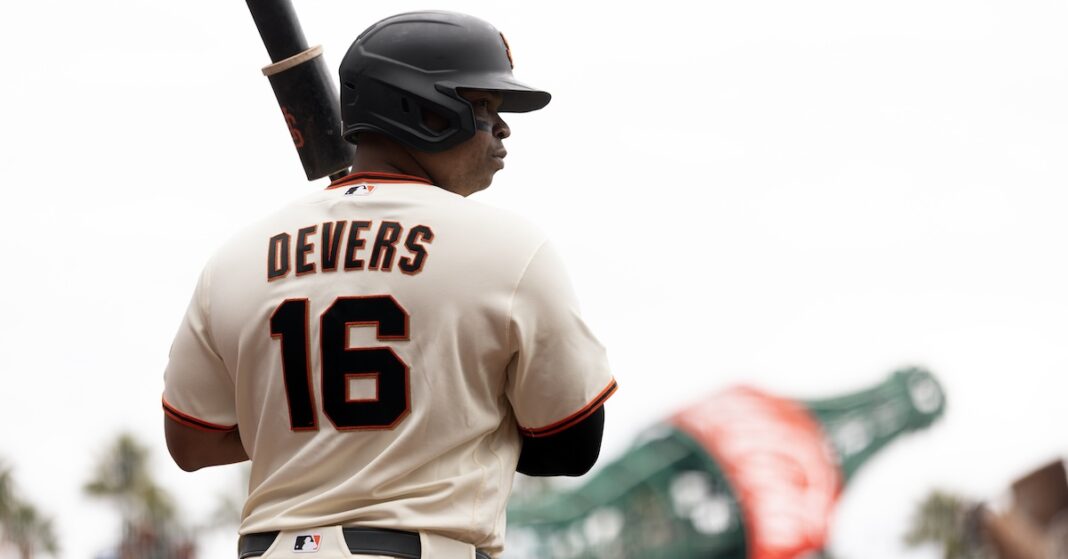

Monday marked the one-year anniversary of the blockbuster trade that sent Rafael Devers from the Red Sox to the Giants in exchange for a four-player package. Neither team marked the occasion by throwing a party; mercifully, both were idle, and so didn’t sink further below .500. The deal hasn’t worked out well for either side, though it’s the Giants with an expensive and apparently declining slugger on the books. While Devers was fairly productive after being dealt last season, so far in 2026, the 29-year-old first baseman has surrounded one very good month (May) with a pair of miserable slumps that are just part of the reason the Giants are buried in the NL West standings.
We’ve told and re-told the story of the drama in Boston that led up to the Devers trade, but the streamlined version is that the signing of third baseman Alex Bregman bumped Devers off his natural position. After that, a lack of communication between the front office and the slugger — whose defense at the hot corner had eroded — exacerbated the team’s attempts to slot him first at designated hitter and then, after Triston Casas was injured, at first base, a position he had never played before and was reluctant to begin learning in-season. On June 15, 2025, the Red Sox sent Devers to the Giants for lefty Kyle Harrison, righties Jose Bello and Jordan Hicks, and outfielder James Tibbs III, with the Giants assuming the roughly $254 million remaining on Devers’ 10-year, $313.5 million contract, which runs though 2033.
The Red Sox were just 36-36 at the time of the trade, the Giants 41-30. Over the remainder of the season, the two teams’ fortunes reversed, with Boston going 53-37 and securing a Wild Card berth, just the team’s second trip to the postseason since winning the World Series in 2018, and San Francisco going 40-51 and missing the playoffs for the eighth time in nine seasons. Each team has changed managers since, with the Giants axing Bob Melvin in favor of Tony Vitello — the rare manager to make the jump directly from the college coaching ranks — last October and the Red Sox firing Alex Cora in late April. Those varying paths have led the two teams to similar spots: the Red Sox are 29-41, last in the AL East, while the Giants are 29-43, two games out of last place in the NL West. (Note that throughout this piece, stats from our site include those from Devers’ two plate appearances in Tuesday night’s suspended game against the Braves, while those from Baseball Savant do not.)
Devers is in a much different spot, to say the least. For all of the behind-the-scenes drama that preceded the trade, he was hitting a robust .272/.401/.504 at the time; his 146 wRC+ was six points higher than his full-season career high, set in 2022. He hit a respectable .236/.347/.460 (125 wRC+) in a ballpark much less favorable for hitters thereafter, finishing with a 135 wRC+, just one point below his 2024 mark, and eight points above his career mark to that point; his total of 35 homers was his highest since 2021. This year, he’s hitting just .234/.294/.411 with nine homers for a 96 wRC+, lower than all but four qualifiers whose primary position is first base, Ildemaro Vargas (93), Nolan Schanuel (92), Josh Bell (87), and Vinnie Pasquantino (81).
Devers’ monthly splits are alarming, to say the least:
Rafael Devers 2026 Monthly Splits
| Split | PA | HR | BB% | K% | AVG | OBP | SLG | BABIP | wRC+ |
|---|---|---|---|---|---|---|---|---|---|
| March/April | 129 | 2 | 5.4% | 31.0% | .207 | .248 | .289 | .288 | 48 |
| May | 118 | 5 | 6.8% | 28.0% | .306 | .356 | .593 | .394 | 160 |
| June | 62 | 2 | 14.5% | 32.3% | .151 | .274 | .321 | .194 | 72 |
Devers’ performance in May offers some reassurance that he’s still capable of being a middle-of-the-lineup force, but those strikeout rates stand out nonetheless. He entered the season with a 22% career strikeout rate, with last year’s 26.3% representing a full-season high (he struck out 27% of the time during the abbreviated 2020 season). He’s almost four points above that overall this year (30.1%), and has topped 30% in more calendar months this season than in any of his previous nine seasons; only in May 2021, when he fanned in 34.6% of his plate appearances, did he reach that 30% threshold. To be fair, he could trim his rate below 30% by the end of this month, but still, the swing-and-miss issues stand out even more given his sharp plunge from last year’s career-high 15.4% walk rate to this year’s 7.8%, his lowest full-season mark since 2019.
You Aren’t a FanGraphs Member
It looks like you aren’t yet a FanGraphs Member (or aren’t logged in). We aren’t mad, just disappointed.
We get it. You want to read this article. But before we let you get back to it, we’d like to point out a few of the good reasons why you should become a Member.
1. Ad Free viewing! We won’t bug you with this ad, or any other.
2. Unlimited articles! Non-Members only get to read 10 free articles a month. Members never get cut off.
3. Dark mode and Classic mode!
4. Custom player page dashboards! Choose the player cards you want, in the order you want them.
5. One-click data exports! Export our projections and leaderboards for your personal projects.
6. Remove the photos on the home page! (Honestly, this doesn’t sound so great to us, but some people wanted it, and we like to give our Members what they want.)
7. Even more Steamer projections! We have handedness, percentile, and context neutral projections available for Members only.
8. Get FanGraphs Walk-Off, a customized year end review! Find out exactly how you used FanGraphs this year, and how that compares to other Members. Don’t be a victim of FOMO.
9. A weekly mailbag column, exclusively for Members.
10. Help support FanGraphs and our entire staff! Our Members provide us with critical resources to improve the site and deliver new features!
We hope you’ll consider a Membership today, for yourself or as a gift! And we realize this has been an awfully long sales pitch, so we’ve also removed all the other ads in this article. We didn’t want to overdo it.
Similarly, Devers’ zone contact rate is an issue. His 74.2% rate is actually 0.3 percentage points higher than last year, when he had the lowest rate among all qualifiers by nearly three full points, but this time he’s not offsetting it with enough power. Munetaka Murakami, whose 71.8% zone contact rate is the majors’ lowest, hit 20 homers and slugged .560 in 57 games before landing on the injured list; again, Devers has less than half as many homers as Murakami and a slugging percentage nearly 150 points lower.
Pitchers have noticed. Devers’ 30.5% chase rate and 50% swing rate are both two points below his career averages, but his 49.9% zone rate is his highest since his 2017 rookie season, indicating that pitchers are less afraid to challenge him than in years past.
So what’s going on? For one thing, Devers has lost some bat speed in recent years, which isn’t that surprising even though he’s still five months short of turning 30; he did get shut down in late 2024 due to soreness and inflammation in both of his shoulders. In late 2023, his swing averaged 73.4 mph (68th percentile), but that fell to 72.5 mph (61st percentile) in ’24, then to 71.6 mph (42nd percentile) last year, and it’s been about that level this year (71.7 mph, 45th percentile). That’s bad enough — his bat speed is now below-average — but what’s even more concerning is the progression of his season, keeping in mind those monthly splits above. He averaged 71.2 mph in March/April, with a 15.5% fast swing rate, then increased that to 71.9 mph with a 20.5% fast swing rate in May. He’s up to an average of 72.4 mph this month, with a 28.8% fast swing rate; while the month-to-month speed increase wasn’t as big as from March/April to May, neither his current average speed nor his fast swing rate have been this high since July 2024, before his shoulder issues really took a bite out of his production — and this month, that production has been terrible. Maybe it’s a sample size issue, but I worry that he’s forcing himself to swing harder, selling out for power in order to offset whatever else is going on, and compromising his swing decision process.
Even more worrisome is Devers’ collapse against four-seam fastballs. He has generally handled heaters well in recent years, hitting for more than enough power to offset his high whiff rates against them. From 2023–25, he hit .253 and slugged .528 against four-seamers, and was 36 runs above average against them, tying him for ninth in the majors. He was the only hitter among the top 37 (everybody who was at least 19 runs above average) with a whiff rate of at least 30% against them (35.2%). He’s an outlier on the scatter plot:

But while Devers had slugged above .500 and produced wOBAs of .371 or higher against four-seamers in those three seasons, this year, he’s slugging .405 with a .286 wOBA — and a 41.2% whiff rate:
Rafael Devers vs. Four-Seam Fastballs
| Season | % | PA | HR | AVG | xBA | SLG | xSLG | wOBA | xwOBA | Whiff |
|---|---|---|---|---|---|---|---|---|---|---|
| 2023 | 40.1% | 235 | 11 | .265 | .244 | .510 | .542 | .371 | .376 | 31.9% |
| 2024 | 37.9% | 155 | 11 | .242 | .213 | .583 | .486 | .392 | .348 | 39.7% |
| 2025 | 42.6% | 261 | 15 | .249 | .240 | .512 | .528 | .380 | .381 | 34.9% |
| 2026 | 42.8% | 120 | 6 | .189 | .184 | .405 | .379 | .286 | .272 | 41.2% |
Source: Baseball Savant
That’s not especially encouraging. Statcast’s new swing timing metrics tell us he’s swinging under those four-seamers — whiffing or making sub-optimal contact, a subject to which I’ll return — 67% of the time, up from 60% last season. That said, he was also at 67% in 2024, with a similarly high whiff rate, and was able to improve.
Devers has become increasingly vulnerable to the high cheese. His recent numbers against pitches in the upper third of the strike zone and higher show a problem that resurfaced last year after recent success against such pitches:
Rafael Devers vs. High Four-Seam Fastballs
| Season | % | PA | HR | AVG | xBA | SLG | xSLG | wOBA | xwOBA | Whiff |
|---|---|---|---|---|---|---|---|---|---|---|
| 2023 | 24.6% | 128 | 6 | .257 | .246 | .514 | .568 | .390 | .402 | 34.5% |
| 2024 | 21.5% | 71 | 5 | .267 | .213 | .650 | .558 | .420 | .367 | 46.0% |
| 2025 | 23.5% | 124 | 4 | .186 | .158 | .361 | .339 | .331 | .314 | 43.8% |
| 2026 | 23.4% | 57 | 2 | .143 | .149 | .306 | .322 | .262 | .268 | 52.3% |
Source: Baseball Savant
Includes those in Gameday Zones 1, 2, 3, 11, and 12.
Amid this decline, Devers has made some minor adjustments at the plate. He’s slightly closed up the most open stance in the game, from an average of 67 degrees open in 2024 to 63 degrees open in ’26. He’s moved deeper in the box by three inches (from 21.8 inches in 2024 to 24.8 in ’26), but with that, his contact point has moved similarly, from seven inches out front to 4.1. That makes him less likely to put the ball in the air and hit it to the pull side, but Devers has generally been more of a spray hitter than a guy who pulled the ball a great deal. For most sluggers, the pull side is still where a good share of the power production comes from, though, and for Devers, that share is shrinking. Even when he does lift the ball to that side, he’s not getting as much for his effort:
Rafael Devers Pulled Air Production
| Season | Pull% | Pull Air% | BBE Pull Air | LA | Dist | Brl% | HR | SLG | xSLG | wOBA | xwOBA |
|---|---|---|---|---|---|---|---|---|---|---|---|
| 2023 | 35.9% | 17.7% | 81 | 31 | 277 | 34.6% | 19 | 1.375 | 1.351 | .789 | .768 |
| 2024 | 32.3% | 15.4% | 59 | 28 | 251 | 16.9% | 6 | 1.070 | 1.018 | .639 | .624 |
| 2025 | 35.8% | 17.2% | 72 | 28 | 289 | 37.5% | 17 | 1.563 | 1.272 | .915 | .740 |
| 2026 | 32.6% | 14.2% | 27 | 32 | 282 | 25.9% | 2 | .962 | 1.053 | .580 | .601 |
Source: Baseball Savant
Last year, Devers’ pull rate placed in the 28th percentile and his pulled air rate in the 45th, while this year’s marks have slipped to the 17th and 26th percentiles, respectively. When he does elevate to his pull side, it’s not as hard, and he’s not barreling it as often, hitting it as far, or leaving the yard with much frequency. All of that, as you’d expect, shows up in his overall Statcast contact profile:
Rafael Devers Statcast Proile
| Season | BBE | EV | LA | Barrel% | HardHit% | AVG | xBA | SLG | xSLG | wOBA | xwOBA |
|---|---|---|---|---|---|---|---|---|---|---|---|
| 2023 | 457 | 93.1 | 12.4 | 12.7% | 55.1% | .271 | .276 | .500 | .544 | .359 | .380 |
| 2024 | 384 | 93.2 | 11.6 | 13.0% | 52.6% | .272 | .267 | .516 | .514 | .364 | .366 |
| 2025 | 419 | 93.5 | 12.6 | 16.0% | 56.1% | .252 | .244 | .479 | .487 | .365 | .367 |
| 2026 | 191 | 91.9 | 13.5 | 9.4% | 49.2% | .234 | .217 | .411 | .398 | .307 | .291 |
I noticed a few other things in poring over Devers’ Statcast page. He’s making contact under balls on 27.4% of his batted ball events, a career-high rate that’s 4.5 points ahead of each of his last two seasons. Those balls rarely turn into hits and almost never produce substantial damage beyond a cheap home run down the foul line, so having a greater share of them as part of your contact profile is bad news. Last year, Devers hit .095 and slugged .158 on the 96 balls he got under, whereas this year, he’s hitting .120 and slugging .140 on 52 such balls.
One more thing to note is that Devers has been particularly vexed by lefties. While he raked against them during his 58-game rookie season in 2017, even including that campaign, he struggled to an 89 wRC+ against southpaws over the 2017–20 timeframe. From 2021–25, he improved to a 104 wRC+, with ’24 (95 wRC+) his only below-average season within that span. This year, he’s down to a career-worst 61 wRC+ (.185/.265/.293) with a 29.4% strikeout rate in 102 plate appearances. Devers is hitting .074 and slugging .296 in 27 plate appearances against lefty fastballs — that’s two homers and a 54.2% whiff rate — compared to a .291 AVG and .545 SLG with a 39.9% whiff rate in 55 appearances against them last year. He’s also been eaten up by sweepers from lefties (.077 AVG/.145 SLG, 31.3% whiff in 14 appearances), which he’s seen as many times as he’s seen traditional sliders from them (57 times, 13.7% of pitches from lefties).
While Devers has started every game against lefties, the time is nigh for Vitello to adjust his lineup, at least until the slugger finds his swing again. Rookie Bryce Eldridge, a fellow lefty who has shared DH and first base responsibilities with Devers since being called up in early May, has enjoyed small-sample success against lefties as part of his .324/.415/.552 (170 wRC+) line, so it makes sense to play him at first on those days. To be fair, the Giants currently lack a reliable right-handed bat to plug in at DH in such a configuration because injuries to outfielders Heliot Ramos and Harrison Bader have thinned their bench. Casey Schmitt, who handled a good chunk of the DH duty before Eldridge was recalled, has spent the past four weeks as the regular left fielder despite no previous professional experience there, but that’s a temporary situation, as Ramos, who has been out since mid-May due to a right quad strain, is slated to start a rehab assignment on Wednesday.
In late April, president of baseball operations Buster Posey expressed confidence in Devers’ track record despite his slow start, though he did characterize the slugger as “a little in between right now. Maybe a tick late on some heaters, and then a little bit out in front on off-speed.” Since then, the Giants have dug such a hole for themselves that Posey and company are reportedly sending out feelers regarding pending free agents Luis Arraez and Robbie Ray. MLB.com’s Mark Feinsand reported that they’re willing to listen to offers on Devers, Willy Adames, and Matt Chapman, but all three are owed so much money as to be immovable “without attaching serious value to them,” as one NL executive told Feinsand. Chapman, who has a 115 wRC+ with 1.7 WAR this far, would provide a significant upgrade to many contenders in need of help at the hot corner — the Phillies, Braves, Brewers, Cardinals, Padres, and Mariners are all candidates to land on next month’s Replacement Level Killers list — but he’s making $25 million this year, has a full no-trade clause, and is owed another $100 million for 2027–30. Adames, who has put up just a 91 wRC+ with -0.3 WAR, is owed $140 million from 2027–31 and has full no-trade protection, if those aforementioned numbers didn’t figuratively place him in that category already.
It’s worth noting that the Red Sox didn’t exactly make out like bandits in the Devers deal. Of the four players they received, only Bello — a 21-year-old starter at Low-A Salem, and no relation to Brayan Bello — is still in the organization. Tibbs, a lefty-swinging 23-year-old, was flipped to the Dodgers on July 31 last year in exchange for Dustin May; he’s 45-FV prospect currently hitting .307/.422/.614 (159 wRC+) while playing right field and DH for Triple-A Oklahoma City. May, who scuffled during his brief time with the Red Sox, departed in free agency and is now flourishing with the Cardinals. Hicks, a 29-year-old righty, was sent to the White Sox on February 1 as part of a deal that also sent 25-year-old righty prospect David Sandlin to Chicago and 23-year-old righty Gage Ziehl to Boston; the Red Sox also sent along $8 million of the remaining $25 million on Hicks’ contract, and there are three as-yet-unidentified PTBNLs in the swap. While Hicks has struggled in Chicago, Harrison was traded to the Brewers on February 9 as part of a six-player deal that sent Caleb Durbin to Boston. That deal was supposed to help fill the third base hole left by Bregman’s opt-out, but Durbin is hitting just .190/.250/.307 while Harrison is thriving in Milwaukee, with a 2.47 ERA and 3.05 FIP in 65.2 innings.
The Red Sox may pat themselves on the back for clearing Devers’ salary from the books, and for avoiding a long-term entanglement with Bregman (who recently called his own play with the Cubs “terrible”), but they have little to show for the whole saga beyond their once-vaunted payroll flexibility. Their recent track record — dating back at least to the meager returns from the Mookie Betts trade — speaks for itself. The Giants, who for years showed willingness to shell out for a cornerstone such as Aaron Judge, Carlos Correa, or Shohei Ohtani who would stick around for the long term, at least took a risk in dealing for a player whom they believed fit that bill, but that doesn’t mean they’re guaranteed the reward.