
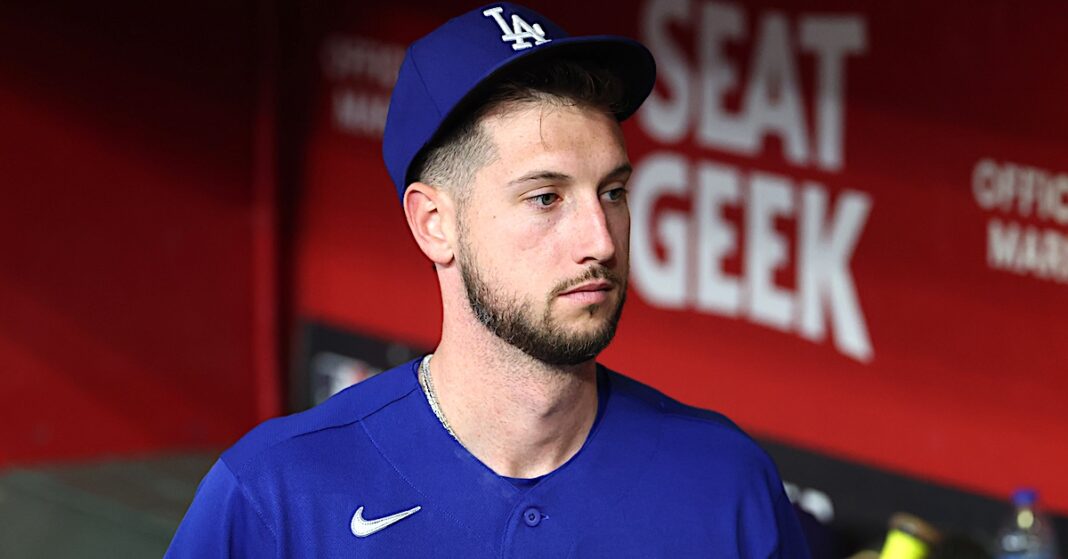

Kyle Tucker’s tenure with the Dodgers hasn’t gone as well as anyone hoped so far, and on Monday night at Target Field, things took a turn for the worse. After walking during his first plate appearance, he yielded to a pinch-runner upon reaching second base due to back spasms. While he hasn’t yet landed on the injured list, the Dodgers have set a timetable that allows for “a mental reset” — to use manager Dave Roberts’ term — as Tucker tries to end a prolonged slump.
Tucker apparently began experiencing back spasms when the Dodgers took the field in the bottom of the first inning, though he didn’t have any balls hit in his direction. When he batted with one out in the top of the second, he fouled off Zebby Matthews’ first pitch — a four-seamer just off the plate — then looked at four straight balls, three of them in similar locations to that initial offering. Tommy Edman followed with a single, at which point Roberts replaced Tucker with pinch-runner Alex Call, who took over in right field.
“Back just like lit up and [I] went out there just tried to hope that it would calm down or go away or something, I’d just keep flying through it,” said Tucker afterwards, adding that “finishing the swing hurt.”
Roberts first noticed Tucker’s discomfort when he was batting. “I saw him take his at-bat — a little bit of wincing and kind of when he was jogging to first base,” the manager said. “And then once he got to second base, I think it was just more not seeing him move the right way, and I didn’t want to put him in any more jeopardy.”
Based on Tucker’s past history with back spasms, neither he nor the Dodgers believe this is more than a day-to-day issue. The team hasn’t sent him for imaging, and while he did not play on Tuesday night, he said that he felt “pretty confident” he would avoid the injured list. With utilityman Enrique Hernández, outfielder Teoscar Hernández and catcher Will Smith already on the IL, and catcher Dalton Rushing having left Monday’s game due to concussion concerns after taking a foul ball off his mask, the Los Angeles roster is already somewhat thin, though the Dodgers did recently activate Edman, who missed the first 12 weeks of the season while recovering from right ankle surgery. Call has gone 4-for-7 with a pair of walks and his first home run of 2026 over the past two nights in place of Tucker.
Roberts said on Tuesday that the team will make a decision about Tucker’s status before Friday’s night’s game against the Padres:
You Aren’t a FanGraphs Member
It looks like you aren’t yet a FanGraphs Member (or aren’t logged in). We aren’t mad, just disappointed.
We get it. You want to read this article. But before we let you get back to it, we’d like to point out a few of the good reasons why you should become a Member.
1. Ad Free viewing! We won’t bug you with this ad, or any other.
2. Unlimited articles! Non-Members only get to read 10 free articles a month. Members never get cut off.
3. Dark mode and Classic mode!
4. Custom player page dashboards! Choose the player cards you want, in the order you want them.
5. One-click data exports! Export our projections and leaderboards for your personal projects.
6. Remove the photos on the home page! (Honestly, this doesn’t sound so great to us, but some people wanted it, and we like to give our Members what they want.)
7. Even more Steamer projections! We have handedness, percentile, and context neutral projections available for Members only.
8. Get FanGraphs Walk-Off, a customized year end review! Find out exactly how you used FanGraphs this year, and how that compares to other Members. Don’t be a victim of FOMO.
9. A weekly mailbag column, exclusively for Members.
10. Help support FanGraphs and our entire staff! Our Members provide us with critical resources to improve the site and deliver new features!
We hope you’ll consider a Membership today, for yourself or as a gift! And we realize this has been an awfully long sales pitch, so we’ve also removed all the other ads in this article. We didn’t want to overdo it.
“I think that the four days, with the off-day, would be a middle [route]… And so hopefully he has taken advantage of this, obviously to get right, but also kind of a mental reset… If he can swing the bat, ideally he would swing the bat tomorrow and do some type of activity to go into the off-day. But if he doesn’t, then we’ll probably have a tougher decision on Friday.”
If he does land on the IL, the Dodgers have Hyeseong Kim and Alek Thomas at Triple-A Oklahoma City; both are on the 40-man roster, so calling up either wouldn’t require additional machinations. Teoscar Hernández, who’s been out since late May due to a left hamstring strain, homered in the first game of his rehab assignment at Oklahoma City on Tuesday night. Continued results like that could prompt the Dodgers to accelerate his return ahead of their June 29 target.
Whether or not Tucker lands on the IL, some kind of reset is in order. The Dodgers signed him to a four-year, $240 million deal in mid-January, setting a record for average annual value in the process — $57.2 million, once deferrals are factored in. That salary is a tall order for any player to live up to, and so far, Tucker has not. He’s hit .234/.333/.374 with six home runs, nothing to write home about but hardly terrible. His 101 wRC+ is within five points of the marks of Fernando Tatis Jr., Matt Chapman, and Rafael Devers, and it’s higher than those of Alex Bregman, Nolan Arenado, Xander Bogaerts, Willy Adames, Bo Bichette, Dansby Swanson, Austin Riley, Manny Machado, Marcus Semien, and Trea Turner, to limit the comparison to NL batting title qualifiers currently playing out nine-figure contracts, most of which extend well past the expiration of his deal.
While Tucker said earlier this season that he wasn’t pressing despite his slow start, Roberts has suggested otherwise on multiple occasions, citing his higher swing and chase rates.
“I do think that the swing rate is higher than it has been in his career, whether it’s the first pitch, just in total,” Roberts said in late May. “I think that speaks to not being selective enough, because he is a guy that by nature can run deep counts and still be fine getting to two strikes, but it just seems like he’s much more hyper aggressive than I recall.”
The manager sounded a similar note prior to Monday’s game. “No player wants to not perform up to their capabilities,” he said. “For me, it’s just wanting him to get back to being who he is as a hitter. And who he is as a hitter is a guy that really controls the strike zone. His swing rate has been much higher, his chase rate much higher. If we can get him back to being who he is, then we’ll bet on the results.”
Tucker is swinging at 48.6% of all pitches, just an eyelash above his career mark but his highest rate since 2022; he was at 45.1% last year. Meanwhile, he’s chasing 25.6% of pitches outside the zone, 2.7 points above his career mark and again his highest since 2022, well above last year’s 17.5%. His 64.2% first-pitch strike rate is a career high and 8.3 points above last year’s rate, which is to say that he’s falling behind in the count more often. To Roberts’ point, Tucker’s rate of swinging at the first pitch (44.3%) is higher than his career norm (41.4%) as well, and ahead of last year’s first-pitch swing rate (36.2%). Using our new Heat Maps Pivot tool, here’s a year-to-year comparison of his first-pitch swing rate:

Translating the visuals into numbers, Tucker has chased 19.9% of first pitches outside the zone this year, up from just 11.6% last year and 9.5% in 2024, his two seasons with very low swing and chase rates and very high walk rates (16.5% in 2024, 14.6% in ’25). But in terms of his actual results on first pitches, they’re in line with his recent performances in that context:
Kyle Tucker in 0-0 Counts
| Season | PA | EV | LA | Brl% | HH% | AVG | xBA | SLG | xSLG | wOBA | xwOBA | Whiff% |
|---|---|---|---|---|---|---|---|---|---|---|---|---|
| 2023 | 105 | 89.3 | 13 | 8.8% | 42.2% | .374 | .358 | .596 | .615 | .402 | .412 | 21.4% |
| 2024 | 42 | 90.8 | 23 | 17.9% | 43.6% | .231 | .336 | .564 | .725 | .333 | .452 | 19.3% |
| 2025 | 73 | 90.0 | 15 | 12.5% | 45.8% | .333 | .378 | .597 | .672 | .399 | .449 | 20.1% |
| 2026 | 39 | 93.2 | 23 | 10.3% | 53.8% | .333 | .387 | .564 | .656 | .386 | .443 | 25.5% |
Source: Baseball Savant
Tucker’s whiff rate when swinging at the first pitch is higher than in any season since 2020 (29.1%), but his average exit velocity in that context is a career high, and his hard-hit rate is his highest since 2019, when he merely had a September cup of coffee with the Astros. So while I do think the elevated swing and chase rates that Roberts has mentioned aren’t a good sign, and that his elevated first-pitch whiff rate means starting more plate appearances down 0-1, the bigger problem is his declining two-strike performance:
Kyle Tucker in Two-Strike Counts
| Season | PA | BBE | EV | LA | Brl% | HH% | AVG | xBA | SLG | xSLG | wOBA | xwOBA | Whiff% |
|---|---|---|---|---|---|---|---|---|---|---|---|---|---|
| 2023 | 313 | 174 | 89.9 | 13 | 8.6% | 44.8% | .236 | .230 | .418 | .415 | .332 | .331 | 17.4% |
| 2024 | 157 | 70 | 88.7 | 24 | 5.8% | 37.7% | .211 | .158 | .431 | .291 | .356 | .293 | 18.7% |
| 2025 | 278 | 145 | 88.4 | 18 | 11.7% | 35.2% | .167 | .160 | .322 | .313 | .285 | .279 | 20.4% |
| 2026 | 164 | 78 | 87.6 | 14 | 1.3% | 38.5% | .155 | .155 | .218 | .205 | .230 | .227 | 22.0% |
Source: Baseball Savant
That performance helps to explain why Tucker has struck out in 20.4% of his plate appearances, his highest mark since his aforementioned 2019 cup of coffee and 5.7 points higher than last season. That anemic two-strike production is at least somewhat weighing down his overall contact profile:
Kyle Tucker Statcast Profile
| Season | BBE | EV | LA | Brl% | HH% | AVG | xBA | SLG | xSLG | wOBA | xwOBA |
|---|---|---|---|---|---|---|---|---|---|---|---|
| 2023 | 499 | 90.2 | 14.8 | 10.4% | 45.3% | .284 | .287 | .517 | .533 | .372 | .386 |
| 2024 | 228 | 91.1 | 21.2 | 12.7% | 44.3% | .289 | .275 | .585 | .546 | .419 | .402 |
| 2025 | 418 | 90.1 | 17.2 | 10.8% | 40.2% | .266 | .270 | .464 | .483 | .363 | .372 |
| 2026 | 211 | 88.9 | 15.6 | 5.2% | 39.3% | .234 | .248 | .374 | .367 | .317 | .323 |
Tucker didn’t have enough batted ball events to qualify in 2024 due to injuries — more on that in a moment — but otherwise, from 2022–25, he ranked in the 65th-to-70th percentile in barrel rate; he’s down in the 24th percentile now. Meanwhile, from 2025 to ’26, he’s fallen from the 53rd percentile to the 43rd in exit velocity and from the 85th to the 27th in xSLG.
As for injuries, Tucker played just 78 games for the Astros in 2024 due to a fractured right shin; he fouled a ball off his leg on June 3 of that season, and only three months later revealed that continued imaging eventually showed a fracture. Last season, when he played in 136 games with the Cubs, he endured a 39-game slump during which he hit.184/.321/.228 with just one homer. On August 21, the Cubs divulged that Tucker had played through a hairline fracture in his right ring finger, suffered during a June 1 slide. The injury didn’t entirely align with his offensive woes, but it couldn’t have helped. After a brief benching for three games from August 19-20 to provide a reset, he tore the cover off the ball for two weeks, but a left calf strain limited him to five games in September.
All of which has made it a little difficult to figure out how good Tucker really is when healthy, but it has to be better than this. While his hard-hit rate is only down about one point from last year, his barrel rate is less than half of what it was, and his expected slugging percentage is down 106 points. The disconnect owes to his hitting more groundballs; his 39.3% rate is still pretty low, but it’s his highest mark since his initial big league stint in 2018, and up 5.4 points relative to last season. What’s more, that rate is up to 53.2% this month, while his pulled-air rate is down to 10.2%, less than half of his full-season mark of 22.3%.
The numbers suggest Tucker has lost some bat speed, and in the aggregate that’s true — he’s dipped from an average swing speed of 72 mph last year to 71.2 this year — but that may in part be a response to his subpar results. He averaged 72.2 mph in March/April before dipping to 70.6 in May and 70.3 this month as he’s sought a combination of stance and swing path that has worked. Check out the monthly fluctuations in his swing path tilt, attack angle, stance angle, and position in the batter’s box dating back to late 2023:

“I think it’s more just me trying to find my swing, and trying to find the consistency in it more than anything,” Tucker said in late April. “I’ve had some good swings. Sometimes, I just get a hit because I just happened to get a hit. But just trying to find the consistency with my swing and do it day in, day out.”
For whatever the reason, the bottom line is that Tucker’s contact has become less efficient. His squared-up rate has fallen from 29.7% last year (84th percentile) to 25.8% this year (56th percentile), and his blast rate from 12.5% (58th percentile) to 8.2% (20th percentile). Perhaps his back spasms are a sign of a larger physical issue that needs addressing, but regardless of whether that’s the case, his mechanics and approach aren’t the ones that earned him this big contract. The Dodgers have enough production up and down their lineup to offset his struggles or even his absence, but he and the team have work to do to find out how to get the old Kyle Tucker back.