
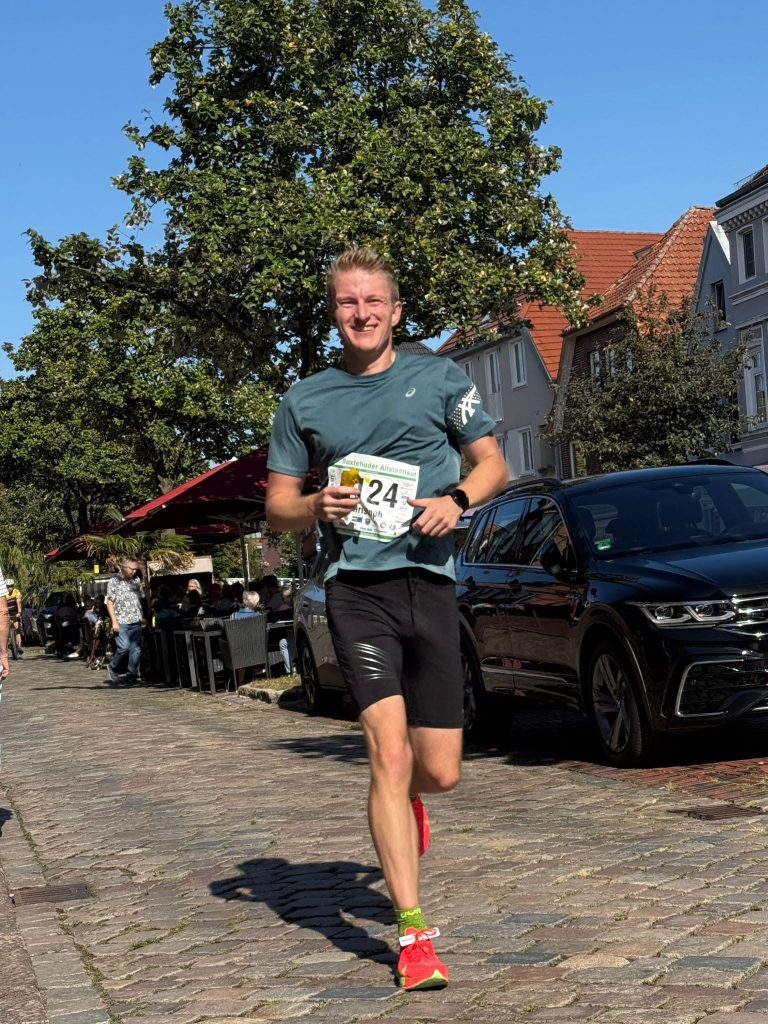

This guest post was written by FIDE Master Christoph von Puttkamer (né Kuberczyk). He is a Publishing Manager at Chessable, author and passionate runner.
Back in mid-2024, after a long break from running, I laced up my shoes again. For the first couple of months, I jogged with no stopwatch, no training plan, and no chasing of personal records – just for health and balance. Then, a year ago, on a whim, I signed up for a local half-marathon. It was even more fun than expected! That single race sparked a new ambition: I wanted to get better at running. Suddenly, I found myself reading training advice and dissecting plans with the same curiosity I usually reserve for chess.
Now, full disclosure: I’ll probably never run as well as I play chess. But I have gotten deeply enough into the material to notice a fascinating overlap. As a coach and writer in the chess community who has spent years thinking about how people improve at the board, I couldn’t help but wonder: couldn’t things that are established facts in the running community also be applied to chess?
Soon I was jotting down a list of mistakes that plague both runners and players, and concepts that offer genuine food for thought. What follows is a semi-serious attempt to see what marathon training can teach us about chess improvement.
Efficiency of a Training Plan
In running, training plans are the norm. They span several months, schedule regular sessions, and prescribe exactly what to do: long runs, tempo workouts, or easy recovery kilometers. These plans aren’t theoretical; they have a proven track record verified by hundreds of thousands of runners.
Chess, by contrast, rarely comes with off-the-shelf blueprints. Chess training is harder to standardize because everyone has different weaknesses and schedules. Furthermore, you don’t have to train every other day to get your hours in; many players prefer a flexible approach, cramming three hours of study into a single free evening. But let’s be honest: this lack of structure is precisely why most ambitious improvement plans collapse before they truly begin.
Regularity builds routine. Without it, even motivated players procrastinate, waiting for the “perfect evening” when they feel full of energy – a unicorn that rarely arrives. A training plan protects your training routine from life’s inevitable distractions because time slots are no longer negotiable.
I used to dislike chess training plans, finding them rigid and nagging. But after months of following running plans while juggling a full-time job, course writing, and fatherhood, I’ve changed my mind. For any adult improver, a training plan is essential to track hours, balance focus, and protect space for life outside of chess.
Plans also introduce a necessary variety. Just as running plans mix short intervals with long, slow runs, a chess plan can alternate between brief tactical bursts and deeper study sessions. Crucially, a plan forces you to schedule unpleasant but necessary work. Left to our moods, we often only work on what we enjoy.
For example, as a coach, I always preached working on weaknesses. However, even for my own play, I conveniently chose the weaknesses I actually enjoyed working on, like openings and endgames. It was enough to reach my goal of becoming a FIDE Master, but my avoidance of calculation training has haunted me ever since. If I had scheduled just one dreaded calculation session per week, I’d have one less Achilles’ heel today.

Phases and Timing in Training
Running plans are strictly divided into phases: Often a base phase for endurance, a sharpening phase for intensity, and a taper phase before race day. Not all training stimuli are equally effective at all times. Trying to compensate for months of missed running two weeks before a marathon is useless; at that point, the hay is already in the barn.
While that realization sounds obvious in running, I’ve routinely made that exact mistake in chess. I’d sign up for a tournament months in advance, do nothing for weeks, and then, in a burst of pre-tournament panic, try to memorize a completely new opening repertoire. The result is typically always the same: the new lines aren’t fully digested, the old ones are rusty, and you arrive at the board completely stripped of confidence.
The final stretch before an event is best used for sharpening tactics, reviewing core lines, and tuning your mind for competition – not for major structural overhauls. Timing matters. Plan backward from your next tournament and decide in advance when to build new skills and when to consolidate.
Trust the Process
Marathon training is a masterclass in delayed gratification. High-volume weeks bring inevitable physical fatigue. Running forums are filled with anxious peak-week posts: “My legs are dead, have I ruined my training?” The universal response is always: Trust the process. You are supposed to be tired; once you taper and recover, the benefits will reveal themselves.
Chess doesn’t produce physical exhaustion, but the psychological pattern is identical. Students follow a plan for a few weeks, suffer a couple of bad tournament results, and immediately panic. But chess progress is rarely linear. The feedback loop is slow and sometimes cruel. If you are improving your white repertoire, it won’t help your next game with Black. If you fix a positional weakness, your next game might be a wild tactical slugfest.
Even a massive 100-point rating improvement doesn’t mean you will suddenly cruise through tournaments with ease; realistically, it will rather lead to 0,5 or 1 point more in the cross table. Not every game will reflect your progress, just as not every run feels like a breakthrough. Trust your plan and respect that chess is a difficult game.
Creating the Best Possible Conditions for the Race
Runners obsess over race-day conditions: managing sleep schedules, timing nutrition, and laying out gear the night before to minimize stress. They care because they feel small variations immediately; a bad night of sleep shows up instantly on a running watch.
Chess doesn’t offer that kind of immediate digital precision. There are only three outcomes – win, lose, or draw – making it harder to isolate variables. But over time, the principle remains: you perform better when you compete under optimal conditions.
When I decided to take chess seriously again, I audited my tournament habits. I stopped drinking alcohol during events, ate a proper breakfast, and brought snacks to stay focused. The improvement was immediate.
Yet, this awareness is shockingly rare in chess. Players constantly complain about running out of energy in the fifth hour of a game, yet show up to rounds sleep-deprived and fasting. I once checked in on a highly motivated student after a disastrous tournament. He told me, “It went badly, but, still, I had a great time. There was a bar next door and I got drunk with my friends every evening!”
He genuinely failed to see the connection. He had effectively erased months of diligent training by sabotaging his recovery. Performance doesn’t just depend on how hard you train, but on how well you set the stage for that training to pay off.

Learn to Get Uncomfortable
For experienced runners, races are about finishing as fast as possible. That requires maintaining a pace that feels deeply uncomfortable. When your brain screams at you to slow down, pushing through that discomfort becomes a mental challenge rather than a physical one. Coaches agree that the only way to manage this in a race is to practice discomfort during training.
Reading about this made me feel caught red-handed. I am definitely guilty of avoiding discomfort during chess games – specifically by standing up and wandering away from the board out of pure boredom. I always promised myself I’d stay seated and focus, but the resolution never survived the first round.
The reason was simple: I never practiced coping with boredom in my training. I only did what I enjoyed and stopped when it became tedious. While runners train to endure real physical pain, I couldn’t even sit still for a few minutes without giving in to mild restlessness.
Enduring discomfort is a trainable skill. A training plan forces us to follow through on the unglamorous aspects of chess – like deep calculation and patience – even when we aren’t in the mood. Our brains constantly conspire to take shortcuts: playing a move because it “surely must win” without calculating the response, or simplifying a tense position early just to escape the mental strain. Each of these is a tiny surrender to comfort. To get better, you have to learn to get uncomfortable.
Main Takeaways:
- Mental strength matters.
- You can train it.
- You should train for it.
The Race Is the Easy Part of the Training Cycle
The phrase “the race is the easy part” sounds absurd in the context of a marathon, but it’s typical running advice to highlight the importance of regular training.
In running, there is a collective understanding that results require serious, consistent work. Chess culture is very different. Chess skills survive for much longer without training (and I always considered this one of the great things about chess), but that also means that tournaments and clubs are full of players who are not actively working on their chess. You don’t have the same supportive environment that nudges you into the direction of working hard.
Too many players expect major breakthroughs via wishful thinking. I once knew an 1850-rated player who threatened to quit chess if he didn’t gain 100 points in a year, yet admitted his only training was “playing occasional blitz online.” Spoiler alert: He didn’t make it. It’s the equivalent of expecting to finish a marathon by occasionally jogging to the mailbox.
Amateur runners with full-time jobs routinely schedule their lives around their mileage. In chess, we need to normalize the same structure. Stagnation is the direct result of expecting results without putting in the work.
Main Takeaways:
- You don’t get results without putting in the work.
- Success is much more rewarding when you’ve earned it.
- Surround yourself with people who support and normalize hard work.
Avoid Junk Miles
In running, “junk miles” refers to training that adds fatigue without moving you forward. Like speeding up a designated recovery run just because you got bored, which only serves to ruin your next high-intensity workout.
This concept transfers beautifully to chess. The primary reason many players hit a plateau is that they log too many junk miles. They rely on training that doesn’t provide the specific stimulus they need, often because they are just consuming chess in the way they find most comfortable.
For a beginner, almost any study moves the needle. For an advanced player, progress requires asking the critical question: What exactly is this training supposed to accomplish?
Take tactics: drilling basic motifs to build pattern recognition requires a completely different mental stimulus than spending 20 minutes visualizing a single complex endgame study. A player missing simple two-move combinations shouldn’t be grinding endgame theory, and someone blundering due to lazy calculations won’t be cured by another 3-minute Puzzle Rush. No method is inherently “junk,” but it becomes junk when it fails to serve your current competitive needs.
The ultimate chess junk mile is sticking to a method purely because it worked for you five years ago. Most likely, your weaknesses have changed since then. Creating a new training stimulus means stepping out of your comfort zone, auditing your actual needs, and building a plan to target them.
Main Takeaways:
- Not all training is good training.
- Creating new stimuli means getting out of your comfort zone.
- Even great methods can turn into “junk” if they’re mismatched to your needs.
- Always ask yourself: What exactly am I trying to improve right now?
Closing Thoughts
Of course, applying all these concepts to chess is just food for thought. But for me, getting into running gave me more ideas on how to tackle chess improvement than most chess articles. The normalization of daily training has been a reminder of how important, but also how rewarding, genuine hard work can be. And how a clear structure and a supportive environment to hold yourself accountable make implementing this hard work easier than you might think.
So, if you’re stuck at a plateau… you might as well give these bullet points a try. Build a plan and get to work 🙂