
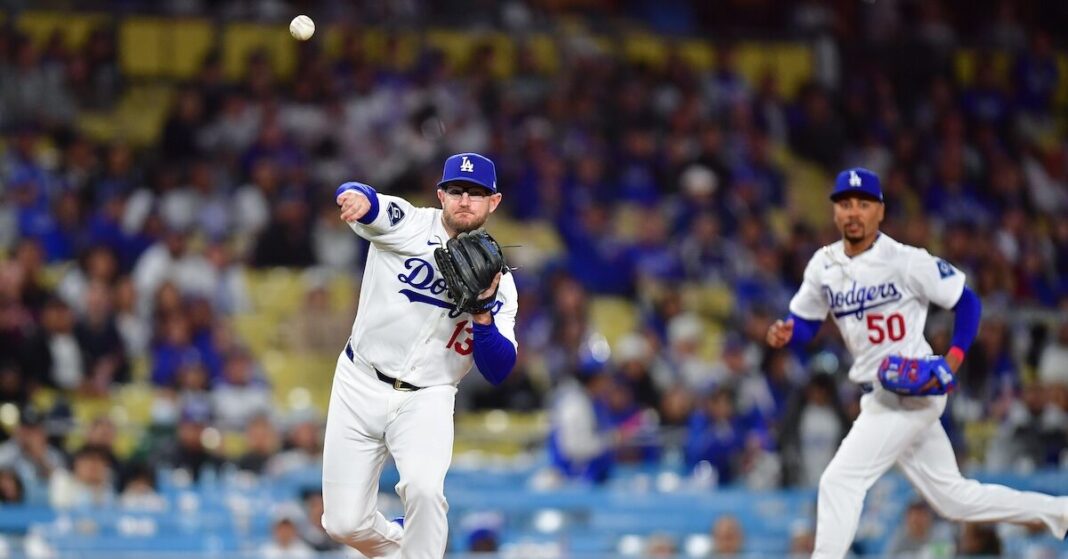

While he’s never been a true liability on the infield, Max Muncy has generally been a player whose defensive contributions took a back seat to his offense. The Dodgers have long counted on Muncy’s combination of power and plate discipline to outweigh his shortcomings in the field while bouncing him from first base to second to third depending on their roster’s current needs. That handling has paid off handsomely, as he’s been a vital contributor to four pennant winners and three World Series champions since being plucked off the scrap heap in April 2017. This year, however, Muncy has really flashed the leather at third base, showing the best range of his career. He leads all third basemen in Statcast’s Fielding Run Value, while tying for second in Defensive Runs Saved.
According to Statcast, Muncy was 11 runs below average at third base in 3,817 innings from 2018–25, roughly the equivalent of four runs below average per full season of play; he was four below average by that measure in just 801.1 innings last year. This year, he’s already six runs above average in 621 innings. According to Statcast’s Outs Above Average, he’s gone from being the majors’ worst qualifier on plays coming in (-9) to tying for second-best (4). DRS has generally been more charitable in its assessment of his defense; he was 16 runs above average at third from 2018–25, and is eight above average this season.
Muncy is just one of several Dodgers whose defensive play has helped his team top the rankings in my annual midseason defensive breakdown, with shortstop Mookie Betts, center fielder Andy Pages, second baseman Alex Freeland, and catcher Will Smith also making major contributions to that placement. I’ll explain the methodology below, but first, a bit more about the 35-year-old slugger, who on Monday night hit a towering solo homer in the first Dodgers-Athletics matchup to feature both Max Muncys, who share the same birthday (August 25) and drafting team (Oakland).
“The truth is, it just means I’m healthy,” the Dodgers third baseman told Fox Sports’ Rowan Kavner earlier this month while referring to his strong season on both sides of the ball. Last year, he was limited to 100 games, spending over eight weeks on the injured list due to a bone bruise in his left knee and an oblique strain, while in 2024, he played just 73 games due to a more severe oblique strain that included a displaced rib. Conversations with Betts last season spurred Muncy to “a better understanding of how he should be thinking about playing his own position,” according to Kavner, with better footwork helping him increase his range and avoid being tied up on balls hit straight at him. “Who I’ve been this year defensively is who I always thought I could be,” he said. “There’s been flashes of it and there’s been stints, but consistently it just hasn’t been there in past years.”
With strong work by Muncy, Betts (7 DRS and 4 FRV in just 49 games at shortstop), Freeland (6 DRS and 3 FRV in 60 games at second), and first baseman Freddie Freeman (2 DRS and 2 FRV in a rebound from a bad year afield tied to his late-2024 ankle woes), the Dodgers infield leads the majors with 27 DRS — 11 runs ahead of the second-ranked Brewers — and ranks third with 18 FRV. Led by Pages, the outfield ranks fourth in DRS (17) and sixth in FRV (8). With that level of quality blanketing the field, it’s not surprising that through Sunday, the team’s .734 Defensive Efficiency led the majors by 10 points.
You Aren’t a FanGraphs Member
It looks like you aren’t yet a FanGraphs Member (or aren’t logged in). We aren’t mad, just disappointed.
We get it. You want to read this article. But before we let you get back to it, we’d like to point out a few of the good reasons why you should become a Member.
1. Ad Free viewing! We won’t bug you with this ad, or any other.
2. Unlimited articles! Non-Members only get to read 10 free articles a month. Members never get cut off.
3. Dark mode and Classic mode!
4. Custom player page dashboards! Choose the player cards you want, in the order you want them.
5. One-click data exports! Export our projections and leaderboards for your personal projects.
6. Remove the photos on the home page! (Honestly, this doesn’t sound so great to us, but some people wanted it, and we like to give our Members what they want.)
7. Even more Steamer projections! We have handedness, percentile, and context neutral projections available for Members only.
8. Get FanGraphs Walk-Off, a customized year end review! Find out exactly how you used FanGraphs this year, and how that compares to other Members. Don’t be a victim of FOMO.
9. A weekly mailbag column, exclusively for Members.
10. Help support FanGraphs and our entire staff! Our Members provide us with critical resources to improve the site and deliver new features!
We hope you’ll consider a Membership today, for yourself or as a gift! And we realize this has been an awfully long sales pitch, so we’ve also removed all the other ads in this article. We didn’t want to overdo it.
This is the fourth year in a row I’ve taken a midseason dip into the alphabet soup of defensive metrics, including DRS, FRV, and our own catcher framing metric (hereafter abbreviated as FRM, as it is on our stat pages). One longtime standby, Ultimate Zone Rating (UZR), has since been retired, and thus is no longer a factor. On an individual level, even a full season of data isn’t enough to get the clearest picture of a player’s defense, and it’s not at all surprising that samples of 700 innings or less produce divergent values across the major metrics. After all, they’re based on differing methodologies that produce varying spreads in runs from top to bottom, spreads that owe something to what they don’t measure, as well as how much regression is built into their systems. Pitchers don’t have FRV values, DRS tends to produce more extreme ratings (positive and negative) than Statcast, and every single-season metric implicitly bears the fine print of a sample size caveat. But within this aggregation, I believe we get enough signal at this point in the season to justify checking in. I don’t proclaim this to be a bulletproof methodology so much as a good point of entry into a broad topic.
To account for all the bits in the alphabet soup, I aggregated the aforementioned metrics, adjusting for the varying spreads in run values by using z-scores, which measure how many standard deviations each team is from the league average in each category. As with the past two seasons, I’ve broken out catcher values for both FRV and DRS from the rest of a team’s values in both metrics. Note that the version of DRS that we display on FanGraphs now includes a framing component (rSZ, for strike zone) that isn’t used in Baseball Reference’s WAR calculations (though you can find it in the Sabermetric Fielding section on a player’s fielding page). The three catcher measures (including FRV) are each weighted at one-half the value of the non-catcher scores, which improves the overall z-score formula’s correlation with run prevention. Last year, I began adding Defensive Efficiency — the rate at which a team turns batted balls into outs, published at Baseball Reference — to the mix as well. I originally weighted that equally with non-catcher DRS and FRV, but found that weighting it at 1.5 times improved the correlation with run prevention. In 2024, before I added Defensive Efficiency, the midseason z-score formula had a -.39 correlation with runs allowed per game (higher scores mean fewer runs allowed), but with the reconfigured formula, this year’s correlation has improved to -.60.
The spreads for the various categories, based on data through Sunday:
Team Defense Metrics Ranges
| Metric | Split | Max | Min | StDev |
|---|---|---|---|---|
| DRS_non-C | Non-Catchers | 58 | -32 | 21.8 |
| DRS_C | Catchers | 13 | -8 | 4.7 |
| FRV_non-C | Non-Catchers | 39 | -20 | 14.6 |
| FRV_C | Catchers | 16 | -11 | 5.9 |
| FRM | Catchers | 6.7 | -5.7 | 3.1 |
| Def Eff | — | .734 | .669 | .014 |
Statistics through June 28.
Here’s how the rankings look, top to bottom; you can see the actual run values for all but the DRS and FRV catcher breakouts here. I’ve highlighted each category’s leaders and trailers, which helps to illustrate where the metrics agree and disagree:
Team Defense Standard Deviation Scores
| Team | DRSnonC-z | DRSC-Z | FRVnonC-Z | FRVC-z | FRM-z | DefEff-z | Tot |
|---|---|---|---|---|---|---|---|
| Dodgers | 2.15 | 0.06 | 1.66 | -0.82 | -0.71 | 2.45 | 6.76 |
| Cubs | 2.15 | 0.06 | 2.63 | -0.98 | -0.55 | 1.73 | 6.63 |
| Diamondbacks | 0.73 | -0.59 | 1.46 | 0.37 | -0.58 | 0.94 | 3.19 |
| Braves | 0.87 | -0.16 | 0.50 | -0.48 | 0.38 | 1.23 | 3.08 |
| Red Sox | 1.42 | 0.06 | 1.18 | 0.37 | 0.09 | 0.00 | 2.86 |
| Padres | -0.18 | 1.56 | 1.25 | 0.37 | -0.10 | 0.14 | 2.20 |
| Yankees | -0.64 | 1.13 | -0.12 | 1.21 | 1.02 | 0.72 | 2.00 |
| Blue Jays | -0.69 | 2.85 | -0.40 | 2.73 | 2.15 | -0.65 | 1.80 |
| Rays | 1.28 | -0.80 | -0.53 | -0.65 | -0.20 | 1.15 | 1.66 |
| Cardinals | 0.55 | -1.23 | 1.25 | 0.37 | 0.44 | -0.36 | 1.05 |
| Marlins | -0.69 | 0.27 | -0.05 | -0.31 | 0.60 | 0.65 | 0.52 |
| Tigers | -1.15 | 0.92 | -0.95 | 1.38 | 1.60 | 0.43 | 0.50 |
| Astros | 0.46 | -0.16 | 0.29 | -0.65 | -1.00 | 0.43 | 0.49 |
| Brewers | 0.82 | -1.23 | -0.12 | -0.82 | -0.78 | 0.79 | 0.48 |
| Nationals | -0.37 | 0.70 | 0.02 | 1.21 | 1.66 | -0.65 | 0.46 |
| Giants | 0.32 | 0.49 | -0.40 | 1.04 | 0.89 | -0.58 | 0.27 |
| Rangers | 0.23 | 0.06 | 0.22 | -0.65 | -1.61 | 0.50 | 0.11 |
| Guardians | 0.27 | -0.37 | 0.57 | -0.48 | -0.26 | -0.14 | 0.07 |
| Mets | 0.27 | 0.92 | -1.22 | 0.53 | 0.86 | -0.22 | -0.12 |
| White Sox | 0.04 | -1.66 | 0.50 | -0.82 | -0.42 | 0.29 | -0.48 |
| Royals | -0.55 | 0.06 | 0.29 | -0.82 | 0.35 | -0.65 | -1.44 |
| Orioles | -0.37 | 0.92 | -0.81 | 1.21 | -0.29 | -0.87 | -1.56 |
| Pirates | -0.14 | -0.37 | -0.88 | -0.31 | -0.58 | -0.65 | -2.62 |
| Reds | -1.19 | -0.80 | -0.46 | -0.14 | -1.84 | 0.22 | -2.72 |
| Mariners | -0.46 | -1.02 | -1.43 | -0.31 | 0.41 | -0.58 | -3.21 |
| Angels | -0.28 | -1.66 | -0.95 | -1.83 | -1.35 | -0.14 | -3.86 |
| Athletics | -1.10 | 0.27 | -1.01 | -0.48 | -1.29 | -0.72 | -3.95 |
| Twins | -1.79 | -0.80 | -1.08 | -0.65 | 1.09 | -1.01 | -4.57 |
| Phillies | -1.97 | 1.13 | -1.36 | 1.55 | 0.83 | -2.02 | -4.60 |
| Rockies | 0.00 | -0.59 | -0.05 | -1.15 | -0.81 | -2.24 | -4.68 |
All statistics through June 28. Yellow = Top-three ranking in category (including ties). Blue = Bottom-three ranking in category (including ties).
What follows is a closer look at the top six teams by this rating. Since writing about the bottom-ranked teams amounts to shooting fish in a barrel, instead I’ll follow with a companion article focused on the contenders with the weakest defenses.
Dodgers
As noted above, the two-time defending champions rank among the majors’ top three teams in all of the non-catcher metrics. Pages, a visually spectacular center fielder who fared well by FRV last year (7) but not DRS (-1), ranks a respectable fourth in the former category (8) this year while leading the position in the latter (17). His arm is an important part of that, as he leads all outfielders with 10 assists; no other flychaser has more than seven, and no other center fielder more than four. Statcast credits his arm as being three runs above average, tied with Pete Crow-Armstrong for the lead among all outfielders.
Betts’ transition from right field to second base and then shortstop has been a key facet of the team’s past two championships; he did the hard work to nail down the final two outs in Game 7 of the World Series last year against the Blue Jays, that after tying the Rays’ Taylor Walls for the position lead with 17 DRS during the regular season.
Despite missing more than five weeks in April and May of this season due to an oblique strain, Betts is third behind Walls and the Diamondbacks’ Geraldo Perdomo in DRS, and tied for eighth in FRV. Freeland, a 24-year-old rookie, has shared time at second base with Miguel Rojas and Hyeseong Kim, helping the team rank fifth in DRS (7) and tie for seventh in FRV (4).
The Dodgers are below-average when it comes to catcher defense, but it’s worth noting that Smith — who landed on the injured list on June 11 due to neck discomfort and has yet to resume baseball activities — has reversed a two-year trend of lousy defensive metrics; he’s got 5 DRS, 1.2 FRM, and -1 FRV in 396 innings this year, compared to -8 DRS, -6.8 FRM, and -8 FRV in 865.1 innings last year. However, Dalton Rushing, who’s done the bulk of the catching since Smith went down, has struggled defensively, with -4 DRS, -3.1 FRM and -4 FRV in just 305.1 innings.
Cubs
This ranking shouldn’t be too surprising, as the Cubs topped my end-of-season rankings last year, and PCA, second baseman Nico Hoerner, and left fielder Ian Happ all brought home Gold Gloves. They’re much closer to the Dodgers than to the third-ranked Diamondbacks overall, similarly excelling in the non-catcher metrics; cumulatively, their outfield ranks first in FRV (22) and second in DRS (20), with their infield second in FRV (19) and fifth in DRS (5), which lines up nicely with their second-ranked Defensive Efficiency (.724). Individually, PCA leads all center fielders with 16 FRV, and is third behind Pages and Ceddanne Rafaela with 12 DRS. Four other players have at least 4 FRV, namely Hoerner (7), shortstop Dansby Swanson (6), first baseman Michael Busch (5, tied for the positional lead), and right fielder Seiya Suzuki (4).
The last of those is the biggest surprise. Through his first four stateside seasons, Suzuki accumulated -8 FRV and -6 DRS in 3,091.2 innings. What’s more, he DHed 102 times last year in order to accommodate the presence of Kyle Tucker, a superior defender (and now a Dodger), in right field. Though he missed the first 12 games of the season due to a right knee sprain, he’s solidly in the black according to both FRV and DRS (7).
With 8 DRS and 3 FRV, newcomer Alex Bregman has fit right in, though he did displace Matt Shaw, who had 12 DRS (but -1 FRV) at third base as a rookie last year. The now-itinerant Shaw, who just landed on the IL for the second time this season — left wrist discomfort, following a bout of back tightness in late May and early June — has played six different positions as well as DH. He has 3 DRS and 3 FRV in 187.2 innings in right field, much of it during Suzuki’s absence. The down note here is at catcher, where Carson Kelly has been subpar across the board (-2 DRS, -2.4 FRM, -4 FRV), though backup Miguel Amaya has been slightly above average in two of the three metrics.
Diamondbacks
The third- through fifth-ranked teams here are closely bunched together, with the Diamondbacks’ fourth-ranked Defensive Efficiency (.713) and strong FRV giving them a slight edge. The Snakes are fourth in both infield and outfield FRV aggregations, each 11 runs above average, and third in non-catcher FRV overall, led by Perdomo and right fielder Corbin Carroll, each with 4 FRV. That may not be particularly eye-catching, but this is really a high-floor situation, in that the team has 11 players with at least 2 FRV (including combined totals at multiple positions), and nobody below -2 FRV. Count catcher Gabriel Moreno (4 FRV) within that tally, with his strong showing there helping to offset the rest of the catching corps’ shortcomings in other metrics. Perdomo, as noted above, is tied for the DRS lead at shortstop (8), while Carroll is tied for third in that metric among right fielders (7).
Braves
Atlanta’s defense has three real strengths. Three-time Gold Glove winner Matt Olson is tied for the lead among first basemen with 5 FRV while being tied for third with 5 DRS. Michael Harris II is seventh among center fielders with 5 FRV and is tied for fourth with 6 DRS. The team’s left fielders — 2025 Gold Glove winner Mauricio Dubón, Eli White, and Mike Yastrzemski – have combined for 9 DRS (second among all teams) and 3 FRV, and both Dubón and White have made positive contributions at other outfield spots as well (center field for the former, right field for the latter). At most other positions, the Braves are within a couple runs on either side of average, which isn’t nothing; the team’s .717 Defensive Efficiency ranks third behind the Dodgers and Cubs.
On a sobering note, Ronald Acuña Jr. appears to be headed for subzero metrics in both categories for the fifth season in a row. Limited to 49 games due to a recurrent left hamstring strain this season, he’s got -2 DRS and -4 FRV this season, and from 2022–26 — a span that includes the aftermath of ACL tears in both knees — has -25 DRS and -18 FRV in 3,772.1 innings.
Red Sox
It hasn’t been a banner season for the Red Sox, but they would be further than nine games below .500 if their defense wasn’t up to snuff. That’s particularly true in the outfield, where their 38 DRS is nearly double the second-ranked Cubs’ 20, though Chicago has a 22-19 edge for the lead in FRV. Rafaela and fellow Gold Glove winner Wilyer Abreu both have 16 DRS, with Abreu leading all right fielders in that category even with Sunday night’s two late-inning errors against the Yankees — one on an airmailed throw home, the other on a dropped ball — factored in. His 5 FRV is tied for the lead at the position as well. Rafaela is second in both DRS and FRV (11) among center fielders, while Jarren Duran and the mostly-absent Roman Anthony have combined for 9 DRS and 3 FRV in left field, making for a very strong outfield.
The Red Sox infield is more uneven. While Caleb Durbin has been good at third base (8 DRS, 1 FRV), their shortstops — the now-injured Trevor Story and Marcelo Mayer, plus smaller doses of Isiah Kiner-Falefa and Andruw Monasterio — have combined for -8 DRS and -6 FRV. IKF, Mayer, Monasterio and Anthony Seigler have combined to net 2 DRS and 2 FRV at second base, with Willson Contreras (2 DRS, 1 FRV) faring similarly. As for their catchers, Carlos Narváez rates pretty well in terms of Statcast’s blocking and framing components en route to 6 FRV, with 1.4 FRM and -1 DRS as well. However, that’s been somewhat offset by the performances of backups Connor Wong and Mickey Gasper, who each have -2 FRV.
Padres
San Diego is the only team singled out here that cracks the top three in any of the catcher rankings. Neither Freddy Fermin nor Rodolfo Durán can hit their hat sizes, but the former has 4 DRS and 3 FRV, the latter 3 DRS and 1 FRV.
The rest of the lineup is a mixed bag. Gold Glove-winning first baseman Ty France leads the position in both DRS (11) and FRV (5), the latter in a tie with Busch and Olson. Two-time Platinum Glove winner Fernando Tatis Jr. has split his time between right field and second base during Jake Cronenworth’s absence due to concussion-related symptoms. He has 2 FRV at both positions, with 0 DRS at second and -1 DRS in right field; the latter is a considerable fall-off from last year’s 9 FRV and 15 DRS in right. Making matters worse, Nick Castellanos had -3 FRV and -3 DRS in just 147 innings in right field in his stead before being released earlier this month. Jackson Merrill is solidly above average in center field (4 DRS, 3 FRV), while both Manny Machado and Xander Bogaerts are below-average via DRS (-7 for the third baseman, -2 for the shortstop) but above-average via FRV (3 and 4, respectively).
That’s a whole lot of alphabet soup to digest. I’ll be back with the lowlights among contending teams in my next installment.