

Since the draft concluded last week, the two of us have been working to add the newly-minted pro players to their team lists (you can find them here), move this year’s graduates to their own tab on The Board (which you can find here), and make a sweeping update to our Top 100 Prospects List. Below you’ll find the updated list, followed by notes on who moved and why via a rundown of the clusters of players that formed around similar profiles throughout the rankings. As a reminder, we rank however many players we have graded as 50 FV or better in our Top “100,” and as of this update, that’s 111 guys. Players whose grade have changed have a “↑” or “↑↑” in the trend column of the table, with the latter designation noting cases where the re-evaluation is quite dramatic; players dealing with full-season injuries are indicated with a bandaid.
If you want more information about these players, please head over to The Board, where you can find full scouting reports, tool grades, pitch repertoires and more. We proactively added a few players to the Graduates tab who are quite close to reaching the at-bat or innings pitched graduation threshold, or who have obviously spent enough days on the active big league roster to have exhausted prospect eligibility. Lastly, you can see the real-time farm system rankings here, with the rankings from before the graduates were pulled off and the draftees were added here.
Updated Top “100” Prospects
…
The 60 FV Tier and Up
| Rank | Name | Position | Team | Age | FV | Trend | ETA |
|---|---|---|---|---|---|---|---|
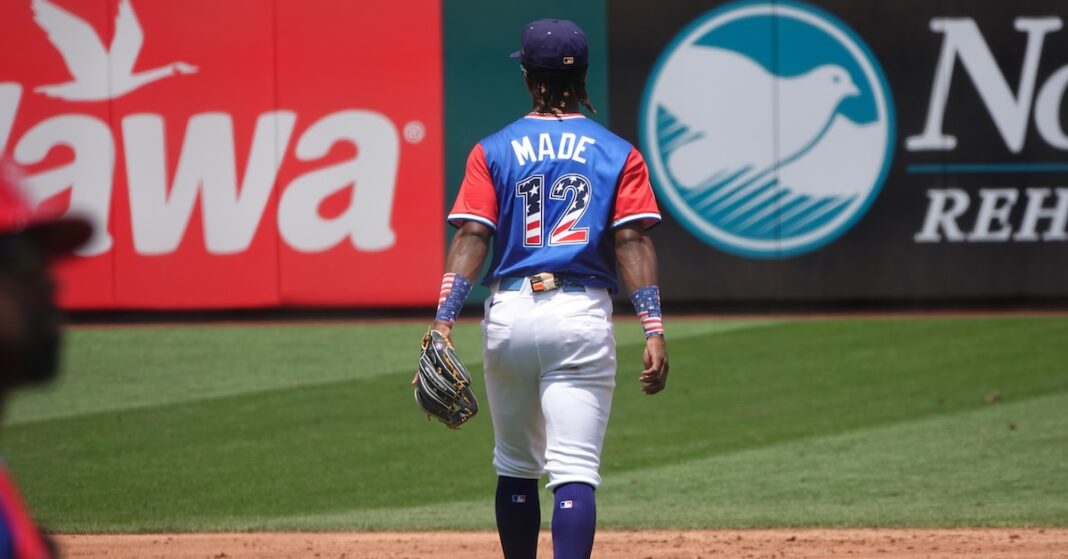
| 1 | Jesús Made | SS | MIL | 19.2 | 65 | 2027 | |
| 2 | Franklin Arias | SS | BOS | 20.7 | 60 | 2027 | |
| 3 | Kade Anderson | SP | SEA | 22.0 | 60 | ↑↑ | 2026 |
| 4 | Walker Jenkins | CF | MIN | 21.4 | 60 | ↑↑ | 2026 |
| 5 | Max Clark | CF | DET | 21.6 | 60 | 2027 | |
| 6 | Leo De Vries | SS | ATH | 19.8 | 60 | 2027 | |
| 7 | Eli Willits | SS | WSN | 18.6 | 60 | ↑ | 2029 |
| 8 | Seth Hernandez | SP | PIT | 20.1 | 60 | 2027 | |
| 9 | Thomas White | SP | MIA | 21.8 | 60 | 2027 |
Made, who was still 18 when the season began, isn’t obliterating the Southern League or anything; instead, he has “merely” posted a slightly above-average line. He still has electric hand speed from both sides of the plate and is currently athletic enough to play shortstop despite the occasional arm accuracy hiccup. Made is a big kid and likely won’t remain at short in perpetuity, but he’s progressing through the minors quickly enough as a hitter that we think he’ll be able to debut there, as his agility for his size is remarkable. Neither his measurable peak power nor his feel for airborne contact has taken a step forward this season, even though he’s visibly larger, but the twitch in Made’s hands and the way he’s been tough for crafty Double-A pitchers to strike out (14.6% K%) are both really exciting. He continues to project as a 30-homer infielder.
Arias has gotten bigger and stronger at the cost of some of his range on defense. He’s still a good enough defender to play shortstop, but he’s seeing increased reps at second base. He had a very impressive Futures Game BP and looks like a do-everything player with special feel for contact.
Anderson doesn’t have cartoonish stuff, but he executes four distinct, high-quality pitches with machine-like consistency, and his delivery’s deception helps his fastball play much better than its pure velocity. He’s a slam-dunk impact starter. We weren’t sure whether to interpret Jenkins’ prior lack of power as an issue of skill or injury and leaned on the skeptical side. He was toward the top of the 50 FV tier at the season’s start, along with the other prospects who we considered stable but lower-ceilinged, but Jenkins’ 2026 has been louder, including a very impressive all-field BP performance at the Futures Game. Clark has had a slightly above-average Triple-A season thus far thanks largely to the quickness of his hitting hands and his ability to make plus contact. His power and center field defense have been more middling. De Vries hasn’t had the kind of power breakout he seemed primed for and had one of the more underwhelming Futures Game BPs, but he’s still having a good year as a teenager at Double-A and we’re not inclined to move him at all.
You Aren’t a FanGraphs Member
It looks like you aren’t yet a FanGraphs Member (or aren’t logged in). We aren’t mad, just disappointed.
We get it. You want to read this article. But before we let you get back to it, we’d like to point out a few of the good reasons why you should become a Member.
1. Ad Free viewing! We won’t bug you with this ad, or any other.
2. Unlimited articles! Non-Members only get to read 10 free articles a month. Members never get cut off.
3. Dark mode and Classic mode!
4. Custom player page dashboards! Choose the player cards you want, in the order you want them.
5. One-click data exports! Export our projections and leaderboards for your personal projects.
6. Remove the photos on the home page! (Honestly, this doesn’t sound so great to us, but some people wanted it, and we like to give our Members what they want.)
7. Even more Steamer projections! We have handedness, percentile, and context neutral projections available for Members only.
8. Get FanGraphs Walk-Off, a customized year end review! Find out exactly how you used FanGraphs this year, and how that compares to other Members. Don’t be a victim of FOMO.
9. A weekly mailbag column, exclusively for Members.
10. Help support FanGraphs and our entire staff! Our Members provide us with critical resources to improve the site and deliver new features!
We hope you’ll consider a Membership today, for yourself or as a gift! And we realize this has been an awfully long sales pitch, so we’ve also removed all the other ads in this article. We didn’t want to overdo it.
Willits, 18, hasn’t had a raw power breakout yet, but he’s starting to look stronger and the special bat-to-ball feel that made him last year’s first overall pick has seamlessly translated to mid-minors play. The shape of Hernandez’s fastball isn’t great, so even though it’s sitting 97, it’s generating merely above-average miss. But the rest of his repertoire is bonkers (he might have the best changeup in baseball at peak), as are Hernandez’s athletic traits (he’s touching 101 with seven feet of extension) and projectability. If you wanted to make an upside-based case for him to be the top pitching prospect in the game, you’d be justified, but give us Anderson’s proximity and fastball playability. White was in the offseason conversation for the game’s top pitching prospect, but he’s currently on the shelf with a shoulder injury.
The Stable 55 FV Tier
| Rank | Name | Position | Team | Age | FV | Trend | ETA |
|---|---|---|---|---|---|---|---|
| 10 | Ryan Sloan | SP | SEA | 20.5 | 55 | 2027 | |
| 11 | Angel Genao | SS | CLE | 22.2 | 55 | 2027 | |
| 12 | Ethan Salas | C | SDP | 20.1 | 55 | ↑ | 2028 |
| 13 | Sebastian Walcott | SS | TEX | 20.4 | 55 | 2027 | |
| 14 | Vahn Lackey | C | MIN | 21.0 | 55 | 2028 | |
| 15 | Grady Emerson | SS | TBR | 18.4 | 55 | 2029 | |
| 16 | Theo Gillen | CF | TBR | 20.9 | 55 | ↑ | 2028 |
| 17 | Josue De Paula | RF | LAD | 21.2 | 55 | 2027 | |
| 18 | George Lombard Jr. | SS | NYY | 21.1 | 55 | ↑ | 2027 |
| 19 | Roch Cholowsky | SS | CHW | 21.3 | 55 | 2027 | |
| 20 | Alfredo Duno | C | CIN | 20.5 | 55 | 2028 | |
| 21 | River Ryan | SP | LAD | 27.9 | 55 | 2026 | |
| 22 | Mike Sirota | CF | LAD | 23.1 | 55 | ↑↑ | 2027 |
| 23 | Rainiel Rodriguez | C | STL | 19.6 | 55 | 2028 | |
| 24 | Bryce Rainer | SS | DET | 21.1 | 55 | 2029 | |
| 25 | Luis Peña | SS | MIL | 19.7 | 55 | 2028 |
Sloan is a monstrous starter who we expect will sit in the upper 90s throughout entire seasons. His secondary stuff isn’t quite as nasty at the guys in the 60 FV tier, however. Genao has been flirting with the 55 FV tier for a while now and finally breaks through here, as he’s held serve at shortstop despite adding muscle and he’s begun to hit the ball harder without sacrificing contact. Salas went from underperforming after a series of aggressive promotions to missing most of last year with injury, but he’s been productive on both sides of the ball at Double-A in 2026, especially as a contact hitter. He has two plus-plus defensive attributes (throwing and framing), but he’s still a terrible ball-blocker. Walcott is recently back from Tommy John and looks fine at the plate, though he isn’t playing defense yet. He has a puncher’s chance to be the top overall prospect during the next 12 months if he shows he’s healthy and viable at shortstop. He’s every bit as freaky as Made, if not more so. Lackey and Emerson were our top two prospects in the draft, and both are more likely to remain at a premium position than Gillen (a fringe center field fit) or De Paula (who might just be a DH), but all four are well-rounded hitters who project as top 10-15 players at their position.
Lombard and Cholowsky can pick it and have power, but both have enough strikeout risk to slide behind the guys with more stable hit tools (Genao through De Paula). The same is true of Duno and Rainer, but to a more extreme degree. Sirota and Peña also have some strikeout risk, but less defensive ability. The consistency of Sirota’s power is remarkable (a 59% hard-hit rate so far this season), but he does have in-zone fastball vulnerability, and his lack of feel for defense will likely relegate him to a corner despite his speed. Peña hasn’t played much because of a prolonged absence after he collapsed in the dugout due to dehydration earlier in the season. His ability to pull the ball has evaporated this year, but we’re chalking that up to timing issues resulting from the layoff.
Ryan is about to be 28 and it’s weird to grapple with the likelihood that a player’s decline phase will come during his years of pre-free agency team control. But a healthy Ryan (he’s currently on the shelf with a hamstring injury) looked ready to be a part of the Dodgers rotation, especially as it awaits its famous reinforcements. His fastball is a monster, while his secondary pitches are all generating below-average miss, though that’s due to his imprecise command rather than a lack of stuff. Rodriguez had some trouble catching at the Futures Game and is maybe the least projectable prospect from the 55 FV tier or better, but he has freaky feel for making impact contact and the 19-year-old has hit well at Double-A since his promotion.
The Helium Group
| Rank | Name | Position | Team | Age | FV | Trend | ETA |
|---|---|---|---|---|---|---|---|
| 30 | Josuar Gonzalez | SS | SFG | 18.8 | 50 | 2030 | |
| 31 | Caden Bodine | C | TBR | 22.6 | 50 | 2028 | |
| 32 | Eric Hartman | CF | ATL | 20.1 | 50 | ↑↑ | 2028 |
| 33 | Jackson Flora | SP | SFG | 21.2 | 50 | 2028 | |
| 36 | Christian Zazueta | SP | LAD | 21.8 | 50 | ↑ | 2027 |
| 37 | Braylon Doughty | SP | CLE | 20.6 | 50 | ↑ | 2029 |
| 41 | Kendry Chourio | SP | KCR | 18.8 | 50 | 2029 | |
| 42 | Alexander Frias | RF | MIL | 18.4 | 50 | ↑↑ | 2031 |
| 43 | Arjun Nimmala | SS | TOR | 20.8 | 50 | 2028 | |
| 44 | Ethan Holliday | 3B | COL | 19.4 | 50 | 🩹 | 2029 |
| 51 | Aiva Arquette | SS | MIA | 22.8 | 50 | 2028 |
These are the players who are talented enough to be elevated an FV tier between now and next February’s Prospect Week. It’s possible Gonzalez would already be there if multiple hamstring injuries this year hadn’t prevented him from being promoted to, and performing at, San Jose. Hartman has a rare power/speed combo but enough strikeout risk that Eric wasn’t ready to 55 him just yet. Bodine has special contact skill for any prospect, let alone a catcher. Nimmala is getting to power and making just enough contact as a 20-year-old at Double-A to be enthused about him being a plus-powered SS/3B. Holliday is the lefty-hitting version of it who is on the shelf with injury. Frias is a freak with crazy bat speed and physical projection, the guy on the list with the best shot to have a Junior Caminero type of rise. The pitching versions of this are Flora, Zazueta and Doughty. Flora was the best pitching prospect in this year’s draft, a beanpole with huge arm strength and special aptitude. Zazueta’s fastball is playing like a plus-plus pitch, his trademark changeup remains excellent, and he isn’t walking anyone at High-A. Doughty has been similarly efficient and has elite potential breaking stuff thanks to his proclivity for spin. Chourio is having his second consecutive dominant season and is approaching an innings count that would quell doubts about him having starter stamina despite his modest size. All three of those pitchers were offseason Picks to Click who have performed as we hoped. Arquette has freaky size and is somehow maintaining a 79% contact rate at Double-A even though he’s been chase prone.
Elite Reliever Floors
| Rank | Name | Position | Team | Age | FV | Trend | ETA |
|---|---|---|---|---|---|---|---|
| 26 | Anthony Eyanson | SP | BOS | 21.8 | 55 | 2027 | |
| 27 | Liam Doyle | SP | STL | 22.1 | 55 | 2027 | |
| 45 | Gage Wood | SP | PHI | 22.6 | 50 | ↑ | 2026 |
| 46 | Brody Hopkins | SP | TBR | 24.5 | 50 | 2026 |
These guys might end up being relievers in the end, but we expect that if that’s the case, they’d be such dominant late-inning weapons that we’d still feel fine, retrospectively, about stuffing them. Doyle has an explosive fastball/slider combo, but he isn’t in great shape and lacks the command of a typical starter. Eyanson has elite breaking stuff that might allow him to get lefties out without him making heavy use of a changeup or split. Wood has a dominant fastball, and could come up and rip well-located heaters past big league hitters in a power relief capacity right now, but his repertoire depth is a little lacking. Hopkins is the opposite; he has premium stuff but is struggling to throw strikes this year. All of these guys are special enough athletes that we’re excited about their eventual roles.
Potential Five-Tool Players
| Rank | Name | Position | Team | Age | FV | Trend | ETA |
|---|---|---|---|---|---|---|---|
| 35 | Eduardo Quintero | CF | LAD | 20.9 | 50 | 2028 | |
| 48 | Roldy Brito | CF | COL | 19.3 | 50 | 2029 | |
| 53 | Felnin Celesten | SS | SEA | 20.9 | 50 | 2029 | |
| 54 | Eric Booth Jr. | CF | BAL | 18.1 | 50 | 2031 | |
| 55 | Hayden Alvarez | CF | LAA | 19.3 | 50 | ↑ | 2029 |
You could argue that these guys belong in the Helium group, as they’re all up-the-middle defenders with a shot to hit for both contact and power. Quintero is the most accomplished contact hitter of the five, as he has an 80% rate at High-A, which is why we’ve got some separation between his rank and the rest of the group. Brito is more physical, with the best peak power of this cluster and also the most advanced baseball IQ, which shows up on the bases and on defense. Alvarez and Celesten are more about projection. They’re body-beautiful players with average contact feel and currently below-average power, but both are built like Abercrombie models and could mature into the Goldilocks Zone where they’ve added big power while remaining at a premium defensive position. We decided to elevate Booth from his pre-draft 45+-FV grade because his toolset and upside felt comparable to this group.
Corner Mashers
| Rank | Name | Position | Team | Age | FV | Trend | ETA |
|---|---|---|---|---|---|---|---|
| 38 | Ralphy Velazquez | 1B | CLE | 21.2 | 50 | 2027 | |
| 39 | Josue Briceño | 1B | DET | 21.8 | 50 | 2027 | |
| 40 | Charlie Condon | 1B | COL | 23.3 | 50 | 2026 | |
| 49 | Josiah Hartshorn | 1B | CHC | 19.5 | 50 | ↑ | 2029 |
| 50 | Taitn Gray | 1B | TBR | 18.9 | 50 | 2030 | |
| 70 | Justin Gonzales | RF | BOS | 19.6 | 50 | ↑↑ | 2028 |
Velazquez, Briceño, and Condon are the proximate versions of this player type. Both Briceño and Condon have looked better and better as they’ve gotten healthy. Hartshorn, Gray, and Gonzales are all a little further away, but they’re ranked aggressively because they all have some combination of contact and plate skills to go with the power. Gray is just back from an elbow scope, Hartshorn is at risk of early physical decline because of his boxy, softer build, and Gonzales doesn’t currently launch at all, but he has freaky size/strength akin to Yandy Díaz.
Stable No. 3/4 Starters
| Rank | Name | Position | Team | Age | FV | Trend | ETA |
|---|---|---|---|---|---|---|---|
| 52 | Zach Root | SP | LAD | 22.5 | 50 | ↑ | 2027 |
| 65 | Elmer Rodríguez | SP | NYY | 22.9 | 50 | 2026 | |
| 66 | Tyler Bremner | SP | LAA | 22.3 | 50 | 2026 | |
| 86 | Karson Milbrandt | SP | MIA | 22.3 | 50 | 2026 | |
| 87 | Michael Forret | SP | TBR | 22.3 | 50 | 2026 | |
| 88 | Tyson Hardin | SP | MIL | 24.7 | 50 | ↑ | 2028 |
| 89 | Riley Quick | SP | MIN | 22.2 | 50 | 2028 | |
| 90 | Keyner Martinez | SP | SFG | 21.9 | 50 | 2028 |
Root’s delivery is unconventional, but he throws strikes and has good secondary weapons for both lefties and righties. Rodríguez is a throwback mid-rotation prospect, a potentially elite groundball generator with a path to doing so in a way that eats innings. A slight uptick in control would get him there. We’re a little concerned about Bremner, who has been just okay at High-A, particularly given his draft orbit. His slider hasn’t progressed much this year. Milbrandt’s high-tempo delivery and sharp secondaries give him the feel of a modern five-and-dive sort of starter prospect. Quick has the look of a durable sinker/slider arm. Forret and Hardin are some of the best bets in the upper minors to develop plus command or better, and Hardin in particular has taken major strides toward that outcome over the last 18 months. Martinez has a blowup outing or inning often enough to keep him in this tier, but on pure stuff and physicality, he’s arguably the most intriguing arm in the group.
Contact Mavens
| Rank | Name | Position | Team | Age | FV | Trend | ETA |
|---|---|---|---|---|---|---|---|
| 59 | Marek Houston | SS | MIN | 22.3 | 50 | ↑ | 2028 |
| 60 | Jhonny Level | 2B | SFG | 19.3 | 50 | 2030 | |
| 61 | Josh Hammond | SS | KCR | 19.8 | 50 | 2029 | |
| 62 | Yolfran Castillo | SS | TEX | 19.5 | 50 | 2030 | |
| 63 | Brady Ebel | SS | MIL | 19.0 | 50 | ↑ | 2030 |
| 64 | Luis Hernández | SS | SFG | 17.6 | 50 | 2032 | |
| 67 | Juneiker Caceres | RF | CLE | 18.9 | 50 | ↑ | 2030 |
| 68 | Kevin Alvarez | LF | HOU | 18.5 | 50 | ↑ | 2030 |
It’s been smooth sailing for Level, who battered the Cal League and is now hitting .307 in High-A as a 19-year-old. He’s mostly playing second base and is still expanding the zone a lot, so the risks in the profile are starting to appear even as he’s performed. Hernández has crushed the complex and looks ready for a new challenge. Hammond, a two-way prospect in high school, is no longer pitching and has thrived in the narrower role. He’s been one of the top hit collectors in the low minors and he plays a good shortstop; we’ll see if he can learn to lift the ball more consistently. Houston looks like a well-rounded hitter, and he has a reliable pair of hands at short. Castillo is hitting in Low-A and is still incredibly projectable. Even though Ebel is one of the younger players on the list, his feel for the game is advanced. He has an almost mesmerizing ability to get himself a clean hop on defense. Caceres may have the best pure hit tool in the minor leagues; our conviction in that will grow if he’s able to lay waste to High-A in the same way he clobbered Low-A arms. Alvarez is a projectable corner outfielder with a nice blend of present contact skill and potential power.
Launchers Layered by Defense
| Rank | Name | Position | Team | Age | FV | Trend | ETA |
|---|---|---|---|---|---|---|---|
| 34 | Kaelen Culpepper | SS | MIN | 23.6 | 50 | 2026 | |
| 47 | Jefferson Rojas | SS | CHC | 21.2 | 50 | 2028 | |
| 72 | Devin Fitz-Gerald | SS | WSN | 20.9 | 50 | ↑ | 2030 |
| 73 | Tyler Bell | SS | COL | 21.1 | 50 | 2029 | |
| 75 | Brayden Taylor | 3B | TBR | 24.2 | 50 | ↑ | 2027 |
| 77 | Edward Florentino | RF | PIT | 19.7 | 50 | 2029 | |
| 96 | Aaron Walton | CF | CLE | 22.2 | 50 | ↑↑ | 2028 |
| 97 | Murf Gray | 3B | PIT | 22.6 | 50 | ↑ | 2028 |
| 98 | Caleb Bonemer | 3B | CHW | 20.8 | 50 | 2029 |
Culpepper is a plus shortstop defender who is getting to power at Triple-A. Rojas has required a beat to adjust to each new level, which this year he has done at Double-A. The presence of Dansby Swanson has dictated that he get more reps at third base, but in a vacuum he should be able to play shortstop and hit for enough pull power to be an average regular there. Hopefully Fitz-Gerald will enjoy a similarly successful adjustment to Double-A. He is playing an excellent shortstop and has a swing geared for power, but he’s really struggled in the month since he was promoted to Harrisburg. New Rockies draftee Tyler Bell fits cleanly in this group, and his grade was elevated a shade compared to before the draft to shoehorn him in. Taylor changed his swing and is less vulnerable to elevated fastballs than he has been in the past. He’s going to get to power and play plus-plus defense at second and third base, or viable defense at shortstop if the Rays need him to. Walton is the center field version of this profile. He has an extreme pull-lift approach, and we aren’t all that confident he’s going to hit, but he can really play center and is getting to power. We like Florentino’s physical projection enough to prioritize him over Walton right now even though Florentino (who also has a sub-70% contact rate) is likely a right fielder. Fellow Pirate Murf Gray felt like a steal the second Pittsburgh drafted him and he moves into the Top 100 after getting promoted twice and continuing to perform — he isn’t just beating up on A-ball arms anymore. Like Gray, Bonemer (68% contact rate, 23 degrees of launch on average) might not be a third baseman, which is a big part of why he falls from the top of the 50 FV tier to the back of it.
Extreme Variance
| Rank | Name | Position | Team | Age | FV | Trend | ETA |
|---|---|---|---|---|---|---|---|
| 57 | Zyhir Hope | RF | LAD | 21.5 | 50 | 2028 | |
| 58 | Jonny Farmelo | CF | SEA | 21.9 | 50 | 2028 | |
| 74 | Tate Southisene | SS | ATL | 19.8 | 50 | ↑ | 2029 |
| 76 | Emil Morales | SS | LAD | 19.8 | 50 | 2030 | |
| 78 | JoJo Parker | 3B | TOR | 20.0 | 50 | ↑ | 2030 |
| 80 | Lazaro Montes | RF | SEA | 21.8 | 50 | 2027 | |
| 81 | Ramon Ramirez | C | KCR | 21.1 | 50 | ↑ | 2028 |
| 82 | Eduardo Tait | C | MIN | 19.9 | 50 | 2029 | |
| 83 | Dorian Soto | SS | BOS | 18.4 | 50 | 2031 | |
| 84 | Angeibel Gomez | CF | KCR | 17.6 | 50 | ↑ | 2031 |
| 85 | Cristian Arguelles | CF | COL | 19.1 | 50 | 2029 | 93 | Elian Peña | 3B | NYM | 18.8 | 50 | ↑ | 2031 |
A cleaner operation in the box has facilitated a breakout for Southisene, though the hit tool remains risky. He’s a potential plus defender, which gives him a path to value even if he doesn’t hit much. Weighing Morales’ offensive upside against his propensity to strikeout and a cloudy defensive fit was a tricky balance to strike; a big finish to the season could prompt a significant re-evaluation. Recently promoted to Double-A, Farmelo’s long swing is about to be stress tested against better arms. Big tools give him big upside if the bat plays. Ramirez enters the Top 100 on the strength of his power, bat-to-ball skills, and arm strength. Both his approach and receiving skills are more raw than most of his peers on the list. Parker seems increasingly likely to slide off short, but he may hit enough for that to not matter. Hope is a classic power hitting outfield prospect with hit tool risk; Montes is the extreme version of the profile.
Soto, Tait, Gomez, and Arguelles are all talented enough that you could include them up with Alexander Frias if you wanted to. Tait has an extra degree of risk due to his chase; his skill set is like a lefty Jorge Alfaro. Arguelles is similar, but he’s a center fielder who is also a little old for the complex level. He tracks the baseball beautifully and has a classic low-ball lefty swing. He’s flirting with hitting .400 despite underlying chase issues. Soto is a switch-hitting shortstop with rare size, athleticism, and bat speed, but his performance so far has been middling. Gomez is the player with the strongest data-driven argument of this contingent. He not only has exciting debut season contact performance, but also rare power consistency for a DSL hitter. He isn’t as visually spectacular as DSL Made was, but he’s skilled and is a projectable 6-foot-2 or so. Peña has made relevant adjustments to breaking stuff. We like the lefty power/contact combo brewing here even though his hit data isn’t eye-popping.
Relief Risk
| Rank | Name | Position | Team | Age | FV | Trend | ETA |
|---|---|---|---|---|---|---|---|
| 71 | Jurrangelo Cijntje | SP | STL | 23.1 | 50 | 2028 | |
| 91 | Carlos Lagrange | SIRP | NYY | 23.2 | 50 | 2026 | |
| 92 | Hagen Smith | SP | CHW | 22.9 | 50 | 2027 | |
| 95 | Luis De León | SP | BAL | 23.3 | 50 | 2027 | |
| 99 | Kendry Rojas | SP | MIN | 23.7 | 50 | 2026 | |
| 100 | Caden Scarborough | SP | TEX | 21.3 | 50 | 2028 | |
| 101 | Jake Bloss | SP | TOR | 25.1 | 50 | 2026 | |
| 102 | George Klassen | SP | LAA | 24.5 | 50 | 2026 | |
| 103 | Jaxon Wiggins | SP | CHC | 24.8 | 50 | 2027 |
These guys still have a shot to start, but are at risk of either being inefficient such that it impacts their workload or of moving out of the rotation altogether. We hoped that Cijntje would break out as he focused more on throwing right-handed, but that hasn’t happened yet. We’re not out on him as a potential starter, but his odds of staying in the rotation have dimmed a little bit. Lagrange has the repertoire depth of a starter, but his fastball’s angle makes it pretty hittable, as hard as it is. Pitchers like this often have to work backwards more frequently, and those guys tend to get funneled toward the bullpen. We think he would thrive there, of course. We don’t quite know what to make of Smith’s arm stroke and in turn his control and command projections. We’re much more confident that he has the stuff to be a dynamite reliever if he needs to move to the bullpen. De León’s control has backed up in Double-A and he was already a volatile strike-thrower. Rojas is up and working in a swing role for Minnesota. He’s been wild in his short time in the big leagues. Skin cancer delayed the start of Scarborough’s season and his velocity has been uneven in his return; we’re mostly holding him steady from the winter report. Bloss’ arm strength and stuff have looked great in his return from Tommy John surgery, though he’s still regaining his touch and feel. Klassen and Wiggins have big stuff and very inconsistent execution.
Short Dudes
| Rank | Name | Position | Team | Age | FV | Trend | ETA |
|---|---|---|---|---|---|---|---|
| 56 | Pedro Ramírez | 2B | CHC | 22.3 | 50 | 2026 | |
| 69 | Michael Arroyo | 2B | SEA | 21.7 | 50 | 2027 | |
| 79 | Axiel Plaz | C | PIT | 20.9 | 50 | ↑↑ | 2028 |
This contingent bucks convention and projects to play a meaningful big league role despite being squat. Ramírez is a great contact hitter and a versatile defender. Plaz is a powder keg with a big arm and power who could factor into Pittsburgh’s 2027 catching mix. Arroyo has been starting in left field more regularly and was already a fringe infield defender, but he’s still performing as a young-for-the-level hitter at Tacoma.
Injured or Distressed
| Rank | Name | Position | Team | Age | FV | Trend | ETA |
|---|---|---|---|---|---|---|---|
| 28 | Aidan Miller | SS | PHI | 22.1 | 55 | 🩹 | 2027 |
| 29 | Jarlin Susana | SP | WSN | 22.3 | 55 | 🩹 | 2027 |
| 94 | Harry Ford | C | WSN | 23.4 | 50 | 2026 | |
| 104 | Thayron Liranzo | C | DET | 23.0 | 50 | 2027 | |
| 105 | Blake Mitchell | C | KCR | 22.0 | 50 | 2027 | |
| 106 | Jeferson Quero | C | MIL | 23.8 | 50 | 2027 | |
| 107 | Dax Kilby | SS | NYY | 19.7 | 50 | 🩹 | 2030 |
| 108 | Travis Sykora | SP | WSN | 22.2 | 50 | 🩹 | 2027 |
| 109 | Juan Valera | SP | BOS | 20.2 | 50 | 🩹 | 2028 |
| 110 | Robby Snelling | SP | MIA | 22.6 | 50 | 🩹 | 2027 |
| 111 | Khal Stephen | SP | CLE | 23.6 | 50 | 🩹 | 2027 |
Miller and Susana are this year’s ultra-talented injured players, relegated to the back of their FV tier. Sykora, Valera, Snelling, and Stephen are recovering from elbow surgery. Kilby is just returning from a hamstring injury that has kept him shelved basically all year. Meanwhile, each of the catchers has red flags on offense. Ford’s swing is awkward, and he started the year miserably before righting the ship during the last month or so. Liranzo and Mitchell have red flag contact rates but still have the kind of power and projection that we like from the position with the least inventory across the sport. Quero’s combination of relative youth, athleticism and power keeps us on him even though he has been just fair (a .320 xwOBA) across 140 games at Triple-A since he returned from a labrum tear and hamstring injury that caused him to miss basically all of 2024 and the first six weeks of 2025.
…
Finally, as we worked on our update, we sourced a fresh crop of data to aid in our decision-making and analysis. The pitcher data is too unwieldy to reproduce here, but below is a slice of the hitter data. It doesn’t represent the totality of the information at our disposal, but it is an interesting subset that we thought our readers would find illuminating. As a point of comparison, you can find this year’s big league averages here, except for average max exit velocity; a quirk our leaderboards displays the absolute rather than average value, which is 111 mph.
Key Hitter Data
| Name | Pos | Org | Age | Chase% | Contact% | Max Exit | EV90 | Launch | HardHit% |
|---|---|---|---|---|---|---|---|---|---|
| Caden Bodine | C | TB | 22 | 30.0% | 89.8% | 109.5 | 104.1 | 11 | 41.8% |
| Juneiker Caceres | OF | CLE | 18 | 24.9% | 86.4% | 110.2 | 103.8 | 11 | 44.3% |
| Max Clark | OF | DET | 21 | 20.9% | 85.6% | 111.3 | 104.5 | 14 | 38.0% |
| Ethan Salas | C | SD | 20 | 23.5% | 85.3% | 112.2 | 106.0 | 13 | 40.7% |
| Josue De Paula | CF | LAD | 21 | 20.1% | 84.9% | 111.2 | 105.2 | 12 | 50.7% |
| Pedro Ramírez | 2B | CHC | 22 | 28.0% | 83.8% | 110.8 | 105.2 | 11 | 42.9% |
| Walker Jenkins | OF | MIN | 21 | 23.1% | 83.3% | 112.3 | 106.6 | 12 | 45.4% |
| Cristian Arguelles | OF | COL | 19 | 25.9% | 83.3% | 110.2 | 102.4 | 9 | 36.6% |
| Angeibel Gomez | OF | KC | 17 | 18.4% | 82.5% | 111.2 | 104.9 | 19 | 49.3% |
| Yolfran Castillo | SS | TEX | 19 | 24.9% | 81.8% | 107.2 | 99.9 | 9 | 25.5% |
| Angel Genao | 3B | CLE | 22 | 22.1% | 81.4% | 110.9 | 104.4 | 4 | 48.3% |
| Franklin Arias | SS | BOS | 20 | 23.7% | 80.7% | 109.8 | 104.8 | 13 | 51.7% |
| Jesús Made | SS | MIL | 19 | 24.9% | 80.7% | 111.2 | 105.2 | 6 | 40.2% |
| Eduardo Quintero | OF | LAD | 20 | 15.0% | 80.4% | 112.5 | 106.6 | 12 | 40.1% |
| Aiva Arquette | SS | MIA | 22 | 27.6% | 79.8% | 113.1 | 107.3 | 12 | 47.6% |
| Kaelen Culpepper | SS | MIN | 23 | 27.6% | 78.9% | 110.2 | 104.7 | 11 | 47.3% |
| Kevin Alvarez | OF | HOU | 18 | 29.8% | 78.7% | 111.9 | 104.5 | 8 | 44.1% |
| Josh Hammond | SS | KC | 19 | 27.6% | 77.9% | 110.4 | 104.6 | 7 | 43.0% |
| Josiah Hartshorn | OF | CHC | 19 | 19.0% | 77.8% | 111.5 | 104.9 | 12 | 46.4% |
| Justin Gonzales | OF | BOS | 19 | 26.8% | 77.7% | 116.2 | 107.7 | 8 | 40.4% |
| Jhonny Level | SS | SF | 19 | 34.5% | 77.6% | 109.8 | 103.4 | 9 | 34.9% |
| JoJo Parker | SS | TOR | 19 | 20.2% | 77.2% | 110.4 | 104.7 | 8 | 43.2% |
| Luis Peña | SS | MIL | 19 | 33.6% | 77.2% | 116.3 | 104.7 | 4 | 37.6% |
| Leo De Vries | SS | ATH | 19 | 24.9% | 77.1% | 111.1 | 103.3 | 14 | 40.7% |
| Luis Hernández | SS | SF | 17 | 32.3% | 76.9% | 111.7 | 103.1 | 8 | 36.3% |
| Jefferson Rojas | SS | CHC | 21 | 29.5% | 76.8% | 110.3 | 104.8 | 15 | 36.5% |
| Josuar Gonzalez | SS | SF | 18 | 20.8% | 76.5% | 109.1 | 106.2 | -5 | 47.5% |
| Eli Willits | SS | WSH | 18 | 17.3% | 75.7% | 110.3 | 100.7 | 15 | 34.6% |
| Ramon Ramirez | C | KC | 21 | 27.8% | 75.6% | 117.9 | 105.6 | 12 | 38.7% |
| Devin Fitz-Gerald | SS | WSH | 20 | 26.2% | 75.6% | 110.5 | 102.1 | 18 | 35.7% |
| Murf Gray | 3B | PIT | 22 | 28.2% | 75.6% | 114.3 | 106.3 | 18 | 44.4% |
| Roldy Brito | 3B | COL | 19 | 35.9% | 75.6% | 113.0 | 104.3 | 7 | 33.9% |
| Hayden Alvarez | OF | LAA | 19 | 22.3% | 75.2% | 108.6 | 103.3 | 12 | 36.3% |
| Theo Gillen | OF | TB | 20 | 19.5% | 75.1% | 111.7 | 106.7 | 7 | 47.9% |
| Brady Ebel | SS | MIL | 18 | 18.4% | 75.1% | 109.9 | 101.8 | 9 | 35.9% |
| Taitn Gray | C | TB | 18 | 22.2% | 74.7% | 112.6 | 106.8 | 8 | 50.4% |
| Brayden Taylor | SS | TB | 24 | 20.5% | 74.7% | 110.8 | 103.5 | 20 | 39.7% |
| Alexander Frias | OF | MIL | 18 | 29.6% | 74.3% | 116.3 | 105.3 | 3 | 46.7% |
| Tate Southisene | SS | ATL | 19 | 20.0% | 74.2% | 110.3 | 106.0 | 10 | 49.3% |
| Felnin Celesten | SS | SEA | 20 | 27.8% | 74.0% | 109.8 | 103.5 | 13 | 32.8% |
| Mike Sirota | CF | LAD | 23 | 11.8% | 73.4% | 112.4 | 107.3 | 13 | 58.5% |
| Dorian Soto | SS | BOS | 18 | 25.8% | 73.3% | 108.0 | 102.7 | 11 | 27.1% |
| Zyhir Hope | CF | LAD | 21 | 27.3% | 72.0% | 113.6 | 106.9 | 15 | 46.4% |
| Jonny Farmelo | OF | SEA | 21 | 24.1% | 71.8% | 110.6 | 104.6 | 15 | 38.9% |
| Axiel Plaz | C | PIT | 20 | 33.5% | 71.3% | 116.7 | 109.9 | 7 | 54.9% |
| Jeferson Quero | C | MIL | 23 | 33.8% | 71.0% | 111.4 | 104.7 | 15 | 40.2% |
| Arjun Nimmala | SS | TOR | 20 | 19.1% | 71.0% | 111.4 | 108.3 | 10 | 52.6% |
| Charlie Condon | OF | COL | 23 | 18.2% | 71.0% | 112.6 | 106.4 | 12 | 46.1% |
| Ethan Holliday | SS | COL | 19 | 24.2% | 70.8% | 111.3 | 107.5 | 10 | 46.2% |
| Eduardo Tait | C | MIN | 19 | 39.4% | 70.3% | 110.7 | 105.7 | 19 | 40.4% |
| George Lombard Jr. | SS | NYY | 21 | 19.0% | 70.1% | 111.0 | 105.9 | 12 | 51.6% |
| Eric Hartman | OF | ATL | 20 | 27.8% | 69.9% | 113.5 | 105.9 | 18 | 45.6% |
| Rainiel Rodriguez | C | STL | 19 | 28.1% | 69.9% | 111.3 | 105.7 | 18 | 39.2% |
| Ralphy Velazquez | 1B | CLE | 21 | 28.8% | 69.3% | 111.1 | 105.8 | 16 | 42.9% |
| Aaron Walton | OF | CLE | 22 | 20.2% | 68.9% | 110.9 | 106.9 | 14 | 44.7% |
| Caleb Bonemer | SS | CWS | 20 | 23.7% | 68.6% | 110.8 | 105.0 | 23 | 38.2% |
| Braden Montgomery | RF | CWS | 23 | 26.3% | 68.6% | 113.9 | 106.6 | 7 | 50.2% |
| Alfredo Duno | C | CIN | 20 | 20.6% | 67.1% | 115.3 | 108.6 | 16 | 48.2% |
| Bryce Rainer | SS | DET | 21 | 19.7% | 66.6% | 116.2 | 111.4 | 4 | 63.0% |
| Edward Florentino | OF | PIT | 19 | 18.3% | 66.2% | 113.9 | 106.2 | 23 | 37.3% |
| Thayron Liranzo | C | DET | 23 | 20.0% | 64.4% | 111.2 | 106.2 | 17 | 56.0% |
| Lazaro Montes | OF | SEA | 21 | 26.2% | 59.5% | 118.3 | 109.4 | 18 | 48.5% |
| Blake Mitchell | C | KC | 21 | 16.1% | 57.7% | 113.6 | 109.0 | 18 | 54.9% |