
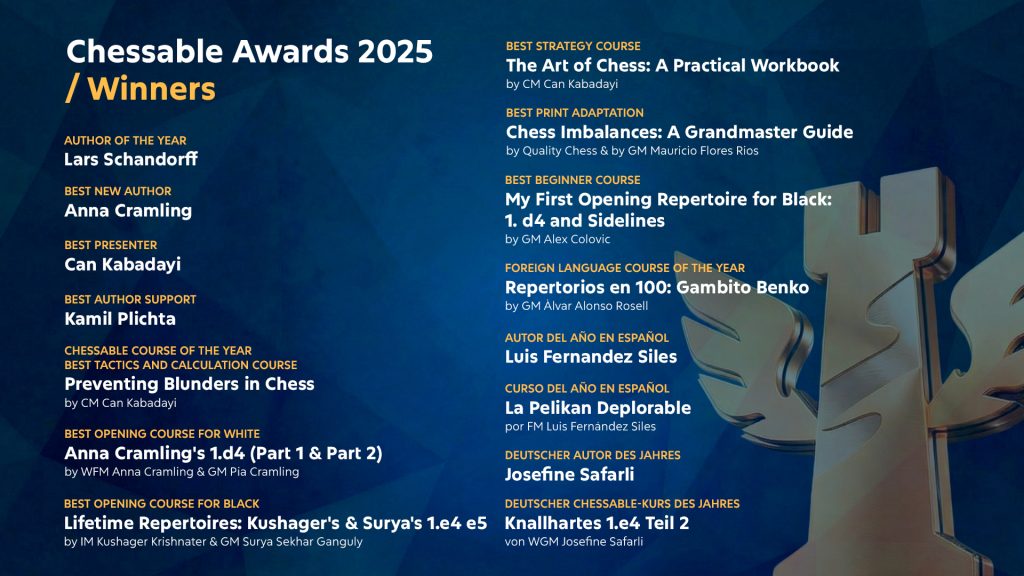

The 2025 Chessable Awards isn’t just a pat on the back. It’s the time of year where we gather, vote, and say:
“Yes! THIS course actually helped me.”
We shine the spotlight on the best titles and authors across 15 different categories.
You were probably still shaking off the holidays when we ran the poll.
But you still took the time to vote — picking the authors and courses that earned it.
Now let’s get to it.
Here are the winners.
The former Danish Champion released 2 Lifetime Repertoires plus an opening deep dive this year… and the 5-star reviews keep pouring in!
As an 11-time national team champion, he built repertoires the same way he played: reliable enough to hold higher-rated opponents, but stacked with winning chances against lower-rated ones.
He pulled the lines straight from his repertoire… and the ones he’s taught as Denmark’s national coach, as an opening adviser to their Olympiad team, and in private lessons with ambitious improvers.
Beyond the moves, the community voted him for the way he teaches.
In the side analysis and videos, he explores the why, the when, and the what-ifs. So you can truly own the opening.
Anna kicked the door into Chessable with a full 2-part 1.d4 repertoire…
Packed with the same lines she and her mother, Pia, have trusted in their biggest tournaments.
Her move choices are not only full of fight. They’re also guided by this constant focus on what actually happens in games.
But the real reason Chessablers love her?
She makes chess improvement doable — exciting ideas, clear explanations, plus a “let’s go!” vibe that pulls you in.
Runner-ups:
What makes Can a standout presenter isn’t just his energy — it’s his precision.
He started chess at 17, so he knows exactly where improvers get stuck. And as a cognitive scientist, he has a knack for teaching like one.
Count on Can to restate ideas until they become automatic. Like his definition of a blunder, “a move that gives your opponent a winning tactic they didn’t have before.”
He also turns fuzzy advice into something you can use. “Checks, captures, and threats” is too vague. What counts as a threat anyway? So he trains you to think in checks, captures, and attacks.
Because when your language is clear, your thinking and your moves become clearer, too.
Runner-ups:
At this point, the Chessable Awards almost feels incomplete without Kamil on the list!
He’s taken Best Author Support in 2021, 2023, 2024… and he shows no signs of slowing down.
In 2025, he published two Lifetime Repertoires. Both stay true to his opening DNA — sharp, original lines with constant piece pressure and sacrifices.
Most important, however, Kamil knows this double-edged style comes with surprises.
That’s why he’s always in the comments answering questions, updating lines… and even adding whole new chapters when students make strong points.
If you want an opening course that truly adapts and grows with you, you can’t go wrong with Kamil.
Runner-ups:
Chessable Course of the Year and Best Tactics & Calculation Course: Preventing Blunders in Chess by CM Can Kabadayi
The Course of the Year takes a break from adding more lines or theory to your chess brain. Instead, it raises the floor of your play with actions you already do — but better.
By cutting out blunders, you stop throwing games, and your rating climbs almost right away.
What’s brilliant here is that:
Can builds the course around the things you already kind of do:
Searching for tactical clues, checks and captures. Visualizing the squares a move leaves behind. Counting defenders…
You just don’t do them consistently — and often in the wrong order — especially when the clock is ticking.
So Can boils down the most critical steps down to CLAMP. It’s a framework designed to catch blunders before playing your move. Then he drills it into your memory through 200+ puzzles and 27+ hours of video, so “move safety” becomes autopilot.
Runner-ups for Chessable Course of the Year:
Runner-ups for Best Tactics & Calculation Course:
Best Opening Course for White: Anna Cramling’s 1.d4 Part 1 & 2 by WFM Anna Cramling & GM Pia Cramling
Here’s an Olympiad-tested 1.d4 repertoire, which mirrors how strong players fight for the full point as White.
Part 1 channels Pia’s pragmatic approach against the solid 1…d5.
You aim for strategic clarity right after move 3. You define the pawn structure early. So your game stays in clear waters, where your understanding takes the lead.
But if Black unbalances the game with 1…Nf6, 1…f5, and other sharp sidelines?
Then Part 2 fights fire with fire!
Crackling with pure Anna Cramling-energy, you lunge for the full point with no-castling pawn storms. You sac the exchange to deliver checkmate on the dark squares.
And when the game grows tense? You turn up the tension even more — confident that the complications favor you!
Runner-ups:
With this Lifetime Repertoire, you’re basically getting coached by the Indian School of Chess.
You’re learning from the same mentors that helped unlock the A-game of Viswanathan Anand (5-time World Champion), Vidit Gujrathi (peak world #14), Arjun Erigaisi (peak world #3), and Koneru Humpy (2-time Women’s World Rapid Champion).
You get a dynamic yet bulletproof 1…e5 you can grow into.
It arms you with club-friendly ideas that scale up to GM-level play — and without reducing you into a box of chess flashcards.
At its core are fighting systems, like the Marshall Gambit, Two Knights Defense, and the …g7-g5 anti-King’s Gambit… Lines that develop lightning-fast, grabs “extra” moves when possible, and puts immediate pressure on White.
But the real game-changer in this course is Surya’s way of teaching.
No stone unturned! He walks you through everything with move-by-move logic, and it’s the closest thing to Surya uploading his elite GM knowledge to your brain.
Runner-ups:
The faster you can spot strong well-rounded moves, the better you play without bleeding time off the clock.
That’s why this workbook zooms in on the 4 positional decisions you must make in every game, at every rating level.
From exchanging your bad piece for the opponent’s good one…
Activating your pieces — and burying theirs — so you have more units in the fight…
To multi-purpose moves that combine attack and defense.
Can drills each theme through a 3-step ladder.
The introduction shows you model positions and explains the main idea in plain language.
Then the multiple-choice section trains you to tell good moves from the bad. And finally, 3 test chapters get you ready for real games with mixed puzzles that grow harder as you go.
Runner-ups:
When the course (and book) dropped, it became an instant classic because it answered the question:
How do you play for a win when the engine shows “triple zeroes”?
Flores Rios teaches you how to unbalance the pieces. Because when your pieces differ from theirs, you open up plans the other side can’t copy nor stop.
Learn how to win from either side of the bishop vs. knight matchup. Build crushing attacks in those “drawish” opposite-colored bishop positions… and stay on the right side of messy “rook vs. minor pieces” battles.
Next, you crank the imbalances up a notch with real sacrifices.
The kind where you give up material with no instant payoff. Yet you still come out ahead 10 moves later, because you control the entire board.
The Chessable adaptation comes with 23 hours of video, 191 MoveTrainer drills, and spaced repetition. So the lessons don’t just make sense, they become skills.
Runner-ups:
A Chessable OG solves 1.d4, 1.c4, and 1.Nf3 with one sweeping plan:
Build the Black Triangle!
It bulletproofs your center. So that around it, you can safely develop your pieces on active squares.
Then once you’re stable, your triangle switches to offense — breaking the enemy center, grabbing space, and pushing their pieces to passive squares.
Best of all? It’s genuinely beginner-friendly.
Only 35 MoveTrainer variations and 7 hours of video — so you can start playing it in a day or two. Then the model games show you how to handle the middlegames you’ll reach.
Runner-ups:
Lock White into awkward structures with this triple-threat gambit for Black!
It shows you 3 ways to fight 1.d4, depending on your ambition and skill level.
You start with a one-page blueprint, plus a small set of lines applying tons of queenside and diagonal pressure.
Then as you climb the rating ladder, you pressure tougher opponents with a bold central push… plus “high-risk, high-reward” lines when you’re out for blood.
Runner-ups:
Congratulations!
…To all of this year’s winners!
And a huge “thank you” to everyone who voted and to every author whose course earned a nomination.
One of the toughest parts of the Chessable Awards is that we can only crown one winner per category. To make sure the rest doesn’t get lost in the celebration, we put every nominated course on sale.
So if you’re bargain-hunting and you want a shortcut to the best of 2025, head to the shop and grab a nominee (or two, or three).