
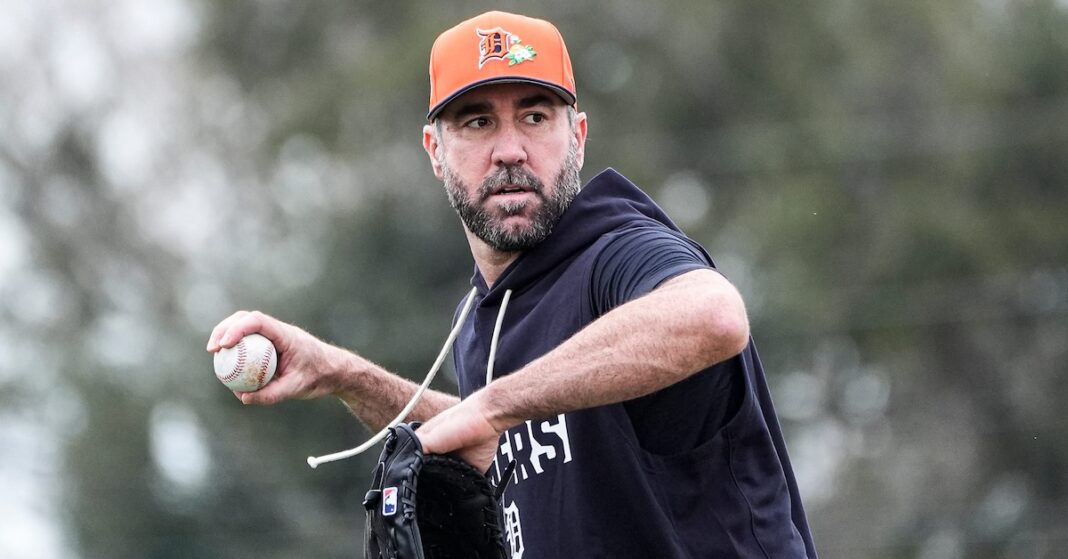

Last week was a huge one for the Tigers’ rotation. First, Framber Valdez agreed to terms on a three-year, $115 million deal, and then Tarik Skubal won a record-setting $32 million salary in arbitration. On Tuesday, the day before the team’s pitchers and catchers were scheduled to report to the Tigers’ spring training facilities in Lakeland, Florida, that rotation was in the news again, as Justin Verlander agreed to a reunion via a one-year deal. Shortly afterwards, the team revealed that Reese Olson, who was already reportedly behind schedule, recently underwent surgery for a torn labrum and will miss the season. Additionally, the Tigers added free agent outfielder Austin Slater on a minor league deal.
First and foremost, this is both a homecoming for Verlander, the best right-handed pitcher in team history by WAR (57.9), and potentially his last lap, as he’ll turn 43 on February 20, and will be the majors’ oldest player so long as Rich Hill doesn’t mount a comeback. Drafted out of Old Dominion with the second overall pick in 2004, Verlander debuted with a pair of starts for the Tigers in July 2005, then spent nearly 12 full seasons in Detroit (2006–17) before being traded to the Astros on August 31, 2017. During that time, he won the American League Rookie of the Year award (2006), as well as the AL MVP and the first of his three Cy Youngs (both 2011), while helping the Tigers to four division titles, a Wild Card berth, and two pennants (2006, ’12); he also threw the first two of his three no-hitters for them, in 2007 and ’11. He collected more hardware in Houston in the form of two Cy Youngs and two World Series rings, but while he may have cemented his Hall of Fame credentials elsewhere, odds are a Tigers cap will adorn his plaque.
According to USA Today’s Bob Nightengale, Verlander’s contract is for $13 million, though $11 million of that is deferred on a schedule that begins paying out in 2030. While that will bring the average annual value of the deal down a bit, the Tigers now project to pay the Competitive Balance Tax for the first time since 2017; according to RosterResource, their $256.3 million estimated luxury tax payroll is squarely over the first threshold of $244 million.
The Giants, for whom Verlander went 4-11 with a 3.85 ERA (and 3.85 FIP) and 2.2 WAR in 152 innings last year, expressed early interest in bringing him back, but beyond president of baseball operations Buster Posey’s words to that effect in September, never appeared to make a strong push. The Orioles, who also pursued Valdez, showed the most interest in Verlander over the winter, but their most notable rotation moves proved to be less eye-catching, as they brought back free agent Zach Eflin and traded for Shane Baz.
As I noted in last week’s roundup of the top starting pitchers still available, for much of last season, it looked as though Verlander might be cooked. He was coming off a dismal 2024 during which he managed just a 5.48 ERA and 4.78 FIP in 90.1 innings for the Astros while missing three weeks at the start of the season for shoulder inflammation, then another two months midseason due to a neck injury; by the time the playoffs rolled around, it was clear he wasn’t a viable option. While he still netted a one-year, $15 million deal with the Giants for 2025, through July 18 he went 0-8 with a 4.99 ERA and 4.29 FIP while striking out only 18.9% of hitters.
Lo and behold, Verlander pulled it together by making several adjustments. He began pulling the ball from his glove earlier in his delivery, moved toward the third base side of the rubber, and raised his release point, all in an effort to produce more deception and improve his angle of attack. According to Statcast, Verlander ended the season releasing his four-seamer — to use one point of reference — about three inches higher and nearly five inches closer to the third base side than in April:
You Aren’t a FanGraphs Member
It looks like you aren’t yet a FanGraphs Member (or aren’t logged in). We aren’t mad, just disappointed.
We get it. You want to read this article. But before we let you get back to it, we’d like to point out a few of the good reasons why you should become a Member.
1. Ad Free viewing! We won’t bug you with this ad, or any other.
2. Unlimited articles! Non-Members only get to read 10 free articles a month. Members never get cut off.
3. Dark mode and Classic mode!
4. Custom player page dashboards! Choose the player cards you want, in the order you want them.
5. One-click data exports! Export our projections and leaderboards for your personal projects.
6. Remove the photos on the home page! (Honestly, this doesn’t sound so great to us, but some people wanted it, and we like to give our Members what they want.)
7. Even more Steamer projections! We have handedness, percentile, and context neutral projections available for Members only.
8. Get FanGraphs Walk-Off, a customized year end review! Find out exactly how you used FanGraphs this year, and how that compares to other Members. Don’t be a victim of FOMO.
9. A weekly mailbag column, exclusively for Members.
10. Help support FanGraphs and our entire staff! Our Members provide us with critical resources to improve the site and deliver new features!
We hope you’ll consider a Membership today, for yourself or as a gift! And we realize this has been an awfully long sales pitch, so we’ve also removed all the other ads in this article. We didn’t want to overdo it.
Justin Verlander Fastball Usage, Release, and Performance
| Month | % | Vert Rel | Hor Rel | EV | Brl% | HH% | AVG | xBA | SLG | xSLG | wOBA | xwOBA |
|---|---|---|---|---|---|---|---|---|---|---|---|---|
| April | 48.0% | 7.04 | -1.46 | 91.0 | 12.2% | 39.0% | .222 | .256 | .444 | .502 | .316 | .351 |
| May | 51.8% | 7.04 | -1.50 | 92.8 | 19.4% | 47.2% | .293 | .345 | .610 | .666 | .425 | .465 |
| June | 45.5% | 7.09 | -1.50 | 96.6 | 16.7% | 66.7% | .381 | .399 | .571 | .699 | .433 | .484 |
| July | 41.1% | 7.14 | -1.61 | 89.5 | 9.7% | 32.3% | .294 | .248 | .559 | .454 | .406 | .358 |
| August | 44.9% | 7.24 | -2.03 | 91.5 | 2.3% | 36.4% | .294 | .283 | .353 | .409 | .312 | .328 |
| September | 40.8% | 7.28 | -1.85 | 90.8 | 12.1% | 45.5% | .244 | .284 | .439 | .560 | .326 | .385 |
| Thru July 18 | 46.6% | 7.05 | -1.49 | 92.6 | 14.0% | 46.5% | .299 | .310 | .560 | .580 | .397 | .409 |
| After July 18 | 43.5% | 7.25 | -1.91 | 90.4 | 7.9% | 37.1% | .250 | .271 | .380 | .468 | .313 | .352 |
Source: Baseball Savant
Ver Rel = vertical release point (feet). Hor Rel = horizontal release point (feet).
The monthly breakdowns don’t correlate perfectly, but as Verlander dialed back his fastball usage over the course of the season, batters didn’t hit it as hard. Using that July 18 date as a dividing line, he trimmed over two ticks in average exit velocity and 180 points of slugging percentage (though just 112 points of expected slugging percentage) against the pitch in the second leg of his season. He also integrated a newish sweeper into his arsenal, one that is thrown from a higher release point than any other sweeper in the majors, as noted by MLB.com’s Jared Greenspan. Batters hit just .053 and slugged .105 against the sweeper, while whiffing on 27.4% of swings against it.
After July 18, Verlander did a much better job of avoiding hard contact overall:
Justin Verlander Statcast Profile
| Split | EV | Brl% | HH% | AVG | xBA | SLG | xSLG | wOBA | xwOBA |
|---|---|---|---|---|---|---|---|---|---|
| Through July 18 | 89.4 | 9.8% | 39.8% | .288 | .268 | .467 | .463 | .352 | .342 |
| After July 18 | 87.5 | 6.3% | 34.6% | .227 | .233 | .352 | .370 | .283 | .292 |
Source: Baseball Savant
During that latter span, Verlander ranked as one of the majors’ 20 most valuable starters while posting a 2.60 ERA and 3.36 FIP with a 22.8% strikeout rate in 13 starts totaling 72.2 innings. I don’t expect him to sustain that for a full season at 43, but I do think he can approximate last year’s 2.2 WAR.
As for where he fits into the Tigers’ rotation, nobody expects Verlander to be the ace of yesteryear. The 29-year-old Skubal and 32-year-old Valdez are the team’s top two starters, with the former the game’s top pitcher according to both last year’s WAR rankings and our preseason Depth Charts projections, and the latter among the top 15 by both measures. Former number one pick Casey Mize, who turns 29 on May 1, and the 30-year-old Jack Flaherty are coming off seasons with nearly identical FIPs, WARs, and workloads (3.89 FIP and 2.4 WAR in 149 innings for the former, 3.85 FIP and 2.5 WAR in 161 innings for the latter), with similar contact profiles as well, but their more superficial numbers left vastly different impressions. Mize, whose 6.0 runs per game of offensive support was the AL’s second-highest mark, accompanied his line with a 14-6 record and a 3.87 ERA, making this his best major league season thus far. Flaherty, who received just 4.3 runs per game of support, went 8-15 with a 4.64 ERA, which led to his bypassing an opt-out and settling for a $20 million salary in 2026. Throw in Verlander and there’s your starting five, a strong enough unit that it ranks second only to the revamped Red Sox rotation in our Depth Charts projections.
The big concern, however, is the loss of the 26-year-old Olson. He pitched well when available last season, posting a 3.15 ERA and 3.50 FIP in 68.2 innings, but a bout of inflammation in his ring finger cost him nearly seven weeks in the first half, and he made just four starts upon returning before a shoulder strain sidelined him in late July. Just last week, a report from Evan Petzold of the Detroit Free Press suggested that Olson was behind schedule and wouldn’t be ready for Opening Day, and then on Tuesday, the Tigers announced that he underwent surgery on February 2 to repair a torn labrum and placed him on the 60-day injured list. That move, and the 60-day IL placement of righty Jackson Jobe, who underwent Tommy John surgery last June, opened up spots on the 40-man roster for Valdez and Verlander.
With Olson and Jobe out, 31-year-old righty Drew Anderson and 25-year-old righties Troy Melton and Keider Montero are the top alternatives if one of the starting five goes down. Anderson just returned from four seasons split between NPB and the KBO after spending parts of 2017–21 in the majors — and I do mean parts, as he totaled 44.1 innings in that span, with a high of 22. His four-seam fastball previously averaged just 92.7 mph in the majors, but he reportedly sat 93-96 mph as a starter in the KBO, touching 99; he also added a kick change and finished the 2025 season second in ERA (2.25) and strikeout rate (35.3%), both behind fellow KBO returnee Cody Ponce, who signed with the Blue Jays. The Tigers signed Anderson to a one-year, $7 million deal with a club option for 2027, so they clearly expect him to contribute in some way, most likely as a long reliever/swingman.
Melton, a 2022 fourth-round pick who entered last season at no. 80 on our Top 100 Prospects list as a 50-FV prospect who had yet to pitch above Double-A, made four starts and 12 relief appearances totaling 45.2 innings for the Tigers, putting up a 2.76 ERA and 4.60 FIP. He’s got better stuff than his 20% strikeout rate indicates, including a high-90s fastball and a plus changeup, and could continue acclimating to the majors in a multi-inning relief role while remaining ready to slot into the rotation. Montero, who’s spent most of the past two seasons with the Tigers, made 12 starts and eight relief appearances totaling 90.2 innings in 2025, with a 4.37 ERA, 4.93 FIP, and 18.5% strikeout rate. Jobe, a 23-year-old righty who entered last season at no. 9 on our Top 100 as a 60-FV prospect, put up a 4.22 ERA and 5.18 FIP in 49 innings across 10 starts for the Tigers before surgery; he could be a factor late in the season if his rehab goes smoothly.
As for Slater, the 33-year-old righty has carved out a nine-year major league career as a reliable lefty-masher, hitting for a 119 wRC+ (.267/.357/.430) in 1,022 plate appearances against southpaws, though just an 80 wRC+ (.227/.311/.329) in 836 PA against righties. Alas, over the past two seasons, he’s finished with a wRC+ even below that latter mark; in a season split between the White Sox and Yankees, he hit just .216/.270/.372 (78 wRC+) with five homers in 160 plate appearances overall. Tigers manager A.J. Hinch does a fair bit of platooning — particularly when it comes to slugging DH/corner outfielder Kerry Carpenter and center fielder Parker Meadows, both lefties — but with righties Jahmai Jones and Matt Vierling either coming off more productive seasons (Jones hit for a 159 wRC+ in 150 plate appearances) or offering more positional utility (Vierling can play center field and third base), Slater’s path to a roster spot is anything but clear.
Before the calendar flipped to February, the Tigers’ offseason appeared rather underwhelming, with the addition of closer Kenley Jansen and the returns of setup man Kyle Finnegan and second baseman Gleyber Torres their only major league free agent moves. With the additions of Valdez and Verlander, the Tigers are now clear AL Central favorites, with 54% odds of winning the division and a higher win projection (85.6) than all but the Mariners (87.7) and Yankees (86.2) among AL teams. The Valdez move is the big one, but the return of Verlander isn’t just a nice treat for fans who watched him leave when the team’s competitive fortunes were on the wane; it’s an appropriately aggressive addition that underscores the Tigers’ ambition to win.