
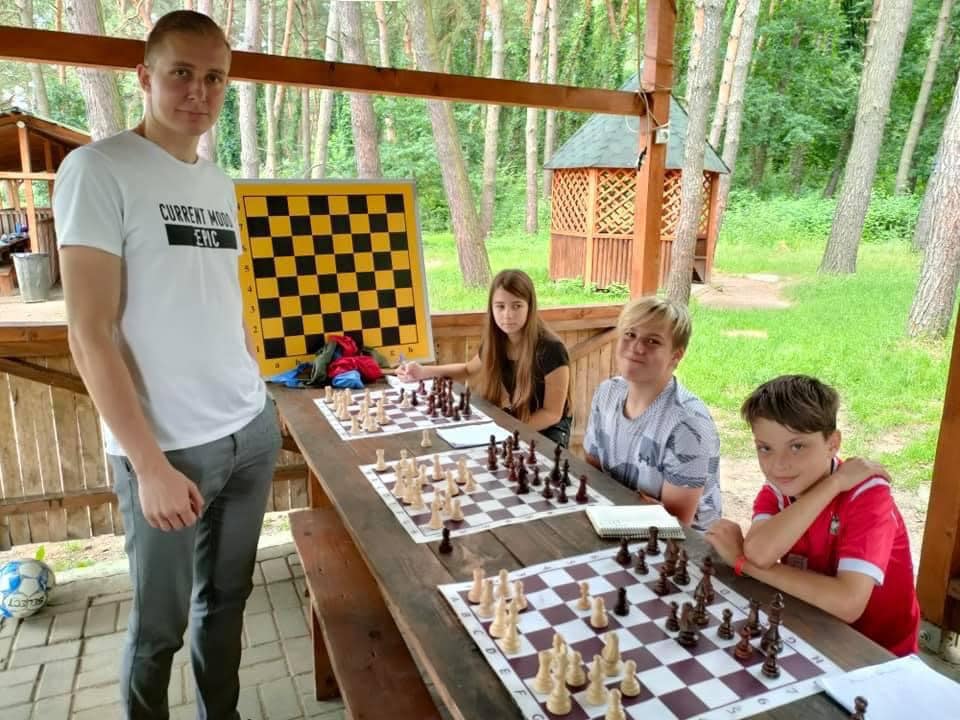

Ukraine has produced some of the most creative and aggressive chess players throughout history. The region of Lviv, in particular, is the hometown of legends such as Vasyl Ivanchuk, Alexander Beliavsky and the Muzychuk sisters, Anna and Mariya. It is within this rich chess tradition that GM Volodymyr Vetoshko developed his uncompromising, dynamic style of play.
A product of the highly competitive Lviv chess scene, Vetoshko studied with renowned Ukrainian grandmasters Vladimir Grabinsky, Mykhaylo Olekseenko, and Adrian Mikhalchishin. Immersed in a culture that prizes fighting chess and deep calculation, he collected an impressive list of junior achievements including five national titles and a silver medal at the European Under 10 Championship.
These early successes laid the foundation for his continued ascent. Later, at the age of 19, he became a grandmaster.
Nowadays, Vetoshko channels his experience into his work as a coach, helping players from around the world develop sharper tactical instincts and a more confident approach to the game. In parallel, he is also a Chessable author, where he distills his practical, fighting philosophy into opening courses designed specially for faster time controls.
In this interview, Vetoshko shares practical tips for chess improvers.
What is your chess coaching philosophy?
I believe every chess player is unique and therefore needs an individual approach. A program of improvement which gives an immense boost to one student can turn out to be completely ineffective with another.
I’m always trying to figure out my student’s weaknesses and strengths, the types of positions they prefer to play (open/closed, dynamic/static, complicated/simple, etc.) and we work accordingly: building a suitable opening repertoire, improving understanding of the positions they struggle with, discussing the right decision making process and many other things.
At the same time, there is a set of things that everybody needs to consistently work on (such as calculation, for instance).

Suppose a player has only 3 hours a week for chess training. How should they spend their time?
To be clear on this one: it’s quite difficult to significantly dedicate 3 hours a week for chess training (if you have strong ambitions), but if you just love chess and want to improve gradually, it’s still possible of course! And the plan in this case should be as simple as possible.
1) Solve tactics at the beginning of a training session! Usually games are decided by a blunder so tactics are what matters the most. And it’s a nice warmup, too! Like stretching for an athlete before a competition 🙂
2) Play online games (Rapid or at least blitz with increment) and make sure you analyze them right after. Remember, the mistake that matters the most is the first one you make! Because you will likely get the same opening position on the board in the future and you need to know whether you stick to the same approach or deviate. And importantly, try to understand why!
3) Choose a simple opening repertoire that you enjoy and stick to it; if you face a line that you don’t know – add it to your repertoire after the game. Review your repertoire from time to time.
What is the biggest factor for improvement for players under 1200 (Chess.com)? Under 2000?
For players under 1200 on Chess.com, the biggest factor is simple: tactics, tactics, tactics. At this Under 1200: learning basic chess principles and definitely tactics, tactics, tactics! At this stage 99% of games are decided by grave tactical errors. Develop your combinational vision by solving lots of puzzles; pay attention to hanging pieces in each game (look for double attacks and keep your pieces defended). Stick to a simple opening repertoire where you have a natural development.
The closer to 2000 you get the more important it becomes to improve other areas as well (positional play, endgame play and building a deeper opening repertoire). Still, however, calculation remains crucial!

What is your preferred way to improve at openings? What’s the approach to chess openings that you try to teach your students?
Besides just memorizing the lines it’s important to understand the ideas behind the moves and to know the plans in the middle game.
I build my repertoire according to my preferences and style. I would find games in the database played by an opening expert in this concrete line of interest and analyze them. Another important thing is to follow recent games from top tournaments. There are so many novelties and interesting ideas implemented! If I see some new approaches in the openings that I play I would analyze them with an engine a bit deeper and add them to my existing repertoire as an alternative. And I can use them at my OTB tournaments, surprising my opponents! The element of surprise is extremely important in chess nowadays.
Also, there are so many great courses available on any opening, it’s possible just to pick the ones you prefer and study! But afterwards I would still suggest expanding your knowledge by going through annotated games of masters in those openings (the more the merrier!), trying to comprehend the ideas and plans throughout the whole game.
It’s important to practice the lines you study in online games. You will get a better understanding of arising positions and you will memorize the lines more effectively. If you face something unexplored, analyze it and add it to your repertoire. And don’t forget to analyze every single game right after you finish it! 🙂
What is your preferred way to improve at the endgame?
Study a set of theoretical endgames (books that come to mind are 100 Endgames You Must Know and Dvoretsky’s Endgame Manual) and play through the annotated games of endgame legends (such as Carlsen, Capablanca).

Is there anything else you would like to share with ambitious chess improvers?
My advice: enjoy the learning process and try to learn something new everyday!
Chessable courses by GM Volodymyr Vetoshko
Across his courses, Vetoshko treats openings as springboards for initiative, calculation and fighting chess, which is particularly effective for players looking to maximize their results in rapid and online formats.
His Rapid and Blitz 1.e4 Repertoire was nominated for a Chessable Award last year as one of the Best Opening Courses for White. It is part of the 2025 Chessable Awards Sale and will be discounted until February 18, 2026.
His newest course, Rapid and Blitz Repertoire for Black, is on introductory sale and will remain discounted until February 19, 2026.
Check out his author page!