


A highly competitive field
The IV International Women’s Chess Championship took place in Bukhara, Uzbekistan, from 10 to 14 March. The Masters tournament was organised as a ten-player round-robin, played at a time control of 60 minutes for the entire game, with a 30-second increment per move from move one. Players were not permitted to agree to a draw before Black’s 30th move.
Alongside the main event, Challengers and Futures competitions were held as nine-round Swiss opens, attracting 41 and 62 participants respectively, most of them young Uzbek players.
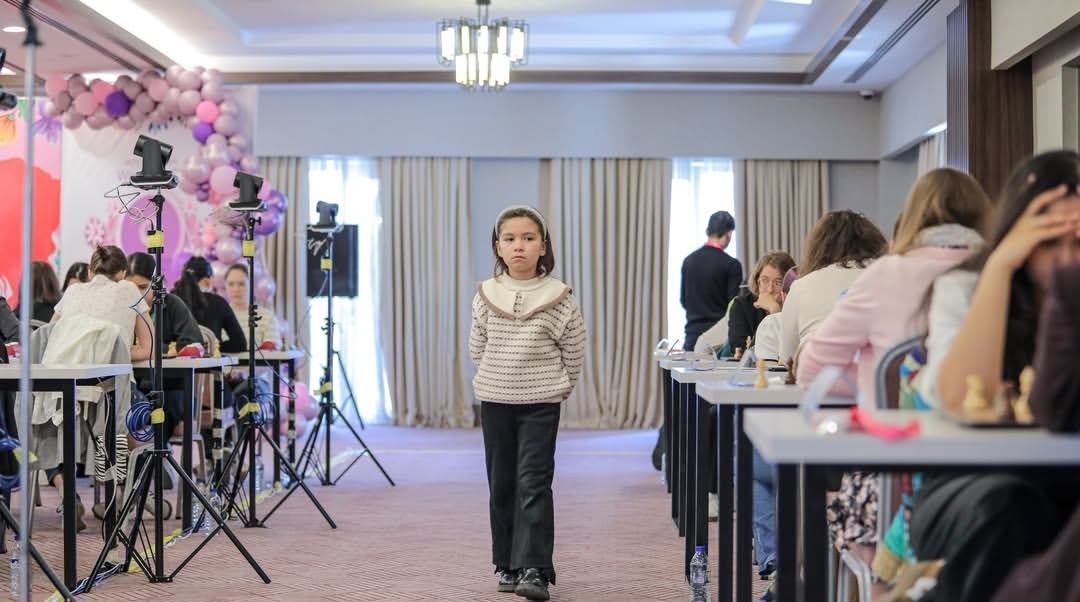
A young kid walks next to the Masters’ boards | Photo: uzchesss on Instagram
Bukhara provided a historically resonant setting for the event. The region has been inhabited for at least five millennia, while the city itself has existed for roughly half that time. Situated on the Silk Road, Bukhara developed as a centre of trade, scholarship, culture and religion, and later served as the capital of successive Uzbek states, including the Khanate and Emirate of Bukhara as well as the Bukhara People’s Soviet Republic.
The Masters field was notably strong: seven of the ten participants were rated above 2400, a significant proportion given that only 43 women worldwide currently hold ratings above that mark. The top three seeds were Stavroula Tsolakidou of Greece (2479), Nana Dzagnidze of Georgia (2469) and Harika Dronavalli of India (2466), all experienced competitors on the international circuit.
Victory went to sixth seed Ulviyya Fataliyeva of Azerbaijan, who scored 6½/9 and produced a tournament performance rating of 2590. After five rounds, she shared second place on 3½/5 alongside Uzbekistan’s Afruza Khamdamova, while Dzagnidze led the standings with 4/5. Fataliyeva then suffered a setback in round six, losing to Harika as both Dzagnidze and Khamdamova drew their games. From that point onwards, however, the Azerbaijani grandmaster finished strongly, winning her final three encounters to secure clear first place.
Her decisive late surge included victories over Tsolakidou, Ukraine’s Yuliia Osmak and Khamdamova. All three games featured complex tactical struggles in which Fataliyeva demonstrated confidence in sharp positions and effective calculation under pressure, allowing her to overtake her rivals in the closing stages of the competition.
Dzagnidze ultimately finished in sole second place on 6/9 points, distinguishing herself as the only player in the field to complete the tournament undefeated. Harika took clear third place with 5½/9, her campaign marked by consistency after an early setback – her only loss came in the first round, against Dzagnidze.
In round eight, Fataliyeva saw her opponent erring on move 11, with the same mistaken capture that Milan Vidmar had played at the 1912 Budapest tournament against Carl Schlechter – the latter got a 19-move victory.
Osmak is not the first player to repeat this mistake, though, as two 2400+ rated players have also played 11.Nxd5? in this position quite recently.
This setup emerging from a Tarrasch Defence, with g2-g3 included, is already slightly favourable for Black after 10…Bxe3. However, White can keep the battle going by replying to the capture with 11.fxe3 bxc3 and either 12.Qd2 or 12.Qd4.
Instead, after 11.Nd5? Black gets a clear advantage via 11…Bxf2+ 12.Kf1 Nxd5 13.Qxd5 Be6! (a key move in the variation) 14.Qf3 Be3 15.Nb4 0-0
Material is equal and White could even collect a pawn on b7 in this position – but Black is nonetheless clearly for choice due to her powerful bishop pair in addition to White’s awkward king position and weakened pawn structure.
Here the Vidmar v. Schlechter game continued with 16.Nc2 Qxb2 17.Qxe3 Qxc2 18.Bxb7? Rae8 19.Qf2?? Qb2, and Black resigned.
Osmak instead went for 16.Nd3, but also saw her position collapse rather quickly. After Fataliyeva’s strong 26…g5, all White could do was delay a certain defeat.
Resignation came after 27.Qh5 Qd4+, with checkmate coming on the next move (28.e3 Qxe3# or 28.Kf3 Qe3#).
Final standings
| 1 | IM | Fataliyeva, Ulviyya | 2431 | 6,5 | 0 | |
| 2 | GM | Dzagnidze, Nana | 2469 | 6 | 0 | |
| 3 | GM | Dronavalli, Harika | 2466 | 5,5 | 0 | |
| 4 | IM | Garifullina, Leya | 2454 | 5 | 0 | |
| 5 | WGM | Khamdamova, Afruza | 2408 | 5 | 0 | |
| 6 | GM | Girya, Olga | 2389 | 4,5 | 0 | |
| 7 | WIM | Omonova, Umida | 2346 | 4 | 0 | |
| 8 | IM | Osmak, Yuliia | 2458 | 3,5 | 0 | |
| 9 | IM | Tokhirjonova, Gulrukhbegim | 2347 | 2,5 | 1 | |
| 10 | IM | Tsolakidou, Stavroula | 2479 | 2,5 | 2 |
All games
In a total of 6 chapters, we look at the following aspects: the right decision based on tactical factors, decisions in exchanges and moves, complex and psychological decisions in longer games and in defence.