


Every civilization begins with a story. Before history was written in ink, it was preserved in imagination. Before dates were recorded, truth travelled through myth. And before scholars debated origins, humanity understood itself through symbols.
When I began Shat Shat Vande Chess, I was not merely tracing the evolution of a board game. I was searching for its pulse — the ancient heartbeat that still echoes beneath sixty-four squares.
The official teaser with anthem song of Shat Shat Vande Chess — a cinematic odyssey that traces the timeless journey of chess, from its ancient origins in Bharat through mythology, history, and across civilizations, to the modern world.
The further we travel into antiquity, the darker the historical record becomes. Manuscripts fade. Empires vanish. Stone crumbles. Certainty dissolves. Yet something survives. Memory! And in ancient Bharat, memory was carried not in archives — but in epics!!
When tradition speaks of Mandodari in Lanka, when it situates strategy in the shadow of the Treta Yug, it may not be offering a modern academic claim. It is offering something deeper — a civilizational metaphor.
In the great war of Lanka, Mandodari is remembered not merely as Ravan’s queen, but as a voice of counsel — composed, discerning, far-seeing. As battle clouds gathered and arrogance overshadowed wisdom, she is said to have urged restraint, reflection, and strategic clarity. In that image of a queen guiding a king through the complexities of war, we glimpse the archetype of disciplined strategy — intellect seeking to steady power.
And in the Mahabharat, the great epic of the Dwapar Yug, we witness how a single game of Chaturang in the royal court of Hastinapur altered the destiny of empires. There, strategy, foresight, and miscalculation shaped the fate of kingdoms. The board — whether of Chaturang or of war — became a theatre where intellect decided history.
On the sacred battlefield of Kurukshetra, Lord Krishna stood between two armies and revealed not merely the art of war, but the science of discernment. In guiding Arjuna through doubt and destiny, He unveiled the eternal principle of disciplined action.
The ancient Indian army was organised into four divisions — elephants, horses, chariots, and infantry — the four limbs known as Chaturang. Within this four-fold formation lay more than military order; it reflected harmony, coordination, foresight, and balance. It was strategy aligned with dharma, power restrained by wisdom, movement governed by consciousness.
In that vision of structured warfare — disciplined yet mindful — one can glimpse the philosophical foundation from which the spirit of chess would one day emerge. It tells us that strategy was born in crisis. That foresight emerged amidst conflict. That intellect rose to discipline power.
History tells us what can be verified. Mythology tells us what was valued! The documented journey of chess — from Chaturang in Bharat, to Chatrang in Persia, to Shatranj in the Arab world, to the global game we know today — is magnificent and undeniable.
But I wished to go further. Beyond inscriptions. Beyond manuscripts. Beyond the comfort of dates! Into the twilight of origins — where imagination and intellect first converged!
This book and this film are not an attempt to replace history with legend. Nor to prove myth as fact. They are an attempt to honour both!! For chess is not merely a set of rules. It is the awakening of strategic consciousness. It is humanity’s discovery that conflict can be studied without bloodshed, that kings can be trained without war, that destiny itself can be rehearsed upon a board. If history anchors the board, mythology gives it soul.
And in that sacred meeting of fact and fable, Shat Shat Vande Chess was born.
For long before the first manuscript of Chaturang… long before Persia named it Chatrang… long before the Arabs called it Shatranj… long before the world called it Chess… the human mind had already begun to move invisible pieces upon the board of destiny!
And from that first unseen move in ancient Bharat, this journey rises — Shat Shat Vande… to the eternal game!!
Note that in traditional Indian nomenclature, we often retain the original phonetic form of names without the terminal “a” commonly used in Western transliteration. For example, it is Lord Ram (not Rama), Ramayan (not Ramayana), Mahabharat (not Mahabharata), and Chaturang (not Chaturanga). I mention this only for contextual clarity as to how they appear in my book and the movie.
Praful Zaveri is the founder of Indian Chess School. In a highly decorated career span of over three decades he has trained more than 5000 students, empowered 100+ trainers to teach chess and has introduced chess in more than ten schools across Mumbai.
His experience and expertise cover coaching, giving seminars, organizing tournaments, officiating as arbiter writing chess books among a myriad of other facets of chess. He has authored eight training manuals, which includes the best-seller – The Chess Course (1999). This book has sold more than 100,000 copies. He authored Mastermind Chess in the year 2018 and The Chess Course, a Curriculum (2013 to 2021) which is widely used across the world to train children.
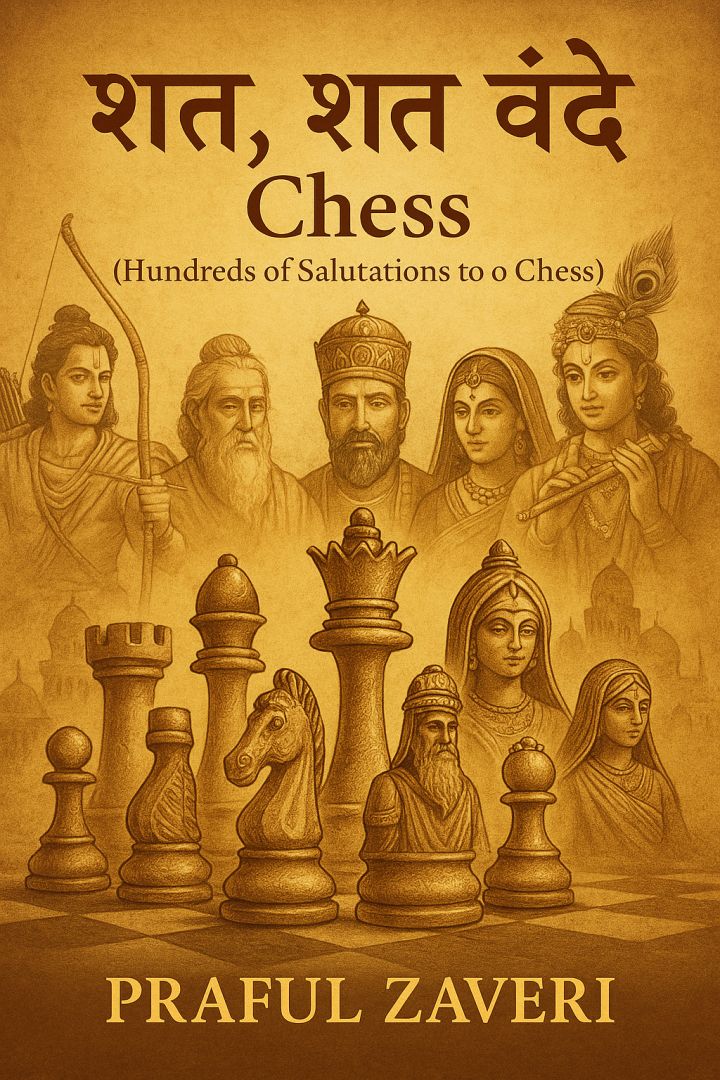 Shat Shat Vande Chess is an Indian book onthe cultural, historical, and philosophical journey of chess. It tells the story of a 15,000‑year “odyssey” of human strategy, storytelling, and thought, blending historical material with mythic and cultural narratives from the Indian subcontinent and beyond. It aims to honour chess as a civilizational heritage object, tracing how ideas of war, kingship, fate, and intellect have been encoded in the game.
- The story is explicitly framed as an odyssey of facts and fables, interweaving documented history, legends, and interpretive commentary.
- It is narrated by a personified “Voice of Time,” which allows the author to move freely across eras and regions while commenting on how chess evolved and what it meant in each context.
- The tone is deliberately literary and reflective, closer to an epic narrative or cultural essay collection than to a technical chess book.
- Origins and diffusion: The book explores origin stories of chess in ancient India (chaturanga and related forms) and follows the game’s transformation as it travels across Persia, the Arab world, and Europe.
- Cultural and philosophical angles: It highlights how different civilizations used chess as a metaphor for morality, politics, war, and spirituality, and how rules and piece‑meanings reflect those underlying philosophies.
- Facts vs. fables: Historical episodes and research are deliberately juxtaposed with legends and symbolic interpretations, inviting the reader to see both the documented evolution and the myths that communities built around the game.
You can buy a copy here