

The author of this guest post is Sara Cavaglià, a PhD candidate at the University of Verona, Italy, and one of the winners of the 2025 Chessable Research Awards. In this article, Cavaglià reports on her pilot study which explores chess as a shared cognitive and physiological experience between two minds under time pressure.
By tracking pupil dilation and heart rate of chess players during blitz games, this research aims to find how cognitive effort and stress evolve in real time, and whether those responses synchronize between opponents as the game unfolds.
Synchronicity In Gaze Patterns, Pupil Dilation and Heart Rate Patterns During Blitz Chess by Sara Cavaglià & Dr Massimiliano Canzi
Introduction
Many psychological experiments have been run to date to study chess-related cognitive processes, including some with eye-tracking technology (Reingold and Charness, 2015; Sheridan and Reingold, 2017). However, almost every single experiment aimed at collecting empirical data on these processes has done so by presenting static chess puzzles on a computer screen and asking participants to, for instance, select the best move or continuation in the position (Blignaut et al., 2008; Küchelmann et al., 2024). While this setup offers a controlled environment to study cognitive processes specifically related to decision-making, it doesn’t manage to recreate the environment the player inhabits during a real, live chess game, such as moving pieces on a real chess-board, a real opponent sitting right in front, time trouble, and higher stakes to win an actual game of chess.
Our aim is to collect (empirical) behavioural, cognitive, and physiological data during live, over-the-board blitz chess playing. Not only are we interested in players’ cognitive effort, but we want to test whether, similarly to what has been reported to happen across other competitive and cooperative activities and sports, many physiological and behavioural measures tend to synchronise between the two players during a live blitz chess game (Kramer et al., 2016; Wirtz et al., 2024). Since this has never been done before to the extent that we have planned, our aim so far is to set up a small-scale pilot study to i) test whether the methodology could be efficiently used to collect simultaneous eye-tracking, pupillometry, heart rate and game data and ii) to collect a small pilot sample of data for a starting, mostly qualitative analysis of the physiological data collected.
Methods
All blitz games took place in a quiet room (Multi-Sensory Lab at the University of Konstanz), where participants were instructed to play a 3+2, best-of-five game match, with playing rules adhering to those of official tournaments. Games were played on a tournament-size DGT chessboard with matching weighted, wooden tournament pieces. A DGT 3000 clock was used. The board was connected to a MacBook Pro running MacOS Sequoia, and games were recorded with the LiveChess software. Each playing session lasted around one hour and each player was compensated 10 euros for their participation.
Gaze and pupil data were collected with two pairs of Tobii Pro Glasses 3, a wearable eye tracking device that simultaneously captures gaze movement, pupil size, audio, and full-HD video from the wearer’s perspective, while being extremely light and completely non-invasive. The eye-tracking devices were connected to two MacBook Pros (one per player). Heart rate was measured using Polar’s heart rate monitors, worn on a chest strap by both players. Around 20 games were played in total, by 3 pairs of players of similar rating, based on chess.com blitz or rapid ratings. Pair one had an average rating of around 1300, pair two a rating of 1700, and pair three, which played two matches of five games each, a rating of 2200. All data was processed, analysed and visualised in R using RStudio.
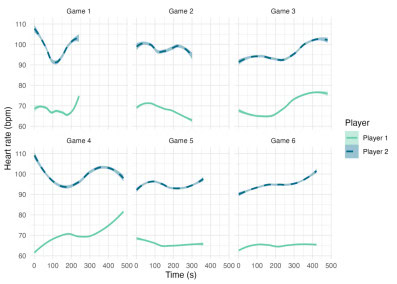
Figure 1. LOWESS (locally-weighted scatterplot smoothing) approximation of heart rate (measured in beats per minute) during six blitz games (3+2) by two players rated 1700.
Results
Looking at Figure 1 above, two things can be readily noticed. First of all, Player 1 and Player 2’s heart rates are, as far the raw values are concerned, quite different. The main reason is that heart rate baselines and ranges vary dramatically across individuals based on factors like age, fitness, mental and physical state, etc. It is not realistic to expect two individuals’ heart rate to ‘synchronise’ in the layperson’s facet of the word. What we do not see here is, for example, that Player 1 and Player 2’s heart rate is, e.g., exactly 80 bpm at the same time during one of six games. However, if we consider each player’s baseline and range of heart rate, we can see that across all six games there are patterns of synchronicity in the direction of change of this physiological measure.
One interesting aspect concerns the relationship between heart rate (and, as we will see later, pupil dilation) patterns and game outcomes. As shown in Figure 1, physiological responses do not clearly reflect the outcomes of the six games; in other words, the fact that Player 1 won Game 2 while Player 2 won all the other games cannot be inferred from the players’ heart rate patterns. A different perspective on the same data is offered in Figure 2, where heart rate values are normalised and 0 corresponds to each player’s average heart rate. This allows us to visually overlap the average heart rate of both players and more easily track the changes throughout the games.

2. LOWESS (locally-weighted scatterplot smoothing) approximation of player-standardised heart rate (z-scores) during five blitz games (3+2) by two players rated 1700.
When we normalise heart rate data by player, the similarities between the two curves become more apparent throughout the majority of games. Of course, as we are limiting ourselves to a visual qualitative analysis of the data, our aim is not to come to a conclusion that we can apply to a larger population. That will come at a later point when we are able to run quantitative statistics analyses on a larger sample of data. However, so far we can see that patterns of synchronicity appear to emerge in some cases more apparently, such as Game 3, Game 5 and to a lesser extent Game 2 and Game 6. Game 4 is the only game played by these two players where the patterns are opposite i.e. whenever the heart rate of Player 1 is decreasing, that of Player 2 is increasing.

Figure 3. LOWESS (locally-weighted scatterplot smoothing) approximation of player-standardised heart rate (z-scores) during five blitz games (3+2) by two players rated 1300.
Similar patterns can be observed also in the data of the 1300-rated pair, as well as that of the 2200-rated pair, suggesting that this behaviour is not strictly related to the player’s ability, but to the specific game situation. In Figure 3, we see that a pattern of synchronicity can be observed for 4 of the 5 games, with Game 1 being the only one that shows diverging patterns between the players. Games 1, 2 and 5 were won by Player 4, while Games 3 and 4 were won by Player 3.
Similarly, we wanted to observe whether similar patterns of synchronicity could be found across measures of pupil dilation, for the same players. When it comes to pupil dilation, the situation is more complex, as the patterns change at a faster rate during the game, compared to heart rate measurements. That said, we were able to find similar patterns of synchronicity across many examples. For this qualitative analysis, we looked at changes of pupil dilation across the entire game. For further quantitative analyses, the goal would be to select time windows of pupil dilation linked to specific events across many games, e.g. blunders, only moves that keep the advantage, and more. The more common approach of looking at event looked windows will help us understand what kind of reaction is commonly found across different situations during gameplay. Our current approach, on the other hand, aims at giving us an overall view of pupil changes (increase and decrease in cognitive load and arousal) throughout entire games, for both players.
For the purpose of this article, let’s focus on one example that clearly displays patterns of synchronicity between the two players. In Figure 4, we can see pupil dilation and contraction for Players 3 and 4, during Game 2 of their five-game-match. The similarities between the two curves are striking, showing that patterns of pupil dilation and pupil contraction happen

Figure 4. LOWESS (locally-weighted scatterplot smoothing) approximation of player-standardised pupil size (z-scores) during one blitz game (Game 2, 3+2) by two players rated 1300.
at the same time for both players during the game, despite differences in the evaluation and despite the outcome of the game favouring Player 4. In particular, times when the pupil size increases are tied to moments of more equal evaluation of the position. The more complex and balanced the position, the more cognitive strain increases for both players. It is after two main blunders during the game, one by each player, that the pupil starts contracting for both. When the position becomes ‘easier to play’, whether because it is winning or because one is dead lost, cognitive workload is less for both players. When the position goes back to equal, before the second blunder (Qxe7??), the pupil again dilates for both players alike. From this example, and our early qualitative analysis, we think that pupil dilation might correlate with the complexity of the position and equal evaluation, rather than with a winning or losing position.
Discussion
The aim of our study so far was not to create a fully-fledged, ‘big’ data set for advanced quantitative analysis of physiological, behavioural, and game data. Our aim so far was to test a novel methodology, never used for research purposes during live chess games, and to collect a small sample of data to see whether the methodology we had devised carried any potential in collecting more, and comprehensive data for cognitive processes and synchronicity during live chess games.
As far as the methodology is concerned, we believe that our goal was a success. We managed to set up a non-invasive, comprehensive methodology for empirical data collection including video, audio, gaze, pupil and heart rate for two players during live chess. Not only does this provide us with never-before access to online processing of decisions, stress management,
cognitive effort and cognitive arousal during chess specifically, but it both supports the use of this methodology for high-level athletes in chess, to study decision-taking patterns, to improve stress-management during time trouble, and more. Eye tracking measurements have already been used to investigate expertise and perception in chess (Reingold and Charness, 2015; Sheridan and Reingold, 2017); however, to our knowledge, no study has adopted this methodology, combined with heart rate monitoring, to explore stress transmission in this context before. Furthermore, the methodology could be used far beyond chess to study other activities where synchronicity might happen between participants, whether that’s other sports (tennis, table tennis come to mind for a very similar 1 vs 1 setup), but this could be expanded into further contexts such as psychological experiments, language-related experiments, clinical settings and more. Additionally, future research could integrate data from gaze measurements as well, to obtain a more comprehensive understanding of physiological responses and stress transmission in these contexts.
As for the results that emerged from our preliminary and qualitative analysis of physiological data, we could conclude that, despite expected individual differences, both pupil size and heart rate tend to synchronise during blitz chess games. This had already been documented in other stressful, competitive, and cooperative activities (Kramer et al., 2016; Wirtz et al., 2024). Specifically, both measures appear to be linked to the general complexity of the position during the game, rather than to players’ winning or losing position or expertise. Comparable analyses conducted on a larger dataset would allow us to generalize this intuition and better understand the specific context in which synchronisation occurs.
Taken together, these findings represent, in our opinion, a promising starting point for in-depth, comprehensive, and quantitative research on chess-related cognitive processes.
References
Blignaut, P. J., Beelders, T. R., & So, C. Y. (2008). The visual span of chess players. In Proceedings of the 2008 symposium on Eye tracking research & applications (pp. 165- 171).
Kramer, U. M., et al. (2016). Social influence on emotional arousal and its link to decision making. Journal of Experimental Psychology: General, 145(5), 571–588.
Küchelmann, T., Velentzas, K., Essig, K., & Schack, T. (2024). Expertise-dependent visuocognitive performance of chess players in mating tasks: evidence from eye movements during task processing. Frontiers in psychology, 15, 1294424.
Reingold, E. M., & Charness, N. (2005). Perception in chess: Evidence from eye movements. Psychological Science, 16(8), 641–642.
Sheridan, H., & Reingold, E. M. (2017). Gaze patterns and expertise in chess. Journal of Eye Movement Research, 10(5), 1–15.
Wirtz, P., Auer, A., & Walther, L. M. (2024). Is your stress my stress? A standardized controlled experimental paradigm to study physiological stress contagion in humans. Psychoneuroendocrinology, 160, 106882.