
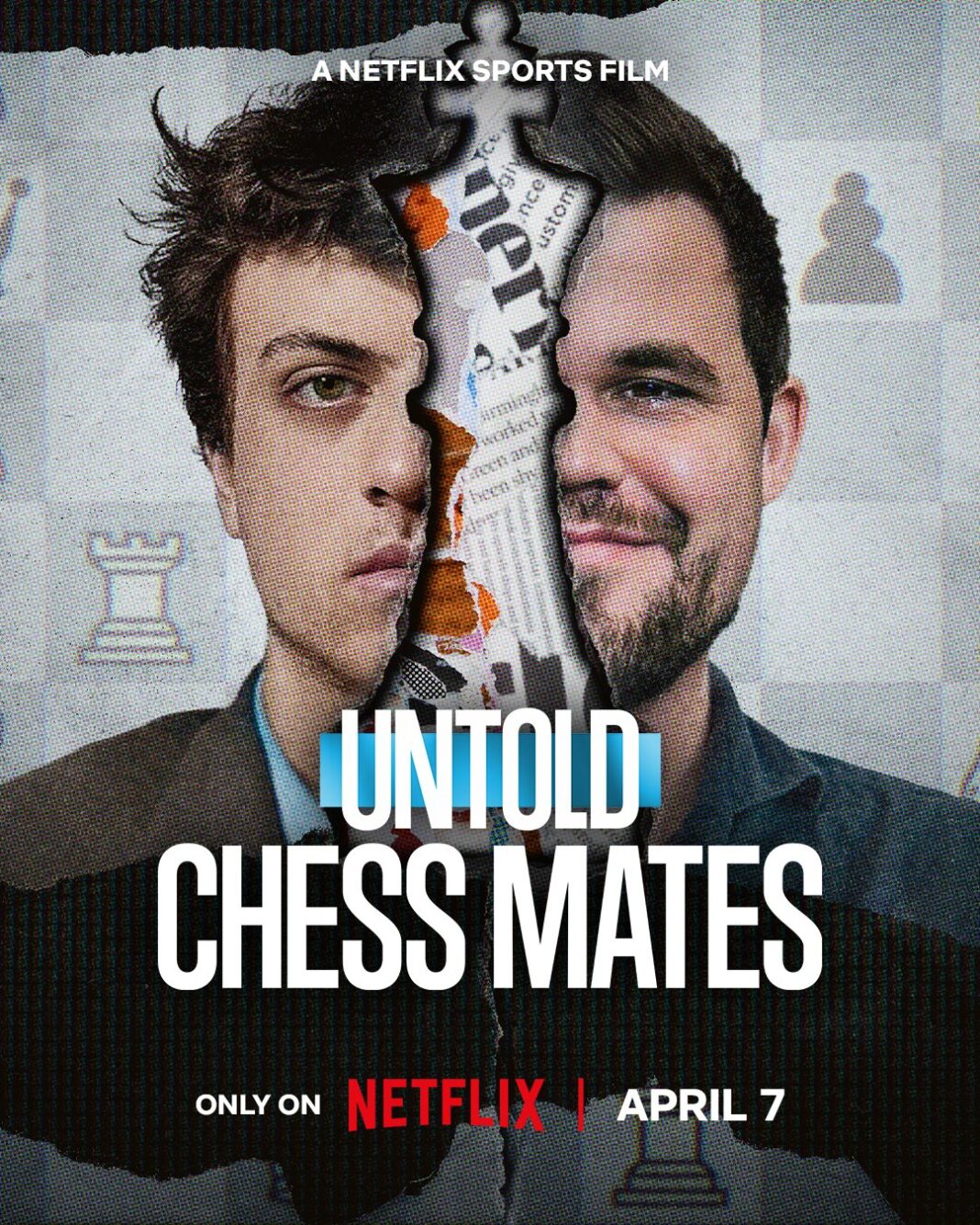

In Netflix’s Untold: Chess Mates, GM Hans Niemann shares new details about the extent of his online cheating, while GM Magnus Carlsen offers fresh insight into what sparked one of the most controversial scandals in modern chess.
The 74-minute film, released to Netflix’s more than 300 million subscribers on Tuesday, revisits the events that followed the 2022 Sinquefield Cup, where the reigning world champion stunned the chess world by withdrawing from the tournament after losing to the rising 19-year-old American in round three.
Following last week’s teaser clips, which featured candid reflections from Carlsen, Niemann, and GM Hikaru Nakamura, the full film expands on the events that sparked an unprecedented global media frenzy.
Niemann is the central figure in the documentary, featuring footage from his small New York apartment, clips from his Twitch streams, and extensive insight into his version of events before and after the St. Louis tournament.
In addition to Carlsen, Chess.com CEO Erik Allebest and Chief Chess Officer IM Danny Rensch provide key behind-the-scenes insight into the controversy, alongside contributions from Nakamura, Henrik Carlsen, and a brief interview with renowned coach NM Bruce Pandolfini.
Carlsen’s withdrawal sparked widespread speculation and ultimately led to public allegations that Niemann had cheated in their over-the-board encounter. The controversy escalated into his $100 million defamation lawsuit against Carlsen, Chess.com, Play Magnus Group, Rensch, and Nakamura.
The case was later dismissed, and ultimately resolved with a settlement, allowing Niemann to return to Chess.com. However, the fallout continues to shape discussions around fair play and has led to increased anti-cheating measures in major chess tournaments.
Until now, Carlsen had addressed the controversy in public only once—during an appearance on The Joe Rogan Experience last year—making his participation in the documentary highly anticipated.
The Norwegian offers new insight into both his mindset during the Sinquefield Cup game and the events leading up to it. “I felt that I was not playing a human,” Carlsen said.
I felt that I was not playing a human.
—Magnus Carlsen
The film picks up on a previously reported element: concerns about Niemann’s online play ahead of the event. Rumors had already circulated among top players, fueled by suspicions following impressive performances in more low-profile tournaments in Europe and Asia.
Carlsen’s own suspicions intensified following a loss to Niemann in the FTX Crypto Cup in Miami. Ahead of that event, the grandmasters had faced off in a casual game at the beach, which the Norwegian won comfortably.

Carlsen explained in the documentary that he had been unsettled by Niemann’s remarks at the opening ceremony, where the teenager said that he was ready to “replace” the world champion.
“What did he really expect from this tournament? Because he is a significant underdog in every single match. If he comes here and expects that he can beat everybody. That seems completely delusional.”
Despite Carlsen winning their mini-match in Miami 3–1 after dropping the first game—when Niemann delivered his now-famous “chess speaks for itself” line—the Norwegian says his suspicions lingered in St. Louis.
Niemann’s late inclusion in the Sinquefield Cup—replacing GM Richard Rapport—had already raised concerns among players. “More than one player considered withdrawing from the event,” Rensch says in the documentary.
At the time of their round-three encounter, the two players were sharing the lead with 1.5 points, after Niemann had scored a crushing victory against GM Shakhriyar Mamedyarov, following a draw against GM Levon Aronian in the first round.
Carlsen wasn’t excited about facing his young opponent, saying: “I think if you are in a situation where you don’t trust your opponent, you have a huge psychological disadvantage.”
If you are in a situation where you don’t trust your opponent, you have a huge psychological disadvantage.
—Magnus Carlsen

Carlsen said he wanted to surprise his opponent by playing an obscure line. “It’s a bit of a risky line, and he plays the exact best move,” he said. “From the player that I had known, I thought he was not that good. And I did not like the situation at that point.”
Niemann, playing with the black pieces, was precise and found all the right moves, eventually outplaying the world champion. Soon, Carlsen’s position deteriorated.
“It definitely felt that I was playing somebody who didn’t appear to be putting a lot of effort into this game. It just seemed that, ‘I am better than you, I am outplaying you. This is normal.’ I am thinking, like, ‘This is back to Miami again. This guy is just f****** with me at this point.'”
The now famous game was annotated by Chess.com’s GM Rafael Leitao at the time.
The game itself raised eyebrows among top players, but Niemann’s post-game interview drew even more scrutiny. The grandmaster himself explained that he “by some ridiculous miracle” had prepared for the exact line that appeared on the board.
Nakamura said that explanation didn’t make sense, and Allebest added: “There’s so many possible openings in chess. We don’t have time to name the thousands of variations in chess. To say that he had looked at one out of ten thousands and be like, ‘I’m gonna focus on this variation,’ it just didn’t make sense to anybody.”
“But is it possible? Sure, yes. Anomalies happen,” Rensch added.
There has been no evidence of Niemann cheating in the game—or in any other over-the-board games—a point Carlsen also acknowledged as part of the settlement.

The Norwegian also revealed a mental spiral he experienced during the game. “I know that I was way in my own head. I recognized that then, and I recognize that now,” he said. “That’s the way it felt to me, both in Miami and also in the Sinquefield Cup. This was someone who had the ability to cheat. It was an unpleasant situation”
I know that I was way in my own head. I recognized that then, and I recognize that now.
—Magnus Carlsen
Untold: Chess Mates also reveals new behind-the-scenes details from St. Louis. Henrik Carlsen said his son considered knocking on Hans’ door and asking, “What’s going on?”
Instead, he requested a meeting with Rensch. “We were just looking for objective information,” he said. The Chief Chess Officer confirmed to him that Niemann had previously been caught cheating on Chess.com.

“In those conversations with Magnus and Henrik in Sinquefield Cup, I also thought Hans might have cheated over-the-board,” Rensch said.
Carlsen added: “For me, that was the confirmation that I needed. This guy is cheating.”
For me, that was the confirmation that I needed. This guy is cheating.
—Magnus Carlsen
Rensch recalled “hearing whispers” from Chess.com staff in 2020, about suspicions of the teenager using computer assistance. “I didn’t want to believe it. We had been putting on a lot of effort, resources, energy, and frankly love, into Hans’ career. Unfortunately, when we peeled back the onion, we saw that Hans had been cheating since the first day he joined Chess.com,” he said. “We had to do what we had to do.”
Rensch said Niemann “burst into tears” when being confronted with the matter and told it was not up for debate. He also said he felt the teenager was trying to “pinpoint” which games he was caught cheating in.
The St. Louis game, as well as the meeting with Henrik Carlsen, led to Chess.com’s Hans Niemann report, which concluded that the grandmaster likely used computer assistance in more than 100 games online. However, it also concluded that there was no evidence of him ever cheating in any games over-the-board.

While Niemann has admitted to cheating in casual games online as a 12-year-old and a 16-year-old, he has consistently denied any cheating beyond that.
In the documentary, he expands on his earlier statements and said: “If you are asking me how many games I cheated in online when I was 12 or 13,” Niemann said “It was nine games… Around the age of 16—maybe 20 to 30.”
If you are asking me how many games I cheated in online when I was 12 or 13. It was nine games… Around the age of 16—maybe 20 to 30.
—Hans Niemann
Niemann described those instances as mistakes made in his youth: “I was a complex person who made mistakes. You make mistakes as a kid. That doesn’t mean that everything you do for the rest of your life should be discredited.”
Untold: Chess Mates is available for streaming on Netflix from April 7.