
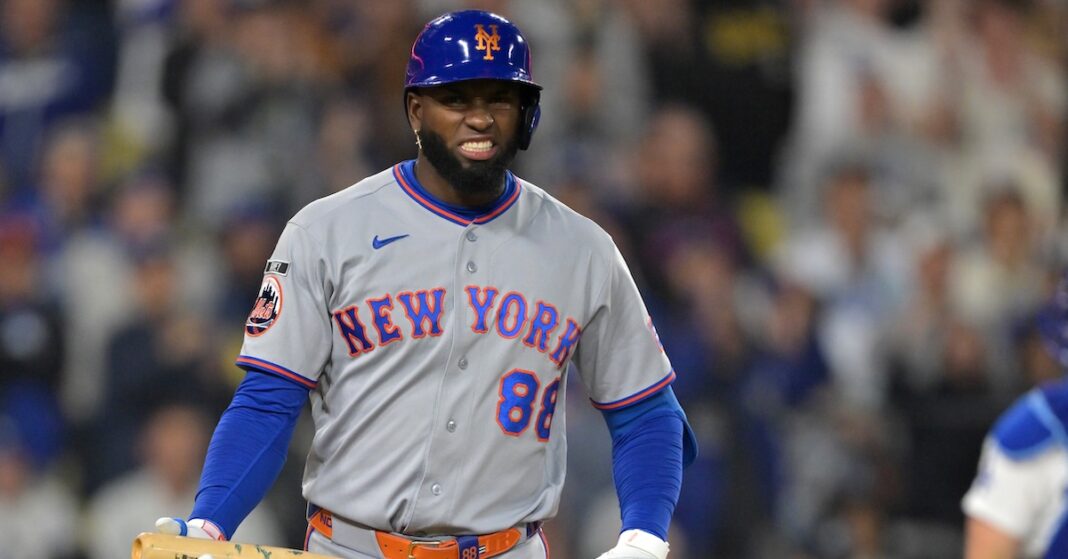

With big expectations entering the season, the New York Mets got off to a reasonably solid start; through their first 11 games, they had a 7-4 record and a half-game lead in the NL East. Since then, though, things have gone… less well. And after getting swept by the Chicago Cubs over the weekend, the team is now sitting on an 11-game losing streak, a skid that has dropped them into last place in the NL East, a full 8 1/2 games behind the Atlanta Braves. So, just how doomed are the Mets?
While you can’t win a pennant in April, you can certainly lose one. As my colleague Jay Jaffe noted last week, when the Mets’ losing streak stood at a mere eight games, the offense bears a large share of the blame. They’ve scored just 19 runs since the streak began, and have managed even three runs in just two of those games. The Royals, the next-worst offense over their last 11 games, have scored more than 50% more runs than the Mets (31 to 19), and considering they’re 2-9 over that stretch, it’s not like they’re cruising either. The loss of Juan Soto to a strained calf muscle is significant, but it’s hard to pin the team’s offensive woes solely on that. Their 1.7 runs per game is about three runs off both the 4.7 they scored last year and what ZiPS projected for this year, and no hitter in history has made that big of a difference.
After crunching the up-to-date NL East ZiPS standings, you can see a significant contrast from the preseason projections:
ZiPS Projected Standings – NL East (4/21)
| Team | W | L | GB | Pct | Div% | WC% | Playoff% | WS Win% | 80th | 20th |
|---|---|---|---|---|---|---|---|---|---|---|
| Atlanta Braves | 88 | 74 | — | .543 | 40.4% | 21.3% | 61.7% | 4.2% | 95.9 | 79.6 |
| Philadelphia Phillies | 86 | 76 | 2 | .531 | 31.9% | 23.1% | 55.0% | 5.8% | 94.1 | 78.5 |
| New York Mets | 84 | 78 | 4 | .519 | 20.7% | 22.2% | 42.9% | 3.4% | 91.0 | 76.2 |
| Miami Marlins | 76 | 86 | 12 | .469 | 6.9% | 12.0% | 18.9% | 0.6% | 85.0 | 69.3 |
| Washington Nationals | 64 | 98 | 24 | .395 | 0.1% | 0.4% | 0.6% | 0.0% | 71.5 | 56.5 |
Forecast to finish second in the division, the Mets and Braves have flipped spots in the projections over the first three weeks of the season. If you squint, there’s at least a tiny bit of good news, in that the projections don’t think that the Mets have sealed their fate quite yet. Coming back to win the division is more than merely theoretical, and they’re still nearly a coin flip to make the playoffs. In a million simulations of the rest of the 2026 season, a team with 85 or fewer wins grabbed the final Wild Card spot 47% of the time. A Wild Card series isn’t the most ambitious goal, but given how the last couple weeks have gone, it feels like a decent consolation prize. The Philadelphia Phillies have also been pretty terrible recently, just not as notoriously, so the Mets have only really been lapped by one divisional rival.
Naturally, though, there’s a lot of bad news. Coming into the season, the Mets had a 65.7% chance of making the playoffs, the third-best probability in the National League. After 11 games, they had peaked over the 70% mark. So dropping to 42.9% this early and this quickly is a notable collapse. It’s also a milder collapse compared to some other systems. The FanGraphs playoff odds tend to be more certain than ZiPS, and per those odds, the Mets have dropped from 83.5% to 41.1% over the losing streak. That’s basically losing nearly half a playoff spot in two weeks!
Unfortunately, the history of teams with double-digit losing streaks doesn’t offer many positive vibes to bolster Mets fans. Going back to 1901, there have been 376 teams that have had at least one 10-game losing streak during the season. They averaged a .409 winning percentage during those seasons, or about a 66-96 record per 162 games. Less than 10% of those teams finished with at least a .500 record, and only four made the playoffs: the 1951 Giants, the 1982 Braves, the 2017 Dodgers, and the 2025 Guardians. Those Dodgers finished with 104 wins! But there’s already a bit of selection bias in there. Most teams that have 10-game losing streaks are lousy teams that expected to be lousy.
You Aren’t a FanGraphs Member
It looks like you aren’t yet a FanGraphs Member (or aren’t logged in). We aren’t mad, just disappointed.
We get it. You want to read this article. But before we let you get back to it, we’d like to point out a few of the good reasons why you should become a Member.
1. Ad Free viewing! We won’t bug you with this ad, or any other.
2. Unlimited articles! Non-Members only get to read 10 free articles a month. Members never get cut off.
3. Dark mode and Classic mode!
4. Custom player page dashboards! Choose the player cards you want, in the order you want them.
5. One-click data exports! Export our projections and leaderboards for your personal projects.
6. Remove the photos on the home page! (Honestly, this doesn’t sound so great to us, but some people wanted it, and we like to give our Members what they want.)
7. Even more Steamer projections! We have handedness, percentile, and context neutral projections available for Members only.
8. Get FanGraphs Walk-Off, a customized year end review! Find out exactly how you used FanGraphs this year, and how that compares to other Members. Don’t be a victim of FOMO.
9. A weekly mailbag column, exclusively for Members.
10. Help support FanGraphs and our entire staff! Our Members provide us with critical resources to improve the site and deliver new features!
We hope you’ll consider a Membership today, for yourself or as a gift! And we realize this has been an awfully long sales pitch, so we’ve also removed all the other ads in this article. We didn’t want to overdo it.
Since FanGraphs started running playoff odds in 2014, there have been 35 teams with a 10-game losing streaks, for a total of 38 non-overlapping streaks (the 2021 Orioles had two disconnected streaks, while the 2024 White Sox had three). And yes, these were teams that far more often than not were projected to be uncompetitive:
FanGraphs Preseason Projections for Teams with 10-plus Loss Streaks
| Team | Losing Streak | Preseason W | Preseason L |
|---|---|---|---|
| 2017 Los Angeles Dodgers | 11 | 96.6 | 65.4 |
| 2026 New York Mets | 11 | 89.9 | 72.1 |
| 2014 Boston Red Sox | 10 | 88.2 | 73.8 |
| 2014 Tampa Bay Rays | 10 | 86.3 | 75.7 |
| 2022 Los Angeles Angels | 14 | 83.3 | 78.7 |
| 2016 Tampa Bay Rays | 11 | 80.9 | 81.1 |
| 2016 Los Angeles Angels | 11 | 80.7 | 81.3 |
| 2018 San Francisco Giants | 11 | 80.5 | 81.5 |
| 2023 Chicago White Sox | 10 | 79.7 | 82.3 |
| 2021 Chicago Cubs | 12 | 79.5 | 82.5 |
| 2021 Chicago Cubs | 11 | 79.5 | 82.5 |
| 2025 Cleveland Guardians | 10 | 79.1 | 82.9 |
| 2016 Minnesota Twins | 13 | 77.8 | 84.2 |
| 2021 Kansas City Royals | 11 | 77.7 | 84.3 |
| 2024 Pittsburgh Pirates | 10 | 77.5 | 84.5 |
| 2025 Athletics | 11 | 76.1 | 85.9 |
| 2022 Cincinnati Reds | 11 | 75.4 | 86.6 |
| 2022 Chicago Cubs | 10 | 74.8 | 87.2 |
| 2023 Pittsburgh Pirates | 10 | 74.4 | 87.6 |
| 2015 Cincinnati Reds | 13 | 74.2 | 87.8 |
| 2015 Colorado Rockies | 11 | 74.2 | 87.8 |
| 2015 Atlanta Braves | 12 | 73.5 | 88.5 |
| 2021 Arizona Diamondbacks | 17 | 72.4 | 89.6 |
| 2023 Kansas City Royals | 10 | 72.4 | 89.6 |
| 2025 Washington Nationals | 11 | 71.9 | 90.1 |
| 2016 Cincinnati Reds | 11 | 71.4 | 90.6 |
| 2018 Kansas City Royals | 10 | 70.9 | 91.1 |
| 2018 Detroit Tigers | 11 | 69.9 | 92.1 |
| 2019 Kansas City Royals | 10 | 69.8 | 92.2 |
| 2021 Texas Rangers | 12 | 69.8 | 92.2 |
| 2023 Oakland Athletics | 11 | 68.7 | 93.3 |
| 2022 Oakland Athletics | 10 | 68.5 | 93.5 |
| 2019 Detroit Tigers | 10 | 68.0 | 94.0 |
| 2024 Chicago White Sox | 21 | 66.3 | 95.7 |
| 2024 Chicago White Sox | 14 | 66.3 | 95.7 |
| 2024 Chicago White Sox | 12 | 66.3 | 95.7 |
| 2021 Pittsburgh Pirates | 10 | 66.2 | 95.8 |
| 2021 Baltimore Orioles | 19 | 64.8 | 97.2 |
| 2021 Baltimore Orioles | 14 | 64.8 | 97.2 |
Only five of the teams with long losing streaks had preseason projections that forecast them to finish .500 or better. So the Mets have naturally more reason for optimism than the usual losing-streak team.
But that also raises a question: Just how accurate are the projections for teams with long losing streaks? That’s an important question for teams like the Mets, because their viability for 2026 depends on the projections being right. Long streaks are tricky in baseball, both for players and teams. For example, there are more hitting streaks and no-hitters than you expect from random chance. This is also true for teams, and while projections are generally calibrated quite well overall, there are still moderately more very long losing and winning streaks than you would expect. If the projections are flawed, then so is having hope! Unfortunately, ZiPS doesn’t have a daily standings update, and while I can construct them historically, it would take a couple of weeks, by which time the Mets will (probably) have seen their losing streak end. Luckily, the FanGraphs Depth Chart projections update daily:
Double-Digit Losing Streaks, 2014-2026
| Team | Losing Streak | Expected W | Expected L | Actual W | Actual L | Diff | Playoffs |
|---|---|---|---|---|---|---|---|
| 2024 Chicago White Sox | 21 | 46.3 | 115.7 | 41 | 121 | -5.3 | |
| 2021 Baltimore Orioles | 19 | 53.2 | 108.8 | 52 | 110 | -1.2 | |
| 2021 Arizona Diamondbacks | 17 | 60.0 | 102.0 | 52 | 110 | -8.0 | |
| 2022 Los Angeles Angels | 14 | 81.5 | 80.5 | 73 | 89 | -8.5 | |
| 2021 Baltimore Orioles | 14 | 61.3 | 100.7 | 52 | 110 | -9.3 | |
| 2024 Chicago White Sox | 14 | 56.2 | 105.8 | 41 | 121 | -15.2 | |
| 2015 Cincinnati Reds | 13 | 64.4 | 97.6 | 64 | 98 | -0.4 | |
| 2016 Minnesota Twins | 13 | 62.5 | 99.5 | 59 | 103 | -3.5 | |
| 2015 Atlanta Braves | 12 | 65.1 | 96.9 | 67 | 95 | 1.9 | |
| 2021 Chicago Cubs | 12 | 69.8 | 92.2 | 71 | 91 | 1.2 | |
| 2021 Texas Rangers | 12 | 61.4 | 100.6 | 60 | 102 | -1.4 | |
| 2024 Chicago White Sox | 12 | 40.5 | 121.5 | 41 | 121 | 0.5 | |
| 2026 New York Mets | 11 | 82.7 | 79.3 | ? | ? | ? | |
| 2017 Los Angeles Dodgers | 11 | 103.4 | 58.6 | 104 | 58 | 0.6 | x |
| 2025 Athletics | 11 | 73.6 | 88.4 | 76 | 86 | 2.4 | |
| 2016 Cincinnati Reds | 11 | 61.9 | 100.1 | 68 | 94 | 6.1 | |
| 2021 Kansas City Royals | 11 | 77.5 | 84.5 | 74 | 88 | -3.5 | |
| 2025 Washington Nationals | 11 | 70.2 | 91.8 | 66 | 96 | -4.2 | |
| 2018 Detroit Tigers | 11 | 68.9 | 93.1 | 64 | 98 | -4.9 | |
| 2015 Colorado Rockies | 11 | 72.5 | 89.5 | 68 | 94 | -4.5 | |
| 2016 Los Angeles Angels | 11 | 70.9 | 91.1 | 74 | 88 | 3.1 | |
| 2018 San Francisco Giants | 11 | 74.7 | 87.3 | 73 | 89 | -1.7 | |
| 2021 Chicago Cubs | 11 | 80.6 | 81.4 | 71 | 91 | -9.6 | |
| 2016 Tampa Bay Rays | 11 | 74.8 | 87.2 | 68 | 94 | -6.8 | |
| 2022 Cincinnati Reds | 11 | 70.1 | 91.9 | 62 | 100 | -8.1 | |
| 2023 Oakland Athletics | 11 | 55.3 | 106.7 | 50 | 112 | -5.3 | |
| 2025 Cleveland Guardians | 10 | 77.2 | 84.8 | 88 | 74 | 10.8 | x |
| 2023 Pittsburgh Pirates | 10 | 74.8 | 87.2 | 76 | 86 | 1.2 | |
| 2022 Chicago Cubs | 10 | 69.2 | 92.8 | 74 | 88 | 4.8 | |
| 2024 Pittsburgh Pirates | 10 | 76.7 | 85.3 | 76 | 86 | -0.7 | |
| 2021 Pittsburgh Pirates | 10 | 63.1 | 68.9 | 61 | 101 | -2.1 | |
| 2022 Oakland Athletics | 10 | 63.3 | 98.7 | 60 | 102 | -3.3 | |
| 2014 Tampa Bay Rays | 10 | 75.7 | 86.3 | 77 | 85 | 1.3 | |
| 2019 Kansas City Royals | 10 | 69.0 | 93.0 | 59 | 103 | -10.0 | |
| 2018 Kansas City Royals | 10 | 56.6 | 105.4 | 58 | 104 | 1.4 | |
| 2023 Kansas City Royals | 10 | 58.5 | 103.5 | 56 | 106 | -2.5 | |
| 2014 Boston Red Sox | 10 | 81.4 | 80.6 | 71 | 91 | -10.4 | |
| 2023 Chicago White Sox | 10 | 72.8 | 89.2 | 61 | 101 | -11.8 | |
| 2019 Detroit Tigers | 10 | 67.8 | 95.2 | 47 | 114 | -20.8 |
The column for expected wins and losses is the team’s projection as of the day after the final game of the losing streak, not the preseason projection, meaning that the projected win-loss record contains information about the losing streak and its negative effect on expectations. The rest-of-season projections missed high by about three wins on average. There’s an important caveat, however: Two-thirds of the streaks ended before the trade deadline, and the vast majority of those teams subsequently traded away some of their players with value. If we look at the trades of the teams involved, including acquisitions, the players the traded away added 2.8 wins to other teams on average.
So there’s no particular reason to distrust the Mets’ projections, at least in terms of the ability to project teams in this deep of a funk. But that doesn’t mean the Mets should sit around and just wait for things to happen. It would have been nice if Jacob Reimer had gotten off to a blazing start and forced the Mets’ hand, but he’s been rather cold at Double-A Binghamton. Without professional outfield experience outside of the Arizona Fall League, he also covers the same positions as Mark Vientos, who doesn’t have any options remaining. MJ Melendez has performed well in his few games since being called up, but Ryan Clifford is probably the most intriguing option. While he hasn’t gotten off to a particularly good start, he at least is hitting the ball incredibly hard, with his 65.7% hard-hit rate leading Triple-A hitters who have faced at least 100 pitches.
Outside of options like those, the Mets don’t really have a great deal of flexibility. It’s still far too early for losing teams to throw in the towel, and of the clubs that are still mired in single-digit win territory, only the Rockies and White Sox were expected to be bad anyway. Moving on from Bo Bichette would be a wild overreaction, and while Marcus Semien might actually be toast offensively, it’s difficult to pull the plug on a player who has nearly three seasons remaining on a contract that you just picked up the past offseason. Similarly, the two most disappointing pitchers on the roster, Kodai Senga and Devin Williams, aren’t the sorts of players the team is going to just give up on.
The best realistic option for the Mets right now might be to batten down the hatches, and just wait and see how they fare in the next month or two. Perhaps a change in approach at the plate is in order as well; the Mets have gone from being the fifth-best team in 2025 at not offering at out-of-zone pitches (26.3%) to the fourth worst (32.2%). I also wouldn’t necessarily count on manager Carlos Mendoza’s job security; he only has a club option for the 2027 season, and firing the manager is one of the few ways that teams in the Mets’ position have to show that they are Doing Something. Mets president of baseball operations David Stearns has supported Mendoza publicly, but if I had a dollar for every time a team expressed confidence in its manager before dropping the axe, I’d be making money in a very weird way (sorry, can’t resist the Hedberg joke).
Maybe all the Mets and their fans can do is wait and hope. Granted, that’s a pretty scary prospect when you’re a fan of the Mets.