
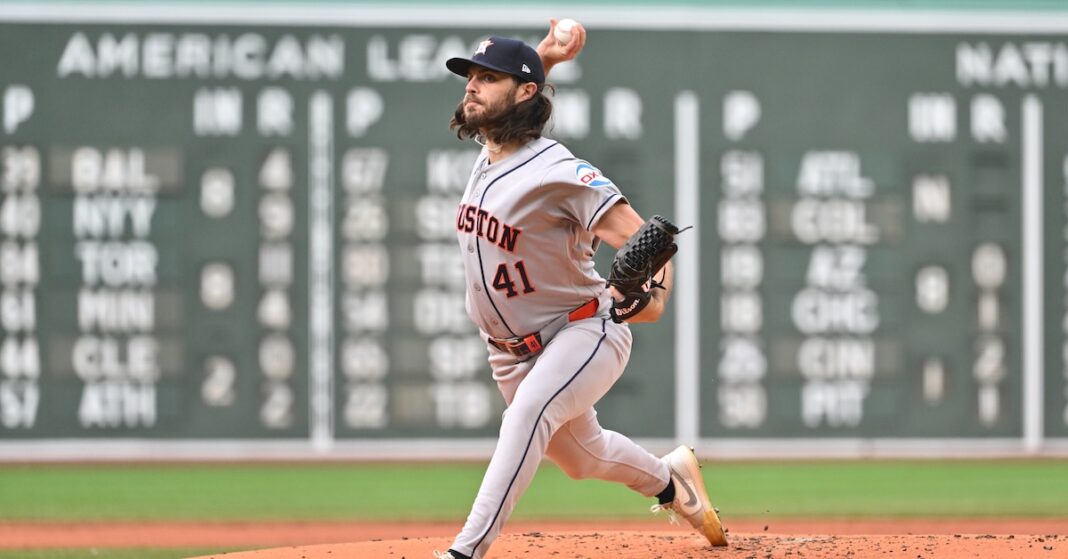

Spencer Arrighetti has twice been featured here at FanGraphs in standalone fashion, yours truly having interviewed the 26-year-old Houston Astros right-hander in April and August of his 2024 rookie season. On both occasions, he displayed an impressive knowledge of pitching analytics, as well as a thoughtful overall approach to his craft.
Our third conversation ended up focusing on his curveball. Arrighetti has been throwing the pitch at 31.4% clip this season, and not only has it been his most-used offering, it has been highly effective. As of this writing, it has yielded a .121 batting average and a .151 slugging percentage while eliciting a hefty 50.9% whiff rate. Arrighetti, who took the mound just seven times last season due to a fractured thumb and then right elbow inflammation, has made five starts this year to the tune of a 4-1 record and a 1.88 ERA over 28 2/3 innings. I spoke with him about his curve at Fenway Park earlier this month.
———
David Laurila: You’re throwing a lot more curveballs than in years past. Why is that?
Spencer Arrighetti: “Before I got hurt, it was a top-10 curveball in baseball. That makes me feel confident to throw it to whomever, and at any time in the count. Having a pitch like that goes a long way, especially as a starting pitcher. I’ve just leaned into it a little more this year. In the past, I had the thought process that to get a chase or a whiff on a curveball, you had to set it up with a fastball — something harder in the zone — in order to make a hitter be early on it, or to be off of the shape. I’ve kind of found that there are guys that I can just spam it to. I can throw it as many times as I want, in the zone, out of the zone, and get good results.
“My velocity is also a little down this year, and that’s probably another reason I’ve shied away from fastballs at certain points — although I think I threw 35%, or maybe even 40% fastballs the other night against the Yankees. I had really good feel for it, really good command for the top rail. The two pitches play off of each other. When I can face a lefty and have command of the fastball away, and up-and-away, and then throw a sweepy curveball off of it, it’s a tough tunnel to follow.
You Aren’t a FanGraphs Member
It looks like you aren’t yet a FanGraphs Member (or aren’t logged in). We aren’t mad, just disappointed.
We get it. You want to read this article. But before we let you get back to it, we’d like to point out a few of the good reasons why you should become a Member.
1. Ad Free viewing! We won’t bug you with this ad, or any other.
2. Unlimited articles! Non-Members only get to read 10 free articles a month. Members never get cut off.
3. Dark mode and Classic mode!
4. Custom player page dashboards! Choose the player cards you want, in the order you want them.
5. One-click data exports! Export our projections and leaderboards for your personal projects.
6. Remove the photos on the home page! (Honestly, this doesn’t sound so great to us, but some people wanted it, and we like to give our Members what they want.)
7. Even more Steamer projections! We have handedness, percentile, and context neutral projections available for Members only.
8. Get FanGraphs Walk-Off, a customized year end review! Find out exactly how you used FanGraphs this year, and how that compares to other Members. Don’t be a victim of FOMO.
9. A weekly mailbag column, exclusively for Members.
10. Help support FanGraphs and our entire staff! Our Members provide us with critical resources to improve the site and deliver new features!
We hope you’ll consider a Membership today, for yourself or as a gift! And we realize this has been an awfully long sales pitch, so we’ve also removed all the other ads in this article. We didn’t want to overdo it.
“The results are speaking for themselves. I obviously don’t want to jinx anything, because I am going to keep throwing my curveball a lot. But yeah, the increased usage is more of a confidence thing, understanding that when I execute it, it is one of the best pitches in major league baseball.”
Laurila: Was throwing more curveballs a plan coming into the season, or has the higher usage been more organic?
Arrighetti: “It’s more organic, honestly. The last couple of years I’ve tried not to make my game plan so much based on analytics, but rather kind of do what’s working. Right now, every time I throw a pitch, it’s the one I firmly believe in the most. I would be okay going to sleep at night if it gets hit over the fence in a big spot in the game.
“That’s something I wasn’t really doing a ton of my rookie season. I tried to have feel and analytics kind of meet in the middle, and be the reason I’d throw something. Now I’m only throwing the one I believe in the most. My belief in that pitch is higher than it’s ever been, which makes me shake to it, or just throw it every time it gets called. I believe that it’s going to yield a good result.”
Laurila: Is it basically always the same curveball, or do you manipulate it for different shapes and velocities?
Arrighetti: “I can manipulate it a little bit. There are certain hitters where speed is the reason why they’ll have better or worse results. I can throw it slower in the zone when I know that a guy struggles with pitches below a certain velocity threshold, because their swing gets going faster, or they have trouble slowing it down, kind of backing off to reload and then swing.
“It’s funny to talk about it in a vacuum, because it never really happens in a vacuum in baseball — the context being, ‘How did I get to this count?’ where I know that the speed is going be the difference, and not necessarily the shape. A lot of times, that depends on being able to throw good fastballs in the zone, as I was saying a little bit earlier. But I would say the manipulation, for me, more so comes down to speed, understanding when I can take a little bit off, knowing that the results are going to be good. The same could be said for throwing it harder. I’ll add a little more sharp movement, as opposed to maybe bigger movement. They all have their own time and place to the right guy.”
Laurila: Sequencing and setting up pitches matters…
Arrighetti: “Yes. That goes back to the fastball. You have to give him a reason to try to get his foot down early and the swing going. I think my average curveball velocity this year is probably somewhere around 76 [mph], and the heater is probably in the 92-94 range. It’s a big enough speed gap that… I can’t really give it a quantitative number, but I do firmly believe that, on average, they are early enough to where the ball isn’t quite into the hitting zone by the time the barrel is getting there. That’s a very good thing.”
Laurila: Could you picture yourself throwing more curveballs than fastballs over the course of a season?
Arrighetti: “No, I don’t think that’s sustainable at all. Not necessarily from a results standpoint, but more so from a continuing-to-feel-good standpoint. The curveball is a higher-stress pitch, especially if I’m trying to throw it really hard. That’s another reason why I’ve kind of leaned into being OK with it being slower; it just feels better on the elbow, feels better on the shoulder. It feels sustainable that way.
“My rookie year, the average velocity of my curveball was probably two or three miles per hour higher, because I would try to throw it as hard as I could every time. I’ve come around to understanding that that isn’t at all necessary. If anything, it’s something that would be a limiting factor in my ability to throw it more.
“I think that I will always mix well, but again, I don’t think I’ll ever throw more curveballs than fastballs. If I were a reliever, I think it would be easy to do that. With a smaller sample, I’m going to throw the one that I believe in the most, and that I believe is the best analytical result, more often or not. But as a starting pitcher, having to face a guy three times, you have to be able to throw your fastball a lot.”
Laurila: You obviously had the elbow issue last year, though it didn’t require surgery.
Arrighetti: “I had a sprain in my UCL, and I attribute that to a mechanical adjustment I’d made trying to throw harder, more so than to me upping the spin usage. The evidence for that would be, this year my mechanics are feeling more similar to where they were in 2024. I’m able to throw the curveball a lot more without pain. I’m able to throw the slider a lot more without pain. It came down to an intent-related thing. Knowing when to step on the gas, and knowing when I don’t need to, has gone a long way. I don’t really have any concerns with the elbow at this point.”
Laurila: Your curveball certainly came back just fine after the time missed.
Arrighetti: “I didn’t throw for 16 weeks out of the year. I typically throw year round. I don’t really take a break when the season ends, because I feel like that’s kind of a one-way ticket to losing feel for certain things, especially certain grips, or just your mechanics as a whole. But as soon as my mechanics felt good again, the spin was back.
“With pitchers who have surgery, you kind of have a little bit of a mental block when it comes to spinning the ball, because you feel that’s probably how you got hurt in the first place. But [that] wasn’t the case for me. Again, I don’t really attribute any of the elbow soreness that I was experiencing to spinning the ball. That’s something that has always come pretty easily for me, and not something that would damage my elbow.”