

The anniversary tournament of the Dresden Chess Club of 1876, held in 1926 to mark the club’s 50th birthday, produced a number of remarkable games. One game stood out in particular: Aron Nimzowitsch’s win with black against Swiss representative Paul Johner, in which the great theoretician demonstrated his blockade strategy in textbook fashion. Nimzowitsch rightly received the first brilliancy prize for this game.
Nimzowitsch, originally Nemcovic – meaning “the German” – was born on 7 November 1886 in Riga, Latvia, then part of Russia, as the child of wealthy German-speaking Jewish parents. He moved to Berlin in 1904 and studied philosophy there, but soon abandoned his studies in favour of chess and thereafter lived as a professional player. After the First World War, Nimzowitsch first moved to Sweden in 1920 and lived from 1922 until his death, on 16 March 1935, in Copenhagen, Denmark.
In the period before the First World War, Nimzowitsch was, according to the calculations of the statistician Jeff Sonas, among the world’s top five players for quite a while. After the post-war depression, he even reached third place in the late 1920s and early 1930s in this retrospectively calculated list of historical Elo ratings, behind Alexander Alekhine and José Raúl Capablanca.
Bent Larsen (1935–2010) was the greatest chess player in Danish history, and for a time, the second-strongest player in the Western world behind Bobby Fischer. Between 1954 and 1971, he won the Danish Championship six times, and achieved numerous international tournament victories throughout his career.
Free video sample: Introduction to Bent Larsen by Peter Heine Nielsen
Free video sample: Introduction to the Opening Section
The documented history of chess in Dresden goes back to the 1840s. As in many other cities, Dresden chess enthusiasts regularly met in cafés – at Café Meißner, Café Français or “The Three Ravens”. In the 1860s and 1870s, the first chess clubs were founded, though they did not endure. On 13 May 1876, the Dresden Chess Club was finally founded at Café König, as the successor to the Dresden Chess Society. The chess enthusiasts of the Dresden Chess Club were subsequently very active, publishing compositions, issuing the Dresdner Schachblätter and organising tournaments. Members of the club were also active in the Saxon Chess Federation.
To mark the 50th anniversary of its founding, the Dresden Chess Club organised a splendid anniversary tournament with ten participants, embedded within the Saxon Chess Congress of 1926 and several other tournaments and events.
Alexander Alekhine was not yet world champion in April 1926, when the tournament took place, but according to Jeff Sonas’ lists he was already number two in the world rankings, behind Emanuel Lasker and ahead of Efim Bogoljubow and José Raúl Capablanca. Nimzowitsch was number five, but since Lasker, Bogoljubow and Capablanca were not playing in Dresden, Nimzowitsch and Alekhine were among the top favourites to win the tournament. As for the remaining players, Akiba Rubinstein – though no longer as strong as before the First World War – and Savielly Tartakower certainly belonged to the world elite as well.
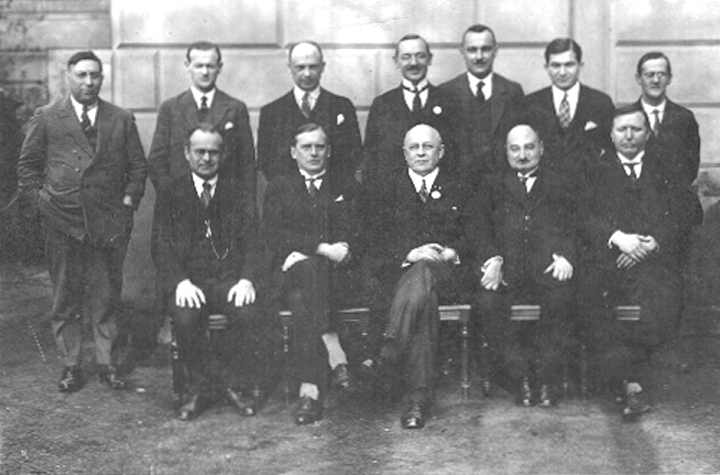
Standing: Akiba Rubinstein, Friedrich Saemisch, Savielly Tartakower, Christof Jobst, Max Blümich, Lajos Steiner, Frederick Yates | Seated: Aron Nimzowitsch, Alexander Alekhine, Otto Krueger, Walther von Holzhausen, Paul F. Johner
Nimzowitsch, Alekhine and Rubinstein began the tournament as expected, each with two wins. In round three, the first top clash between Alekhine and Nimzowitsch took place. That game ended in a draw, while Rubinstein was able to defeat Saemisch and thus took the sole lead.
In round four, Rubinstein defeated Max Bluemich from Leipzig, the long-serving president of the Saxon Chess Federation, who later, as an avowed National Socialist, cast a dark shadow over his achievements as a chess organiser.
Nimzowitsch defeated Tartakower in that round, while Alekhine dropped half a point against Paul Johner.
In the following fifth round, Nimzowitsch managed to defeat tournament leader Rubinstein, thereby taking the lead himself. Alekhine beat Tartakower and, together with Rubinstein, stood half a point behind Nimzowitsch. The gap between the leading group and the rest of the field was now already 1½ points.
In the chasing duel between Alekhine and Rubinstein in round six, Alekhine prevailed, but he could not reduce the gap to Nimzowitsch, as the latter also scored against Lajos Steiner. The Hungarian-born Lajos Steiner, then only 25 years old, came from a chess family and played for Hungary in three Chess Olympiads in the early 1930s. At the beginning of the Second World War, Steiner, who was Jewish by birth, immigrated to Australia, where for a long time he was the country’s strongest player.
Both Nimzowitsch and Alekhine also scored full points in the seventh round, so there was no change at the top. In the final two rounds, Nimzowitsch won against Walter von Holzhausen and Friedrich Saemisch. Alekhine, by contrast, ran out of steam. The future world champion Alekhine could not get beyond draws against Frederick Yates and Von Holzhausen.
The Austrian Baron Walter von Holzhausen was an illustrious figure with a lively past. His passion was chess composition. As a major during the First World War, he had been taken prisoner by Russia and taught the other prisoners chess in the camp. He also published a chess camp newspaper there and assembled a large collection of chess problems. However, both were lost when he escaped from the camp.
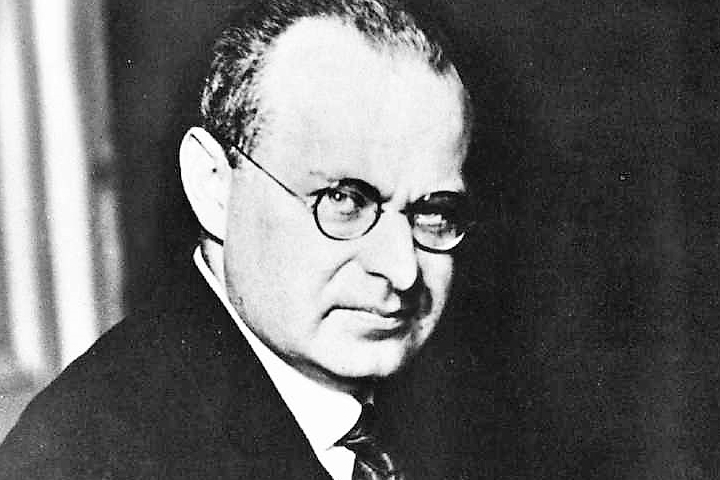
Aron Nimzowitsch
In the end, Aron Nimzowitsch won the tournament by a full point. He received the first prize of 1,000 marks, donated by Haus Bergmann Zigarettenfabrik AG. Alekhine received 800 marks for second place, Rubinstein 600 marks for third, and Tartakower 400 marks for fourth. Baron von Holzhausen was the best non-grandmaster and was awarded 200 marks, donated by Geheimrat Arnold.
The first brilliancy prize, which Nimzowitsch received for his game against Paul Johner, consisted of 5,000 Gildehof cigarettes, donated by the Dresden tobacco factory Haus Bergmann. After the Second World War, Haus Bergmann AG was taken over by British American Tobacco (BAT). The popular BAT brand “HB” long remained a reference to Haus Bergmann.
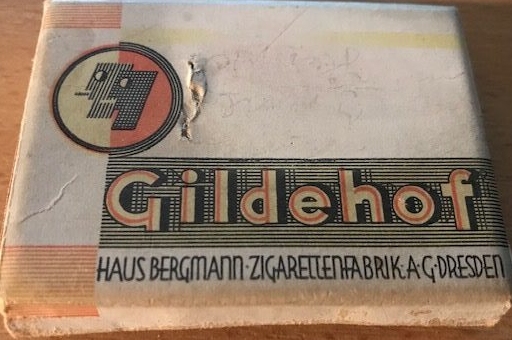
Alekhine and Nimzowitsch shared the second brilliancy prize for their games against Rubinstein, receiving 2,500 cigarettes each. Whether Nimzowitsch was pleased about the brilliancy prize is doubtful. He had been a heavy smoker in his youth, but had been forced to give up the habit for health reasons, and had subsequently developed a strong aversion to the smell of tobacco.
A famous anecdote tells that Nimzowitsch once complained to the arbiter at a tournament because his opponent had put a cigarette in his mouth.
“But he hasn’t even lit it yet”, replied the arbiter.
“The threat is stronger than the execution”, Nimzowitsch is said to have answered.