
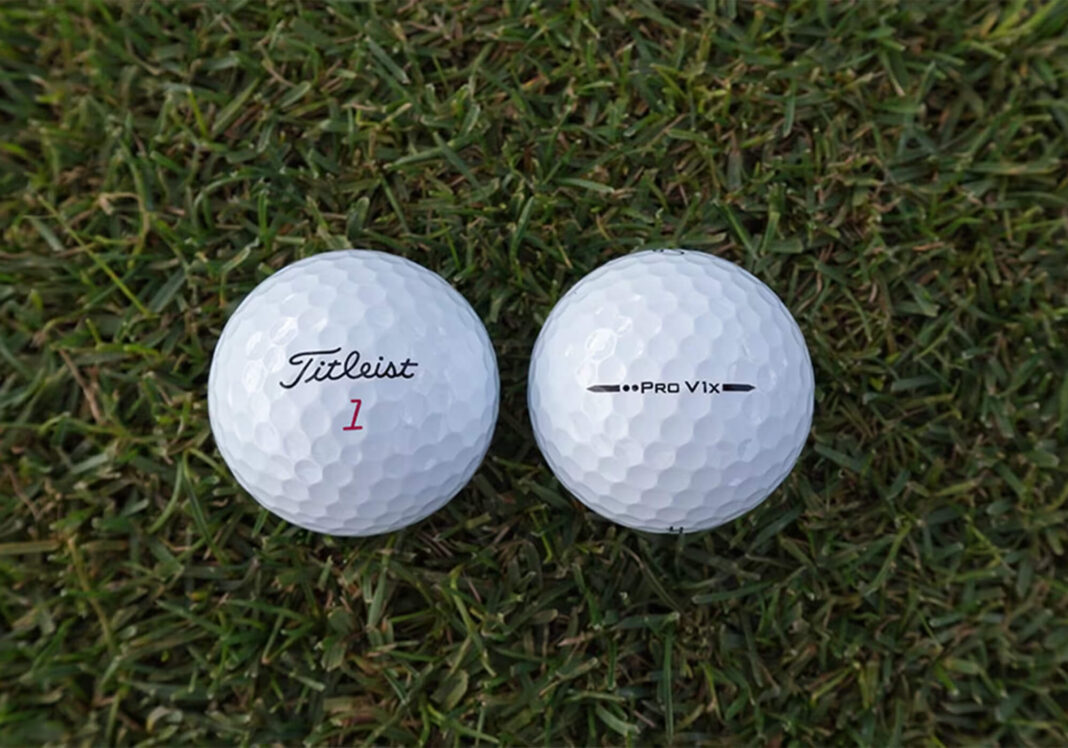

Cam Young is winning with a ball that likely conforms to the USGA’s 2030 rollback. The story behind it suggests the math doesn’t work the way the governing bodies have been selling it.
When word got out that Cam Young’s Pro V1x Double Dot would likely conform under the USGA’s revised Overall Distance Standard, the easy read was that an elite player tripped into a Trojan horse. He’s bombing it 375 yards down the 72nd hole at TPC Sawgrass. He’s won The Players, the Wyndham and the Cadillac Championship. He’s doing all of it with a ball Titleist designed to be lower flying and lower spinning. The ball also, apparently, threads the needle on the rollback rule the USGA hasn’t even implemented yet.
Uh oh? Oopsie?
The fundamental question raised is this: Did the USGA get it wrong when it claimed that distance lost to the rollback would be linear with swing speed?
I’d wager that what we’re learning from Cam Young and his Double Dot has become an uncomfortable discussion point for the people who created the 2030 test conditions and the underlying assumptions to justify them. The governing bodies’ assertions from Day One have been that, on percentage, golfers would experience equivalent dips in distance as a result of the rollback.
What we’re learning suggests something different entirely. The swing profile that makes Double Dot work for Young is exactly the swing profile most likely to fare best under a rollback. The gap between him (and others who generate similar launch conditions) and the rest of the PGA Tour isn’t going to close. It’s going to widen. That’s the asymmetric outcome the USGA’s distance math hasn’t previously acknowledged. Young doesn’t lose much of anything. The same is likely true for Bryson DeChambeau. The guys who don’t hit it as high and don’t spin it as much? Good luck, fellas. Remember to diversify your bonds.
A refresh on Cam Young’s ball
Pro V1x Double Dot is a CPO (custom performance option). Like Left Dot, it’s a Tour-only option. It’s a lower-compression, lower-flying and lower-spinning take on Pro V1x. A not insignificant detail: it’s likely the lowest-flying and lowest-spinning ball within the larger Pro V1 family.
As far as known golf ball performance levers go, dropping compression typically costs you a little speed. In Young’s case, the lower flight and tighter spin profile balance the speed loss.
In Titleist’s mini doc on Young’s fitting, JJ Van Wezenbeeck, Titleist’s Senior Director of Player Promotions, noted that his launch dropped from nine degrees to something well shy of optimal with Double Dot. The fix was an 11-degree GT3 (lofted down 0.75 degrees). That took Young’s launch from nine to 11 degrees with only a 100-rpm bump in spin (2,400 to 2,500). That’s a really tidy fitting outcome and it tells you something about how the ball plays.
Worth noting: Young is a high ball hitter. Bringing flight down doesn’t mean hitting stingers all day. It’s about lowering flight toward optimal. The same is true for the spin reduction. The ball gives him more efficient flight and tighter dispersion. The reduced spin shows up most obviously with the irons. Young says, “This ball is easier to control with the irons. It doesn’t spin as much, and it just allows me to be better with my distance control.”
I suppose that’s another detail that gets lost in the rollback debate. While the entire conversation is about reducing distance off the tee, the two most important factors when fitting a golf ball are flight and spin (not speed/compression). In their most aggressive rounds, a Tour player is going to hit his driver 14 times at most. The majority of the rest of the full swing shots are going to be with irons and wedges. It’s the reason Titleist suggests fitting the ball to the irons and the driver to the ball. That’s exactly what we see in the video.
For context, Young ranked 17th in driving distance at 313.2 yards before he switched to Double Dot. He’s averaging 312 yards this year and gained roughly 120 spots in fairway accuracy. He’s sixth on Tour in Strokes Gained: Off the Tee. The 375-yard bullet down 18 at Sawgrass was the longest drive on that hole in the Shotlink era.
All that with the heavy suggestion that the ball he’s doing it with would be conforming under the new rule.
Threading the needle
The fact that Double Dot also happens to thread the needle on the new USGA test conditions is part happy accident, part engineering inevitability. The new test parameters have been on the table for years. Manufacturers know what’s coming.
Worth a quick point of clarity: there is no 2030 conforming list yet so nobody can state with total confidence that a ball is conforming. The USGA has been quiet on the specifics of Double Dot, although there is reason to believe it has been tested. PGA Tour testing suggests it would.
The reality, and this is the part nobody really wants to say out loud, is that what’s optimal for Cam Young right now happens to align with what’s likely to be optimal under the rollback. That’s not so much coincidence as it is a design space. And, yeah, it means other Tour players who don’t operate in Young’s flight windows are going to suffer more. Which is what the USGA has said wouldn’t happen.
What the new test conditions actually do
For the uninitiated, the USGA’s current Overall Distance Standard tests golf balls at 120-mph clubhead speed, 10-degree launch and 2,520 rpm of spin. The conformance limit is 317 yards with a three-yard tolerance. Effective January 2030, the test conditions change to 125 mph, 11-degree launch and 2,200 rpm. The 317-yard limit stays put.
Higher speed, higher launch, lower spin. Same ceiling.
The new window lives in a remote corner of the launch-and-spin chart. That’s not where most Tour players live. It isn’t where most weekend chops live, either. There are probably fewer than a handful of guys on Tour who reliably play golf within that space. The new conditions appear to reward a particular kind of swing.
Whether you want to call it a loophole, a workaround or a design reality, the unlock isn’t speed. The unlock is the flight and spin profile that gets you to 317 yards (or just under) at the new test conditions.
That’s exactly what Double Dot does. Take a little speed off via lower compression and, for Young, recoup it through a lower-flight aerodynamics package and a lower-spin profile (which is driven, in part, by the lower compression). The result is a tour-caliber ball that conforms to a more restrictive test. Which is to say: less distance under the proposed test but nearly equivalent distance for a select group of players who play through high-launch and high-spin windows.
The asymmetry problem
The USGA’s underlying assertion, and the one that’s been broadly communicated to golfers, is that distance loss under the rollback will land roughly proportionally. The longest hitters lose the most. Average golfers lose a few yards. Slow swingers basically don’t notice. Nice and clean and linear. The kind of thing you can sell at a press conference.
What’s lost in the conversation is that while speed matters, flight and spin matter just as much, arguably more.
As an extreme example to hopefully put some real-world context to how this works: we’ve talked plenty about the driver speed penalty with low-compression golf balls (aka “soft is slow”). It’s also true that for a specific player launch and spin profile, Callaway’s Supersoft (a super-low compression offering that’s invariably slower off the driver), under a narrow set of conditions, can be longer than something like Pro V1x Left Dash (one of the firmest and fastest balls on the market). If the only lever you’re pulling is speed, the math doesn’t survive across the population of golfers.
In Golf Digest’s recent CEO roundtable, the moderator framed the original assumption: longest hitters lose most, shortest lose least.
Acushnet CEO David Maher’s response was direct: “We don’t see it that way.”
Maher noted that Tour testing shows non-uniform impact, with high-speed, high-launch players affected one way and lower-speed, lower-spin players affected another. Titleist’s data, per Maher, aligns with the Tour’s. Which is to say: not aligned with the USGA’s.
Maher also offered numbers that don’t get cited enough. The mean of the fastest one percent of measured clubhead speeds on the PGA Tour was flat from 2019 to 2021 and declined in 2022 and 2023. The mean of the fastest five, 10, 20 and 50 percent has been flat since 2017. Average course playing length on the PGA Tour has been under 7,200 yards every year since 2004.
The premise driving the rollback (that distance is running away unchecked) is doing more rhetorical work than statistical work. To put it another way: the USGA is offering a cure for a problem that may not be serious enough to need it.
The result of a rollback on Tour is going to be uneven. Some players will lose 12 yards. Some will lose more. Others, particularly those with swing profiles like Cam Young, will lose less. Possibly a lot less. That isn’t a hypothetical concern. It’s an emerging Tour fairness problem brought to light by Double Dot. At the Tour level, it’s a problem that has a lot of money attached to it.
So much for the renaissance
One of the friendlier arguments for the rollback, the one that doesn’t lean on yard-loss data, is that it will usher in a return to shotmaking. Working the ball. Shaping shots. Reanimating the soul of the professional game, etc.
Lovely thought. It’s also at odds with reality.
Cam Young’s results suggest the workaround for a rollback ball is lower spin and ultimately tighter dispersion. Which is to say: straighter shots, not more imaginative ones. The optimization path for a rollback environment isn’t curve. It’s control. If anything, manufacturers are going to lean further into low-spin constructions to keep Tour players competitive within the new test envelope.
If the underlying complaint is that pro golf has become too distance-centric and too narrow stylistically, creating a rule that will likely encourage more golfers to swing for the same narrow corner of the launch chart feels like an absolutely bonkers approach. The game gets more uniform, not less.
What does the USGA do now?
The OEMs are well down the road. Titleist, Callaway, TaylorMade and the rest have spent two-plus years building toward the 2030 spec. At least one of those balls (Double Dot apparently among them) is already on Tour.
The way I see it, the USGA has three options. None of them is particularly fun.
Option 1: Hold the line. Push the rollback through as scheduled. The likely outcome is that Tour pros experience uneven distance loss, the long bombers find new technical workarounds (because the design space is bigger than the USGA seems to have modeled it to be) and the public spends a few years arguing about it. The renaissance doesn’t materialize. The game gets a little shorter and a little more uniform. There’s also likely to be less parity on the leaderboards from week to week as the distance divide widens.
Option 2: Tweak the test conditions again. This is probably the most defensible move and also the one that says, in effect, “We got it wrong the first time.” Manufacturers who’ve already retooled are not going to love being asked to retool again. Delay beyond 2030? Maybe.
Option 3: Scrap it.
Pulling the plug on the rollback would be a meaningful institutional admission that the underlying premise needed more pressure testing than it got. Don’t hold your breath.
For now, what do we have? A Tour-only ball that Cam Young will tell you he’s playing for his own optimization, that happens to conform to a not-yet-active rule. A set of test conditions that were sold as fair and uniform that the PGA Tour’s testing says are neither. The asymmetry argument the USGA has dismissed since Day One is now at the forefront of the conversation. The CEO of the company that sells the most golf balls in the world is on record saying his data and the Tour’s data don’t match the USGA’s.
The Tour, which historically picks its fights carefully, seems increasingly willing to fight this one. If Double Dot becomes the template and if more Tour players start finding their way into balls like it (and they will, because that’s what optimization looks like), the pushback won’t stay polite for long.
Young probably didn’t blow up the rollback all by himself. But his results, his ball and his fitting story laid out the case the USGA didn’t want made in public, with timing the USGA can’t really do anything about.
The rest is what the USGA decides to do next.
Let us know where you land. Was the rollback wrong from the jump, a good idea executed poorly or a fix that was never going to do what its proponents wanted?
The post Did Cam Young Blow Up The USGA Ball Rollback? appeared first on MyGolfSpy.