
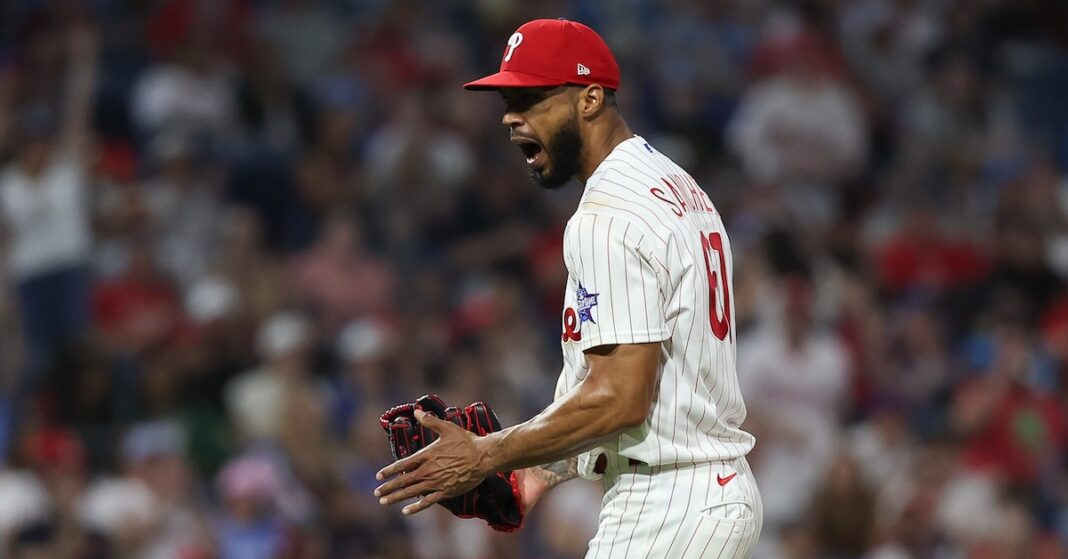

In high school statistics, we got one rule beaten into our heads over and over again: Don’t extrapolate outside the bounds of your data. Then, when we were done learning that one, we got another rule: Outliers tend to revert towards the mean. Gee, thanks a lot, Mr. Gilliam – how am I supposed to explain Cristopher Sánchez using those two rules?
Look at this table of pitching statistics. Clearly, extrapolating past the edge of Sánchez’s performance seems fine:
Cristopher Sánchez Keeps Getting Better
| Year | K% | BB% | ERA | xERA | FIP | xFIP | SIERA | WAR/200 IP |
|---|---|---|---|---|---|---|---|---|
| 2023 | 24.2% | 4.0% | 3.44 | 3.72 | 3.99 | 3.09 | 3.33 | 3.6 |
| 2024 | 20.3% | 5.8% | 3.32 | 6.3 | 3 | 3.19 | 3.58 | 5.2 |
| 2025 | 26.3% | 5.5% | 2.5 | 3.02 | 2.55 | 2.77 | 3.02 | 6.3 |
| 2026 | 29.9% | 5.2% | 1.82 | 2.74 | 1.91 | 2.27 | 2.48 | 7.8 |
We have all of these ERA estimators – FIP, xFIP, xERA, SIERA – because merely looking at someone’s ERA can be misleading. ERA is noisy. Between inherited runners, sequencing, scoring decisions, and just plain old variance, knowing a player’s ERA in one year doesn’t necessarily mean you know how well they played. The whole alphabet of advanced pitching statistics comes down to trying to solve that noise problem by focusing on indicators with greater stability.
In other words, advanced ERA estimators tend to move around less than actual ERA. It follows naturally that changes in ERA estimators are more predictive of future results than changes in ERA. When all of these markers are moving in tandem – and moving by a lot, to boot – the aggregate picture looks very different than your average pitcher with a shiny ERA early in the season.
The rate of Sánchez’s improvement is downright staggering. Consider this: From 2024 to 2025, no pitcher who threw even 100 innings lowered their SIERA by more than Sánchez. From 2025 to 2026, only nine pitchers have lowered theirs by more. Prefer FIP? Only three pitchers lowered their FIP by more than Sánchez from 2024 to 2025, and only 11 have lowered theirs by more from 2025 to 2026.
Perhaps you’d like to focus on K-BB% instead. From 2024 to 2025, well, you guessed it, no pitcher improved their K-BB% by more than Sánchez. From 2025 to 2026, only six pitchers have improved their K-BB% by more than Sánchez. He was the biggest breakout of 2025 – and he’s broken out by nearly as much again between 2025 and 2026.
You Aren’t a FanGraphs Member
It looks like you aren’t yet a FanGraphs Member (or aren’t logged in). We aren’t mad, just disappointed.
We get it. You want to read this article. But before we let you get back to it, we’d like to point out a few of the good reasons why you should become a Member.
1. Ad Free viewing! We won’t bug you with this ad, or any other.
2. Unlimited articles! Non-Members only get to read 10 free articles a month. Members never get cut off.
3. Dark mode and Classic mode!
4. Custom player page dashboards! Choose the player cards you want, in the order you want them.
5. One-click data exports! Export our projections and leaderboards for your personal projects.
6. Remove the photos on the home page! (Honestly, this doesn’t sound so great to us, but some people wanted it, and we like to give our Members what they want.)
7. Even more Steamer projections! We have handedness, percentile, and context neutral projections available for Members only.
8. Get FanGraphs Walk-Off, a customized year end review! Find out exactly how you used FanGraphs this year, and how that compares to other Members. Don’t be a victim of FOMO.
9. A weekly mailbag column, exclusively for Members.
10. Help support FanGraphs and our entire staff! Our Members provide us with critical resources to improve the site and deliver new features!
We hope you’ll consider a Membership today, for yourself or as a gift! And we realize this has been an awfully long sales pitch, so we’ve also removed all the other ads in this article. We didn’t want to overdo it.
This type of continuous and enormous improvement will mess with your head. If you’re a baseball fan but not a Phillies fan, you likely have a rough idea of Sánchez’s improvement already. But that rough idea surely came from one of the prior two years when he improved. The natural process that follows from that is to look at some leaderboards, remind yourself that Sánchez broke out last year, and go “oh, and he’s on an early hot streak too.” But that’s ignoring how much he’s improved his game from the already high level that initially gave people the heuristic that he had broken out.
How is Sánchez doing all of this breaking out? I’ll start with one thing I don’t think is helping him: a massive change in raw stuff. Anytime a pitcher starts missing this many more bats, I always assume he’s learned a new pitch, or at least completely overhauled one of his existing ones. But Sánchez’s arsenal is shockingly stable. Both of our pitch models think that all three of his pitches are about as good as they were last year. His usage rates of each are roughly unchanged. Their physical characteristics are stable. He’s just getting more out of each.
To find that extra little bit, Sánchez has followed in Zack Wheeler’s footsteps by differentiating his approach against lefties and righties. In 2024 and 2025, Sánchez used his fastball 55% of the time against lefties and 44% of the time against righties. That’s a narrow split, and entirely out of whack with how the pitch is best used. Lefties posted a .246 wOBA against it when they managed to put it in play – and they struggled to even put it in play. Sánchez’s 1.97 runs above average per 100 sinkers in those two years was the sixth-highest same-handed sinker value. The guys ahead of him are either elite starters or specialist relievers: Tyler Holton, Tim Hill, Tyler Rogers, Wheeler, and Bryan Woo.
When Sánchez threw his sinker to righties, on the other hand, it didn’t perform nearly as well. He’s allowed almost exactly league average results there – 0.06 runs above average per 100 pitches. The obvious solution was to throw fewer sinkers to righties and more to lefties. Sánchez has done just that:
Cristopher Sanchez, Sinker Usage By Handedness
| Year | Sinker% vs. LHH | Sinker% vs. RHH |
|---|---|---|
| 2024 | 56.2% | 45.2% |
| 2025 | 55.5% | 43.4% |
| 2026 | 66.5% | 38.3% |
That’s an enormous change. It doesn’t live in a vacuum, though. Now that Sánchez is throwing more sinkers to lefties and fewer to righties, he has to throw fewer of his other pitches to lefties, and more of them to righties. In both cases, he’s swapped sinkers and changeups:
Cristopher Sánchez, Changeup Usage By Handedness
| Year | Changeup% vs. LHH | Changeup% vs. RHH |
|---|---|---|
| 2024 | 25.6% | 38.1% |
| 2025 | 14.7% | 43.4% |
| 2026 | 10.2% | 45.3% |
Sánchez’s changeup has been devastating against righties and merely good against lefties. It’s a perfect complement to his sinker, which has similar characteristics in reverse. In fact, if you take the change in pitch usage in 2026 and multiply it by the by-handedness effectiveness of those pitches in 2025, Sánchez has lowered his ERA (and presumably his fancy ERA estimators) by between 0.1 and 0.2 merely by using his best pitches more often against the batters who are worst against them.
You might think that would narrow Sánchez’s platoon splits, but that’s not quite right. This plan makes him better against both righties and lefties, rather than affecting one disproportionately. And with the caveat that splits like these are incredibly noisy in small samples, some of the more stable measures of by-handedness performance agree. In his career, he’s allowed a 2.20 FIP (2.36 xFIP) against lefties and a 3.27 FIP (3.22 xFIP) against righties. In 2026, he’s allowed a 1.48 FIP (1.39 xFIP) against lefties and a 2.08 FIP (2.61 xFIP) against righties. He’s never had a better K-BB% against either handedness. If you can name a statistic other than a noisy one like BABIP, Sánchez’s by-handedness performance is probably as good in that statistic as it’s ever been.
That doesn’t explain all of Sánchez’s improvement, but it’s a good start, and in all honesty, I can’t tell you where the rest of it is coming from with any confidence. That’s how pitching is sometimes; even if you use second-order statistics to reduce the inherent variance of throwing a ball towards some guys trying to hit it with a stick, baseball players still get hot and cold, and their performance still varies over time. Sánchez is on a roll at the moment. When he has the ball on a string, it feels like it doesn’t matter who’s at the plate. But he’s going to be down at some point too. That’s just how sports work. And when he is, the changes he’s made to his pitch mix are still going to help him out.
Projecting baseball is hard for a lot of reasons, but the biggest one is that everyone on both sides is trying to get better at this zero-sum confrontation all the time. Most jobs don’t have direct adversaries. In day-to-day situations, improvement gets measured against a static target. If you get better at making spreadsheets, the spreadsheets don’t counter by hiding their data better. But baseball has never been like that.
It’s easier than at any point in the past to improve on the margins. I feel strongly about this point. The proliferation of data across all aspects of life makes it much easier to find holes in your own process, as it were. But that’s a double-edged sword in sports, where both sides have teams of analysts cranking out reports and teams of performance coaches trying to turn those numbers into actionable insights.
Why am I rambling about this in the middle of an article about Sánchez? Because I think his ascent is fascinating when viewed through this lens. Sánchez came up as a very straightforward pitcher, and quite honestly, he’s still a very straightforward pitcher. He only throws three pitches. He doesn’t mix fastballs or breaking balls, bucking the trend. Until this year, he didn’t adapt his pitch mix all that much based on his opponents.
His earlier leaps forward? Those were about throwing harder, and commanding the ball better, and general “just do the stuff you already do but better” types of additions. A generation ago, he might have stopped there. Heck, he might have stopped before there – the resources that teams and players now devote to conditioning, pitch design, and velocity training vastly outstrip past eras of the game.
This year’s change is different. It’s about how he’s using the tools he already had more effectively. It’s also a good sign for the future. If Sánchez can make these changes, why can’t he make others? Lefties probably won’t flail away quite so helplessly against Sánchez’s sinker forever, but what’s to stop him from mixing in a four-seamer to counter their adjustment? The sheer volume of changeups he’s throwing to right-handers is probably unsustainable; throw enough, and they can start sitting on a single pitch. But why not replicate the change Logan Webb made and thread in a cutter that sits halfway between the sinker and changeup horizontally?
At just 29 years old, Sánchez has a long major league career still ahead of him. He’ll surely make a number of changes to his approach, just as the hitters who he’s so comprehensively dominated in recent years will alter the way they attack him. I’m thrilled to see Sánchez start to proactively make the types of changes I’m talking about – and I’m excited to see what’s next.