
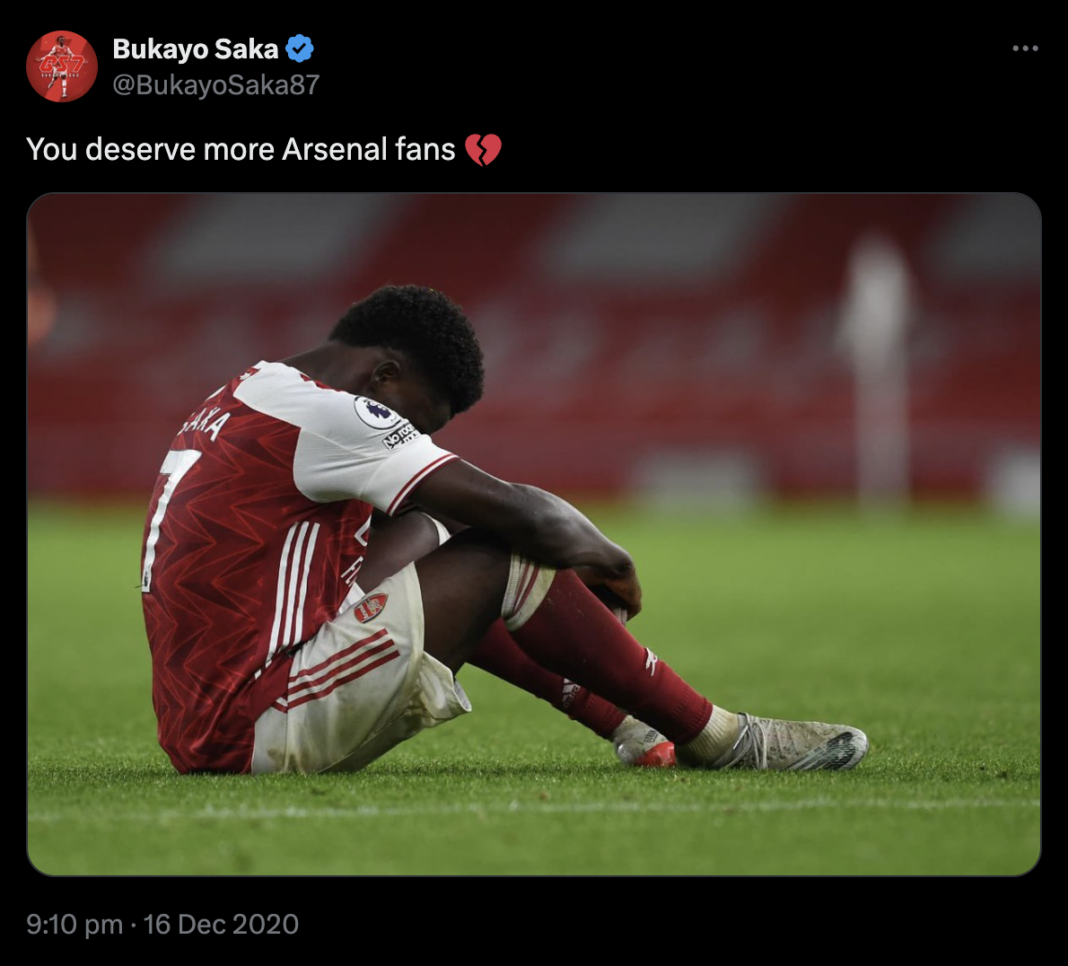

Around five-and-a-half years ago, Arsenal were 15th in the Premier League and had won two of their last 12 league games. Two of their next three, following the visit of London rivals Chelsea, were against teams below them. That spell, from Christmas to New Year, would determine whether or not the team would be plunged into a shock relegation battle.
Bukayo Saka, at the age of 19 and telling fans they deserved more, was pushed further forward and handed the responsibility to give it to us. Another 19-year-old, Gabriel Martinelli, made his first league start of the season.
Emile Smith Rowe, 20 and, like Saka, a Hale End graduate, was also handed his first start of the campaign.
In their wildest nightmares, fans, players, and Mikel Arteta would not have imagined such a desperate situation unfolding, the club teetering on the edge of disaster. Arteta chose, in that moment, to turn to two homegrown players to turn the entire club around, and they did precisely that.
Arsenal beat Chelsea (3-1) on Boxing Day to start a seven-game unbeaten run, and a new team was born. A little more than two years later, Mikel Arteta would tell a packed media room that he has “very wild dreams”. They have now been realised.
—
In the space of four weeks earlier this year, Arsenal played six games across four competitions, winning just one. Those games were book-ended by defeats to Manchester City, in the League Cup and the Premier League, and also included a nervy 180 minutes against Sporting CP in the Champions League (1-0 on aggregate), an FA Cup exit against Championship side Southampton, and a chastening league defeat against Bournemouth.
The next two games brought happier results. 1-0 against Newcastle, 1-1 against Atlético Madrid, but very little relief. With four games to go and the tension unbearable, Arteta turned to Hale End once more. When he did so in 2020, there were no fans in the stadium to offer a response. This time there were, and the trust placed in Myles Lewis-Skelly to suddenly play in midfield in place of a clearly exhausted Martin Zubimendi was rewarded with the most electrifying half of football Arsenal had played for months.
No new Arsenal was born this time, but the connection between the fans and the Arsenal that has its origin story in December 2020 was restored. An academy graduate was at the heart of it once more. The anxiety was gone, replaced by joy, hope, belief. And there has been no looking back.
—
The story of Arsenal’s title-winning team is, more than anything else, the story of the best defence on the planet.
First and foremost, everything for Mikel Arteta comes down to dominating the opposition. It begins with a high press – in the Premier League, only Brighton allow fewer passes per defensive action, and nobody performs defensive actions with a higher defensive line – Arsenal set out to win the ball high and dominate territory. The press is more often than not orchestrated by captain Martin Odegaard, relies on the running of the player leading the line, plays into the mentality and superhuman athletic abilities of Declan Rice, demands the Arsenal right-back both covers the space in behind them and closes down the opposition left-back, and leaves the centre-backs battling in high-risk situations with oceans of space behind them. It is relentless.
In arguably their best performance of the season – the 4-1 win against Aston Villa – Arsenal pressed aggressively to wrestle control of the game from one of the few teams to get the better of them this season. What is even more special, even more unique, is how Arsenal get back behind the ball again when that high press does not lead to a turnover. Arsenal get back into their 4-4-2 block with all 11 men behind the ball. There are, when it works, no gaps. There is no way through.
Arsenal keep teams away from their goal more than anyone else, conceding the fewest shots in the league by some distance, but when the ball is near the Arsenal goal they are still the best defensive side in the league. You still cannot fashion good chances. They do not give you an inch.
Arsenal have conceded the fewest shots in the league by a long distance. They have conceded just 87 shots on target – that’s 2.35 per game – the lowest in the league by a long way, and the xG per shot conceded is also the lowest in the league. Almost 38% of Arsenal’s shots conceded this season have been from outside the box, the highest proportion in the league.
Nobody has conceded fewer goals from fast breaks, nobody allows the opposition fewer touches in the box, only Brighton have conceded fewer from set pieces.
The effort, intensity, and willingness to do anything to stop a goal is embodied by Gabriel. Though Arsenal face the fewest shots in the league, he has the fourth-most blocks of any player in the Premier League. He alone has blocked 11.3% of all the shots faced by Arsenal this season. Arsenal have conceded 19 goals in his 2,706 Premier League minutes this season – a goal every 142 minutes, compared to a goal every 89 minutes when the Brazilian is not on the pitch.
Gabriel’s obvious fire and fury and strength is perfectly complemented by William Saliba’s calm. No defender in the league, per Gradient Sports, is found in the ideal defensive position more often than the Frenchman. The pair are a true fire and ice, brawn and brains combination.
And when something does get through the backline, David Raya is behind them, with perfect judgement and timing. No goalkeeper in the league is as adept at claiming crosses and Raya has also won the ball every time he has left his box to win it this season.
The Arsenal number one has made a string of big saves too – he ranks high for saving shots he is not expected to save and low for ‘saveable’ shots conceded – when he has been beaten, it has been but his biggest strength is in stopping threatening moments before they even emerge threatening. By consistently claiming crosses and sweeping outside of his box, he gives his defenders less to do and removes the possibility of the opposition even getting shots away.

Leeds boss Daniel Farke perfectly summarised the challenge of trying to score against Arsenal when Arsenal won 4-0 at Elland Road at the end of January. Leeds had scored in 12 of their last 13 league games heading into that fixture, they had lost just one of their last 10 matches.
“Whatever we did today, in the first half, they always found an answer,” Farke said.
“We changed the formation in the second half, we brought different types of offensive players on, we brought many offensive-thinking players on as well, but whatever we did, they always had an answer today, so we were not able to create chances.”
Defensively, this Arsenal team have an answer for everything. When they have conceded, there has been no pattern to the goals, for there is no obvious defensive weakness.
There have been a couple of standout errors (Zubimendi against Man Utd, Rice against Tottenham) but they have been incredibly rare and clinically punished – nobody in the league comes near Arsenal for how infrequently they concede the ball in dangerous positions.

There have been couple of rare misjudgements from Raya (at Sunderland and Wolves), a few well-taken set pieces, a few strikes from long range that nobody could do too much about. Every team concedes goals, no team in the world is more difficult to create scoring opportunities against than ours.
—
While the strength of the Arsenal defence is obvious, there are often misconceptions when it comes to talking about the attack and the players that it consists of.
All the way back in August, in the opening game of the season, Arsenal looked like a team determined to play more open, more direct football, attacking wide open spaces at speed with the shackles off. It was risky, it was frenetic. The 22 shots faced at Old Trafford is a massive outlier – Arsenal have conceded 8.16 shots per game on average this season and in no other game have they faced more than 15.
Tweaks were necessary, but Arsenal have continued to play more directly than ever. Of all passes attempted, 9.6% have been long passes, up from 7.3% last season and 7.4% the season before.
The idea that Arsenal do not play forward enough is a myth. Only six teams in the league play a higher share of their passes forwards. Only Crystal Palace play a lower proportion of their passes backwards. Arsenal rank fourth in the Premier League for direct attacks and first for goals scored from direct attacks.
Despite suggestions he didn’t, it is clear Arteta did try to make changes to accommodate Viktor Gyokeres and his strengths as a striker by having Arsenal get forward quicker. If anything, Arsenal should arguably be playing the ball forward less often – those nervy games, seen out (or in some cases – Sunderland, Wolves – not seen out) with a one-goal lead have seen Arsenal struggle to keep the ball and make sure the game is played in the opposition half: a next step for this team is to be happier to keep the ball when leading to keep opponents at arms’ length.
Steps do continue to be taken, though. Arteta is not the stubborn dictator that he is often painted as, and there has been more fluidity in the team’s game over the last two years, especially on the left flank, where Riccardo Calafiori is trusted to find space wherever it may be and Leandro Trossard has been given license to roam deep to help the build-up phase and centrally to overwhelm defensive blocks.
After years of relying on the right, that left flank has been more threatening this season when those two have played, and they do not play with the rigidity that Arteta is often accused of enforcing. Here is Calafiori’s touch map for the season:

And here is Trossard’s:

That pair started the season well and have been successfully reunited during the run-in.
When it comes to learning and adapting, Arteta himself admitted it took a while to figure out how to use Eberechi Eze. Unlike Martin Odegaard, Eze is not necessarily heavily involved throughout games but will pop up with a special moment to turn the tide, as he has done against Bayer Leverkusen, Tottenham (twice!), Crystal Palace and Newcastle. Playing him more centrally, with more freedom, and finally pairing him with Odegaard has shown Arteta is still figuring out combinations and ways to get more out of the player, who was an opportunistic arrival signed after the season had already begun.
Those teething problems for some of the summer additions should not be a real surprise. Gyokeres has carried the burden up front alone for long stints, Eze has had his role adapted as the season has progressed. They have had to adapt to the team, and the team has had to adapt to them, all without a consistent framework: Burnley last Monday was the first time all season that Bukayo Saka, Kai Havertz, and Martin Odegaard – the the key trio for the 91-goal haul in 2023-24 – have all started together.
Calafiori helps grease the wheels in attack and has been in and out due to injuries, and Gyokeres has looked better of late but was thrown in the deep end and clearly needed some time to adjust with a team that didn’t quite seem to grasp his limitations at times.
For years now, Odegaard (and particularly his partnership with Saka) has been the heartbeat of this team. He has had to deal with unfortunate injuries punctuating his season but has, when on the pitch, delivered much more than he has been given credit for:
Odegaard 2025-26 Premier League stats per 90 minutes
- Chances created – 4th in the league (1st amongst Arsenal players)
- Open play chances created – 5th (1st)
- Assists – 3rd (1st)
- Open play assists – 3rd (1st)
- Final third passes – 5th (1st)
- Through balls – 2nd (1st)
- Carries that end in a chance – 6th (2nd)
Saka has not looked at his best for long stretches but remains one of the best wingers in the league. He had a spell in the late autumn where he looked incredibly sharp and dangerous, just without a bit of luck in front of goal, and Arsenal played their best football. He has had another lately and Arsenal have looked better again.
It should be no surprise that with the attacking stars of the last few years often injured or shy of their absolute best, and new players bedding in, Arsenal have opted to lean into their defensive abilities instead this season. There is a lot more to come at the attacking end of the pitch.
—
And then there’s the set pieces.
The Premier League has become more physical, teams have become more organised and harder to break down. Arsenal’s most consistent struggles over recent seasons have already come against the most organised, compact, robust teams: Eddie Howe’s Newcastle, Marco Silva’s Fulham, Sergio Conceicao’s Porto, Unai Emery’s Aston Villa, Thomas Frank’s Brentford, Andoni Iraola’s Bournemouth.
These sides do not just park the bus, though they are adept at that. But before defending in numbers in their own third, they get in your faces. They make things physical and gritty. They cannot be outfought, they fly forward when they have the opportunity, and good luck to you if you think you can consistently pick the lock when they’re defending their box.
One way to break the game open against them? Set pieces.
Perhaps it’s been a blessing that the Premier League has, on the whole, become a league that looks like a lot of Newcastles, Portos, Fulhams. They have been Arsenal’s Achilles heel for the past two to three years, Arteta will have already been obsessed with how to conquer them before the entire league’s meta made the shift.
Nico Jover, more often than not, had the answers.
The deliveries from corners have been impeccable. The choreographed movement has been devastating, both psychologically and tactically. The number of variations has kept everyone guessing at all times. The aura and gravity of Gabriel in the box creates advantages for other players, who slip under the radar as he attracts extra attention – the defender scored 4 goals in 18 games before December last season, he has netted ‘just’ 5 in 72 since.
There are bodies running from the far post to the near post. There’s the player who peels off at the back post in the space that is vacated. There’s Gabriel hovering menacingly around the penalty spot, ready to charge. There are the jinks in front of the opposition goalkeeper. There are, at Newcastle in September and in games recently, the short corners, dragging players out of the box and changing the angle for the cross.
Each corner deliberate, each one planned to crack open the specific flaws of that day’s opposition, each week a different routine. You can’t stop what you can’t see coming.
Arsenal have scored the most goals from set pieces in a season in Premier League history. Arsenal have taken the lead through a set-piece goal more often than any team in Premier League history. Arsenal are better at this than anyone around, then anyone has ever been, and all goals are created equal.
—
At the start of this 22-year wait. Arsenal were ridiculed for being small, naive, for being soft, for being mentally weak, for being too romantic about their approach. Exactly seven years after our last title win, I remember being in the away end at Fulham on the final day of the season, where Arsenal fans sarcastically sung in celebration every time their team managed not to concede from a corner.
Arsenal have been crowned champions again with a team characterised by its uncompromising nature, its ruthless efficiency, its pragmatism, organisation, work ethic. Stadiums up and down the country have been subjected to the away end chanting set piece again, olé olé.
Early in Arteta’s reign, the team was though of as ill-disciplined. Last season, 2024-25, the team received six red cards, the most in the league. This season, Arsenal have not received a red card, nor conceded a penalty. No team in Premier League history has completed a campaign with both of those achievements.
The transformation, year-on-year, in every possible measure, has been nigh-on unthinkable. And this team will continue to change. More partnerships will emerge, more lessons will be learned. Opponents will adapt, managers will tweak, players will leave, others will arrive and their attributes – how they fit what you already have and how they add something new – will have to be folded in.
Arsenal at their best are fluid, they play with energy, they press high, yet those are not the lasting memories people will have when they think of this team. Mikel Arteta may want to control every detail, but he knows he cannot, and the reins are handed to the players more and more, in different ways, over time. He is still a young manager, he won’t stop evolving. He adapted to Eze, who he reportedly listened to when the summer signing told him in April to go easier on the players, not to work them as hard. The results and performances since have been more relaxed than those that preceded them – that doesn’t feel like a coincidence.
He has consistently allowed Trossard to roam, allowed Calafiori to do whatever he feels is necessary, consistently given players freedom to move around freely in the build-up to create an advantage and, when push came to shove, shuffled with his midfield considerably to give more responsibility to Declan Rice at the base and reward Lewis-Skelly’s efforts with a starring role.
He also isn’t cautious. Trossard was shoved to left-back with Arsenal in need of a goal at Newcastle. Max Dowman was integrated at 15 and, at 16, thrown on against Everton to deliver what will become one of the most iconic moments in the history of our club. With everything on the line, he made major changes to the midfield in recent weeks.
I cannot wait to see how these things continue to develop from now on, without the title-drought albatross around this team’s collective neck.
The season is finished, the wait is over: Arsenal are champions of England, and there’s every reason to believe there’s still more to come.