

Why calculation matters more than ever
Engines have flattened the opening jungle. Computer prep can bring a club player to move twenty-five. Tablebases tell you the absolute truth in technical endgames. But in the middlegame, ideas die or thrive on the strength of the variations you can see. Pattern recognition gets you the candidate moves, but only accurate calculation picks the right one. Calculation is the skill that translates knowing chess into winning at chess.
The eternal training problem
How do you actually train calculation?
Here is the cruel part: the moment you touch a piece on the board, you have stopped calculating. You are now analysing — pushing wood around, looking at a position on the board. Alexander Kotov’s classic “Think Like a Grandmaster” gave the answer half a century ago: never move a piece. Sit on your hands. Build the variation tree in your head.
But who validates your variations? Who tells you whether that sacrifice on h7 was brilliancy or hallucination?
Fritz 21: Rated Calculation
Imagine a board that will not move when you do.
Activate Rated Calculation from any position and Fritz 21 does three magnificent things. It freezes the board — the pieces stay where they are, no matter how many moves you enter. It opens a quiet little dialog and politely asks you to calculate. And in the background, a chess engine watches every move you enter on the board, silently scoring it against its own analysis.
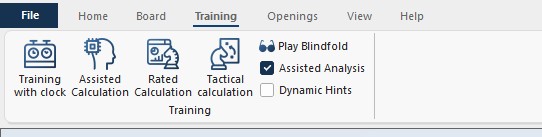
While playing an easy game, open the training tab and click “Rated Calculation”
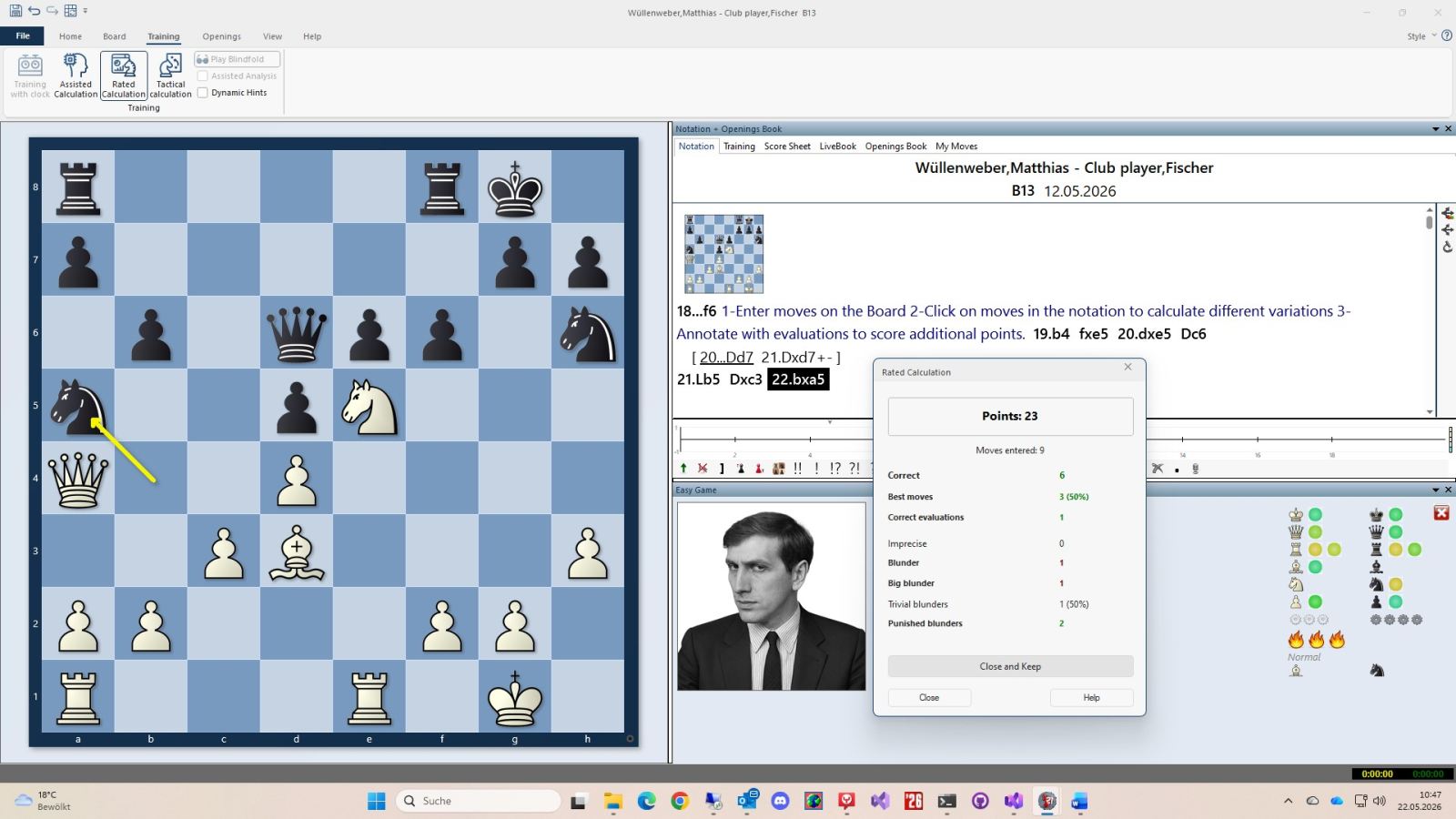
1 — Enter moves on the board. 2 — Click on moves in the notation to calculate different variations. 3 — Annotate with evaluations to score additional points.
That is it. You play your line as if you were calculating during a real game — because you are. You delete and promote variations to test ideas. You annotate the position with “+-” or “=+” when you have finished a line. And every move you enter scores or loses points:
- Best Move — three points. You found exactly what the engine would play.
- Correct — two points. Within forty centipawns of the truth. Close enough.
- Imprecise — one point. You slipped a little. Forty to eighty centipawns of slip.
- Blunder — penalty. Eighty to one hundred and fifty centipawns of disaster. Minus one point.
- Big Blunder — bigger penalty. The piece is on the wrong square and so are you. Minus two pointes.
- Punished Blunders — bonus points when you show why the previous move does not work.
When you close the calculation session, the moves are saved into the game with proper annotations: exclamation marks, question marks, all the rest. Every blunder you made is preserved with a question mark. Every gem with an exclamation. You do not just train; you build a permanent training record.
Tactics Calculation
Same engine, sharper purpose.
Each session of Tactics Calculation pulls a brand new puzzle from the ChessBase tactics server. A combination possibly played today in a tournament. Updated continuously. New positions, new themes, new blunders. Fritz drops you straight into the tactical position — your opponent has just played, and now it is your turn. No piece moves. No hints. Just visualise the line and enter it on the board.
Fritz scores you the same way the rated calculation does, with the same points-and-penalties accounting. Tactics positions are sharp, have a defined solution and are thus well suited to begin in calculation training.
Why this makes you stronger
Four reasons, none of them magical.
Calibration. You immediately see, which of your obvious moves work or not. After a few sessions, your sense of what is really a candidate move starts to sharpen.
Visualisation under pressure. The board does not help you. Your imagination does all the work, just like in a real game when you are trying to see five moves ahead in the middle of an attack. This is the muscle that fatigues first at the board, and the only way to grow it is to use it.
Persistent feedback. Annotations remain in the game file. Mistakes do not evaporate when you close the program. You can come back next week and see exactly what you missed.
Points motivate. The points system gives you a delta you can chase. Last week 14 points. This week 21 points. You can feel the skill growing. And that, more than any opening repertoire, is what raises your playing strength.
Become the calculator your heroes were
Every great calculator was made, not born. Now you have Fritz 21. A quiet engine. A board that refuses to help you cheat.
Go in. Calculate. Come back stronger.