
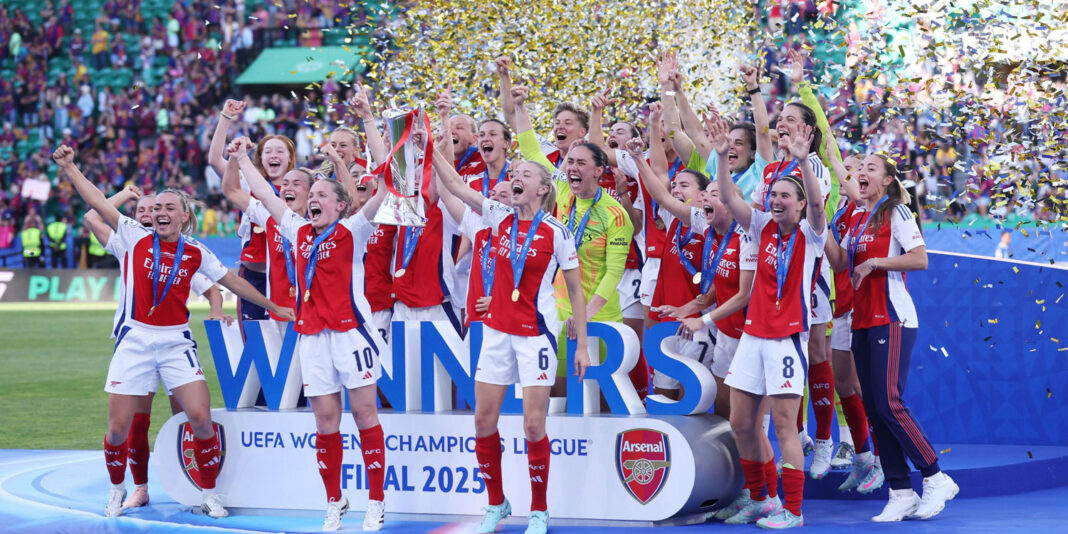

When I think about Arsenal and Europe, the relationship feels curious and distant somehow. Winning the trophy remains an itch I am desperate to scratch. Whenever the hypothetical arises, ‘Premier League or Champions League?’ my answer is always the same. ‘Champions League, then, once we have done it, Premier League every time.’
I think Arsenal fans have a range of answers to that pub garden question. One of the many reasons that I am so fascinated by the club’s history is because- at the risk of stating the obvious- it informs so much of the present, in ways we don’t always consciously understand.
Arsenal’s European record, across competitions, is really paltry for a club of our size. A lot of the aura of Liverpool (especially Liverpool) and Manchester United is grounded in their conquests abroad. A significant part of Manchester United’s story is their rebuild after the Munich air disaster in 1958 to winning the European Cup 10 years later. (Busby’s United side finished 2nd in the league three times in a row before they ever won silverware, incidentally).
Heysel was a tragedy of a different kind but also forms an important part of Liverpool’s story and even when they were no longer a domestic powerhouse in the early 2000s, they still managed to summon some sort of witchcraft to win the Champions League in 2005. I do believe, on some level, that a club’s historic record in a competition counts for something beyond coincidence.
In FA Cup Finals, even poor Arsenal teams manage to morph into a hyper competent outfit. In League Cup Finals, even good Arsenal teams wilt under the lights and manage to lose pathetically. Then there are mid-size English clubs like Aston Villa and Nottingham Forest, who hoisted the trophy in another era but can hold onto it as currency forever more (as they are not shy of reminding us every time we visit Villa Park and the City Ground).
Arsenal don’t have this continental currency. They have two European trophies (even Spurs have lapped this achievement, Spurs!) Some of this is a question of serendipity, or lack thereof. If the European Cup had existed in the 1930s, there is an excellent chance that Chapman / Allison’s Arsenal would have won it at least once.
In 1989/90 they were denied the chance to compete due to English clubs being banned from Europe. Gaps between league titles often denied them the chance to really build up an IQ for European tournaments, with a 20-year absence from the major European tournament between 1971 and 1991. During the era of English dominance in the European Cup from the late 1970s to the mid-1980s, Arsenal were pretty hopeless.
The women’s team offers a useful corollary here. They dominated England in the 1990s and early 2000s when the Women’s Champions League was first invented, so they had a lot of cracks at the tournament- often tumbling out in semi-finals, before the breaks fell for them the right way and they won it against the odds in 2006-07.
I believe that achievement counted for something when a massively injury hit side progressed to the semi-finals in 2023 and won the tournament again last season. For Chelsea, who had moved to a period of domestic dominance, the competition still represents something of a monkey on the back in a way that it isn’t for Arsenal. Like I said, I think that history counts for something deep in the psyche of the players.
The 2006 Final defeat in Paris just did not hit me as hard as it did pretty much every other Arsenal fan I know. Not at the time. I think I mentally prepared for defeat when Jens Lehmann was sent off but I still don’t think it entirely explains why that defeat was not as visceral for me as it was for others. I recall confidently proclaiming in the bars of Paris post-match that Arsenal would return to the final within the next five years.

At that time, Arsenal had spent several seasons as a very strong domestic team who flattered to deceive in Europe. I interpreted that as a psychological issue at that time, which I felt getting to the final would shatter. Of course, I think I was mostly wrong about that now. Firstly, by the time 2006 rolled around, the personnel of the squad had changed enormously compared to 2000 – 2005.
I also look back at Arsenal’s period of underwhelming European performance (relative to expectations) in the early 21st century as more of a stylistic issue. Arsenal were a team who blended physicality and explosiveness and teams on the continent were just better set up to repel it. Arsenal evolved into more of a ‘European’ outfit post 2006 but lacked the quality of the previous team to make it count. They were essentially stuck in a sort of purgatory.
In the 2006-07 season, Arsenal were eliminated from the Champions League by PSV Eindhoven with a pair of insipid performances. That defeat hit me really, really hard. It was a delayed reaction from Paris, where I had protected myself with the idea that we had cracked Europe and it was a matter of time before we claimed the trophy.
PSV were dispatched with absurd ease by Liverpool in the next round, who again progressed to the final with a less than vintage outfit. It made me realise that Paris really was our chance, a chance that had come together via serendipity really when an enormous injury crisis forced Arsene Wenger to adopt a more defensive system. It was not the beginning of the masterplan; it was a moment in time and we missed it.
That’s why I felt so much more desolate after that PSV defeat. It was delayed trauma. In the ensuing years, I have thought about Arsenal hurling the Champions League monkey from their backs but with the idea that it would have to be another ‘stars aligning’ type campaign. For six-and-a-half years we weren’t even in the competition.
For us to win it, it felt like it would have to be a Steaua Bucharest (1986), PSV Eindhoven (1988), Red Star Belgrade (1991), Borussia Dortmund (1997), Liverpool (2005) or Chelsea (2012) type situation. Maybe one year, just one year, the breaks could fall our way. But the idea that Arsenal would get to a final, maybe win a final, as one of the bona fide best teams in Europe felt fanciful.
On Saturday, we will contest the Champions League Final as English champions and as one of the bona fide best teams in Europe. Arsenal haven’t lost in the tournament this season (one more game, lads, please!) and have the best defensive record in it by a distance. Arsenal are utterly indisputably there on merit.
For most contemporary Arsenal fans, Europe doesn’t really form a huge part of our story, of our identity (though I have spoken and written at length about how the 1994 Cup Winners Cup victory was incredibly formative in terms of my identity as an Arsenal fan). I travelled to Baku for the Europa League Final in 2019 and, as I wrote at the time, the whole experience caused me enormous disillusionment.
With Arsenal, with UEFA and the direction of the sport in general. The former disillusionment has been mended. The other two less so. While, for many of us, Arsenal and Europe feels a little cerebral, our achievements more domestic (the Invincibles!) on Saturday in Budapest, Arsenal have a chance to put that right. To create a new history, to banish some of the ghosts of Copenhagen, of Baku, of Paris (x2), of Brussels and turn this global club into a European powerhouse.