
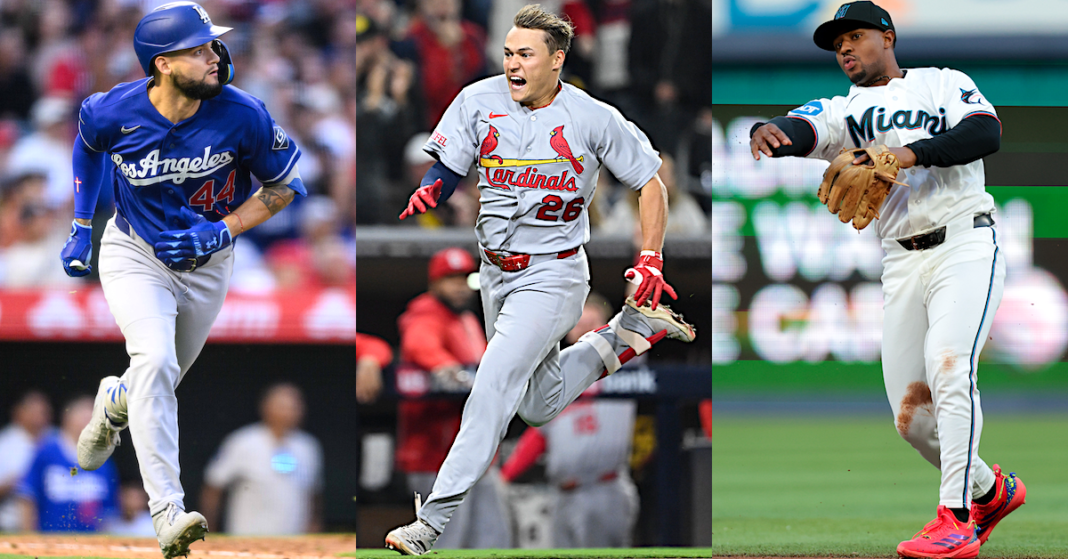

I’m not sure whether it’s called the Effectively Wild rule or not, but I learned a fun rule of thumb from that podcast: Statistical samples are only stable after Mike Trout leads the league in WAR. Until then, it’s still too early. This rule made more sense a decade ago, when Trout was the clear best player in the sport, but the sentiment applies today. When Aaron Judge, Shohei Ohtani, and Bobby Witt Jr. are near the top of the leaderboard, it’s probably been long enough to believe the statistics. If they aren’t, it’s too early.
Ohtani and Witt are indeed atop the combined WAR leaderboards, but Judge isn’t even in the top 30. And the rest of the names are kind of strange, too, particularly if you limit yourself to the hitter’s leaderboard and leave Ohtani’s singular two-way nature behind. Oh, there’s a Dodger in the top five, but it’s Andy Pages. There’s a Yankee, but it’s Ben Rice. Two rookies are in the top 10, and they’re both behind Xavier Edwards. It’s an odd leaderboard, no matter how you look at it, and it got me wondering two things. First, is that Mike Trout rule generally true? And second, what does it say about 2026 if so?
I settled on one thing first: no two-way players. That might annoy the Ohtani fans out there, but I had two good reasons. One, he’s been around for a while now, so it’s not like this is some special consideration that only applies to 2026. Second, pulling all these numbers is hard work. I didn’t want to handle corner cases in every year, so I stuck with the pure hitting leaderboard. Given that I wanted to look at the whole 21st century and see how often hitters stay atop the heap from one year to (early in) the next, I opted for a simple definition and only looked at hitters.
For each year, I compared statistics through the end of May to the previous full-season leaderboard, grabbing qualified players in both instances. Here’s what I wanted to know: How rare is it to have so few of last year’s best players atop the leaderboard? Only five of the top 25 position players this year were among the top 25 batters of 2025 (Witt, Corbin Carroll, Pete Crow-Armstrong, Cody Bellinger, and Matt Olson). That sounds minuscule to me. And indeed, it is. If you exclude 2021 (full-season leaders from 2020 were a lot less impressive than your average year, thanks to the 60-game season), no season in the 21st century has seen fewer holdovers. This year is in a four-way tie with 2005, 2011, and 2012 for the most upheaval-filled start to a season since 2001.
That might understate how surprising this year has been. Only two of this year’s top 10 batters (by WAR, through the end of May) were in last year’s top 25. That had only happened twice before this century: in 2016 (Trout and Manny Machado) and 2001 (Barry Bonds and Jason Giambi). The average number of top 10 hitters at this point in the season who were top 25 hitters in the previous year is 4.5. Heck, as recently as 2024, eight of the top 10 were in the previous year’s top 25. Indeed, this season is one of the change-heaviest years of recent memory, and it seemingly came out of nowhere.
This pattern held regardless of how I sliced the data. Back-to-back years as top 10 hitters? Top 25 hitters who were in last year’s top 50? Top 15 hitters who were in last year’s top 10? I kept coming up with ways to say “this class of hitters is unexpected,” and the data kept agreeing. This year really is weird! I knew it.
You Aren’t a FanGraphs Member
It looks like you aren’t yet a FanGraphs Member (or aren’t logged in). We aren’t mad, just disappointed.
We get it. You want to read this article. But before we let you get back to it, we’d like to point out a few of the good reasons why you should become a Member.
1. Ad Free viewing! We won’t bug you with this ad, or any other.
2. Unlimited articles! Non-Members only get to read 10 free articles a month. Members never get cut off.
3. Dark mode and Classic mode!
4. Custom player page dashboards! Choose the player cards you want, in the order you want them.
5. One-click data exports! Export our projections and leaderboards for your personal projects.
6. Remove the photos on the home page! (Honestly, this doesn’t sound so great to us, but some people wanted it, and we like to give our Members what they want.)
7. Even more Steamer projections! We have handedness, percentile, and context neutral projections available for Members only.
8. Get FanGraphs Walk-Off, a customized year end review! Find out exactly how you used FanGraphs this year, and how that compares to other Members. Don’t be a victim of FOMO.
9. A weekly mailbag column, exclusively for Members.
10. Help support FanGraphs and our entire staff! Our Members provide us with critical resources to improve the site and deliver new features!
We hope you’ll consider a Membership today, for yourself or as a gift! And we realize this has been an awfully long sales pitch, so we’ve also removed all the other ads in this article. We didn’t want to overdo it.
In fact, there’s a larger pattern in the data. This particular measure of stability – how much the leaderboards partway through one year look like the previous year’s final tally – has gone through some cycles in the 21st century. From 2001-2010, there was very little leaderboard mobility. Bonds, Giambi, Alex Rodriguez, and Albert Pujols figured heavily for vast swaths of that time. Evan Longoria and Chase Utley joined the party in the latter half of the decade. The good players from the turn of the millennium mostly kept mashing, in other words, and even as they tailed off, players from the latter half of their generation stood stalwart behind them. If you’re looking for some mathematical grounding, 35% of players on early-year top 25 lists had been on the prior year’s top 25 finishers; 46% of players on early-year top 10s had been among the previous year’s top 25.
Then came an interregnum, with a new bumper crop of stars replacing the old ones as they aged out. That produced incredible volatility and much lower year-to-year consistency. From 2011-2016, players like Trout, Bryce Harper, Buster Posey, Josh Donaldson, and Yadier Molina started popping up at the top of the list. Holdovers like Matt Holliday and David Wright were still around. But with the best players of the first decade of the century in full decline, there was a ton of turnover; only 25% of players on early-year top 25s had been on the previous year’s list, and only 33% of early-year top 10 players had been on the previous year’s top 25.
Inevitably, though, the top players stabilized. Trout kept holding serve. Mookie Betts debuted, and Freddie Freeman ascended to stardom. Judge and Ohtani joined this group before long; Francisco Lindor, Christian Yelich, and Machado danced around the edges. A new hegemony emerged, with numbers that looked a lot like 2001-2010. From 2017-2025 (excluding 2021), 35% of top 25 members were holdovers, and a whopping 53% of players in the top 10 for batting WAR through the end of May had been in the previous year’s top 25. That brings us to today:
Repeat Position Player WAR Leaders, Prior Year vs. Through May
| Era | Last Year’s Top 25, This Year’s Top 25 | Last Year’s Top 25, This Year’s Top 10 |
|---|---|---|
| 2001-2010 | 35.0% | 46.0% |
| 2011-2016 | 25.0% | 33.3% |
| 2017-2025 | 35.0% | 52.5% |
| 2026 | 20.0% | 20.0% |
Could we be on the verge of another upheaval of the established order of baseball? To strain the comparison a little bit, is Witt the spiritual successor to Miguel Cabrera, an established star set to duel with an up-and-comer for the next half decade? Will Judge and Ohtani gracefully cede the leaderboard to young replacements? This year’s top 25 includes five players in their first or second seasons: Kevin McGonigle (ninth) JJ Wetherholt (10th), Colson Montgomery (15th), Nick Kurtz (16th), and Drake Baldwin (22nd). Is that quintet here to stay?
It’s too early to say. We’re only two months into the season. The usual suspects are still great. Ohtani literally leads baseball in total WAR right now; it’s not like he crumbled to dust, he’s just doing a little more on the mound and a little less at the plate this season. Yordan Alvarez, who at 2.7 WAR ranks in the top five, is an established star who probably would’ve been a repeater if not for an injury-riddled 2025 campaign. Juan Soto would be in this group if he hadn’t hit the IL early in the year. Kurtz missed out on last year’s top 25 because of a technicality; he would have tied for 25th if he’d registered enough playing time to qualify. (I assume there are similar misses like this off and on in history; I stuck with a consistent “must qualify” definition for ease of data pulls.)
But if you’re looking for a sign that the game might be about to change, this is as good an indication as any. Regime changes never feel that way at the start. Oh, a few rookies got off to hot starts? The league will figure them out. Oh, these old hitters aren’t performing as well? They’ll return to form. That asteroid headed for us? Surely going to miss. It’s easy to believe that inertia will keep everything the same, right up until you read the definition of inertia and realize that once an object is in motion, inertia keeps that going, too.
Anyway, it’s not just your imagination. The “statistics stabilize when the best player in the league is on top of the charts” shortcut is frequently true, as it was when Trout was at his peak and, more recently, with Judge and Ohtani. And yet, every now and then we get an anomalous assortment of leaders, an occasion that tends to signal turnover to come. This change is exciting precisely because we don’t get it all that often. Enjoy it! I know I will.