
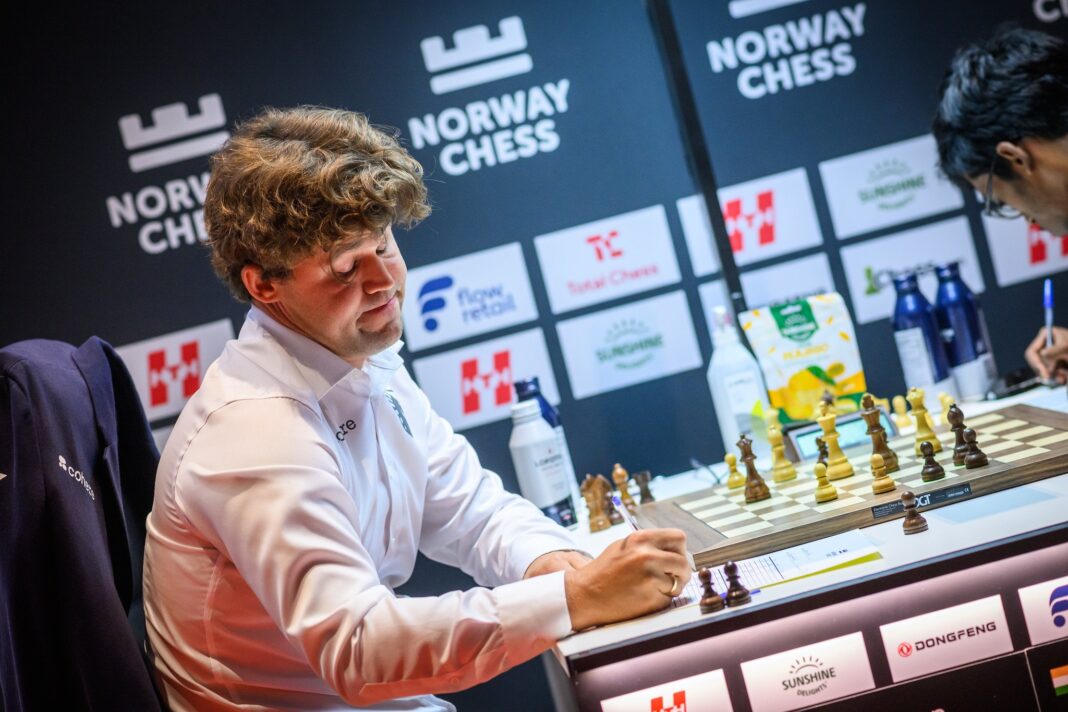

GMs Praggnanandhaa Rameshbabu and Bibisara Assaubayeva are the 2026 Norway Chess and Norway Chess Women champions. Assaubayeva ran away with it, while Praggnanandhaa came clutch in a comeback that shocked the other players and even himself.
Let’s take a look at nine conclusions we can draw from the two world-class tournaments in Oslo.
- Praggnanandhaa Comes Back From The Dead
- Classical Wins Really Count In Norway
- No Increment Means Drama
- World Champions Look Shaky Before Title Defense
- Underwhelming Performance From Carlsen
- Assaubayeva Perseveres In Time Trouble
- Zhu Jiner Finishes Clutch & Above Past Champions
- Indian Women Finish At Bottom
- New Champions In Both Tournaments
1. Praggnanandhaa Comes Back From The Dead
Until now, 2026 started slow for the Indian star. He lost three points in January, in London, and then slid 17 rating points further in the 2026 Tata Steel Chess Masters, a tournament where all four Indian super-GMs finished in the bottom half. Then, it was only after another eight points lost in the 2026 FIDE Candidates that Praggnanandhaa, in June, gained two points in the 2026 Super Chess Classic Romania, his first rating gain of the year. When Praggnanandhaa trailed in last place in round six of Norway Chess, it was fair to ask: how long will this go on?
Four games later, after winning all of them, he reversed that narrative.
Chess.com’s Tarjei Svensen asked: if someone had told Praggnanandhaa he’d win the tournament, after his second consecutive loss in round six, would he believe it?
I’d of course just laugh at them, but somehow, I think I started believing that I could come back once I beat Alireza, because I felt like I was a lot more in control. Every game, you’re just feeling, I can do it, but you still don’t expect to win four in a row.”
On the way, he achieved two classical wins over world number-one GM Magnus Carlsen, though he said, “For me, winning the tournament is more special.” In this case, Pragg managed to kill two birds with one stone, and the win has put India back in the spotlight. Prime Minister Narenda Modi tweeted his congratulations, a gesture he’s gotten used to extending by now.
Congratulations to Praggnanandhaa for this remarkable feat!
This is indeed an incredible milestone that highlights his continued excellence.
My best wishes to him for his future endeavours. @rpraggnachess https://t.co/ryE0qElL9G
— Narendra Modi (@narendramodi) June 6, 2026
Chief Minister of Tamil Nadu Vijay also recognized this historic accomplishment, the first time an Indian player has won Norway Chess.
#WATCH | Chennai | Tamil Nadu CM Vijay meets Indian Grandmaster R Praggnanandhaa and awards him Rs 50 lakh on behalf of the Sports Development Authority of Tamil Nadu after the chess player won the Norway Chess 2026 title.
(Source: TNDIPR) pic.twitter.com/Lf4dNgYrEX
— ANI (@ANI) June 8, 2026
Praggnanandhaa is on the leaderboard for the 2026-27 FIDE Circuit, which will count for the next FIDE Candidates Tournament in 2028. He’s the frontrunner for India, though we can see that Uzbekistan’s top two GMs lead the race.
2026-27 FIDE Circuit

2. Classical Wins Really Count In Norway
The Norway Chess format is uniquely designed to encourage players to take risks in their classical games—and avoid quick draws. As such, classical wins are awarded three points, whereas if players draw, the most they can earn is 1.5 points after winning in armageddon. A draw in classical but a loss in armageddon nets one point, and a loss in classical gives zero.

So missed out on tournament victory by one point. We can point to round seven as one clear moment where he could have pushed for more. He had just survived a losing position against World Champion Gukesh Dommaraju, but by move 40 was ahead with 19 minutes against one minute in a complicated (but equal) position. He offered a draw, Gukesh quickly accepted, and GM David Howell predicted: “I think Wesley, if he doesn’t win the tournament, will regret that moment.”
I think Wesley, if he doesn’t win the tournament, will regret that moment.
—David Howell

At the time, the safety-first option kept So in the lead, 2.5 points ahead of Firouzja. Look at how far back Praggnanandhaa was.

3. No Increment Means Drama
Another aspect of Norway Chess that sets it apart from other supertournaments is the time control. Before move 40, players do not receive any added time, and only starting on move 41 do they receive a 10-second increment, less than the standard 30 seconds. It’s another quirk that ensures fighting and decisive games.
The quality of moves was certainly affected in the time-trouble stage, and one game in particular stands out most. Heading into round eight, second-placed GM Divya Deshmukh had her last chance to stop the tournament leader, Assaubayeva, and Divya achieved a winning position. In mutual time trouble, however, the Kazakh GM turned the game; and she ran away with the tournament after this win.
Had Divya won that game, she would have taken the sole lead. Who knows how the tournament would have ended for her then, with that boost in confidence? Instead, she went on to lose her last two games and finish fifth.

4. World Champions Look Shaky Before Title Defense
The curse of the world champion’s crown, since Carlsen abdicated, continues. First, it was GM Ding Liren who dropped out of the top-20 before losing the title to Gukesh. The Indian GM, who led his nation to Olympiad glory, then convincingly won the Candidates Tournament, and finally became the youngest world champion in history, somehow seems to have inherited the burden.
Live Ratings After Norway Chess

Something’s got to change if he’s to defend his title later this year. As he’s dropped, Sindarov’s rating has only gone up and has entered the top-five.
Sindarov: “I’m here just chilling!” #NorwayChess pic.twitter.com/Kk01pi9JlZ
— chess24 (@chess24com) June 4, 2026
Howell had this advice for Gukesh:
He needs his coaches to tell him to try new things, to switch things up. He’s been doing the same thing for the last 18 months, he needs to maybe just play a few games a little safer, play them a little more solid… A draw is a fine result in some games. Just because he’s world champion, nobody expects him to beat Magnus twice, nobody expects him to go 10/10 in this tournament. He’s taking so much risk every game, even when he’s not in form. When you’re not in form, that’s when to go back to basics. Keep it super simple, take minimum risk.
He’s taking so much risk every game, even when he’s not in form. When you’re not in form, that’s when to go back to basics.
—David Howell
Women’s World Champion Ju Wenjun has less to be worried about, since she’s still the clear rating favorite against her challenger, GM Vaishali Rameshbabu. She gained one rating point in Norway, but she scored just two classical wins—and if not for a shocking final-round victory against Assaubayeva, from an equal endgame, she would dropped rating.
She finished on a high note, but that was still fourth place. It’s not a bad performance, but not outstanding either.

5. Underwhelming Performance From Carlsen
Carlsen made international headlines last year when he slammed the table. He achieved a winning position but collapsed in time trouble, and Gukesh navigated the complications to score his first win against the Norwegian. Though Carlsen got down to his final seconds again in both games, he hit back to win both encounters this year.

There’s not much more good news for Carlsen, whose won the event seven times before. He had the greatest loss of rating among the field (-18); and though world number-two is over 20 points behind, he’s that much closer to falling out of the number-one spot for the first time since 2011. Before his game in round nine, Carlsen gave his take on the underwhelming performance:
The truth is that this is now the fourth Norway Chess tournament that I’ve had like a really bad result. And so it’s going to happen occasionally, and I’ve also won a ton. It’s just now I won a tournament [2026 TePe Sigeman Chess Tournament] a few weeks ago, and this tournament I’m doing badly, and you know a lot of people are going to have the takeaway that I did really poorly, which is fair.
I won a tournament a few weeks ago, and this tournament I’m doing badly, and you know a lot of people are going to have the takeaway that I did really poorly, which is fair.
—Magnus Carlsen
6. Assaubayeva Perseveres In Time Trouble
It’s not often that we talk about blitz skills in classical tournaments, but this year it seems to be relevant that the three-time women’s world blitz champion took the crown, in her first time playing the event.
Sindarov, her second and friend, on the Chess24 broadcast identified her resilience with little time as a main factor behind her success in what may be the most important classical tournament victory of her career so far.
In my opinion, one of the important things is when they get into time trouble, Bibisara here is better than everyone in the women’s category. She’s a three-time world blitz champion, first, but second, in my opinion, we work a lot for time trouble with our coach Roman [Vidonyak], so that’s why I believe she played really, really well in time trouble.

7. Zhu Jiner Finishes Clutch & Above Past Champions
Still, the women’s world number-four recovered and won her three remaining games to finish on a +3 rating gain.

An incredible run, considering she was a half-point away from last place when she started that winning streak. Zhu finished second, and GM Anna Muzychuk also won in the final round to finish third.

8. Indian Women Finish At Bottom
The tournament was a disappointment for GMs Divya and Koneru Humpy, the two Indian women in the event. While the tournament never got off for Humpy (zero wins, two classical losses, eight classical draws), the same cannot be said for Divya. After four classical draws, she defeated Zhu, seemed to pick up steam, but couldn’t hold that momentum through to the end.

9. New Champions In Both Tournaments
In both events, we have new champions. It’s especially significant in the open tournament; thanks to Carlsen’s dominance over the years, it has only ever seen five winners in 11 years. In the Women, 22-year-old Assaubayeva is the youngest player to win the event.

How to rewatch?
Norway Chess 2026 featured Open and Women’s six-player tournaments for equal prize funds of 1,690,000 NOK (~$182k). It ran May 25 to June 5 in Oslo, with players facing their opponents twice at classical chess (120 minutes/40 moves, with a 10-second increment from move 41). The winner of a classical game got three points, the loser, zero; after a draw, the players got one point and fought for another half-point in armageddon (10 minutes for White, seven for Black, who has draw odds).
Previous coverage: