
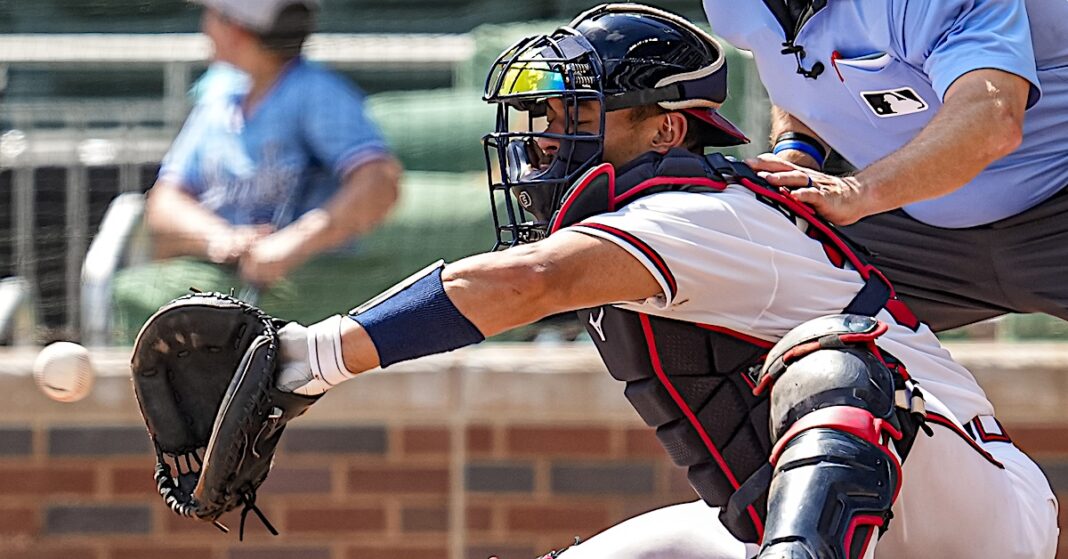

Like many baseball nerds, I have been itching to get my sweaty hands on enough ABS challenge data to draw some really strong conclusions. Unfortunately, it’s early in the season and challenges happen so rarely that we don’t have much to go on just yet. But you know what they say about idle hands. I am impatient, and I have been devising devilish ways to dodge the damnable data deficit. I’d like to show you one of them. Today we’re bundling.
Here’s what I did. I went to Statcast’s framing leaderboard and I bundled catchers by their strengths and weaknesses at framing pitches in certain locations. Fortunately, catchers are easy to bundle, because they’re already predisposed toward scrunching themselves into tiny little balls. Finding catchers with similar tendencies allowed me to work in the aggregate, searching for patterns in a more robust dataset. I won’t bore you with my methodology, but it’s not much more advanced than scrolling the leaderboard looking for catchers whose framing runs number is red in one zone but blue in another zone. I ended up with four groups:
- Catchers who are significantly better framers at the top of the zone than the bottom of the zone.
- Catchers who are significantly better framers at the bottom of the zone than the top of the zone.
- Catchers who are significantly better framers on their glove side than their arm side.
- Catchers who are significantly better framers on their arm side than their glove side.
Each group had around 10 members, and there was some overlap. For example, Patrick Bailey is in the Top Framers and the Glove Side Framers. A few catchers were too good to be in any of the groups, like Brandon Valenzuela. A lot more catchers were too bad or average to be in any of them, like Tyler Stephenson. Feel free to skip this part, but just in case anybody’s curious, these are the four groups:
Once my catchers were nice and bundled, I calculated their success rate on challenges both in the location where they’re good at framing and the location where they’re bad. Then I compared those rates to the rates of the catchers who were their polar opposites. I also calculated the average location of the pitches they challenged, in order to get a sense of how different the pitches they challenged really were.
Before we get into the data, let’s think about some possible results and about how we might end up there. The first possibility is that the differences aren’t that big. Just because you’re better at framing in one spot doesn’t necessarily mean you’ll be better or worse at challenging there. This challenging stuff is so new that we’re not sure what’s what.
The second possibility is that catchers will be good at challenging in the spots where they’re good at framing. It’s certainly not inconceivable. Maybe you handle those pitches better because you see them better, or you’re better prepared for them, or you know that area of the zone well, so you have a better sense of where the edge is.
You Aren’t a FanGraphs Member
It looks like you aren’t yet a FanGraphs Member (or aren’t logged in). We aren’t mad, just disappointed.
We get it. You want to read this article. But before we let you get back to it, we’d like to point out a few of the good reasons why you should become a Member.
1. Ad Free viewing! We won’t bug you with this ad, or any other.
2. Unlimited articles! Non-Members only get to read 10 free articles a month. Members never get cut off.
3. Dark mode and Classic mode!
4. Custom player page dashboards! Choose the player cards you want, in the order you want them.
5. One-click data exports! Export our projections and leaderboards for your personal projects.
6. Remove the photos on the home page! (Honestly, this doesn’t sound so great to us, but some people wanted it, and we like to give our Members what they want.)
7. Even more Steamer projections! We have handedness, percentile, and context neutral projections available for Members only.
8. Get FanGraphs Walk-Off, a customized year end review! Find out exactly how you used FanGraphs this year, and how that compares to other Members. Don’t be a victim of FOMO.
9. A weekly mailbag column, exclusively for Members.
10. Help support FanGraphs and our entire staff! Our Members provide us with critical resources to improve the site and deliver new features!
We hope you’ll consider a Membership today, for yourself or as a gift! And we realize this has been an awfully long sales pitch, so we’ve also removed all the other ads in this article. We didn’t want to overdo it.
The last possibility is the opposite, that catchers will be better at challenging in spots where they’re worse at framing. I can think of a couple explanations for that. The first is that they’ll have juicier pitches to challenge. If you’re bad at framing, say, pitches at the top of the zone, you’re probably getting stuck with a lot of bad calls up there, which leaves you with better opportunities for challenges. We can also come at this from the other angle. Maybe when you’re good at framing in one spot, you feel like all pitches in that spot look really good, so you challenge too frequently. I found something similar when I looked at which parks have the best batter’s eyes. When hitters can see the ball well, their plate discipline doesn’t get better as you’d expect; they get more aggressive because more pitches look good to them.
So those are the possibilities. Let’s see what the data says. We’ll start with catchers who are better on one side of the plate. (Since all catchers throw right-handed, I’ll refer to the third base side of home plate, the inside corner to right-handed batters, as their glove side, and the first base side as their arm side.) The columns below show success rate, and they show the average horizontal location of the pitches challenged, measured in inches from the center of home plate.
Challenges on the Corners
| Group | Glove Side Success% | Glove Side Plate X | Arm Side Success% | Arm Side Plate X |
|---|---|---|---|---|
| Glove Side Framers | 59% | -9.6 | 63% | 9.5 |
| Arm Side Framers | 69% | -9.3 | 53% | 9.9 |
Well, the third possibility looks like the right one. Catchers run success rates that are 10 percentage points higher on the side where they’re bad at framing. They’re challenging pitches that are either 0.3 or 0.4 inches closer to the center of the plate.
Now let’s move to the top and bottom of the zone. The columns show success rate on challenges and the average height of the pitches in feet.
Challenges at the Top and Bottom
| Group | Top Success% | Top Avg Height | Bottom Success% | Bottom Avg Height |
|---|---|---|---|---|
| Top Framers | 51% | 3.28 | 62% | 1.58 |
| Bottom Framers | 63% | 3.22 | 53% | 1.57 |
Yup, it’s more of the same here. The catchers who are better at framing at one end of the zone are about 10 percentage points worse on challenges in that location. You might notice that the gaps are a bit bigger here, 12 percentage points and 0.7 inches at the top, but only nine percentage points and 0.2 inches at the bottom. If I had to guess, I’d say that’s because the top of the zone is more variable anyway. As I wrote a couple years ago, the knees of short and tall players are much closer in height than their shoulders.
As you can see, the overall success rates are just about identical, and once again, that holds true across the league. The league-wide success rates on challenges at the top and bottom of the zone are nearly identical, just a hair under 59%.
I know this is basic stuff and some of it is fairly intuitive, but I think it already gives us some actionable information. For example, you might also have noticed from the first table that success rates are generally higher on the glove side than the arm side. That actually holds across the entire league. So far this season, catchers are running success rates of 63% on the glove side and 59% on the arm side. Unless you’re a member of our special Glove Side Framers group, you should be more aggressive at challenging pitches to your glove side. That’s all I’ve got right now, but I’ll keep thinking of ways to slice the data.