
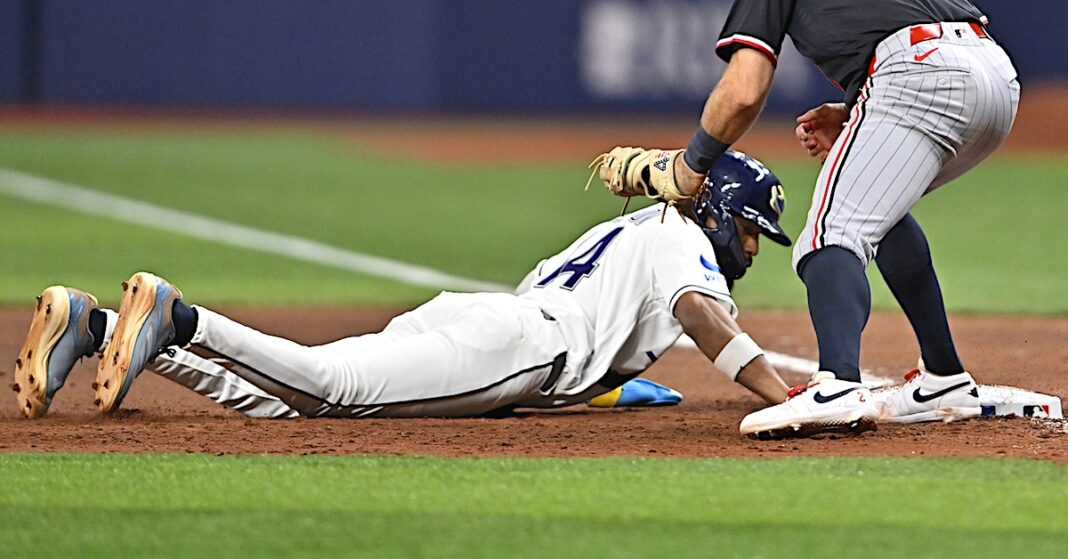

Chandler Simpson is fast. Being fast is kind of his whole deal. As a minor leaguer in 2024, Simpson stole 104 bases in 110 games. As a rookie in 2025, he stole 44 bases in 109 games. Then he stole 14 in his first 40 games of this season. If you watched Monday night’s nationally televised game between the Rays and the Dodgers, none of this is news to you. Simpson entered as a pinch-runner during a pivotal moment, and his presence instantly altered the gravity of the entire broadcast. ESPN’s cameras never left him, the commentators never stopped talking about him, and the Dodgers were so preoccupied with him that they barely had any focus to spare for the batters who came to the plate while he was on base. But Simpson never stole a base, and that’s likely not news to you either.
Simpson’s last steal came on May 11. That’s 28 games and more than a month ago. Over that time he’s been thrown out four times. On June 4, Marc Topkin of the Tampa Bay Times wrote an excellent article breaking down the circumstances behind the drought. Topkin used his own observations alongside first-hand explanations from Simpson, teammate Cedric Mullins, manager Kevin Cash, and first base/baserunning/outfield coach Corey Dickerson. Topkin noted first that Simpson has had fewer opportunities because he’s slumping at the plate. Since May 20, he’s running a .227 on-base percentage, the fourth-lowest mark among qualified players. Next, Topkin pointed out that Simpson’s downturn has roughly coincided with a downturn in Tampa Bay’s fortunes. The Rays have fallen behind early in games, putting them in situations where it doesn’t make as much sense to risk outs on stolen base attempts. Simpson and the rest of the Rays, though, were less focused on the circumstances and more focused on the intent of the opposition.
“I think the reason he’s in that funk right now is that teams have made a really impressive adjustment against him,” manager Kevin Cash told Topkin. “Every team we see, they were mindful. Now, they’re that much more mindful. We’re seeing pitchers alter their deliveries.”
Asked what opponents are doing to keep him tethered to the base, Simpson answered, “Everything. They’ve been pulling everything out. Slide-step (deliveries), quicker moves, pitchouts, random perfect throws on the money.” Monday night’s game provided an excellent example.
Simpson entered as a pinch-runner in the eighth inning, and it seemed like the drought was sure to break. The situation cried out for a steal. The Rays were down by just one run. There were no outs, the Dodgers had a righty on the mound in Will Klein, and the odds that the Rays would knock Simpson in from first seemed relatively low. Ben Williamson was batting in the five slot, and none of the four batters below him in the order could match his 88 wRC+. In fact, Williamson and those four batters have combined for just eight homers this season. If the Rays were going to score a run, they’d need all the help they could get from Simpson. The only thing working against him was the fact that catcher Dalton Rushing has an excellent arm.
“We’ll keep our eye on him,” said play-by-play announcer Jon “Boog” Sciambi as Simpson arrived at first base and strapped on his sliding mitt. He wasn’t kidding. Klein tried to throw Simpson’s timing off by holding the ball until deep into the pitch clock, and the broadcast crew was so convinced that Simpson would be on the move that they kept the camera tight on him and very nearly missed the first pitch entirely. This is what was on the screen as Klein released the ball.
You Aren’t a FanGraphs Member
It looks like you aren’t yet a FanGraphs Member (or aren’t logged in). We aren’t mad, just disappointed.
We get it. You want to read this article. But before we let you get back to it, we’d like to point out a few of the good reasons why you should become a Member.
1. Ad Free viewing! We won’t bug you with this ad, or any other.
2. Unlimited articles! Non-Members only get to read 10 free articles a month. Members never get cut off.
3. Dark mode and Classic mode!
4. Custom player page dashboards! Choose the player cards you want, in the order you want them.
5. One-click data exports! Export our projections and leaderboards for your personal projects.
6. Remove the photos on the home page! (Honestly, this doesn’t sound so great to us, but some people wanted it, and we like to give our Members what they want.)
7. Even more Steamer projections! We have handedness, percentile, and context neutral projections available for Members only.
8. Get FanGraphs Walk-Off, a customized year end review! Find out exactly how you used FanGraphs this year, and how that compares to other Members. Don’t be a victim of FOMO.
9. A weekly mailbag column, exclusively for Members.
10. Help support FanGraphs and our entire staff! Our Members provide us with critical resources to improve the site and deliver new features!
We hope you’ll consider a Membership today, for yourself or as a gift! And we realize this has been an awfully long sales pitch, so we’ve also removed all the other ads in this article. We didn’t want to overdo it.

When Klein got the ball back and set himself on the mound, the broadcast tried a different trick, zooming out from the high third base camera angle to get both Klein and Simpson in the frame at the same time. Klein threw over to first, then he went back to his original plan and held onto the ball for even longer. The tactic worked better than he could have hoped. Simpson was trying to time up his delivery, and he took off for second while the pitcher was still stationary on the mound. He skidded to a halt, hung up between first and second. The Dodgers had him! But so flustered were the Dodgers by the threat of Simpson’s speed that Klein simply stepped off and threw the ball weakly to second base. Had he thrown to first behind Simpson or simply stopped and forced Simpson to pick a direction, he would have had him out easily, but the throw allowed the speedster to return safely to first base.

If you look closely at the GIF above, you’ll notice that Klein took a little breath just to set himself, and that’s what triggered Simpson’s premature departure. If you’re feeling conspiratorial, you could argue that this little movement – probably the maximum allowed without earning a balk call once the pitcher has come to a set position – was at least partly intended to serve this exact purpose. Regardless, that was Klein’s second disengagement from the rubber, which tilted the odds even further in Simpson’s favor. After all the effort to keep Simpson close, one more disengagement without picking him off would allow him to walk to second base. At this point, he had still thrown just one pitch to Williamson! To mark the occasion, ESPN found another camera angle for observing Simpson.

Klein held the ball again, then he quick-pitched. He succeeded in disrupting Simpson, who broke toward second but stopped immediately because he found his jump unsatisfactory. Klein held the ball even longer before the third pitch, but this time Simpson was undeterred. He took off for second, only for Williamson to foul the pitch off and force him back to first. Did ESPN find yet another camera angle? You know they did.

On the fourth pitch, Simpson again broke toward second and then stopped. Williamson chopped the ball to second base. Because Simpson had stopped dead in his tracks, Miguel Rojas looked to have a play at second base, but it would have been tight and Simpson’s speed again served as a deterrent. Rojas took the easy out at first base for a fielder’s choice.
With Simpson as second base and constantly deking toward third with little stutter steps, Klein kept on holding the ball and started varying his looks. On the first pitch, he turned his head toward second and started his delivery while still facing Simpson. On the second pitch, he never looked back toward second at all. On the third pitch, he took a quick look toward second, briefly turned toward home, then whipped his head around for a much longer look at second, then started his delivery with his head pointed at third. All that chicanery kept Simpson at the bag for another pitch, after which Rushing got in on the action, rising out of his crouch to fake a back pick.

You can also see that at one point, Rushing quickly drops his glove toward the ground as if he’s signaling the beginning of a pickoff play. Feints within feints. And after all that, Simpson tried to steal third two pitches later. Unfortunately for the Rays, Austin Slater tapped it toward third base, moving Simpson to third but notching the second out of the inning.

Had Simpson been able to swipe either bag, that second groundout could have scored him and tied the game. Instead, a fly ball to center ended the threat, but it’s hard to imagine what more he could have done. Even though Klein had thrown just nine pitches and used every trick in the book to keep him close, Simpson still attempted three full-on steals and twice broke for the next bag only to pull up with an unsatisfactory jump.
That’s what the Rays were talking about. Simpson’s mere presence turned the game on its ear. Despite his best efforts, the scorebook won’t list even an attempted steal. All he did was advance on two weak groundouts. But for five minutes, the entire ballgame turned into an edge-of-your-seat episode of the Chandler Simpson Show. In order to keep him from moving into scoring position in a one-run game, the Dodgers tried everything short of strapping ankle weights on him. But I have waited a thousand words to tell you that’s not really what this article is about.
I was intrigued by Topkin’s article, so I went back and examined all the other times Simpson has reached base during his stolen base slump. It was obvious that opponents were careful when he was on base. Opposing pitchers held the ball, they threw over, they altered their deliveries; all the stuff Simpson mentioned, even the pitchouts. But that’s not the only thing that’s kept Simpson from stealing for so long.
As Topkin hinted at, the circumstances have played a huge role here. A host of factors has contributed to the drought. Over and over, Simpson has reached base at moments when it would have been either unwise to steal, or flat-out impossible to steal because there was a runner on base ahead of him. Over and over, the Rays scuttled stolen base opportunities by putting the ball into play immediately, denying Simpson the chance to size up the pitcher and take off. Over and over, Simpson tried for a steal only to have the attempt nullified due to a foul or a ball in play or a walk. At a certain point, it starts to feel like the universe just doesn’t want Simpson to steal a base. We’re going to break down every time Simpson has reached base since the start of his stretch with a steal, beginning with the most recent.
On June 14, Simpson reached base on a single, but Mullins was on first base at the time and only advanced to second on the play. With a runner on the base ahead of him, Simpson couldn’t steal.
The same exact thing happened on June 13.
On June 12, Simpson led off the fifth inning with a walk, but he only got three pitches at first base before the ball was put in play. During those three pitches, lefty Sam Aldegheri was on the mound, and he was aggressive about staring Simpson down and chopping up his timing.
On June 10, Simpson entered as a pinch-runner in the eighth inning and tried to steal second on the third pitch. It didn’t matter because Mullins decided to whack that third pitch into Manatee County.
On June 8, Simpson entered as a pinch-runner on second base. The Rays were up a run in the top of the seventh, and he was already in scoring position, so it wasn’t really a steal situation. Danny Coulombe needed just five pitches to retire the side, though he still managed to execute a classic left-and-pivot to keep Simpson close.
On June 6, Simpson again reached first in a non-steal situation. It didn’t matter anyway; Yandy Díaz put the second pitch he saw into play.
On June 1, Simpson snagged second base! But it came on a wild pitch, which means he got no credit for a stolen base.
I’m not an official scorer, and I understand why the rule works that way, but very few baserunners would have advanced on that particular pitch. Simpson may not get the credit, but he definitely stole the base.
So that’s the entire month of June up until now. You could argue that Simpson’s pinch-running appearance against the Dodgers was the only legitimate base-stealing chance he had over these last two-and-a-half weeks. Compounding the paucity of opportunities was the behavior of Tampa’s batters. The Rays are one of the more aggressive teams in baseball, running the 10th-highest swing rate and seeing the ninth-fewest pitches per plate appearance, but when Simpson has been on base, they’ve seemed almost pathologically determined to put the ball in play as quickly as humanly possible, costing him the chance to run. Should we keep going back? We should probably keep going back.
On May 31, Simpson reached on a fielder’s choice, but the Angels made an error on the play, so he had a runner on base ahead of him. No chance to steal.
On May 30, he walked to load the bases. No chance to steal.
On May 29, Simpson led off the fourth inning with a bunt single, then moved to second base on an infield single on the second pitch. Already in scoring position in a tie game, he elected to stay put as Richie Palacios struck out and Nick Fortes grounded into an inning-ending double play. He singled again in the seventh inning, but the batter behind him only saw one pitch (and even before that one pitch, Brent Suter attempted to pick Simpson off).
Against the Orioles on May 27, Simpson had one legitimate chance to steal, but he didn’t take it. I suspect this was the game plan. First, that’s because from May 10 to 27, Simpson spent nearly every game at the top of the lineup. In front of big boppers like Junior Caminero and Díaz, just being on base means being in scoring position. Specific to this series, Adley Rutschman, who ranks fifth among catchers at stopping basestealers, was behind the plate, and as you’ll see in a few paragraphs, Rutschman had already caught him stealing once. Simpson led off the game with a single. Righty starter Trey Gibson threw over after the fourth pitch. On the fifth, Caminero eliminated Simpson by hitting into a 5-4-3 double play. Simpson walked in the third inning, but had a runner ahead of him on base.
On May 26, Simpson led off the game with a double and got knocked in three pitches later. He also singled in the fifth inning. Although Shane Baz kept a very close eye on him, throwing over twice, holding the ball, and mixing in a slide step, Simpson stole on the sixth pitch. But the sixth pitch was ball four to Caminero. No stolen base.
Simpson tallied three hits on May 25. He singled with two outs in the third and advanced to second on a single three pitches later. He doubled with two outs in the top of the seventh, but it was a one-run game and didn’t make much sense to risk taking the bat out of Caminero’s hands, especially when reliever Yennier Cano immediately fell behind, 2-0. Simpson finally risked it in the ninth inning, and Rutschman threw him out by a hair.
Now Simpson didn’t get the world’s best jump here, but he did pick a curveball, which is usually a good pitch to run on. He was just unfortunate to pick a curveball that ended up right over the heart of the plate where it made for an easy catch and throw. Also, remember when Simpson cited “random perfect throws on the money” as a reason for his dry spell? This is exactly what he was talking about. The ball arrived in the second baseman’s glove at the exact moment that Simpson’s slide made contact with it. Simpson also started the 12th inning at second base as the zombie runner, but he tagged up on a fly ball on the second pitch of the inning and advanced to third.
Simpson also reached base three times against the Yankees on May 22. This was a game the Rays specifically mentioned in Topkins’ article, and the video shows why. Simpson led off the game with a single, and Cy Young winner Gerrit Cole, in his first start back from Tommy John surgery, was clearly bothered by the presence of Simpson. He did everything he could to keep him close. Before coming set on the rubber before each pitch, Cole turned his head toward first to take long looks at Simpson in his peripheral vision. On the first pitch to Caminero, Cole held the ball until there were five seconds left on the pitch clock, then used a slide step. He quick-pitched on the second pitch. He threw over after the third. He eschewed the slide step on the fourth. He threw over before the fifth. None of it mattered. Simpson took off on the fifth pitch, but of course, Caminero fouled it off.
Simpson stole on the sixth pitch too, but it was ball four to Caminero. Two attempted steals, zero official steal attempts. Two batters later, Simpson tried to take third using one of the Yankees’ patented vault leads. It did not go great.
Undeterred, Simpson tried to steal twice more that game, but one pitch was fouled off and the next was an inning-ending strike three.
On May 20, Simpson reached on a fielder’s choice with two outs in the bottom of the eighth inning. Down two runs, Caminero represented the tying run. “Think he would go here down two?” asked Kevin Brown in the MASN booth. “I think it’s 50/50,” replied color commentator Ben McDonald. Pitcher Anthony Nunez certainly thought so, as he attempted to pick him off twice. Simpson didn’t steal until the count was full and ended up advancing to third on a single.
On May 19, Yennier Cano and Samuel Basallo caught Simpson stealing by throwing back-to-back pitchouts. I will repeat that. In the year 2026, the Orioles threw back-to-back pitchouts to stop a baserunner. That is not a thing that happens anymore.
Once again, it took an absolutely freakish throw from Basallo to nail Simpson. It looked exactly like Rutschman’s, not only perfectly on target, but perfectly on time to catch Simpson as he slid into the glove.

On May 18, Simpson doubled, but got caught in a rundown on the very next pitch, a shot right at the shortstop that left him caught in between.
He walked again later in the game, but had a runner ahead of him, giving him no chance to steal.
On May 17, he reached on a fielder’s choice with the bases loaded. No chance to steal.
On May 16, he singled, but Díaz hit into a double play on the very next pitch.
On May 15, Simpson just got plain thrown out by Marlins catcher Joe Mack.
This was merely a very good throw rather than an absolutely perfect one. The pitcher’s delivery was fairly slow to home plate. It was the only time during this whole drought that Simpson simply tried to steal and wasn’t quite fast enough for a standard catch and throw.
On May 13, Simpson walked, but Díaz hit into a fielder’s choice on the very next pitch. Simpson also started as the zombie runner in the 10th inning. He danced around the basepaths trying to distract the pitcher, and it seemed to work. He came in to score on a single on the second pitch of the inning.
And that’s it. That’s the whole of Simpson’s miserable stolen base drought. He got picked off once and thrown out stealing three times. Two of those times required absolutely perfect throws from Orioles backstops. One of those perfect throws also needed to come on a pitchout. And aside from that, Simpson had scant few decent chances to actually steal a base.
If you’re keeping score at home, that makes three times Simpson didn’t make an attempt because it was simply a particularly lousy steal situation. It makes seven times that Simpson reached base with a runner ahead of him, giving him no shot to steal. It makes 10 times that he reached base but never really got a chance to steal because the next batter put the ball in play within the first three pitches. It makes seven steal attempts ruined by fouls, walks, strikeouts, or balls in play. It makes just two genuinely good steal situations in which he didn’t attempt a steal, and that’s including the first one we documented, when he did try to steal against Klein, only to be chased back to the bag because he took off prematurely. Simpson is going to steal a base eventually. Now that I’ve spent an entire day writing and researching all this, he’ll probably swipe four tonight. But over the last month and change, nothing has been going his way.