
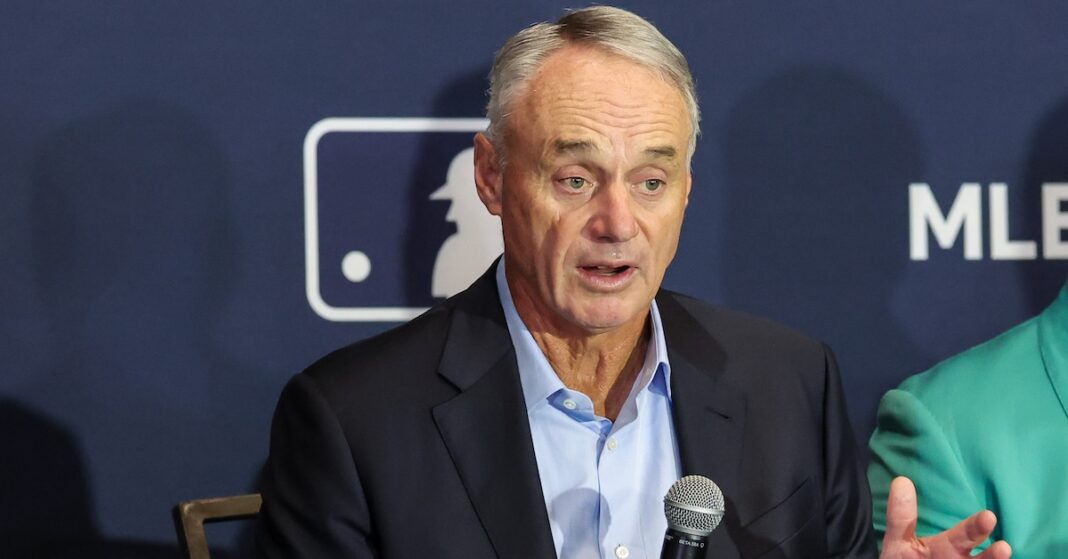

With July just days away, we’re entering one of the most exciting stretches of the major league season, with the contours of the playoff race coming into full view, All-Star Week festivities looming, and the trade deadline fast approaching. Unfortunately, that doesn’t exempt us from having to contemplate the drier world of player compensation schema, and for what is unlikely to be the last time as MLB and the MLBPA negotiate a new collective bargaining agreement. Last week, MLB released a new proposal that would massively overhaul how major league players are paid. By my count, this is the league’s third proposal this month, following its more detailed outline of a potential salary cap and a separate framework that would make the largest changes to amateur talent acquisition since the draft was first instituted in 1965.
Any discussion of baseball’s finances tends to be emotionally charged among fans, so I will freely note my personal biases as a prelude to analyzing the league’s proposal. When I pay money to attend a baseball game (something I admittedly do less than I used to before I covered the sport professionally), I’m paying that money to watch the players play baseball, more so than to watch an owner own a team. Even cynical ol’ me had a Panini sticker book back in the day. Now, teams certainly bear many of the costs to get those players onto the field, but the largest expense — namely, the massive stadiums they play in — is one largely borne by taxpayers. If MLB has a revenue problem, that strikes me as something ownership ought to address. If Bob Castellini and Bob Nutting are suffering because Steve Cohen and Guggenheim Baseball Management have access to more potential revenue than they do (ignoring that the Mets’ and Dodgers’ owners paid a lot more for their respective teams because of those revenue streams) and someone needs to write Castellini and Nutting a check, I’m not sure why it should be Shohei Ohtani and Francisco Lindor (or at least, their comparable future versions) rather than the other owners.
That being said, let’s move on to the meat of the deal.
The biggest proposed changes are those that would alter the maximum length and value of free agent contracts. The maximum free agent contract length would be five years, a drastic change from the open-ended version that has always existed in free agency. Teams could offer a sixth year to their own players. In addition, the maximum first-year free agent salary would be set at 15% of the salary cap (16% for the player’s current employer), and could only increase by 5% per season. Crunch some numbers and a player hitting free agency this year would only be eligible for at most a five-year, $202 million contract. Players who sign with their current team would be limited to a six-year, $265 million contract.
These restrictions were proposed as part of a salary cap framework, the attendant payroll restrictions of which would likely already do the heavy lifting of limiting free agent salaries. But this proposal also hurts free agents by significantly reducing their security. For an elite free agent maxing out on a five-year deal, five years of awesome play could never result in a higher salary beyond the year-to-year growth in the overall limits, while injury or decline could still hurt them considerably come year six. It’s a direct transfer of risk from the owners to the players, with nothing really offered in return.
A limit on free agent salaries could also affect good players who aren’t in the ultra-elite category of a Soto or an Ohtani, even those who aren’t making more than $40 million a year right now, roughly the annual maximum for a five-year deal under the proposal. Consider Trea Turner. He received an 11-year, $300 million contract from the Phillies before the 2023 season. That’s works out to “only” $27 million per year, well short of the annual maximum we’d see under MLB’s proposal. But Turner’s salary was “only” $27 million per year because it came as part of an 11-year contract. At the time, ZiPS projected that 78% of Turner’s value would come in the first five years of the deal. That suggests that if the contract could only be for five years, a comparable offer to his actual 11-year deal would be five years, $235 million. The Phillies wouldn’t be allowed to sign that deal under this proposal, and that’s in 2023 dollars rather than 2027 dollars, which are less valuable.
You Aren’t a FanGraphs Member
It looks like you aren’t yet a FanGraphs Member (or aren’t logged in). We aren’t mad, just disappointed.
We get it. You want to read this article. But before we let you get back to it, we’d like to point out a few of the good reasons why you should become a Member.
1. Ad Free viewing! We won’t bug you with this ad, or any other.
2. Unlimited articles! Non-Members only get to read 10 free articles a month. Members never get cut off.
3. Dark mode and Classic mode!
4. Custom player page dashboards! Choose the player cards you want, in the order you want them.
5. One-click data exports! Export our projections and leaderboards for your personal projects.
6. Remove the photos on the home page! (Honestly, this doesn’t sound so great to us, but some people wanted it, and we like to give our Members what they want.)
7. Even more Steamer projections! We have handedness, percentile, and context neutral projections available for Members only.
8. Get FanGraphs Walk-Off, a customized year end review! Find out exactly how you used FanGraphs this year, and how that compares to other Members. Don’t be a victim of FOMO.
9. A weekly mailbag column, exclusively for Members.
10. Help support FanGraphs and our entire staff! Our Members provide us with critical resources to improve the site and deliver new features!
We hope you’ll consider a Membership today, for yourself or as a gift! And we realize this has been an awfully long sales pitch, so we’ve also removed all the other ads in this article. We didn’t want to overdo it.
The maximum contract length is only applicable to the years covered by free agency, so a player with less than a year of service time could still sign a contract extension that covers a maximum of 12 years (the six cost-controlled years if the player is younger than age 30 in year six, the five year contract maximum, and the additional year allowed for players signing with their existing team).
The free agency restrictions are the headline here, but there are smaller things in MLB’s proposal as well, some of which do offer some benefit to players, even if they’re on the teensy side.
In its opening proposal, the MLBPA proposed reducing the service time necessary to reach free agency from six years to five for players age 30 or older, an ask that almost certainly became more urgent after MLB’s draft proposal, which would delay the start of many players’ free agency clocks by a year or two (and in the case of a Bryce Harper, three). The league’s proposal would accept the union’s accelerated free agency timeline, though in keeping with the MLBPA’s proposal, the first year of free agency would come with some strings attached. Teams would be allowed to keep a player for one last season for a salary equal to the average of the 125 highest-compensated players from the year before, the same way the current qualifying offer is calculated. This offers the potential for increased compensation compared to a final year of arbitration for most players, though there may be a few superstars who would do better in arb given their exemplary performance.
Under this framework, the qualifying offer (and the free agent compensation that was tied to it) would end up in the dustbin of history, something the players have wanted for quite a while given how the QO depresses the free agent value of second-tier free agents. Also proposal would also eliminate deferred compensation, the benefits of which are mixed; owners have generally done pretty well here, at least when they aren’t signing Bruce Sutter, but the end of deferrals would also reduce the ability of players like Ohtani to structure their contracts to avoid big tax hits when they play in high-tax jurisdictions like California.
Though its impact is relatively small in terms of total dollars, the proposed increases to the league minimum salary do give the players at least something they want. For players with zero or one full year of service time, the minimum salary would move from $780,000 in 2026 to $900,000 in 2027, a 15% increase. Even in constant dollars, this is a gain, as the $700,000 minimum from April 2022, the first year of the expiring CBA, is worth about $811,000 in May 2026 money. Players with less than two years of service time would also earn a $100,000 bonus from the pre-arbitration bonus pool (which would grow from $50 million to $65 million) if they play a full season in the majors. Players with two years of service time who aren’t eligible for arbitration would get a minimum bump to $1 million. Even here, though, the league is undershooting the union, which proposed a $1.5 million league minimum salary starting in 2027. I’m a believer in the MLBPA fighting for more salary for players with little service time, as they’re the players who are the most poorly paid for the wins they generate.
Also in the proposal, the Prospect Promotion Incentive, which currently uses draft picks to incentivize teams to call up top prospects on the Opening Day rather than engage in service time shenanigans, would give these teams an extra amateur draft pick as well. As it stands, teams get an extra draft pick if a PPI-eligible player wins the Rookie of the Year award or finishes in the top three in the Cy Young or MVP voting and accrues a full year of service time. This proposal would give those teams an international draft pick in addition to the domestic amateur draft pick they currently get, and teams with PPI-eligible players who finish second or third in Rookie of the Year voting and fourth or fifth in the Cy Young or MVP voting would receive an international draft pick.
Stripped to the essentials, this proposal, like previous ones, is less an attempt to address baseball’s revenue disparities than it is a way to force the players to foot the bill. It would likely make lower-revenue teams more financially competitive with higher-revenue teams, and give owners more cost certainty, while shifting significant amounts of long-term risk onto the players, with only a few small concessions in return. The final CBA almost certainly won’t contain these exact terms, but this proposal suggests that if MLB has a revenue-distribution problem, owners believe that the way to address it is by limiting how much of that revenue can reach the players.
Before I go, I do want to break the fourth wall for a minute to talk about the comment section the last time I wrote about an MLB proposal. Normally, we have a pretty civil comment section. But last week, there were a lot of extremely disrespectful comments targeting other commenters, and I had to remove more comments than I have over the last year’s worth of my articles combined. Vigorous disagreement is absolutely fine and is a part of a healthy environment, but insulting each other is not. Please respect your fellow readers.