
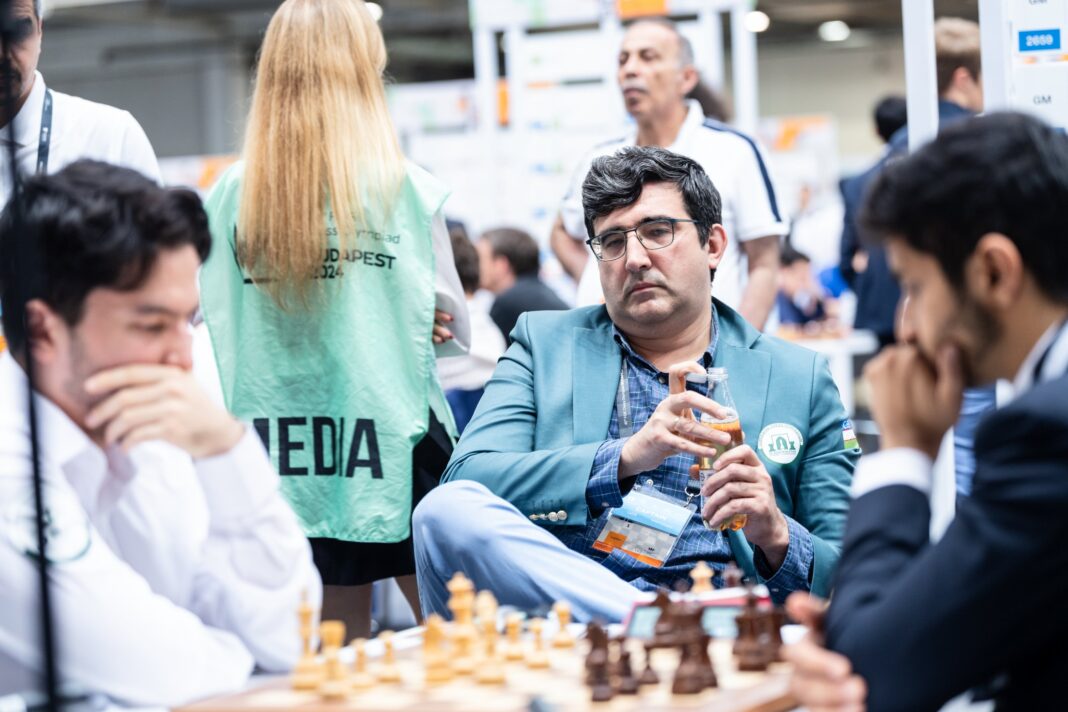

GM Vladimir Kramnik has been banned from FIDE events and official chess-related roles for two years after the FIDE Ethics & Disciplinary Commission (EDC) found him guilty of bullying, harassment, and unfounded cheating accusations. Kramnik called the verdict “unlawful” and said he intends to appeal.
The decision, announced and dated Friday, July 3, comes almost eight months after FIDE referred the 14th world champion to the EDC over his public statements about GMs Daniel Naroditsky and David Navara.
The timing of the announcement was striking. It came on the same day as the inaugural Naroditsky Memorial Rapid & Blitz began in Charlotte, North Carolina, where the grandmaster lived and worked until his tragic death last year. His death was ruled an accident, a report by the medical examiner showed.
♟ FIDE Ethics & Disciplinary Commission issues a decision in the case involving GM Vladimir Kramnik
The EDC found Kramnik responsible for multiple violations of the FIDE Ethics Code and Disciplinary Code. The Chamber found that his conduct breached provisions relating to the… pic.twitter.com/F3BtAy8Bv0
— International Chess Federation (@FIDE_chess) July 3, 2026
8 Guilty Findings, 3 Not Guilty
Of the 11 charges considered by the EDC, Kramnik was found guilty on eight and not guilty on three. Two of the guilty findings were unanimous: Article 6.5(a), bullying and cyberbullying, and Article 6.24, responsibility and role model behavior.
The other six guilty findings were by majority. In its conclusion, the chamber wrote:
The EDC Chamber finds by a majority of its members that the Respondent is guilty of violations of the following articles of the EDC Code: 6.3 (Right of all individuals to dignity and to be treated with respect), 6.4 (Safeguarding the dignity of individuals), 6.5(e) (Psychological abuse), Art 11.6(a) (False or unjustified accusations), 11.4(d) (Failure to cooperate), and 11.7(f) (Reckless or manifestly unfounded accusations of chess cheating).
The chamber did not accept the remaining three charges. The ruling states:
The EDC Chamber finds by a majority of its members that the Respondent is not guilty of violations of the following articles of the EDC Code: 6.10 (Integrity, honesty and responsibility), 6.25 (Responsibility and accountability) and 11.6(c) (Causing reputational harm).
The EDC imposed:
- A worldwide two-year ban from FIDE events and official chess-related roles
- The final 12 months suspended, subject to a three-year probationary period
- A supplementary sanction of 12 months of unpaid service for the chess community
The ban applies to participation in FIDE events and involvement in chess-related activity. For example, it would prevent Kramnik from serving again as captain of Uzbekistan’s team at the Chess Olympiad, a role he held in 2024 when the team won bronze in Budapest.
Kramnik To Appeal
The ban takes effect immediately. However, Kramnik has already said he will use his right to appeal the decision within 21 days. The Russian grandmaster who resides in Geneva, Switzerland, said in a statement that he had “already prepared in advance” the text of his appeal and intends to file it “in the coming days.”
He also said he would supplement it with new points based on what he described as “numerous procedural and other violations” in the decision.
Official Statement regarding EDC decision from 3 July 2026
I have just reviewed the text of the Ethics Commission’s decision in case 12/2025.
I had already prepared in advance the text of my appeal, which I intend to file in the coming days. I will supplement it with new…
— Vladimir Kramnik (@VBkramnik) July 3, 2026
“Without going into details, the number of gross violations of major articles of the FIDE Regulations committed by the Ethics Commission in this case runs into the dozens,” Kramnik wrote.
He added: “I am absolutely confident that this unlawful verdict will ultimately be overturned, and I intend to pursue all necessary instances to the very end in order to restore justice and, in particular, my reputation.”
I am absolutely confident that this unlawful verdict will ultimately be overturned.
—Vladimir Kramnik
Kramnik ended his statement this way: “Blatant and undisguised lawlessness must be—and will be—punished.”
Naroditsky, Navara Central To Case
The case, titled “Alleged Bullying by GM Vladimir Kramnik,” combined complaints from the FIDE Management Board and FIDE Fair Play Commission (FPL), and an investigation was opened just over three weeks after Naroditsky’s passing, alleging possible violation of the principle of human dignity, particularly the bullying of Naroditsky and Navara.
Kramnik, who retired from classical chess in 2019, has become an increasingly polarizing figure in the chess world by launching a campaign against what he believes is a cheating epidemic in chess. While the 51-year-old insisted he has never accused anyone directly of cheating, saying he has merely been “asking questions,” the chess community has widely interpreted some of his posts and videos as accusations of foul play.

At the end of 2023, Chess.com muted Kramnik’s account following repeated accusations against other players, among them Naroditsky. He was later suspended from prize events and is now permanently banned, following what Chess.com called repeated and egregious violations of the company’s Community Policy.
Kramnik’s conduct toward Naroditsky drew criticism from several top players. GM Magnus Carlsen described his former colleague’s treatment of Naroditsky as “horrible,” while GM Levon Aronian suggested he get “professional help.” GMs Hikaru Nakamura and Nihal Sarin also described Kramnik’s conduct as harassment.
Public outrage also grew beyond social media. A Change.org petition gathered more than 52,000 signatures, calling on FIDE to impose sanctions on both Kramnik and FIDE CEO GM Emil Sutovsky.
EDC: Kramnik Went Beyond Analysis
Following the complaint by the FIDE Management Board, the Fair Play Panel submitted a separate report concerning “unfounded cheating accusations & cyberbullying,” and the two complaints were merged into a single decision, saying they arose from the same factual background and involved the same respondent.
The three-person “First Instance Chamber,” as it’s called, consisted of Chairperson Khaled Arfa, Ali Nihat Yazici, and Alan Borda. Several findings were split decisions, with Arfa dissenting from multiple guilty findings and Borda dissenting from several not-guilty findings.
The panel noted Kramnik’s status as a former world champion and his “exceptional standing within the chess community,” which amplified his reach and the impact of his statements, and said Kramnik “failed to adapt his conduct to his status as a ‘role model.'”
The respondent [Kramnik] failed to adapt his conduct to his status as a ‘role model.’
—FIDE Ethics & Disciplinary Commission
In the findings on cyberbullying, the decision said Kramnik’s posts and videos formed a sustained course of conduct rather than isolated remarks. The record included accusations of lying and defamation, the phrase “Cheating Tuesdays,” references to “chess mafia,” sarcastic commentary, and invitations such as “draw your own conclusions” and “enjoy”:
Far from acting as a detached analyst, the Respondent actively fostered a dynamic that falls squarely within the established paradigm of cyberbullying, satisfying the requisite criteria of “unwanted, repeated and intentional, aggressive behavior.”

The EDC rejected Kramnik’s argument that he was only publishing statistical data and asking for further investigation. “Even assuming that the Respondent’s analysis justified further private inquiry, it did not justify public accusations,” the ruling states.
Experts Challenged Kramnik’s Statistical Claims
A key part of the case was dedicated to a report by the Fair Play Panel, which examined the statistical methods Kramnik has used to raise suspicions about online cheating. Professor IM Kenneth Regan, GM David Smerdon, renowned statistician Jeff Sonas, and statistics professor Jeffrey S. Rosenthal looked at the metrics Kramnik has cited in public discussions of online cheating, including winning streaks, accuracy scores, and performance ratings.
In 2024, Rosenthal examined Kramnik’s claim about Nakamura’s winning streaks being “extremely low probability mathematically,” a claim that was widely interpreted as an insinuation of foul play.
According to the decision, the experts supported Rosenthal’s analysis that the winning streaks “do not support claims of irregular behavior” and were “fully consistent with normal human play.”
The decision states that Regan and Sonas rejected Kramnik’s objections to Rosenthal’s report and found his methodology and conclusions to be sound. Smerdon, meanwhile, conducted an independent test using Kramnik’s own parameters on the top 50 Chess.com blitz players and concluded that the streaks were “normal” and “entirely consistent with normal statistical variations.”
The experts were also critical of Kramnik’s reliance on accuracy metrics and performance ratings, which they said were unreliable for proving misconduct. Regan’s analysis found no evidence of cheating in Nakamura’s or Naroditsky’s Titled Tuesday games.
The report also noted:
As aggravating factors, the Respondent’s conduct includes targeting minors (as young as ten), persistently harassing specific individuals (including GMs Nakamura, Naroditsky, and Navara), and threatening the opposition with legal action. Together, these establish an escalating pattern of behavior that has caused significant reputational and psychological harm.
The Fair Play report further states that public cheating allegations require transparency. According to the decision, Regan and Sonas said Kramnik should disclose his data, methods, and the qualifications of his team—something he had not done, according to the report.
Kramnik Denied Wrongdoing

Kramnik denied all allegations throughout the process. According to the ruling, he argued that his posts were requests for investigation rather than cheating accusations, that his statistical work was being misrepresented, and that FIDE and Chess.com had ignored his good-faith attempts to address what he believes is a serious cheating problem in online chess.
The 51-year-old also denied harassing Naroditsky and Navara, denied making false or unjustified accusations, and argued that he was responsible only for his direct statements—not for how others interpreted them on social media.
Kramnik also challenged the jurisdiction of the Fair Play Commission and its Investigatory Panel, arguing that the commission’s authority should be limited to concrete cheating incidents in FIDE events. The chamber rejected that argument and noted that the Fair Play Commission’s mandate covers “all cheating-related matters, including false accusations.”
The ruling also notes that Kramnik initially indicated willingness to cooperate with the Fair Play investigation, but later declined to answer the Investigatory Panel’s questions after challenging its jurisdiction. The chamber found that the refusal was unjustified and held that he had failed to cooperate.
For Kramnik, who retired from classical chess in 2019 and has since played only occasional rapid and blitz events, the ban may have limited impact on his playing career. But it remains a significant sanction against one of the most accomplished players in chess history.
Unless overturned on appeal, the ruling bars him from FIDE chess competitions and from official chess-related roles for the next year, with another year suspended during a three-year probationary period. It would also prevent him from returning as captain of Uzbekistan’s Olympiad team, a role he held in 2024 when the team won bronze in Budapest.