

I love the draft. Well, from a broader standpoint I find it morally abominable that workers entering an industry have no say in which company they work for or where they’ll be posted. But since we have a draft, and it seems highly unlikely that that’s going to change in the near future, I love covering it.
This is the confluence of amateur baseball (especially college ball, my great love) and the professional game. It’s the dawn of a new age of possibility; for months, we don’t know for sure where Roch Cholowsky or Jackson Flora are going to be playing in the pros. The moment in which we find out is an exciting one. I love seeing the stars of tomorrow before they’ve had their quirks sanded off by the great finishing school that is minor league baseball.
This is a minority position among baseball fans — even diehard fans — and media. In American professional sports, public interest in the draft is proportional to the proximity of draftees to the major leagues. This is as close to a law of natural science as you’ll find in sports, but since the pandemic, Major League Baseball has toyed with finding the limits of that law.
I’ve followed the draft closely since it was a perfunctory broadcast on MLB Network, followed by a conference call, but this is the first one I’ve attended in person.
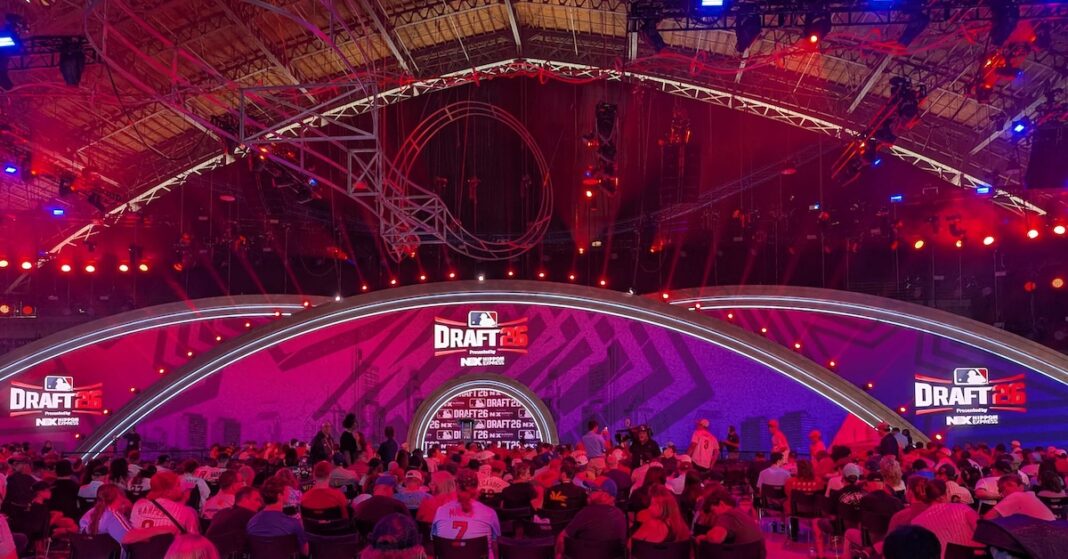
Elements of it were impressive. The set, which featured three arched screens spanning the width of the Pennsylvania Convention Center’s Grand Hall, was terrific. It might not have been as evocative a location as the Fort Worth Stockyards — if the air in Philadelphia weren’t like an autoclave right now, it could’ve been fun to set up a stage on Independence Mall — but the Convention Center lies right at the heart of Center City and hosts events like this all the time.
The crowd, which packed the limited seating space, performed as advertised. When a selection of big league mascots paraded in before the first pick, they booed the hell out of Blooper. Commissioner Rob Manfred got the expected boos when he was introduced; when he announced the Braves’ pick at no. 26 and declared that the Mets were on the clock at no. 27, those jeers reached a peak so ferocious that even the normally humorless commissioner was unable to suppress an amused chuckle.
You Aren’t a FanGraphs Member
It looks like you aren’t yet a FanGraphs Member (or aren’t logged in). We aren’t mad, just disappointed.
We get it. You want to read this article. But before we let you get back to it, we’d like to point out a few of the good reasons why you should become a Member.
1. Ad Free viewing! We won’t bug you with this ad, or any other.
2. Unlimited articles! Non-Members only get to read 10 free articles a month. Members never get cut off.
3. Dark mode and Classic mode!
4. Custom player page dashboards! Choose the player cards you want, in the order you want them.
5. One-click data exports! Export our projections and leaderboards for your personal projects.
6. Remove the photos on the home page! (Honestly, this doesn’t sound so great to us, but some people wanted it, and we like to give our Members what they want.)
7. Even more Steamer projections! We have handedness, percentile, and context neutral projections available for Members only.
8. Get FanGraphs Walk-Off, a customized year end review! Find out exactly how you used FanGraphs this year, and how that compares to other Members. Don’t be a victim of FOMO.
9. A weekly mailbag column, exclusively for Members.
10. Help support FanGraphs and our entire staff! Our Members provide us with critical resources to improve the site and deliver new features!
We hope you’ll consider a Membership today, for yourself or as a gift! And we realize this has been an awfully long sales pitch, so we’ve also removed all the other ads in this article. We didn’t want to overdo it.
But the logistics of the event were balky. There’s a skybridge between the event hotel and the Convention Center; I crossed it nearly three hours before the first pick and was waved through the security checkpoint. Shortly thereafter, the bridge was closed, forcing the rest of the press corps to go the long way around the block. The credential scanners didn’t work, which caused delays. Admittedly, this isn’t exactly MLB’s fault, and no one cares when the media gets inconvenienced, but we don’t run into problems like this at important events like playoff games, and rarely for regular season games. If you want your event to get attention, you make the process of covering it as smooth as possible.
In years past, the festivities proper would end after one round, but the rest of the Day 1 picks would still be shown on the screen while the writers who build their calendars around this event — not just our contingent, but MLB.com, USA Today, Yahoo, Baseball Prospectus, ESPN, and Baseball America, just to drop the names of publications who sent writers I spoke to — covered the draft at the draft. The press area would close only after selections were done for the day. This time, the draft board went dark right after the first round, and the working media was shooed out of the hall not long after Manfred’s benediction, leaving only the desk for the MLB.com live stream still in action as stagehands struck the sets. By the time league officials decided folks could stick around an hour longer, most of the writers had already left.
For an event created to highlight talented ballplayers, those were thin on the ground. Before the White Sox made their first pick, a pair of their former players — Greg Luzinski and Jimmy Rollins, who by coincidence also happen to be local legends in Philadelphia — made an appearance and chatted with MLB Network host Robert Flores for a few minutes. But that was about it.
Last year’s draft was the first in 15 years to not have a single prospect attend in person, and none attended on Saturday in Philadelphia. This was not as scandalous a revelation; last year’s draft took place in Cobb County, Georgia, one of the cradles of amateur baseball. The closest thing we had to a hometown prospect in this year’s first round was a pair of New Jerseyans, University of Virginia outfielder AJ Gracia and Coastal Carolina pitcher Cameron Flukey, who both grew up more than an hour away, well beyond the farthest reaches of Philadelphia’s exurbs.
The highlight of every NFL and NBA draft on TV is seeing the best college players take the stage and pose with their new team’s cap and jersey, and introduce themselves to their new community of fans. That’s never been quite as big a deal in baseball, but you don’t have to go back too far to find some really fun moments. In 2024, JJ Wetherholt, a Pittsburgher by birth, showed up in Fort Worth in a black Stetson and a bolo tie, to the uproarious approval of the fans in attendance. It was a first star moment for a player who quickly proved to be a star in the making.
Interaction with the prospects themselves was limited to a set of canned interviews taped at the MLB Draft Combine in Phoenix last month, plus an MLB Network segment on Georgia Tech catcher Vahn Lackey, the eventual no. 3 overall pick. In the convention hall, we did not get to see Cholowsky’s reaction to being selected first overall, and we might be better off for it; when the time came for Manfred to call the top pick’s name, he mispronounced it.
I was left wanting more, but I’ll sit at my computer and refresh the Draft Tracker on MLB.com all the live long day no matter where the draft is held, or under what circumstances. All things considered, I enjoyed the show, but it felt like an afterthought.
That’s a reversal from the direction Major League Baseball seemed to be going in the first half of this decade. In 2021, the draft moved from early June to the All-Star break. This rescheduling eased the awkwardness of college players being drafted with almost a month of the postseason left — every year, a handful of players got picked while they were actually playing in NCAA Tournament games — but it was supposed to take the draft out of that sleepy TV studio in Secaucus and turn it into a spectacle for fans.
MLB started putting on the Draft Combine, which put its stars of tomorrow on TV and in front of the national prospect media, including yours truly. In 2023, I spilled more than 4,000 words of virtual ink on the question of whether the Combine, which had been attended by a few dozen fans, could ever grow into something worthy of mainstream interest.
It was an interesting question, I thought, not least because it clearly mattered to MLB’s bigwigs. The response, both to my article and the Combine in general, was that almost no one in the mainstream cared.
Three years later, the draft has moved from a prime Sunday night slot to post-hangover brunch o’clock on Saturday. ESPN used to send its prospect guru Kiley McDaniel to call the draft alongside Kyle Peterson, Eduardo Perez, and a selection of the network’s college baseball announcers. NBC, in its first year with the rights to the event, simply used MLB Network’s panel. Only the top 10 picks made it to air on NBC itself; after that, viewers had to switch to MLB Network and Peacock.
The first round alone competed directly with 10 different regular season games. Even taking into account the day of the week, that’s a huge number of day games; it’s like MLB intentionally counter-programmed an event it was trying to turn into a special occasion just two or three years ago. When I made it back to my hotel and turned on MLB Network, I saw Big Inning whip-around coverage; the last three rounds of Day 1 had been relegated to a stream on MLB.com.
I don’t know if I’m cynical enough to believe that stepping back on the draft was a calculated decision, that MLB is diminishing the draft in order to soften the ground for restricting it in the next CBA. In the unlikely event that MLB gets its 12-round, all-college draft, the league would pay to ensure that the top prospects, reputations burnished by two years’ exposure on the road to Omaha, would be there to pick up a jersey and shake the hand of Manfred’s successor. Intentional or not, that would make a stark contrast to the drafts of 2025 and 2026, which could’ve been conference calls, as they were 20 years ago.
Regardless, this is clearly no longer a mainstream-interest event. The schedule is different and the TV sets are a million times fancier, but MLB is once again treating the draft like it’s for sickos only.
Which is fine. Like I said, I’m a draft sicko. It’s just disappointing that the league is no longer trying to create more of us.