


The Pittsburgh Penguins have more options than they had a few months ago. That should create competition, but it also creates pressure.
President of hockey operations and general manager Kyle Dubas has spent the offseason reshaping the edges of the roster without fully tearing down the core. Pittsburgh has added forwards, changed the blue line, rebuilt part of the goalie picture and created more internal battles than it had entering last season. Some players will benefit from that. Others could get pushed aside quickly.
The Penguins’ current depth chart shows how crowded the picture has become. There are more NHL-caliber names than clean roles, and that makes training camp more than a formality for several players.
Some have to prove they are still useful. Some have to prove they are more than interesting bets. Others need to show they are ready for responsibility Pittsburgh may not be able to avoid giving them.
Here are the five Penguins with the most to prove entering 2026-27.
1. Ryan Graves
Ryan Graves has the most to prove because his contract and role are moving in opposite directions.
Graves is signed through 2028-29 with a $4.5 million average annual value (AAV), which would be manageable if he were a steady top-four defenseman. Instead, he enters the season trying to prove he still belongs in Pittsburgh’s regular defensive group. That is a difficult place for any veteran to be, especially one with three years remaining on his deal.
His situation has become one of the strangest on the roster. Pittsburgh still has a left-side problem, but Graves has not done enough to make himself the solution. Samuel Girard is the obvious left-shot defenseman at the top of the depth chart, while Declan Carlile, Ilya Solovyov, Owen Pickering and others are part of the broader conversation. Even with the left side unsettled, Graves still feels like a player fighting from behind.
The pressure is obvious. If he rebounds and becomes a reliable defensive option, the Penguins can make the contract easier to stomach. If he struggles again, the organization may be stuck deciding whether to bury the deal, attempt a trade or eventually consider a buyout. Pittsburgh’s worst-contract conversation already starts with Graves, and that will not change unless his play does.
This season may be his last real chance to shift the narrative in Pittsburgh.
2. Nicholas Robertson
Nicholas Robertson already got the contract. Now he has to prove the Penguins were right to make the bet.
Robertson’s new two-year contract carries a $3.25 million AAV, giving him security and giving Pittsburgh two seasons to figure out whether his scoring can translate in a larger role. The deal avoided arbitration, but the harder part starts now.
The case for Robertson is easy to understand. He can shoot, he has already scored at the NHL level and he is still young enough to become more than he was with the Toronto Maple Leafs. His updated contract page also keeps him under team control as a restricted free agent after 2027-28, which gives the Penguins a little more runway if the fit works.
The concern is opportunity. Pittsburgh has Andrei Kuzmenko, Egor Chinakhov, Bryan Rust, Rickard Rakell, Rutger McGroarty, Ville Koivunen, and others competing for offensive minutes. Robertson needs a top-nine role to maximize his strengths, but he is not the only winger trying to win one.
His new deal raised the right question. Is he a real piece of the next Penguins forward group, or just another talented player in a crowded lineup? Robertson has to make that answer obvious.
3. Artūrs Šilovs
Artūrs Šilovs may have the most important job on this list because goaltending could decide Pittsburgh’s floor.
The Penguins are asking a young goalie group to replace more experienced NHL minutes, and that is a massive swing. The current situation see Šilovs, Sergei Murashov, and Joel Blomqvist as the main names in net. There is upside in that trio, but there is also real volatility.
Šilovs is signed for one year at $2.8 million, which makes this season a direct evaluation. He has NHL experience and playoff moments, but his regular-season profile still leaves plenty to prove. If he stabilizes the crease, Pittsburgh becomes much easier to trust. If he does not, the Penguins may have to accelerate Murashov’s timeline or lean harder on Blomqvist.
The broader goalie situation is one of the biggest unknowns on the roster. Pittsburgh did not simply swap one established starter for another. It shifted toward youth, projection, and internal upside. That can work, but it puts pressure on the player most likely to start with the biggest NHL role.
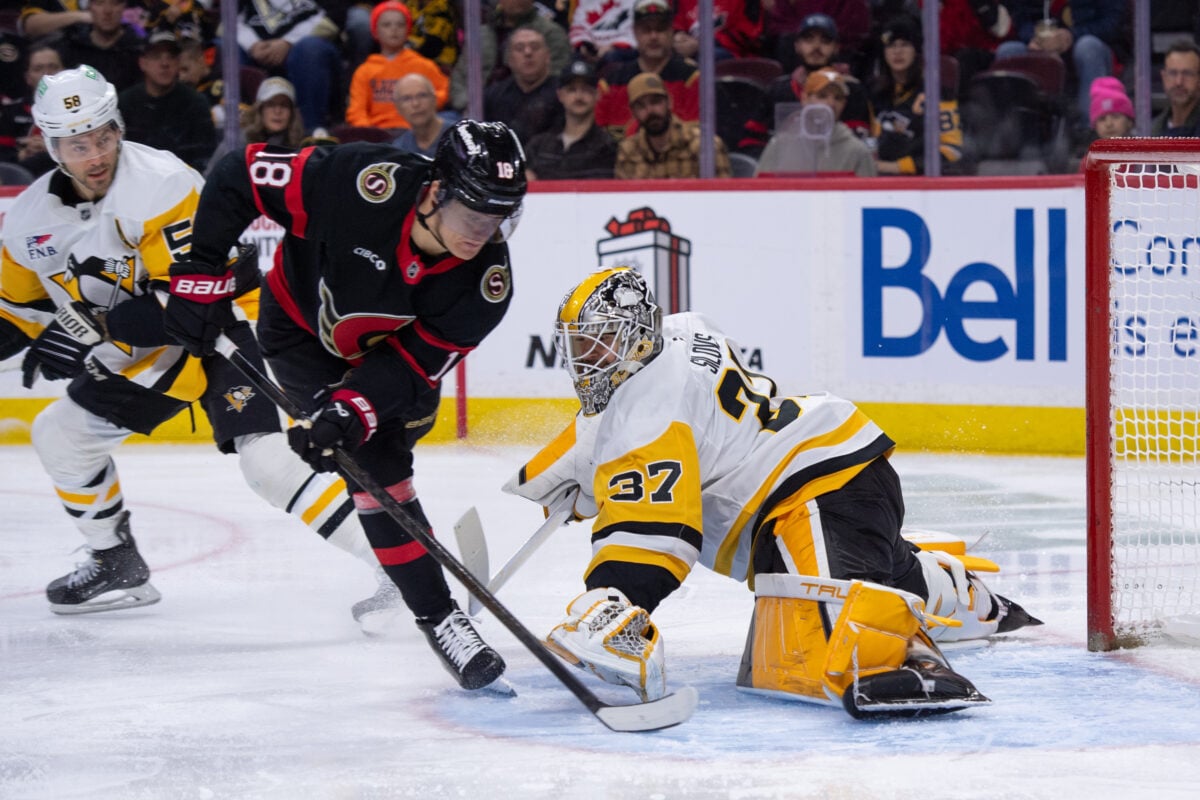
The Penguins’ goalie questions all begin with Šilovs. He does not have to become a star, but he has to give head coach Dan Muse enough stability to keep the season from becoming chaotic.
4. Rutger McGroarty
McGroarty has to prove he is too close to the NHL to be squeezed out by roster math.
McGroarty’s skill set still makes sense for Pittsburgh. He is competitive, direct, and more physically projectable than some of the organization’s other young forwards. The Penguins need players who can eventually bring offense, pace and battle level together. McGroarty can be that type of player, but he has to force the issue.
His American Hockey League (AHL) production helped his case. McGroarty finished with 34 points in 30 regular-season games for Wilkes-Barre/Scranton, and his AHL profile shows a player who has already handled professional hockey well below the NHL level. The question is whether that can become a regular role in Pittsburgh.
The problem is the roster around him. Robertson’s arrival, Kuzmenko’s signing, Chinakhov’s role, Koivunen’s push, and the veteran wingers all make the path tighter. McGroarty’s roster squeeze is already one of the more important young-player storylines entering camp.
He cannot afford to look merely close. He needs to look ready. If McGroarty gives the coaching staff a reason to keep him, Pittsburgh will have to find room. If he blends into the competition, another AHL start becomes easier to justify.
5. Hendrix Lapierre
Hendrix Lapierre has a different kind of pressure because the Penguins need more clarity down the middle.
Lapierre signed a two-year deal with a $1.3 million AAV after Pittsburgh acquired him from the Washington Capitals. That is a manageable contract, and it gives the Penguins another young center option at a time when the position behind Sidney Crosby still feels unsettled.
The opportunity is real. Evgeni Malkin’s shift away from being the automatic second-line center solution changes Pittsburgh’s structure. Tommy Novak and Blake Lizotte are part of the answer, Ben Kindel could push for more responsibility, and Lapierre has to show he belongs in that conversation rather than sitting on the edge of it.
Lapierre does not need to become a high-end scorer to make the deal work. He has to become useful enough to hold a role. If he can handle third-line minutes, provide energy, support the defensive structure and create enough offense to avoid being a placeholder, the Penguins will have found something valuable.
The risk is that he becomes another player without a defined lane. Pittsburgh’s center problem makes Lapierre’s camp especially important because the Penguins need someone behind Crosby to claim responsibility. If he does not, the front office may have to keep searching.
Penguins Need Answers Quickly
The Penguins do not need all five players to hit their best-case outcomes. That would be unrealistic. They do, however, need enough of them to answer major questions.
Graves has to prove his contract is not completely lost. Robertson has to turn a new deal into a real role. Šilovs must stabilize a young goalie group. McGroarty needs to force his way through a crowded forward picture. Lapierre has to show he can help solve the center issue.
Those are five different kinds of pressure, but they all point toward the same larger problem. Pittsburgh has options. It needs answers.
If enough of these players deliver, the Penguins become more balanced, flexible, and dangerous than they look on paper. If most of them fall short, Dubas will have more work to do before the season gets too far away from him.
Training camp will not settle everything, but it should reveal who is ready to be part of the solution and who is still stuck in the question pile.
Free Newsletter
Get Pittsburgh Penguins coverage delivered to your inbox
In-depth analysis, breaking news, and insider takes – free.
Subscribe Free →