

Albert Baldeo |
Some cricketers become legends within cricket. Sir Garfield Sobers became the measure of cricketing greatness itself, not simply the greatest all-rounder.
Sobers was not merely one of the greats; he occupied a class entirely his own. Yet numbers and accolades alone cannot explain his lasting hold on the imagination. Viewed in a deeper psychological and historical context, his artistry and flamboyance reflected the post-colonial era-a spirit of celebration and liberation from oppression. His triumphs lifted marginalized people beyond their daily burdens, carrying them into moments of pride, achievement and joy inspired by the superlatives that followed him.
He made excellence appear effortless and the impossible seem natural. His batting carried elegance without fragility, aggression without recklessness and power without ugliness. His bowling reflected a remarkable intelligence and adaptability. His fielding revealed athleticism, anticipation and courage. He was not simply performing skills, but expressing cricket as an art form, and a testament that we are, at a minimum, as good as anyone else. You may mention cricket giants like Jacques Kallis, Imran Khan, Ian Botham, Richard Hadlee, Kapil Dev, and others, but Sobers comes out universally as the best of them all.
For Barbados, he is a cherished National Hero. For the West Indies, he is a towering symbol of Caribbean excellence during a period when achievement on the cricket field carried deep historical, cultural and emotional meaning. He helped demonstrate to the world that our small countries can produce greatness without limits-that Caribbean talent, discipline and imagination could stand supreme on the international stage. His genius became the inheritance of the entire Caribbean, and ultimately, of the whole cricketing world.
The son of a merchant seaman, he was only five when his father died at sea in January 1942, after his ship was torpedoed by a German U-boat. Sobers’ rise from his ensuing hardship to greatness, to his sobriquet “King Cricket” is a monumental inspiration for many to follow, and his genius has bequeathed an indelible memory wherever cricket is played. He was born with an extra finger on each hand, which he removed himself, a harbinger that the Good Lord had overflowed that extra talent into him, demonstrated by him playing golf, soccer and basketball for Barbados, and making his first class and Test debuts in cricket at the age of 16 and 17 respectively.
He was a one-man cricket team, the dream of any captain. His versatility with the ball enabled him to bowl left-arm orthodox and wrist spin and fast-medium pace, including bowling bouncers. The completeness of his versatile skills and talents bestrode the cricketing world like a colossus, and like the proverbial Napoleon on the battlefields of cricket, he conquered all before him, excelling in every conceivable department of the game, except wicketkeeping. Oh, if only Sir Garry, and players like Kanhai, Hall, Lara, Lloyd, Richards, Headley and others were available to proudly don West Indian flannels…West Indian pride will soar once again.
Uniquely gifted, he was blessed with supreme athleticism, panther reflexes, eagle eyesight and the heart of a lion. He was a peerless exemplar of cricketing brilliance, endowed with an alliance of such natural gifts of talent and genius, that cricket may never see his like again. He was the cricketer’s cricketer, whose phenomenal genius hardly brooked human limits. It was legendary, both in quality and quantity. Sobers has set the standards by which other cricketers are measured, and like Muhammad Ali in boxing, Michael Jordan in basketball, and Pele in soccer, Sobers is similarly unrivalled in the world of cricket.
Sir Neville Cardus, that doyen of cricket scribes, gave the appropriate imprimatur to his all-round genius in Wisden, 1967, page 38, when he wrote: “Garfield St Aubyn Sobers…the most renowned name of any cricketer since Bradman’s high noon. He is, in fact, even more famous than Bradman ever was; for he was accomplished in every department of the game, and has exhibited his genius in all climes and conditions. We can safely agree that no player has proven versatility of skill as convincingly as Sobers has done, effortlessly, and after the manner born.”
In fact, Sobers is to cricket what Shakespeare is to literature, Michelangelo to art, and Mozart to music. His only perceivable Achilles heel was as a captain, a consideration which can be excluded in the present context of argument.
Sir Donald Bradman, who saw Sobers’ 254 against Australia for a World XI in Melbourne in 1971-72, reckoned that it was the best innings he had ever seen on Australian soil.
Sir Clyde Walcott said: “Sir Gary is remembered not only for his remarkable trail of statistical records, but for the quality of his cricket and the way he enjoyed the game.”
E W Swanton reminded us that “the true measure of his influence must take account of his sportsmanship and an unselfishness that were never questioned, an example second to none”.
John Arlott described Sobers as “the finest all-round player in the history of cricket”.
C L R James reiterated that: “A man of genius is what he is, he cannot be something else and remain a man of genius.”
Michael Manley once said this of Sobers: “Sobers was destined, in typically Caribbean fashion, to shine like some great star alone in the firmament of his own genius.” Let Sobers have the last word. In his book, The Changing Face of Cricket, he commends CLR James’ words to all readers everywhere, as if answering those who continue to argue that he is not the greatest, “What do they know of cricket, who only cricket know?”
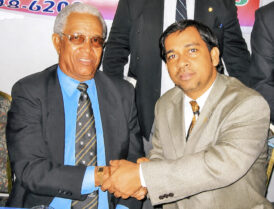
Hon. Albert Baldeo is a District Leader, civil rights activist and community advocate, and his groundbreaking political efforts placed previously ignored minority communities in LITTLE CARIBBEAN, like Richmond Hill and Ozone Park, NY, USA firmly on the political and economic map. As the President of the Baldeo Foundation and Queens Justice Center, he has continued to fight for equal rights, dignity and inclusion in Government and decision-making, and continues to be inspired by role models like Sir Garry Sobers. He can be contacted at the Baldeo Foundation: (718) 529-2300.