
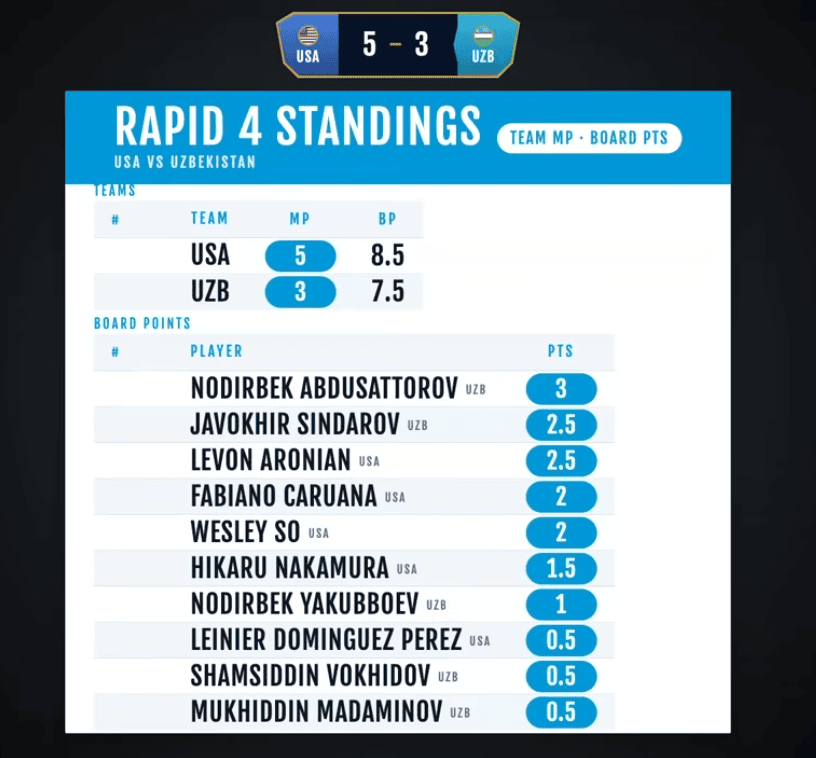

The U.S. leads 5-3 against Uzbekistan after day one of the WR Chess Rapid & Blitz Miami 2026. GM Levon Aronian was the MVP, putting up the highest individual score on his team, 2.5/3. GM Nodirbek Abdusattorov’s 3/4, the highest on team Uzbekistan, was not enough to tie the score.
There’s one more day of this event, with eight rounds of blitz coming up. That’s on Tuesday, July 28, starting at 1:00 p.m. ET / 19:00 CEST / 10:30 p.m. IST.
Rapid Standings
This new tournament, organized by FIDE presidential candidate Wadim Rosenstein, invites five top players from the U.S. and another five from Uzbekistan and pits them in a two-day Scheveningen match. The first day features rapid chess, with a 15+10 time control, and the second day is all blitz, with 3+2.
| Team U.S.A. | Team Uzbekistan |
| GM Hikaru Nakamura | GM Javokhir Sindarov |
| GM Fabiano Caruana | GM Nodirbek Abdusattorov |
| GM Wesley So | GM Nodirbek Yakubboev |
| GM Levon Aronian | GM Shamsiddin Vokhidov |
| GM Leinier Dominguez | GM Mukhiddin Madaminov |
Each round features four boards (a different player sits out per round), and a team victory per round is worth two points—regardless of whether you win 4-0 or 2.5-1.5 in individual matchups. In the blitz portion, on Tuesday, each match win is also worth two points.
Day one featured four rapid games.

The United States led from start to finish on day one. Round two was especially critical as Uzbekistan was one draw away from winning the round, which in hindsight, we know would have been enough to tie the score.
| Round | U.S. Score | Uzbekistan Score | Round Outcome |
| Round 1 | 2.5 | 1.5 | U.S. Win |
| Round 2 | 2 | 2 | Tie |
| Round 3 | 2.5 | 1.5 | U.S. Win |
| Round 4 | 1.5 | 2.5 | Uzbekistan Win |
Round one was a convincing victory by the U.S. GM Wesley So scored the only win, against GM Mukhiddin Madaminov, with three draws in the other games.
So came armed with a novel pawn sacrifice in the Berlin Defense, and for the missing pawn he had the bishop pair and Marshall-like compensation. White eventually returned the extra pawn, and Black was better with the two bishops. So felt his conversion was shaky, but the computer indicates he never let go of the win.
Perhaps understanding that So was already winning on the board next to him, thus claiming the match, GM Leinier Dominguez let go of a win against GM Shamsiddin Vokhidov and steered the game into an opposite-color bishop draw. GM Fabiano Caruana vs. GM Javokhir Sindarov and GM Hikaru Nakamura vs. GM Nodirbek Abdusattorov were solid draws.
So proved instrumental to the team in round two as well, winning his game against Vokhidov to tie the match score. At first, the U.S. was in trouble when Nakamura lost a quick game in 22 moves against Sindarov, who credited the win to opening preparation. He knew he had a great position when he played 16.Bf7!, but not that it was flat-out winning. He played every best move with an overall accuracy of 99.7. Yikes!
Sindarov told Chess.com’s FM Mike Klein, “That game for me was very easy because I have a very good opening preparation… I think he knows everything, but he forgets this line.”
As Nakamura explained, it was a “slight mishap, but Wesley saved us.” With draws on the other two boards (though Caruana was a piece up against Abdusattorov at one point), it was up to So to win what was objectively a fortress position, and after the mistake 61…g6??, with Black overlooking the response, the American was able to do just that.
Abdusattorov, who has for the first time brought his brother to a chess tournament, told WIM Fiona Steil-Antoni that the second round was the decisive one in the match. “I think after the second round it was a bit tough,” he said.

The U.S. picked up another two-point win in round three, scoring 2.5-1.5. Nakamura nicely outplayed Vokhidov in a queen and bishop endgame, while Aronian won with his signature creativity against Sindarov. The paradoxical 13…Nxh5!, grabbing a pawn on the edge of the board and leaving his own e-pawn hanging, was not on GM Yasser Seirawan or WGM Anastasiya Karlovich’s radar, but Aronian played it calmly.

Abdusattorov, in that same round, converted the exchange-up endgame by realizing that his king belonged on the queenside. The monarch marched right over, hid behind the black pawns, and his rooks took care of the rest. Still, it was Uzbekistan’s only win of the round.
In round four, there was one draw between Madaminov and Caruana; elsewhere, the teams traded blows with an American win by Aronian against Yakubboev and an Uzbek win by Sindarov against Dominguez. The deciding game of the match was So vs. Abdusattorov, a dynamic game with opposite-sides castling. The Uzbek ultimately won with the rook against two minor pieces, with queens still on the board.
Abdusattorov was still optimistic about his team’s chances. He said, positively, “In general we played very well. we have good chances to win all the matches too.” He looks forward to the blitz, though he thinks the Americans are favorites. “We have to be confident in our level and then maybe we have the same chances,” he said.
While Abdusattorov is “very excited and ready to play,” Sindarov said he looks forward to playing cards with Aronian this evening!

USA vs. Uzbekistan: WR Chess Rapid & Blitz Miami 2026 takes place on July 27 and 28 in Miami. Some of the strongest players in the U.S. meet Uzbekistan’s brightest stars in Miami for a two-day rapid and blitz showdown. The format is a Scheveningen match across four boards, with a rapid stage followed by a blitz stage. The time control is 15+10 for rapid and 3+2 for blitz.