
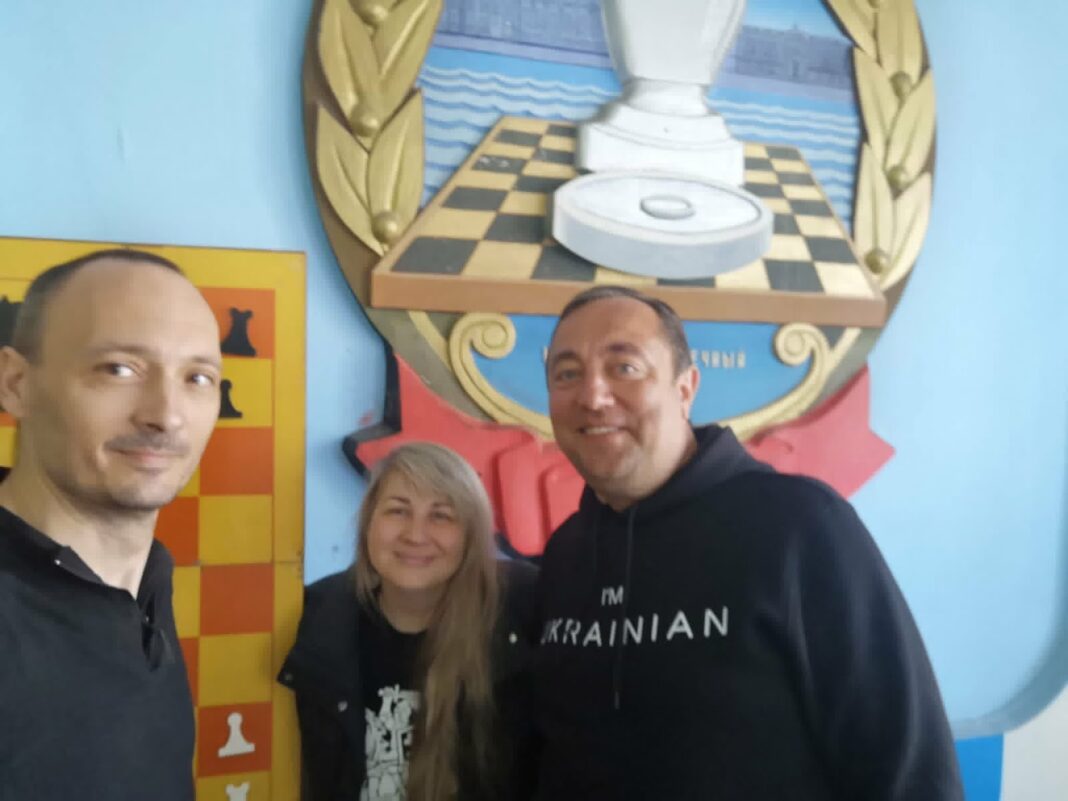

A Russian artillery attack destroyed the 121-year-old building that housed Kherson’s Children’s and Youth Sports School for Chess and Checkers, consuming what the regional chess federation says housed a library of more than 5,000 chess books.
According to local authorities, the historic building caught fire during a massive bombardment of residential areas in Kherson, Ukraine, early on Saturday, July 25. The resulting fire gutted the school, leaving little more than its charred exterior walls. The destruction of the chess center was reported by local outlet Hryvna, while Italian news agency ANSA confirmed that the historic former Italian consular building had also been hit and set on fire.
The attack on the chess school came during a wider artillery bombardment of residential areas in Kherson. A 47-year-old man was killed and seven other civilians were injured, two of them seriously, according to Kherson Regional Police.
Vitaly Bogdanov, President of the Kherson Oblast Chess Federation, told Chess.com that he was informed of the destruction in a call from the city’s Military Administration and immediately went to inspect the site.
“It was a black night for Kherson sports and our history,” he said. “What I saw with my own eyes cannot be described in words—the scale of the disaster is total. All that remains of the historic building where generations of talented children were raised are charred walls.”
All that remains of the historic building where generations of talented children were raised are charred walls.
—Vitaly Bogdanov
Bogdanov also took the photographs of the destroyed school that were published by Ukrainian media. He has headed the regional federation since 2005. The historic school has been the center of Kherson’s chess community throughout his tenure.
“This school was my second home, the work of my life, a space for the development of intellect and children’s dreams,” he said.
The strike didn’t just destroy the building itself, but teaching materials, historical documents, and an extensive chess library that consisted of 5,000 books are all gone, Bogdanov said.
“It was an invaluable intellectual collection that had been built up over generations by coaches and trainers. The enemy did not just burn walls—they tried to destroy our knowledge and our chess heritage.”

Before Russia’s full-scale invasion of Ukraine in February 2022, Bogdanov said Kherson hosted around 100 chess tournaments each year. It also hosted national championships, while the school halls were used for events with hundreds of children and adults. “These are, without a doubt, completely different times,” Bogdanov said.
Russian forces occupied Kherson during the first months of the full-scale invasion. Ukraine recaptured the city in November 2022, but Russian troops remain positioned across the Dnipro River and continue to subject the city to artillery fire and drone attacks.
“Since the war began, many students and coaches have moved abroad or to other regions of Ukraine,” Bogdanov said. “Due to this, combined with the daily shelling, tournaments are becoming fewer and further between, and they are held strictly underground in safe locations.”
Due to this, combined with the daily shelling, tournaments are becoming fewer and further between, and they are held strictly underground in safe locations.
—Vitaly Bogdanov
Some chess activities have continued online, while children in the city have gathered to play underground, he said.
Kherson’s chess school developed several top Ukrainian players, who went on to compete successfully at international level. Among them is GM Natalia Zhukova, two-time European Women’s Champion.

She shared Bogdanov’s pictures on Facebook with the text: “This is my chess house in Kherson, where I grew up 💔 And someone is talking about equal conditions for athletes.”
Other prominent players raised by the Kherson chess system include GMs Yuri Solodovnichenko and Egor Bogdanov, as well as IM Inna Gaponenko, who played on the Ukrainian team that won team gold at the 2006 Women’s Chess Olympiad.
In May 2021, the club was visited by GM Viktorija Cmilyte-Nielsen, the 2011 European Women’s Champion, who served as the speaker of Lithuania’s parliament. She played a 10-board simul against students inside the building.
Asked for his fondest memory of the club, Bogdanov recalled not a particular tournament or victory, but the children who once filled its halls. “My fondest memory will always be the shining eyes of the children during our massive celebrations, when the Sports School halls were packed to capacity with hundreds of young players,” he said.
“The unique, creative atmosphere remains unforgettable: the sun-drenched rooms, the majestic sculpted portraits of world champions on the walls, and the ringing silence right before the start of each round.”

Several notable personalities in the chess world have condemned the attack. Among them are the 13th world champion GM Garry Kasparov, who shared Nielsen’s post on X/Twitter.
Typical Russian target, along with sleeping civilians. Looking forward to helping rebuild this chess club, after the new Ukrainian club in Sevastopol! 🇺🇦✌️ https://t.co/AvBggtaQ6N
— Garry Kasparov (@Kasparov63) July 25, 2026
Jan Henric Buettner, one of three candidates in Septembers FIDE election, condemned the destruction in a statement that was also shared with Chess.com.
“No chess player, no child, and no civilian should have to fear for their safety simply because they gathered around a chessboard. Attacks that harm civilians and destroy places dedicated to learning, culture, and community deserve our unequivocal condemnation.”
Statement on the Attack on the Kherson Chess Club
I am deeply saddened by the news that the chess club in Kherson was struck in yesterday’s attack.
Chess clubs are places where children and adults come together in peace—to learn, to think, to compete with respect, and to build…
— Jan Henric Buettner (@JanHBuettner) July 25, 2026
Buettner said his thoughts were with those who had lost a place that meant so much to Kherson’s chess community. “I hope that the club can one day be rebuilt and once again become a place where people meet in peace,” he said.
“Chess teaches us that even the fiercest contests are governed by rules and respect. War reminds us of the terrible consequences when those principles are abandoned.”
Chess teaches us that even the fiercest contests are governed by rules and respect. War reminds us of the terrible consequences when those principles are abandoned.
—Vitaly Bogdanov

The historic building was not the only distinctive feature of the chess school. Behind it was a large courtyard with a fountain and an old oak tree that had stood through generations of Kherson’s history. Although the building was gutted, Bogdanov said the tree miraculously survived.
“It has seen so much in its long life, including the Russian occupation,” he said.
Last month, the Chess Federation of Russia (CFR) was suspended from the International Chess Federation after it refused to cease organizing chess events in Russian-occupied Ukrainian territories.
During the more than eight months in which Russia controlled Kherson in 2022, occupation authorities attempted to establish their own regional chess organization and advertised classes for children, Bogdanov said.
“They almost immediately registered a fake Kherson federation and ran television advertisements inviting children to join the classes. But Ukraine drove them out.”

The historic building that was once home to thousands of children and adults is gone, but Bogdanov remains convinced that Kherson’s chess community will return.
For the future, Bogdanov is convinced that chess in Kherson will rise again and that they will rebuild the chess center.