
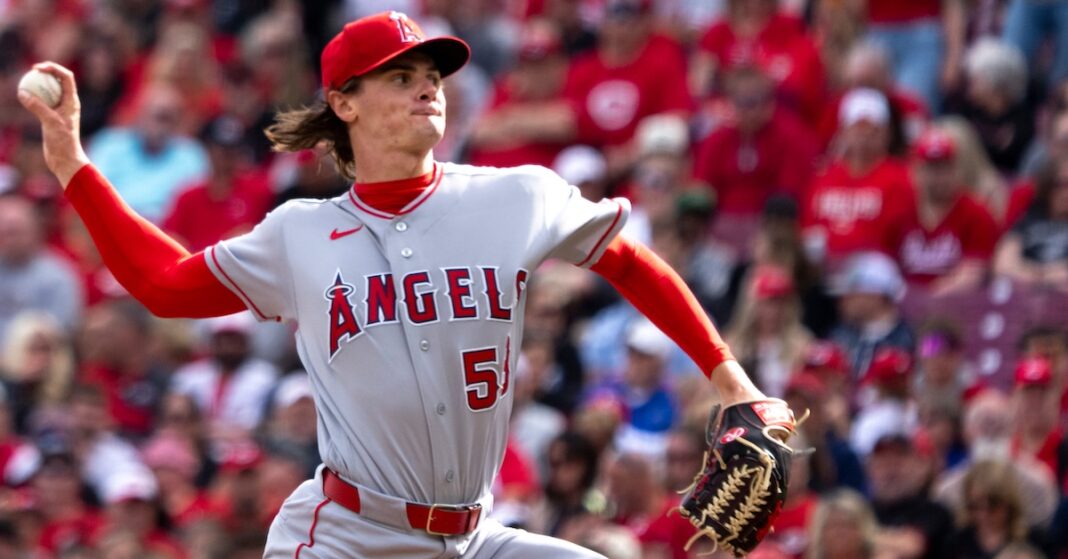

George Klassen’s initial big league outings were clunky. He allowed seven runs in just 4 2/3 innings over a pair of April starts, which, combined with an index fingernail contusion, has him back at Triple-A Salt Lake for more seasoning. That doesn’t mean his future isn’t promising. The 24-year-old right-hander ranks second on our Los Angeles Angels Top Prospects list, and 57th on our Top 100. Moreover, he was described by Brendan Gawlowski as having “some of the best stuff in the [Angels] system.”
An inability to consistently land his plus stuff in the strike zone is currently Klassen’s bugaboo. He issued free passes to 10 of the 32 batters he faced in his two starts in the majors — one against the Reds, another against the Mariners — and while big league jitters were certainly a factor, George Kirby he’s not. As Gawlowski wrote in his scouting report, “Klassen’s command remains below average… [and] there are markers in his delivery that suggest his feel for location will likely remain crude.”
A few years ago, Klassen was Mitch Williams-wild. As Eric Longenhagen pointed out in November 2024, the West Bend, Wisconsin native walked nearly a batter per inning in his 2023 draft year at the University of Minnesota. But as our lead prospect analyst also noted, “his feel for the strike zone improved right away in pro ball.” That was in the Phillies system. The Angels later acquired the erstwhile sixth-round pick from Philadelphia in the July 2024 Carlos Estévez deal.
His arsenal runs five deep, and that was the first thing I asked him about when we spoke at Tempe Diablo Stadium during spring training. In January’s scouting report, Gawlowski had opined that “the cutter looks like a tight slider and the slider like a sharp power curve.”
How does Klassen classify his pitches?
The hard-throwing righty told me that he throws “a four-seamer, a four-seamer with sink, a slider, a curveball, and a changeup,” to which I replied, “No cutter?”
You Aren’t a FanGraphs Member
It looks like you aren’t yet a FanGraphs Member (or aren’t logged in). We aren’t mad, just disappointed.
We get it. You want to read this article. But before we let you get back to it, we’d like to point out a few of the good reasons why you should become a Member.
1. Ad Free viewing! We won’t bug you with this ad, or any other.
2. Unlimited articles! Non-Members only get to read 10 free articles a month. Members never get cut off.
3. Dark mode and Classic mode!
4. Custom player page dashboards! Choose the player cards you want, in the order you want them.
5. One-click data exports! Export our projections and leaderboards for your personal projects.
6. Remove the photos on the home page! (Honestly, this doesn’t sound so great to us, but some people wanted it, and we like to give our Members what they want.)
7. Even more Steamer projections! We have handedness, percentile, and context neutral projections available for Members only.
8. Get FanGraphs Walk-Off, a customized year end review! Find out exactly how you used FanGraphs this year, and how that compares to other Members. Don’t be a victim of FOMO.
9. A weekly mailbag column, exclusively for Members.
10. Help support FanGraphs and our entire staff! Our Members provide us with critical resources to improve the site and deliver new features!
We hope you’ll consider a Membership today, for yourself or as a gift! And we realize this has been an awfully long sales pitch, so we’ve also removed all the other ads in this article. We didn’t want to overdo it.
“It’s not a cutter,” he answered. “It’s a gyro. I tried the whole slider thing in college, but I would either yank it or it would be a two-seam. So I do more of a spiked grip, throw it like a fastball, and get that gyro shape to it.
“The harder one I call a slider — gyro, cutter, whatever you want to call it — is more north and south,” he explained after being told of Gawlowski’s take. “And then the curveball, which I guess is like a slider, is more like 11-5. It’s maybe more of a slurve, but a bigger shape. What he said makes sense.”
The Statcast breakdown of the 145 pitches Klassen has throw thus far in the majors has him with 56 four-seamers, 36 changeups, 21 sliders, 16 curveballs, and 16 sinkers.
The last of those pitches is what Klassen called “a four-seamer with sink.”
“When I was here [at the Angels’ complex] in October, we worked on a simple quarter turn with my four-seam,” explained Klassen, whose heaters average roughly 97 mph and have reached triple digits. “With the horseshoe facing in toward my hand, I get more ride, and if we quarter turn it so the horseshoe is facing the other way, I get more arm-side run. I actually used to do that by accident at times, but now I can do it intentionally.
How could it happen by accident?
“Sometimes you might over-grip a pitch,” said Klassen. “One of my Minnesota teammates, Brett Bateman, plays for the Cubs now. He said their scouting reports were arm-side run, arm-side sink, and that day I was just throwing ride-balls. He texted me and said, ‘Dude, what’s going on?’ I said, ‘I don’t know.’ Then, the next time we faced them, it was all sink. We kind of figured that out in instructs, and now I can use it to my advantage.”
The changeup is also relatively new.
“We worked on that a ton last year, and I got comfortable with in the last five weeks of the season,” said Klassen, who was mostly fastball-curveball when he turned pro (he had recently begun tinkering with the gyro slider). “It’s kind of a baby split. I tried a circle change and kind of death gripped it, but having the pressure between these two fingers when I throw it works better for me. I don’t throw it like a splitter. I throw it like a changeup, but just with a baby split.”
And again, consistently landing his plus stuff in the strike zone has been an issue. Not surprisingly, Klassen cited command when I asked if he had any final thoughts on his still-continuing development.
“For me, being in the strike zone is the biggest thing,” said Klassen, who punched out five batters and didn’t issue a walk over 4 2/3 innings in this season’s lone Triple-A start. “I’ll sometimes get away with it, but I can get lazy in my delivery and pull off. That’s a big thing we worked on in the fall, staying down on my back leg. We also moved over to the third base side of the rubber. Being more stable in back lets everything be on time, and the third base side helps my fastball play better, because it is coming from way over here; it’s maybe a little deceptive. It is a little harder to get the ball to the outside corner [against right-handed hitters], but that’s just something I have to work on. As a pitcher, there are always going to be things to work on.”