
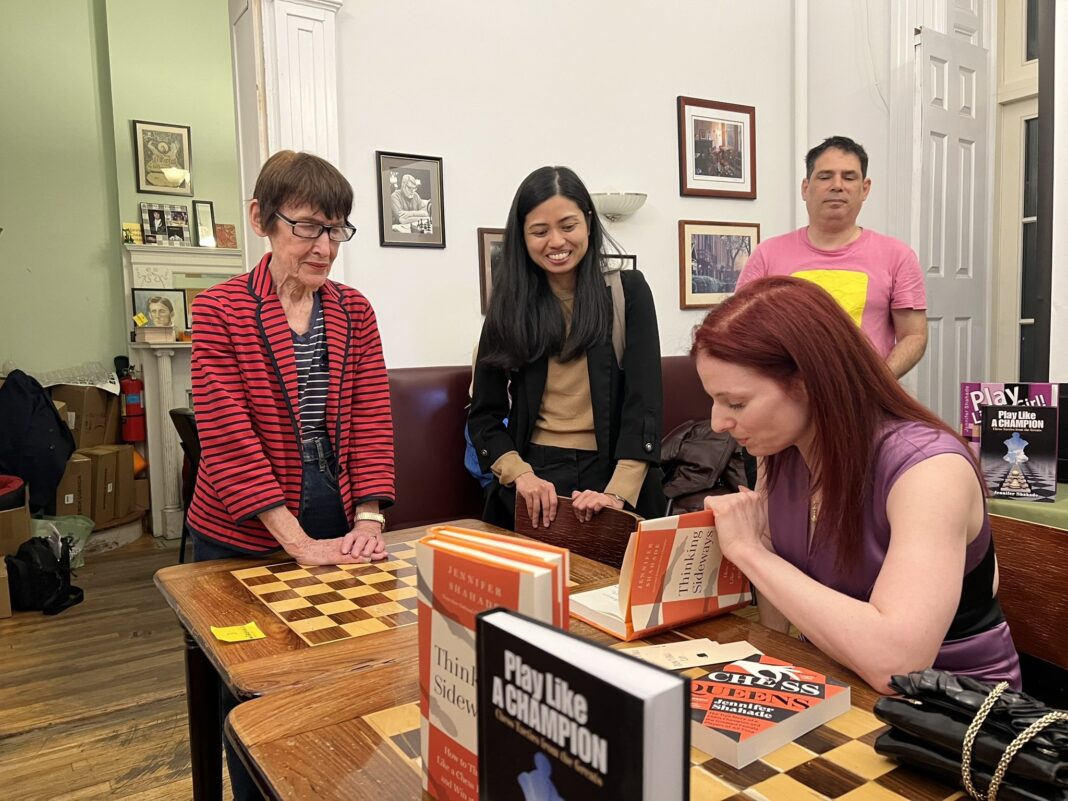

WGM Jennifer Shahade delivers a case for why chess thinking matters far beyond the board in her new book Thinking Sideways: How to Think Like a Chess Player and Win at Life.
The two-time U.S. Women’s Champion has long been known as one of the chess world’s most influential voices, as a player, commentator, author, and poker star.
In an interview with Chess.com’s FM Mike Klein, she shared the ideas behind her new book, which mixes chess philosophy with psychology, poker, and decision-making.
What exactly does “thinking sideways” mean? Shahade challenges the common misconception and explains:
“Everybody’s always asking chess players, ‘You think so far ahead… I could never think that many moves ahead,’” she said. “And there is a lot of truth… that chess players really do think more about more options than thinking super far ahead.”
In fact, she argues the opposite of what many expect: “In our current world, where there is so much uncertainty… you’re doing it right if you don’t think too many moves ahead.”
In our current world, where there is so much uncertainty… you’re doing it right if you don’t think too many moves ahead.
—Jennifer Shahade
That philosophy is the heart of Thinking Sideways, which navigates the complexity by expanding your choices rather than committing to a single prediction.
Shahade also discusses the concept of “candidate moves,” a familiar chess concept among club players.
“When you see a chess position… many people stop [at intuition] and just play that move,” she said. “But we want to do better than that… come up with at least three candidate moves… evaluate each one and pick the best one.”
The challenging part is that people tend to struggle with different parts of that process, she said. “Some people are very good at evaluating all their options, but then they’re really indecisive… if you’re good at seeing every possibility, you can easily get frozen. So it makes sense that it’s hard to combine two, and that is why chess is so hard. Life is even harder.”
Shahade also shared how the ideas for the book translated directly into her poker success, including a career-best performance shortly after finishing the script. “One way that I did this is via visualizing myself winning… I just made the visuals of me winning a little bit more convincing and vivid,” she said.
She also leaned into confidence, even if it felt slightly irrational. “A lot of the research… showed that very high confidence helps you succeed, even if it’s sometimes a little bit delusional.”

A key reason for that success was eliminating a major distraction: “I banned myself from my phone… my brain was just so much more alert… I was really able to retain things.”
I banned myself from my phone… my brain was just so much more alert… I was really able to retain things.
—Jennifer Shahade
Ultimately, Thinking Sideways is about more than performance, she said. “It’s honestly about happiness and making people proud of themselves and their unique skill sets,” Shahade said, adding: “I think that we’re in such a hyper-competitive world, especially in chess. It’s so competitive and it can be so cutthroat. I want people to be able to step back and say like, ‘Okay, I’m worthy.'”
Thinking Sideways was released on April 7, the same day as Netflix’s Untold: Chess Mates and Ben Mezrich’s Checkmate. The book has already been well-received, with praise from the Financial Times and The Guardian.
Shahade Reaches Settlement In Legal Case Against US Chess
The book’s release comes a week after Shahade reached a settlement with US Chess following her 2023 lawsuit against the federation for misconduct and retaliation.
In a joint statement, US Chess thanked Shahade “for her courage in coming forward with reports of abuse,” noting that her actions helped reinforce its commitment to a “safe, inclusive, and welcoming chess community.” As part of the resolution, Shahade has been named US Chess’s first-ever Official Ambassador, with plans to appear at events around the country.
Shahade’s legal team said: “We are proud of Jennifer for her fortitude and courage. Her selfless commitment to helping others has been both acknowledged and rewarded through this process.”