
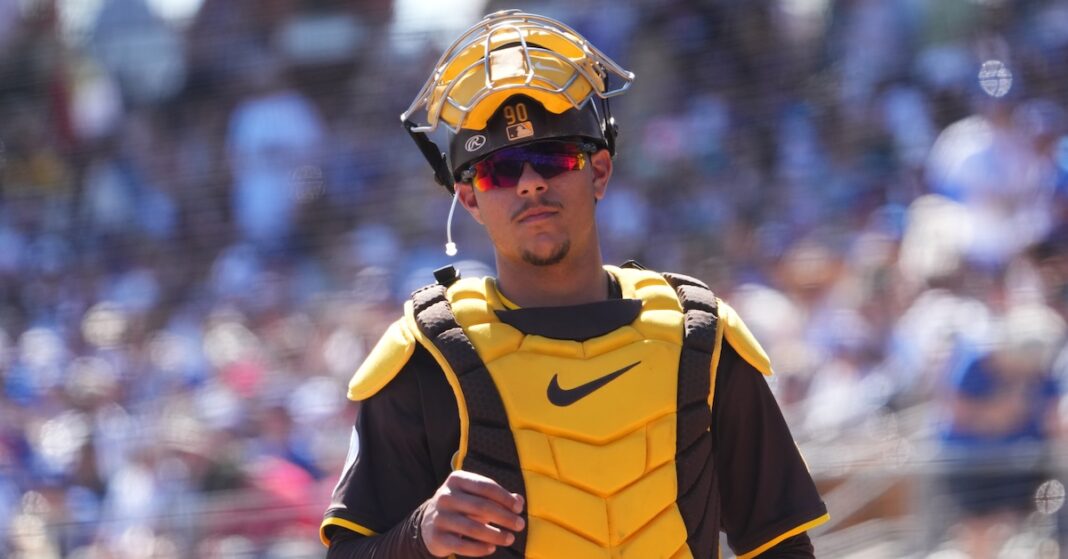

Below is an analysis of the prospects in the farm system of the San Diego Padres. Scouting reports were compiled with information provided by industry sources as well as my own observations. This is the sixth year we’re delineating between two anticipated relief roles, the abbreviations for which you’ll see in the “position” column below: MIRP for multi-inning relief pitchers, and SIRP for single-inning relief pitchers. The ETAs listed generally correspond to the year a player has to be added to the 40-man roster to avoid being made eligible for the Rule 5 draft. Manual adjustments are made where they seem appropriate, but we use that as a rule of thumb.
A quick overview of what FV (Future Value) means can be found here. A much deeper overview can be found here.
All of the ranked prospects below also appear on The Board, a resource the site offers featuring sortable scouting information for every organization. It has more details (and updated TrackMan data from various sources) than this article and integrates every team’s list so readers can compare prospects across farm systems. It can be found here.
Other Prospects of Note
Grouped by type and listed in order of preference within each category.
Humberto Cruz
Humberto Cruz, RHP
Cruz faces an uncertain future. Not only is he out for the season while recovering from an internal brace procedure, but he’s also been placed on the restricted list. The Padres haven’t given many details about the nature of the placement, saying only that “Humberto Cruz has been placed on the restricted list. We have no further comment at this time as it is a pending legal matter” in a statement issued to MadFriars; the league has not issued a suspension. Among other things, he will not have access to Padres facilities as he completes his rehab. It sounds like this might be a career-altering setback, and for all intents and purposes, he has no trade value right now.
On talent, Cruz was one of the best arms in the ACL last summer. He’s lean and athletic, with a mid-90s fastball, an above-average slider, and a projectable change. His body control and command projection are starter quality, and his short and clean arm stroke portends further development of his changeup. The big question (well, from a talent perspective, anyway) is whether he can throw harder. Cruz sat 92-96 and touched 97 with his fastball, but was generally near the bottom of that range; it was a similar story with his 82-86 mph slider. Naturally, both pitches are more effective at the top of the band, and if he’s able to live up there, he’s got mid-rotation upside. Just a teenager, Cruz has time to fill out and pick up a few ticks naturally as he gets stronger and puts in his time in the weight room. We’re in a holding pattern on all of that for at least a year, however, and possibly for a while after.
Reliever Beach
Misael Tamarez, RHP
Omar Cruz, LHP
Cole Paplham, RHP
Andrew Moore, RHP
Sean Barnett, RHP
Harry Gustin, LHP
Francis Peña, RHP
Manuel Castro, RHP
Luis Germán, RHP
Tamarez first reached Triple-A in 2022. He was converted full-time to relief last year and appears to have started leaning more on his four-seamer this season. He runs the pitch into the triple digits and if he had a better breaking ball or average control, he’d have a blurb on the main section. He looks like a lower-end optionable reliever. Cruz debuted last year. He’s an up-down lefty with a good changeup but a light repertoire otherwise, and not enough strikes to trust in anything other than low-leverage settings. Paplham is a sinker-slider reliever who has touched 100 and flashed a plus slider, but he’s been besieged by injuries throughout his career, most notably by a comebacker that him in the face last spring.
Moore sits in the mid-90s with an above-average curveball. His delivery looks fluid to the eye, but he’s walked nearly seven per nine in his career, and everything but the curve got hit hard last year. The arm strength and breaking ball give him a path to mid-relief value. Barnett was a two-way player out of Wingate, the same school that produced Mitch Farris. He was a more interesting prospect on the mound, as he touched 98 with good feel for spin, but he’s been erratic in games. Gustin’s a lefty with average stuff and control, and those types tend to get a shot. The way his curveball pops out of the hand and drops into the zone is aesthetically pleasing. Peña is a sinker-slider reliever who sits in the mid-90s and upper 80s with those offerings respectively. Neither is plus, and Peña’s control backed up at Triple-A last year to the point that he’s been sent back to Double-A to begin 2026. Castro is a 5-foot-8 reliever at Double-A San Antonio. He has a plus curveball and sits 93-94. Germán has a 70 fastball but has never thrown strikes.
Grass Dwellers
Braedon Karpathios, OF
Tirso Ornelas, OF
Nick Schnell, OF
Kavares Tears, OF
Carlos Rodriguez, OF
Kasen Wells, CF
Qrey Lott, OF
Karpathios is an upright hitter with above-average power, but he needs a long, indirect swing to generate it, and his ability to make contact has collapsed at Double-A. Ornelas has long projected as a platoon corner outfielder, but despite several swing adjustments, he’s never found a way to bring his above-average raw power into games. He’s a depth option in his current form. Schnell has power and speed, but a long swing and far too much swing-and-miss to profile. He’s performing in El Paso and could help for a stretch if he gets hot at the right time. Tears has a chance to develop plus raw power. He isn’t getting to it in games, however, and that mixed with a ton of strikeouts at the A-ball levels shades him down into this tier. Rodriguez is a light-hitting, contact-oriented outfielder who can cover center. Wells matches that description, but is younger and further away from the big leagues. Lott was an undrafted free agent who signed out of a Florida JUCO last year. He’s athletic and has power, but he’s really raw.
Dirt Dwellers
Romeo Sanabria, 1B
Blake Hunt, C
Bradley Frye, INF
Marcos Castañon, INF
Jose Verdugo, INF
Sanabria has average power and has at times looked like a bench bat prospect. In 726 Double-A plate appearances, he has a .359 slugging percentage, and he’s not particularly young for the level anymore. Hunt is a fringy defender with plus power. He was phantom’d a couple of years ago and offers more with the bat than plenty of second stringers at the big league level. An oblique strain has kept him out so far this year. Frye was an undrafted free agent out of Mercer. He has a sinewy frame and is Lake Elsinore’s hottest hitter out of the gate. He’s a sleeper with a late-bloomer chance as he fills out. Castañon is a 27-year-old bat-first depth infielder from UC Santa Barbara. He has bat speed but no real defensive position, and he’s chase prone. Verdugo is a tiny middle infielder who produced in the DSL last summer. The Padres challenged him with an assignment to Low-A, where he’s treading water.
Length Options
Evan Fitterer, RHP
Victor Lizarraga, RHP
Carlos Alvarez, LHP
Jaxon Dalena, RHP
Jesus A. Castro, RHP
Fitterer is working in a hybrid role at Triple-A. His mid-90s fastball is categorized as a four-seamer despite an anomalous eight inches of vertical break. His secondaries are functional, but there’s no out pitch here. Lizarraga spins a nice curve and has at times had a depth starter projection here, but his walks have spiked in recent years as upper-level hitters have forced him to nibble with his soft stuff. Alvarez signed for $1 million in the 2025 international class, a real bounty for a pitcher in that market. He’s a projectable 6-foot-4 with low-90s velo and an advanced breaking ball for his age. He walked 31 hitters in 23 innings across 11 starts in his debut DSL season. Dalena is another small-school two-way guy who has found his way to the mound with the Padres. He touches the mid-90s with ride and a projectable curve. He’s on the shelf to begin 2026. Castro is a short righty out of Mexico. He performed in the DSL and gets plus tail on his sinker. From there, it’s pitchability over stuff.
Complexes
Isaac Ponce, C
Deivid Coronil, SS
Yimy Tovar, SS
Yoesmerli Beltre, RHP
Luis Maracara, RHP
Diego Serna, LHP
Erick Batista, RHP
In the 2023-24 international classes, the Padres allocated more than 98% of their budget toward Ethan Salas, Leo De Vries, and Humberto Cruz. For obvious reasons, the complexes have looked a little light lately. Ponce repeated the DSL last year, where he hit six homers and posted a 112 wRC+. He’s posted 1.9 pop times in extended, but his blocking and receiving are less advanced. Coronil signed for $900,000 in the 2025 international class. He had a little prospect helium heading into last season, but didn’t hit a lick in the DSL. Tovar was my favorite of the $10,000 position players on the complex last year, a shortstop with barrel feel and good hands, if not quite enough range or pop to dream on more than a utility player someday. You won’t get rich betting on complex relievers, but Beltre performed in the DSL last year and is up to 97; his slider needs work. Maracara was very young for the ACL last year, where he struggled to throw strikes. He doesn’t have much arm strength, but he has the fluidity to project on his command, and he’s shown Eric an above-average change and projectable curve. The Padres seem to sign the best pitcher coming out of Mexico every year, usually from the Diablos Rojos program, and they’ve done it again with Serna, who is a little more filled out than some of his predecessors. He’ll bump 90 mph with life and throws a ton of strikes. Batista is a small righty with an upper-90s fastball and good feel to spin, but no history of throwing strikes.
System Overview
There isn’t a whole lot to add, right? A.J. Preller has run the show here for more than a decade now, and the club’s strengths and weaknesses under his stewardship are common knowledge. The Padres have the thinnest system in baseball for obvious reasons. The combination of several big swings on the trade market and a tendency to bet big on one or two players in Latin America has crushed the organization’s depth, particularly at the lower levels. You may quibble with the execution on some of those trades or signings — the Mason Miller for Leo De Vries and friends swap last summer was a particularly high-stakes move — but both strategies are reasonable for a team in San Diego’s win-now position. A shallow farm is simply the cost of staying competitive when you’ve got a veteran-laden team late in its competitive window.
For years now, the Padres have had one of the game’s strongest scouting operations. They’re relentless in both the amateur and pro spaces, and prior to going all-in on Juan Soto, they’d assembled one of the best farm systems in the game. When winter comes to San Diego, as it surely must at some point, new ownership will have to weigh the impulse to shake up the front office with the current regime’s history of finding and acquiring talent.
If there’s a criticism to level at the group it’s that for a team with a long history of good scouting, the Padres are light on diamonds in the rough at the moment. There are a few undrafted free agents and $10,000 international signings listed above but not a ton, particularly given how many roster spots the Pads are able to dedicate to flier types at the lower levels. San Diego has historically not developed well, and that’s part of the problem here too, but the coaching staffs haven’t been given much to work with lately. In a similar vein, if you look at the club’s big league contributors, they’re almost all former big-dollar signees and veterans gathered from elsewhere. It feels like it’s been a long time since the club snuck a Jake Cronenworth from somewhere, and there don’t seem to be many candidates on the horizon.