
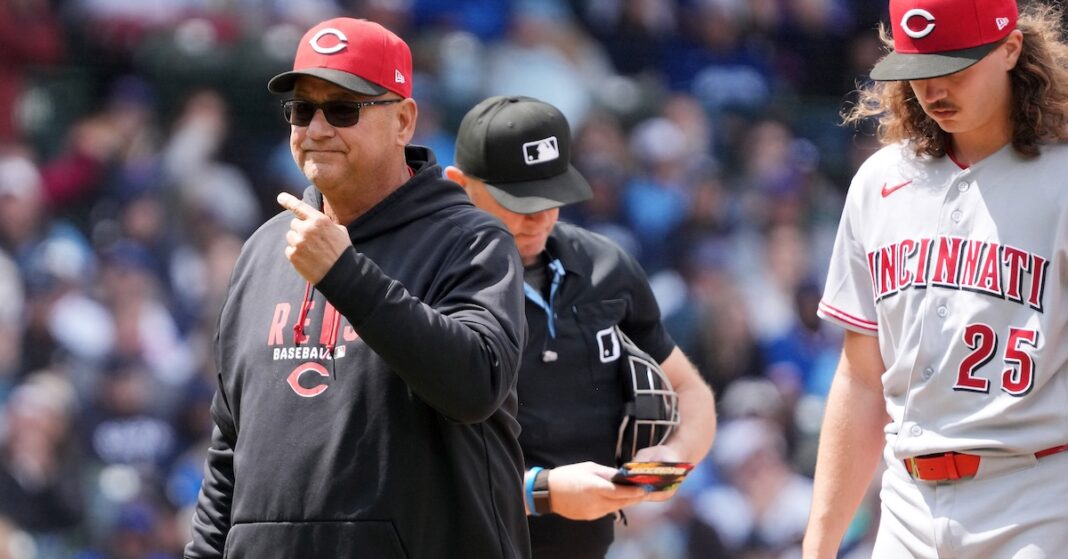

Imagine a video game designed around failure. One where winning isn’t defined as completing a set of objectives, but rather as finding the most creative, painful, and improbable ways to avoid completing the task at hand. I haven’t heard of such a game, but I’m convinced that it must exist, because the Reds are speedrunning it before our very eyes.
Entering May, Cincinnati was 20-11 and in sole possession of first place in the NL Central. To that point, they hadn’t been more than a game out of the division since April 3. One week later, the Reds are now 20-18, six games back, and in sole possession of last place in the division. Now, measuring strictly on length of losing streak, Cincinnati’s skid isn’t nearly as notable as the 12-gamer put up by the Mets or the 10-gamer that contributed to the dismissal of Phillies manager Rob Thomson. But by several other measures, the last week of Reds baseball has been an even more profound and excruciating experience of failure.
The Reds’ true talent as a team is still a bit of an enigma at this point in the season. They haven’t hit well — their team wOBA sits at .311, which ranks all the way down at 23rd in the majors, but a BABIP of .262 and an xwOBA of .332 suggest some misfortune at the plate. On the other side of the ball, their 4.61 team ERA is in the bottom third of the league, their 5.16 xERA ranks last in the majors, and their 4.80 FIP doesn’t rate much better. With those numbers in mind, it should come as no surprise that Cincinnati’s win total as estimated by BaseRuns sits around 16, a full four wins fewer than their actual mark.
But while the underlying numbers cast a bit of a pall over the Reds’ record in the first month of the season, it’s not unreasonable to expect some of the troubling trends to improve. Eugenio Suárez is unlikely to maintain the 82 wRC+ he’s posted so far once he’s no longer sidelined with an oblique strain. Andrew Abbott is likely to pull his 119 ERA- closer to his 81 career mark. Hunter Greene should return to the mound sometime in the second half after undergoing a procedure to remove bone chips from his elbow back in March.
But between the underperformance at the plate, the dubious overperformance on the mound, and the slow starts from key contributors on the roster, it’s difficult to definitively say whether or not the Reds are actually a good, contending team. Still, what matters more for the purposes of this conversation is that the Reds are not a capital B, bad team. Rest-of-season projections have Cincinnati finishing with an 79-83 record, just a few games under .500. And even if we take the team’s BaseRuns record as gospel, a .422 winning percentage still places them well ahead of recent White Sox and Rockies teams. Though that isn’t a high bar to clear, it is important to establish that the Reds are not historically bad in the way those White Sox and Rockies teams were, because some of Cincinnati’s recent on-field results are historically bad.
Last Friday’s game against the Pirates was the first of a seven-game road trip against divisional opponents, or rather the tutorial mode of what would become a week-long odyssey through some sort of anti-survival tactical RPG. The 9-1 loss, merely the opening scenes of a larger narrative, served to set the tone and build tension, but in a restrained way. After all, the tutorial is just the beginning. The worst is yet to come.
You Aren’t a FanGraphs Member
It looks like you aren’t yet a FanGraphs Member (or aren’t logged in). We aren’t mad, just disappointed.
We get it. You want to read this article. But before we let you get back to it, we’d like to point out a few of the good reasons why you should become a Member.
1. Ad Free viewing! We won’t bug you with this ad, or any other.
2. Unlimited articles! Non-Members only get to read 10 free articles a month. Members never get cut off.
3. Dark mode and Classic mode!
4. Custom player page dashboards! Choose the player cards you want, in the order you want them.
5. One-click data exports! Export our projections and leaderboards for your personal projects.
6. Remove the photos on the home page! (Honestly, this doesn’t sound so great to us, but some people wanted it, and we like to give our Members what they want.)
7. Even more Steamer projections! We have handedness, percentile, and context neutral projections available for Members only.
8. Get FanGraphs Walk-Off, a customized year end review! Find out exactly how you used FanGraphs this year, and how that compares to other Members. Don’t be a victim of FOMO.
9. A weekly mailbag column, exclusively for Members.
10. Help support FanGraphs and our entire staff! Our Members provide us with critical resources to improve the site and deliver new features!
We hope you’ll consider a Membership today, for yourself or as a gift! And we realize this has been an awfully long sales pitch, so we’ve also removed all the other ads in this article. We didn’t want to overdo it.
An hour and a half rain delay cast a literal dark cloud over the proceedings as Brady Singer took the mound in Pittsburgh. In the bottom of the first, the Reds starter struck out Pirates center fielder Oneil Cruz on three pitches and got a line out from second baseman Brandon Lowe. But then, with an 0-2 count against left fielder Bryan Reynolds, Singer missed his spot with a four-seamer, and Reynolds launched the center-cut fastball to the deepest part of the ballpark. It was one of those home runs that prompts the folks at Baseball Savant to generate a highlight clip complete with a data viz breaking down the precise details of the moonshot that cleared the center field topiaries at PNC Park.
Reynolds continued to terrorize with two outs his next time to the plate. After ceding a lead off walk to the number nine hitter, Singer needed just three pitches to retire Cruz and Lowe. Just as Cincinnati was almost out of the inning, Reynolds sliced a hanging slider into right field. Spencer Steer laid out in an attempt to make a diving catch, but he wound up face down in the grass as the ball skated to the wall. Henry Davis scored from second, Reynolds cruised into third, and Steer was left to dig sod out of his belt and wonder if he would have been better off just fielding the liner on a hop.
Twice Cincinnati’s defense was on the cusp of a scoreless inning and failed to execute. The Bucs would continue to tack on runs as the game progressed, but the pair of two-out daggers from Reynolds were the difference makers in a game where the Reds managed just three hits. Still, in the grand scheme of things, the gloomy weather, the ice-cold offense, the pitches Singer surely wants back, the defensive miscues, and the position player pitching in the bottom of the eighth was all just world-building to set up what would unfold next.
The narrative-driving calamity — the one that sends a story’s characters reeling and colors all subsequent conflict and chaos — befell the Reds on Saturday. After one inning, the score was already 5-2 in favor of the Pirates. Perhaps allowing five runs on two singles, three doubles, and a walk in the first inning made Reds starter Rhett Lowder a little tentative when he came back out for the second. Perhaps the 43 degree weather that had everyone blowing on their hands to keep warm made it difficult to grip the baseball. Whatever the reason, Lowder recorded just one out in the inning. After striking out Cruz to open the frame, he walked the next three batters to load the bases and force Reds manager Terry Francona to go to the bullpen.
Since he’d already been up and warming in the first, Connor Phillips was able to get ready quickly once it became clear that Lowder was incapable of hitting water from the Roberto Clemente Bridge. Phillips throws a four-seamer at 98 mph and a sweeper at 86 mph. His pitches finish in the zone about 44% of the time, and he’s able to get chases on around 24% of his pitches out of the zone. To the first three batters he faced on Saturday, Phillips threw one pitch in the zone (out of 14) and got one swing on a pitch out of the zone. Which is all an elaborate way of saying he walked in three runs in pretty short order. It also means that the Reds had issued six consecutive walks when shortstop Konnor Griffin stepped into the box as the eighth batter of the inning. After Griffin took an 0-0 sweeper for a called strike and fouled off an 0-1 sweeper, Phillips finally found himself ahead in the count. Naturally, he threw his next sweeper in the dirt. Griffin sent his fourth sweeper rocketing to left field, where it landed just foul. After that, another walk must not have seemed so bad compared to what Griffin might do to another sweeper left out over the plate, so Phillips threw back-to-back fastballs that missed outside, and Griffin took the seventh consecutive free pass of the inning.
Seven consecutive outcomes of any kind in baseball is hard to manage, but stringing together seven consecutive walks is even less likely than, say, seven straight hits or seven straight strikeouts. So far this season, 21.4% of the league’s plate appearances have ended in a hit and 22.5% have ended in a strikeout, while just 9.5% have ended in a walk. Ignoring for a minute the individual batter’s impact on the likelihood of each outcome, that puts the probability of seven straight hits at 0.002% and the probability of seven straight strikeouts at 0.003%, while the probability of seven straight walks is 0.000007%. The only way to even the odds would be to send Nick Kurtz and his league-leading 21.6% walk rate to the plate seven times in a row.
The larger reason why seven straight walks is so much less likely, the one fueling those numbers, is that a walk is neither the pitcher nor the batter’s ideal outcome. Sure, the batter will take a walk, but if possible, they’d all rather get a hit. Pirates hitters are no different. As a team, they rank 12th in walk rate at 10.2%. The lowest walk rate of the bunch belongs to infielder Nick Gonzales at 6.0%. And not only did he get in on the action, he worked a four-pitch walk as the first batter Phillips faced after he came in to get the inning back on the rails.
But even though Pittsburgh’s hitters don’t have a pronounced affinity for walks, Cincinnati’s pitchers do. They rank second in the majors in walk rate at 12%, and though Lowder sits on the lower side at 9.2%, Phillips leads the team (minimum 10 innings pitched) at 22.5%. But as walk-prone as a pitcher might be, it’s still up to the batter to resist the urge to chase pitches out of the zone, and finding seven such hitters who bat one after the other is a tall order, especially given a Pirates team that ranks ninth in chase rate. Griffin watched the Reds walk six of his teammates and still stepped into the box intent on taking some aggressive hacks, quickly falling behind in the count. He nearly ended the streak a batter early because he clearly had no interest in a free pass. But Phillips insisted he take one anyway.
And that’s what makes this variety of failure especially painful. No matter the outcome of a plate appearance, some of the credit/blame goes to the pitcher and some of the credit/blame goes to the hitter. But when that many walks happen in quick succession, the pitcher(s) deserve way more blame than the hitters deserve credit. Because the hitters weren’t even trying to walk! The walk is simply a consolation prize. So while a hitter passively accepts a walk, the pitcher is actively trying to avoid it. Maybe not as much as they’re trying to avoid home runs or extra base hits, but avoiding walks is on the list. As such, issuing seven walks at all when you’re actively trying not to do that is repugnant. Issuing seven consecutive walks is unfathomable. If you’ve ever done HIIT training, you know the recovery value of the 30-second rest period between the two-minute blocks of max effort. A series of five to 10 intervals with the rest periods in between is manageable. Without the rest periods, the strain of the all-out effort becomes unbearable much more quickly. Walking batter after batter with nary a strike to be found, and not even one weak grounder to break the tension? That’s a distinctly painful form of failure.
But it didn’t stop there. Or even start there, really. Those seven walks came in the bottom of the second. As the final out in the top of that inning, Reds second baseman Sal Stewart struck out swinging at a splitter off the plate. This made Stewart the first of what would be six consecutive Reds hitters to strike out. In the top of third, DH Nathaniel Lowe, first baseman Steer, and center fielder Will Benson all struck out, and then in the fourth, catcher Tyler Stephenson and third baseman Ke’Bryan Hayes followed suit. All six strikeouts came against Pirates starter Paul Skenes Carmen Mlodzinski. Before racking up 10 total strikeouts over 5 2/3 innings on Saturday, Mlodzinski’s strikeout rate was 23.8%, which is about a 60th-percentile rate relative to the league. He got a decent chunk of those strikeouts by relying on one of the classic pitching formulas: start with a few fastballs in the zone, then induce a whiff with either a breaking pitch just below the zone or a four-seam fastball just above it. It’s a tactic most major league hitters have seen time and time again, but that doesn’t necessarily make it easy to resist, especially for an offense that owns the league’s third-highest strikeout rate.
The consecutive strikeouts on offense are not quite as agonizing as the consecutive walks on defense because while batters don’t step up to the plate looking to walk, pitchers do attack hitters hoping for a strikeout. For that reason, six consecutive strikeouts isn’t nearly as rare as seven consecutive walks and wouldn’t be noteworthy were it not for it happening concurrently with the seven consecutive walks. It’s the one-two punch of streaking failure, both unrelenting and both somewhat self-imposed. In the end, the Pirates got the win with a final score of 17-7, and after tossing a scoreless inning on Friday, Reds catcher Jose Trevino got another two innings on the mound on Saturday, this time allowing two runs.
Though clearly an excruciating brand of failure, was Saturday’s performance also a singular display of failure? Has any other team managed such high quantities of rapid-fire failure in such an unlikely fashion? In short: no. At least not recently. After querying the play-by-play data in the FanGraphs database that goes back to 2002, I couldn’t find anything truly comparable to what the Reds did on Saturday. The longest streak of consecutive walks I could find was five, which has happened a handful of times, most recently on October 1, 2022. Up 4-1 over the Dodgers in the bottom of the seventh inning, the Rockies turned to Dinelson Lamet, who immediately issued free passes to Trea Turner, Freddie Freeman, and Trayce Thompson before being pulled from the game and replaced by Chad Smith. Colorado’s new reliever continued Lamet’s work by walking both Joey Gallo and Austin Barnes, but then Cody Bellinger snapped the streak with a game-tying sac fly. Smith snuck in one more walk to Max Muncy before Colorado opted to bring in Gavin Hollowell to get the final two outs of the inning. The Dodgers added two more runs in the eighth to walk away with a 6-4 victory.
I also looked for games that featured both a walk streak and a strikeout streak. I summed the lengths of the two streaks as a quick measure of magnitude. Only one game matched the combined streak length of 13 authored by the Reds. On April 13, 2012, the Padres struck out nine consecutive times against the Dodgers, and later in the game, San Diego’s bullpen issued four consecutive walks. All nine punch outs came against Dodgers starter Aaron Harang, beginning with the second batter of the game. But despite the early dominance from Harang, the game was tied 8-8 entering the bottom of the ninth. Andrew Cashner came in to pitch for the Padres and retired the first two batters, but then walked second baseman Mark Ellis, center fielder Matt Kemp, and first baseman James Loney. With the bases loaded, Joe Thatcher took over for Cashner and walked right fielder Andre Ethier on four pitches. Ellis scored, ending both the game and the walk streak.
Since, for reasons already discussed, the failure associated with a long walk streak is more profound than that of a long strikeout streak, I wanted to find a game where the combined streak length wasn’t so strikeout-heavy. The best I could find was a game with a combined streak length of 10 on August 9 of last year. The Red Sox sandwiched six strikeouts against Padres pitching around four walks issued to Padres hitters. With Boston up one in the top of the fifth, Padres reliever Jeremiah Estrada got whiffs on his splitter to strike out both Red Sox DH Masataka Yoshida and first baseman Abraham Toro. In the bottom half of the inning, Red Sox starter Lucas Giolito distributed free passes to Padres center fielder Jackson Merrill, shortstop Xander Bogaerts, DH Ryan O’Hearn, and left fielder Ramón Laureano — all with two outs. San Diego scored two in the inning to take the lead. When Boston came to bat in the sixth, Estrada struck out the side. Adrian Morejon took over for Estrada in the seventh and added one more strikeout to the streak by punching out left fielder Roman Anthony. The Red Sox did manage to tie the game in the ninth, but the Padres walked it off in the 10th.
While both games represent impressive levels of failure from the teams involved, none are as exquisite as the recent example offered by the Reds, especially given that Cincinnati’s suffering has only compounded since then. In the series finale against the Pirates, second-year starter Chase Burns turned in a career-best performance of seven scoreless innings with seven strikeouts and just one walk. However, the Bucs countered with a second-year starter of their own. Braxton Ashcraft threw 7 2/3 scoreless with six strikeouts and two walks (also a career-best outing). With two outs, the bases empty, and the game still scoreless in the bottom of the eighth, Griffin doubled off Tony Santillan, pinch-hitter Jake Mangum worked a walk, and then a single from Cruz drove in what would be the game’s only run. With the bullpen running on fumes, Burns delivered exactly what the Reds needed, but the Pirates were just a tiny bit better, managing yet another two-out rally to eke out a win and sweep the series.
On Monday, the Reds moved on to Chicago, where they would suffer walk-off losses in three consecutive games. In the first game of the series, Cincinnati held a one-run lead going into the ninth. Pete Crow-Armstrong led off the bottom half of the inning with a fly ball to deep center field that Dane Myers was unable to wrangle up against the ivy. Understanding the treacherous nature of center field at Wrigley Field, Crow-Armstrong powered around the bases, making it all the way to third on the play. Reds closer Emilio Pagán recovered to strike out shortstop Dansby Swanson, but second baseman Nico Hoerner lined the first pitch he saw from Pagán into left, deep enough for Crow-Armstrong to tag up and score. With the game now tied, Cubs manager Craig Counsell sent pinch-hitter Michael Conforto to the plate in place of DH Matt Shaw. Conforto, who struggled at the plate last year and signed a minor league contract with Chicago in late February, notched the first walk-off homer of his decade-long career. For the first time on this road trip, the Reds were able to generate enough offense to get a lead late in the game, only to have it snatched away by a pinch-hit home run from a player who was unemployed at the start of spring training.
Tuesday’s walk-off loss came on a groundball up the middle off the bat of first baseman Michael Busch in the bottom of the 10th. Reds shortstop Elly De La Cruz positioned himself to backhand the ball, but it shot over his shoulder on the hop, allowing the zombie runner to score from second. In his best start since opening day, Abbott held the Cubs scoreless for 5 2/3 innings, while the Reds offense built a 2-0 lead on a pair of solo homers against Cubs starter Jameson Taillon. But once again, Chicago managed a late-inning comeback and Cincinnati’s typically strong infield defense squandered one of Abbott’s few good starts so far this season. And if that wasn’t bad enough already, Pagán, who entered the game in the ninth, had to be carted off the field after sustaining a hamstring injury one pitch into his outing.
In their attempt to turn the page on Wednesday, the Reds orchestrated a late-inning comeback of their own. Trailing 4-2 heading into the ninth, Steer led off and slugged a middle-middle fastball from Corbin Martin deep into the left field bleachers. Benson and Stephenson followed with back-to-back singles to chase Martin from the game and bring in Hoby Milner. A bunt from Matt McLain loaded the bases, and though Myer struck out, Bleday dropped a single into right to bring the score even. Then perhaps as cosmic retribution for Monday’s snafu, the Reds had an interaction with the ivy go their way, as De La Cruz hit a sac fly to right that scored, not one, but two runs, giving Cincinnati a 6-4 lead and needing just three outs to secure a victory.
But you already know this doesn’t end well for the Reds. Crow-Armstrong came through with a two-run homer off Graham Ashcraft to tie things up and send the game to extras. Then with Brock Burke pitching the 10th for Cincinnati and the zombie runner on second, the sequence went: sac bunt, IBB, strike out, IBB. Then, with the bases loaded, Busch dug in and worked a five-pitch walk. The bat never once left his shoulder. And just like that, the Reds found a fresh, new way to walk in a run and lose in heartbreaking fashion.
On Thursday, the Reds concluded their road trip and finally snapped their streak of walk-off losses. Instead, they lost at the hands of a seven-run fourth inning that featured traumatic flashbacks to Saturday’s debacle. With Lowder on the mound once again, the frame opened with consecutive walks to third baseman Alex Bregman and left fielder Ian Happ. Lowder then exited with a shoulder injury and in came… Phillips. But this time, he didn’t walk the first batter he faced on four pitches. Instead, Busch singled to load the bases, and then Phillips walked in a run. After a fielder’s choice, two singles, a double, and a sac fly, the Cubs were up 8-0 and able to cruise to an 8-3 victory to round out the four-game sweep.
On the one hand, it’s only seven games out of a 162-game slate, and as previously acknowledged, there have been longer losing streaks already in 2026. And despite what they’ve endured over the last week, the Reds still have a winning record, so it certainly hasn’t doomed their season. But to shrug this off as just another losing streak would also be wildly inaccurate. These were not standard losses. These were dramatic defeats. And not just re-runs of the conventional horrors baseball is known to serve up on a night-in, night-out basis. These lickings plumbed the depths of baseball despair, discovering more extreme and distressing modes of failure than ever before.
And yet, even as the team remains shrouded in darkness, there is a bright side. The Reds have reached historic levels of down bad over the past week. They’ve discovered new varieties of down bad never before seen. They’ve taken rare varieties of down bad and combined them in unique and terrifying ways. After all, they aren’t the first team to suffer three consecutive walk-off losses. Three in a row has happened numerous times over the past couple of decades (most recently to the 2019 Rockies from June 21-23). The Diamondbacks got hit with four consecutive walk-off losses in 2010! But did any of those walk-off loss streaks come right after breaking new ground in the consecutive-walks-issued space? I doubt it. And as you may have noted, a lot of the comparable calamities brought up as points of reference throughout this discussion were instances of really good teams dealing fatal blows to truly awful teams. But the Reds are not an awful team. They’re like a little bit below .500 team, getting knocked around by their peers in the NL Central. The things that have happened to them this week are so statistically improbable that this level of torturous losing is simply not sustainable. Even among the worst teams on record, these things rarely happen, and when they do, it’s at the hands of some juggernaut.
There really is no way that things can continue to go this poorly for the Reds. Unless you believe they really are doing this on purpose as a part of that video game about innovating failure that I made up during the intro. Or perhaps if you think they’re cursed. And not that I’m looking to start any conspiracy theories or anything, but if you happened to look at the season-to-date xFIP for a certain reliever after he issued four walks on Saturday, you’d know that it was 6.66.