
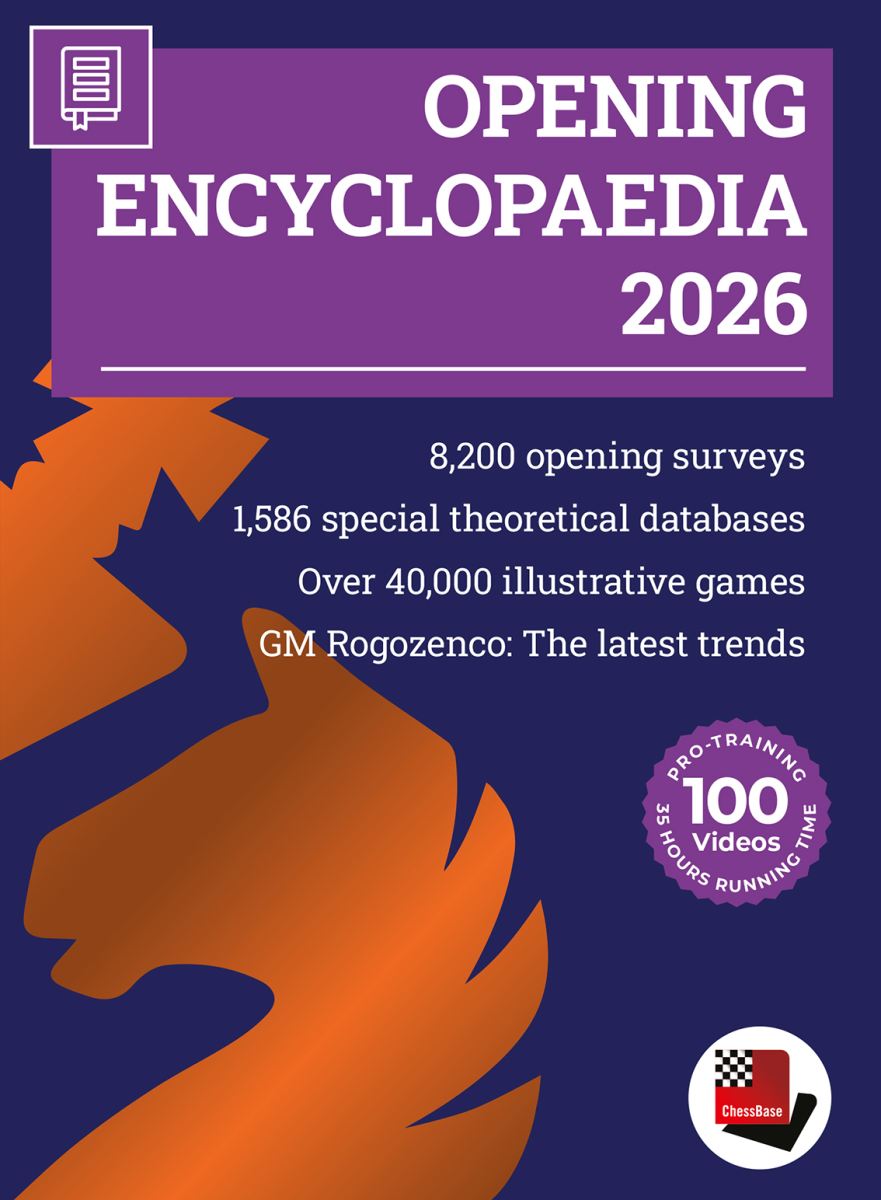

YOUR EASY ACCESS TO OPENING THEORY: Whether you want to build up a reliable and powerful opening repertoire or find new opening ideas for your existing repertoire, the Opening Encyclopaedia covers the entire opening theory on one product.
YOUR EASY ACCESS TO OPENING THEORY
Be well prepared with the new Opening Encyclopaedia 2026! Whether you want to build up a reliable and powerful opening repertoire or find new opening ideas for your existing repertoire, the Opening Encyclopaedia covers the entire opening theory on one product and is the ideal start for your opening training. Many new articles enrich the current theory with new or revisited ideas. The Encyclopaedia can help you learn openings quickly and give you a head start on your next opponent. Each article contains explanations and annotated games illustrating typical plans to deepen your understanding.
1. Depth and breadth of content
With the Opening Encyclopedia 2026, ChessBase has released a new edition of its well-known standard reference work while remaining true to its original concept: bringing together as much up-to-date opening knowledge as possible in one place. Yet the Encyclopedia is far more than just a collection of opening articles. It is best understood as a vast toolbox for anyone who wants to truly understand and improve their openings.
Once again, the defining feature of the Opening Encyclopedia is the sheer density of material it contains. With more than 1,500 theory databases, over 40,000 model games, 100 videos with a total running time of 35 hours, and around 8,200 opening surveys, the work offers an almost complete coverage of modern opening theory.
2. Structure and design
The structure is perhaps the most striking feature of the Opening Encyclopedia. Even though the theory databases form the core of the product, such an enormous amount of information can quickly become overwhelming rather than helpful if left unstructured. To make effective use of this wealth of material, a clear and logical organisation is essential. Here, the Opening Encyclopedia proves convincing across the board:
The premiere chess database with over 11.7 million games
The ChessBase Mega Database 2026 is the premiere chess database with over 11.7 million games from 1475 to 2025 in high quality.
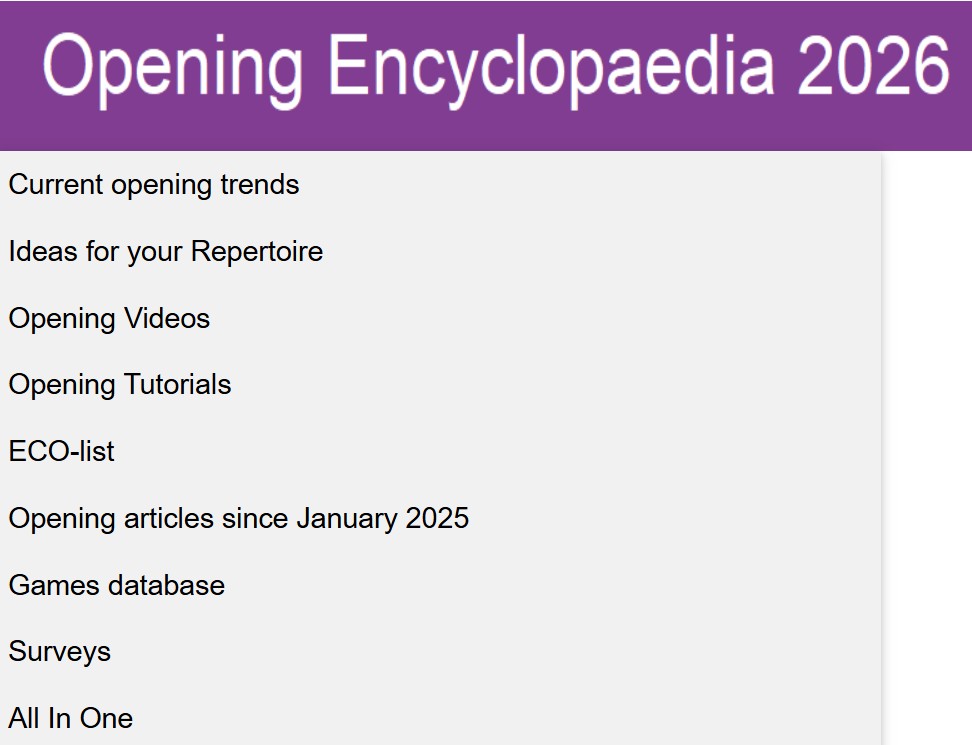
The material is organised in such a way that users can either gain a quick overview or dive deeper into specific lines whenever they wish. That is precisely what sets the Opening Encyclopedia apart from many purely database-driven products, where one often ends up simply clicking through variations without really learning anything.
While the latest opening trends will mainly appeal to players specifically looking for current theoretical debates, the repertoire suggestions provide practical ways to expand one’s own opening repertoire in a systematic manner. In the end, it is up to the user to decide in which direction they want to work with the Opening Encyclopedia.
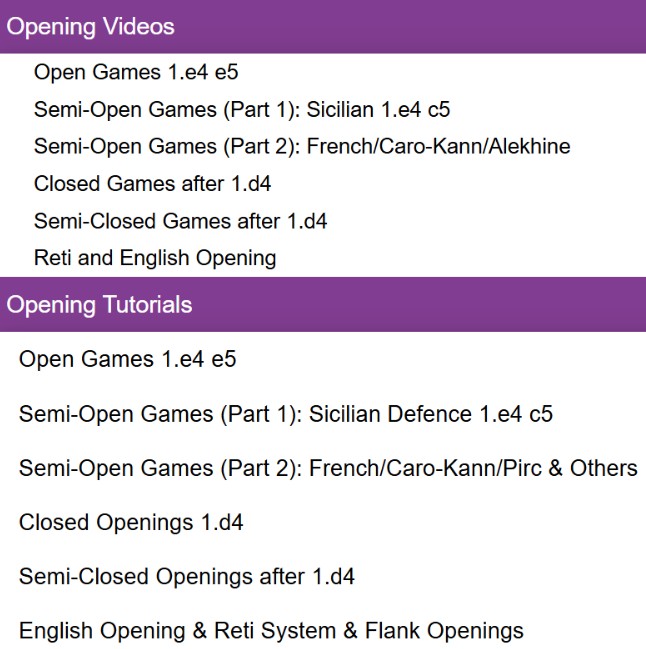
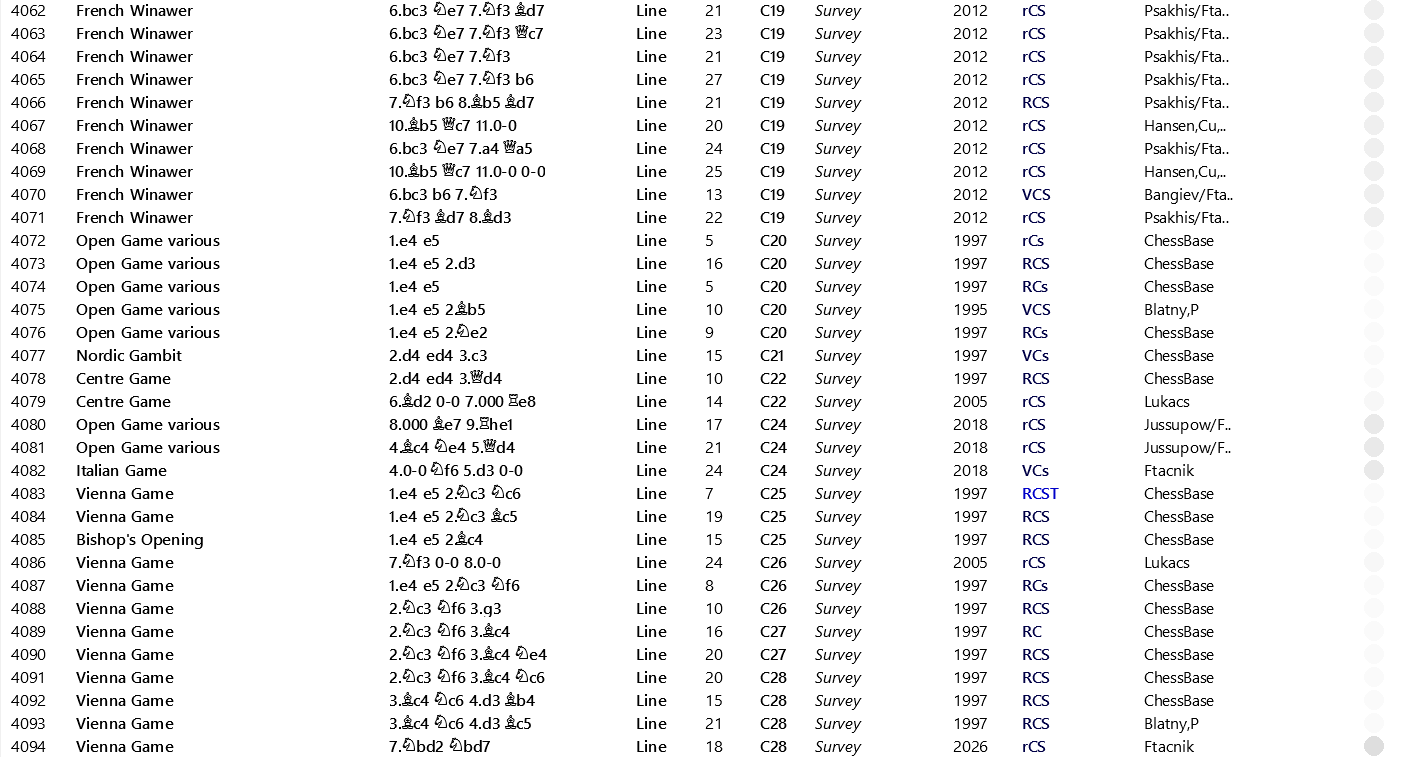
Players who are only beginning to work seriously on their openings will find the opening surveys especially useful for building up a database in a systematic way and later expanding it with additional sources and analyses. These surveys are organised according to ECO codes and provide a complete overview of all openings. As a result, it makes no difference whether an opponent chooses the Grob Opening, the Vienna Game, or the latest fashionable line in the Sveshnikov Sicilian – every opening is covered.
access your chess data in cloud databases – and 13 million games.
ChessBase Mobile has everything you need as a chess player on the go:
- Access the ChessBase online database – with more than 13 million games: search for players, positions, openings etc.
- Save your own games and analyses in cloud databases
- Synchronise your personal databases across all your devices
- Analyse your games with the built-in engine
- Live opening book: use the most comprehensive and up-to-date statistics for every opening position
- Access your opening repertoire in the cloud: create and edit your personal opening repertoire
- 300 opening overviews, with repertoire suggestions: get started with new systems!
- Practise opening variations with three modes.
- Advanced notation: add comments, symbols, variations, arrows and markings to your games
- Advanced sharing options: share games and positions via link, image, GIF, FEN or QR code
- PGN compatibility: upload and download games or databases as PGN files
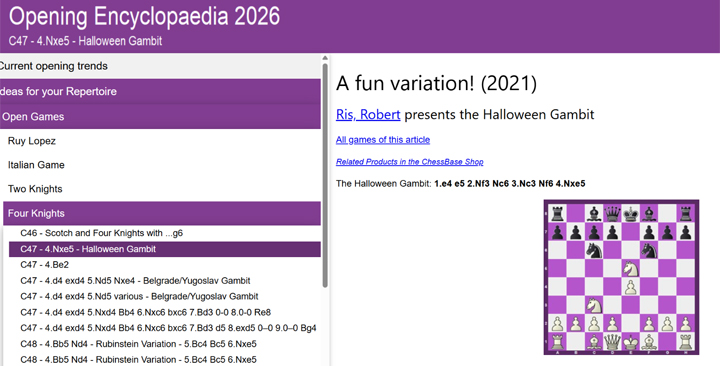
Despite its encyclopedic ambitions, the Opening Encyclopedia does a remarkably good job of presenting the material in a didactically accessible way. By now, the opening articles follow a fairly standardised structure and a clear format:
- structured overviews of the main variations
- carefully selected model games
- explanatory notes on typical plans
2.5 million games
The new Corr Database 2026 is the large ChessBase collection of correspondence games from the period from 1804 to 2025. With more than 80,000 tournaments and over 2.5 million correspondence games, the Corr 2026 is a must for all Correspondence chess fans.
That said, the learning curve still depends heavily on the user. Beginners will certainly benefit from the explanations, but may also find themselves overwhelmed by the sheer amount of material. For ambitious club players and tournament competitors, however, the Encyclopedia is where the product truly begins to show its greatest strengths.
The model games in particular are a real highlight. This is especially valuable for players who do not own the Megabase and would otherwise struggle to find well-annotated games. Instead of dry theory, the reader gains a genuine feel for how the resulting positions should actually be played.
Which plans are typical? Where are the traps? What matters in the long run?
For club players especially, that is worth its weight in gold.
3. Practical relevance
A major strength of the 2026 edition is its up-to-date content. New trends from tournament practice have clearly been incorporated, keeping the user in touch with current developments, and it is obvious that this is not simply recycled material from previous editions. Players who do not have the time to follow every theoretical trend on their own are presented here with everything neatly prepared and easy to access.
Particularly exciting are the video contributions covering the latest developments. They offer insight into what is currently fashionable at grandmaster level — and, just as importantly, why.
This makes the Encyclopedia not only a reference work, but also something of a “trend radar” for chess openings.
4. Target audience
Officially, the product is aimed at players of all levels — and in principle that is true. In practice, however, I would say that users should be clear about what they expect from it:
- Beginners will benefit from the Opening Encyclopedia only to a certain extent, since the sheer volume of information can be overwhelming.
- Club players can already get a great deal out of it if they are looking for a broad overview.
- Tournament players receive a powerful tool for preparation and repertoire maintenance.
Anyone who only plays occasionally will probably never make full use of its scope. But players who are serious about improving will find an enormous treasure trove here. From a coach’s perspective, I can say that having access to well-structured theory is extremely useful when you need to give quick feedback on the current state of play in an opening. It saves a huge amount of time that can then be devoted to other areas of work.
5. Working with the Encyclopedia in ChessBase: Efficient, but with room for improvement
The greatest strength of the Encyclopedia lies in its integration with the ChessBase software. If you know how to work with it, you can:
- build your own repertoires
- update, organise and maintain existing opening files
- prepare specific variations in a targeted way
- analyse opponents
That said, I still see room for improvement in the workflow. Even though this is not a review of the database program itself, it is important to point out that ChessBase now allows many databases to be assigned specific functions (for example White repertoire, Black repertoire, or reference database). What has always bothered me, however, is that the standard range of ChessBase products still cannot be fully integrated into the quick-access bar in a seamless way.
While the Mega Database can be assigned as the reference database and repertoire databases can be separated into White and Black, there is no dedicated function for the Opening Encyclopedia, which instead has to be selected via the variable database slot. If one also wants to compare analyses with a FritzTrainer and perhaps even a personal analysis database, too many slots are already occupied.
As a result, the workflow can become unnecessarily cumbersome when trying to compare played games across three databases — Mega Database, Opening Encyclopedia and an analysis database or FritzTrainer — without constantly having to redefine the active database setup.

In my view, this is where the Opening Encyclopedia should be given the place it truly deserves. That would allow it to evolve from being merely a reference work into an active — perhaps even interactive — part of one’s everyday chess work.
6. Summary
Overall, it is fair to say that Opening Encyclopedia 2026 is not the kind of product one simply “works through” from beginning to end. It is much more a toolbox that reveals its full value gradually over time.
For those willing to invest the effort, it offers:
- an extremely comprehensive reference work
- many clear and accessible explanations
- up-to-date theory at a very high level
In short: anyone who is serious about working on their openings will be very well served here.
As strong as the overall package is, a few things still stand out:
- The sheer amount of material can be overwhelming. Without a clear plan, it is easy to lose track.
- Not every article is equally strong. Some are excellent, others more average.
- Good usability overall, though the integration could still be improved — especially within the ChessBase database program itself (for example ChessBase 18).
In my opinion, none of these points are dealbreakers, but they are things prospective users should be aware of.
Overall evaluation: ★★★★★ 5/5
–> More reviews <–
EXPAND YOUR CHESS HORIZONS
Data, plans, practice – the new Opening Report In ChessBase there are always attempts to show the typical plans of an opening variation. In the age of engines, chess is much more concrete than previously thought. But amateurs in particular love openings with clear plans, see the London System. In ChessBase ’26, three functions deal with the display of plans. The new opening report examines which piece moves or pawn advances are significant for each important variation. In the reference search you can now see on the board where the pieces usually go. If you start the new Monte Carlo analysis, the board also shows the most common figure paths.