
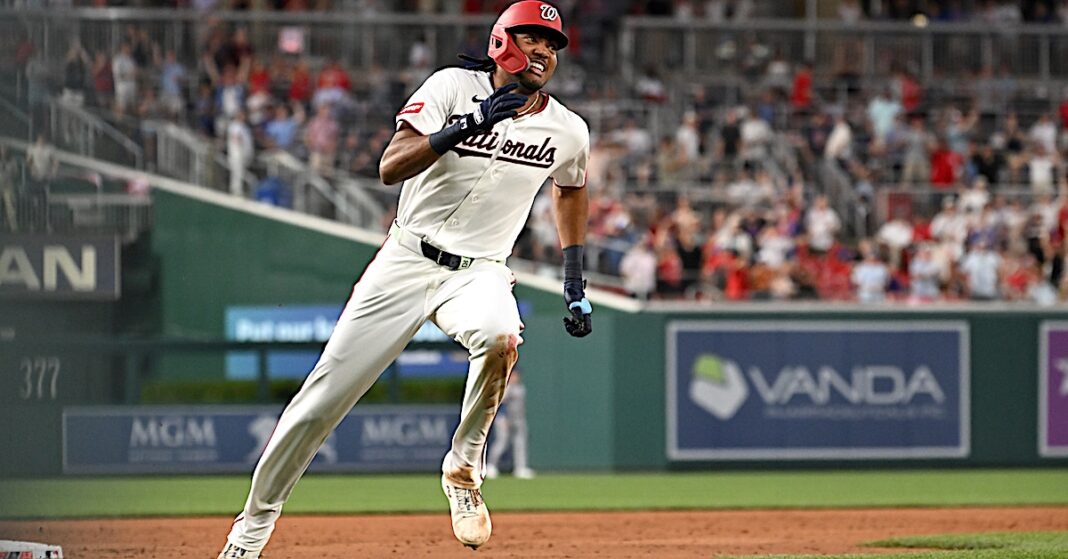

Welcome to another edition of Five Things I Liked (Or Didn’t Like) This Week in Baseball. In keeping with the increasingly lenient definition of “this week” that I’ve been using of late, we’ve got stuff from all throughout May in this column. May is a great time to watch baseball. (It’s always a great time to watch baseball, but May is particularly good.) The weather is heating up. Ballparks are swelling with the start of summer crowds. Tarps are coming off. So please join me on a trip through the league, from fun teams to watch to nifty little plays. And as always, thanks to Zach Lowe of The Ringer for the inspiration.
1. The Go-Go Nats
Nationals fans have endured seven years in the wilderness since the team’s 2019 title. Washington’s season-high win total in that span was 71 (2023 and 2024). This year’s team is finally playing around .500 ball, though our projections think the Nats will end up right around that 71-win high-water mark again. (We have them down for 74 at the moment.) But while the winning hasn’t quite come back yet, the fun has.
This year, the Nationals are dominating on offense. They’re leading the majors in scoring by a mile, averaging an enormous 5.49 runs per game. They’ve hit the most doubles in baseball – in fact, they have the most extra-base hits in baseball. They’re top 10 in on-base percentage, top five in slugging, and top five in stolen bases. They’re first in overall baserunning value. They’re third in BaseRuns-projected scoring. This isn’t smoke and mirrors.
That would be enough to make the Nats a fun watch, but they’re also last in the majors in runs allowed; their pitchers are giving up an unbelievable 5.80 runs per game. That isn’t smoke and mirrors either! They barely strike anyone out. They have one of the lowest average fastball velocities in the majors. They have a below-average defense. They allow the highest contact quality in the majors; opponents are barreling up 10.7% of the balls they put in play against the Nats, a mark that would be in the top 60 of individual players. That’s what entire teams do against Nationals pitchers. This is the kind of run-scoring environment you usually only see at elevation.
Combine those two things, and every Nats game is a tinder box waiting for a match. This week alone, they’ve delivered two iconic games while scoring 25 runs in a four-game series with the Mets. First, they gave up a 10-spot in the 12th inning on Monday night, with the last three runs charged to Jorbit Vivas, a mid-inning entry as a position player pitching. That was strange enough that the umps had to pause the game to make sure it was legal.
The next day, the Nats fell behind 5-0 against Nolan McLean, and then James Wood unleashed chaos:
You Aren’t a FanGraphs Member
It looks like you aren’t yet a FanGraphs Member (or aren’t logged in). We aren’t mad, just disappointed.
We get it. You want to read this article. But before we let you get back to it, we’d like to point out a few of the good reasons why you should become a Member.
1. Ad Free viewing! We won’t bug you with this ad, or any other.
2. Unlimited articles! Non-Members only get to read 10 free articles a month. Members never get cut off.
3. Dark mode and Classic mode!
4. Custom player page dashboards! Choose the player cards you want, in the order you want them.
5. One-click data exports! Export our projections and leaderboards for your personal projects.
6. Remove the photos on the home page! (Honestly, this doesn’t sound so great to us, but some people wanted it, and we like to give our Members what they want.)
7. Even more Steamer projections! We have handedness, percentile, and context neutral projections available for Members only.
8. Get FanGraphs Walk-Off, a customized year end review! Find out exactly how you used FanGraphs this year, and how that compares to other Members. Don’t be a victim of FOMO.
9. A weekly mailbag column, exclusively for Members.
10. Help support FanGraphs and our entire staff! Our Members provide us with critical resources to improve the site and deliver new features!
We hope you’ll consider a Membership today, for yourself or as a gift! And we realize this has been an awfully long sales pitch, so we’ve also removed all the other ads in this article. We didn’t want to overdo it.
Crazy stuff like that happens during Nats games, because their top guys both get on base a ton and push the envelope. Wood is one of the best hitters in baseball. CJ Abrams and Daylen Lile are in fine form. Curtis Mead, a scrap-heap pickup this winter, looks like an excellent platoon bat. Nasim Nuñez and Jacob Young aren’t hitting yet (Young looks closer to turning things around), but they’re running wild when they reach base. Besides himself, the baserunners Wood drove home on that grand slam reached on a double, a hit-by-pitch, and an infield single, an assortment of get-on-base methods that’s emblematic of this offense as a whole — Washington can score in every way imaginable.
The Nats are still at least a year or two away from being serious contenders. You can’t run out a pitching staff like theirs and expect to win 85 games, no matter how great your offense is. But this iteration of the Nationals is already tremendously exciting, a big improvement on some of their recent squads, and the future looks brighter than it has in quite a while as a result. Watch a Nats game if you get a chance; whichever team you’re rooting for, you won’t be disappointed with the offenses.
2. Tacos in Denver
The Rockies were at home this week, which means I watched parts of every game they played. Why? They have my favorite promotion in baseball, and the best time to watch for it is when they’re playing at Coors. If the Rockies score seven or more runs in a game, Denver-area taco bells offer a huge discount on crunchy tacos the next day.
That doesn’t sound like something I’m craving offhand, and to be honest, I haven’t eaten at a Taco Bell in years. But it’s less about the promotion for me – I don’t live in Denver – and more about the hype around the promotion. Playing at elevation makes a seven-run outburst far more likely. Playing at elevation also makes a blowout more likely – but what better way to keep everyone’s interest in a blowout than offering cheap food? The knowledge of this deal changes my experience with the game.
Sunday afternoon against the Diamondbacks, the home team fell behind 8-2 after six innings. The outcome of the game wasn’t in much doubt at this point. But in the eighth, the Rockies started to rally. Hunter Goodman singled. TJ Rumfield got hit by a pitch. Troy Johnston walked. The gap quickly closed to 8-4, sending Arizona deeper into its bullpen. Let’s just say the broadcast played into it:
This gets my attention every time. The counter starts at one run — six more runs until we get tacos! — which feels too aspirational to me. But at around four runs scored, the alerts start to become exciting. Three more runs until tacos? There are two runners on base! This could turn around quickly!
I’m not going to try to deceive you: The stadium was pretty empty by this point. But the fans who stuck around got into it, and Rockies games really do have a festive, let’s-get-some-runs atmosphere. And when Jake McCarthy scored to make it 8-6, I was on the edge of my seat. They ended up losing 8-6, leaving the taco dream unfulfilled, but that silly promotion and scorebug reminder made this game more exciting than it had to be.
The next day, the promotion worked the other way. The Rockies jumped out to an early 6-2 lead, but stalled tantalizingly close to tacos. As rain poured down, the stadium emptied out, but the game continued. Then Willi Castro came through:
The remaining crowd was pumped. The announcers were pumped. The specter of tacos brings suspense to a lot of not-obviously-exciting baseball, particularly in a ballpark where anything can happen.
If the Rockies are at home, I always try to duck in for some of their broadcast. The stadium and backdrop are gorgeous. The uniforms, alternates included, are consistently good. The broadcast booth of Drew Goodman and Ryan Spilborghs fit the vibe well; Spilborghs has an unending amount of minor observations and stories about his playing days, Goodman keeps things moving, and no one forgets about the tacos. The Rockies aren’t good this year. They haven’t been good for a while. But fun? Indubitably, and for more reasons than just the on-field product.
3. Karma
Miguel Rojas pulled off a clever play last week:
There was no infield fly rule in effect because only one runner was on base, so Rojas adroitly let the ball drop and retired Drew Gilbert at second. Gilbert is an aggressive baserunner with plus speed. Eric Haase, who hit the pop, is a 33-year-old backup catcher. The math here is pretty easy, and Rojas got a perfect hop to boot:
That’s the kind of play that you should only attempt if you’re sure of it. A ton of things could go wrong, and the edge to gain isn’t that large. But Rojas was very sure. He had it measured exactly right, and knew that there was no risk of letting Gilbert escape given where everyone was standing. He just forgot to consider the supernatural influence of karma.
Jung Hoo Lee, the next batter, fought off an 0-2 fastball and punched it to left field near the foul line:
The ball barely stayed fair, and you’d think that this was the exact situation that Rojas had in mind when he pulled off the switcheroo. Teoscar Hernández, playing left field that night, has a strong throwing arm. The play was right in front of him. Maybe switching Gilbert out for Haase could save the Dodgers a base. But then disaster struck in the form of a wall.
Hernández was probably thinking a little too much about how to play the carom and make a throw to third, or maybe he just misjudged the ball badly. Either way, he came in at a very flat angle, expecting the ball to settle in the corner, only for it to kick past him instead:
By the time Hernández got back on his horse and returned to the ball, it had rolled all the way to the outfield fence. This time, he played the ball to bounce, and it sat down instead. All the while, Lee was motoring around the bases:
Can you blame this all on Rojas? Of course not. He wasn’t playing left field. He didn’t make the ball kick off the wall instead of settling down or bouncing into the stands. But I can’t help but enjoy the juxtaposition of making a clever play for a tiny edge, then having it spectacularly stop mattering one batter later.
4. Martín’s Office
It’s low-key amazing that Martín Pérez remains a productive major leaguer. He debuted in 2012, and has been worth less than 20 WAR in the ensuing 15 years, a consummate role player. After a career year in Texas in 2022, he put up a 4.49 ERA and 4.95 FIP over two years of work – 0.8 WAR in 276 innings, dangerously close to replacement level. He signed a minor league deal with the Braves to keep pitching this season and promptly got DFA’d, though he did immediately re-sign with them thereafter. But fringy though Pérez might be, the Braves are down a ton of starters, and so they’ve needed him anyway. On Tuesday, he was at his baffling best.
Pérez doesn’t have good stuff, to put it mildly. He uses a changeup as his primary pitch, mixes in three upper-80s fastballs to complement it, and occasionally breaks out a show-me curveball. Our pitching models and the eye test agree: This is crushable stuff. Xavier Edwards opened up the game with a no-doubt bomb to the second deck in left. But what Pérez lacks in stuff, he makes up for in guile. The next time he saw Edwards, he turned him into a statue:
That was only a batter after this similar encounter:
And Pérez wasn’t even close to done. As the Marlins got more and more frustrated, Pérez worked the edges even more. He dotted up Heriberto Hernández on an 89-mph four-seamer that caught a lot of plate:
And with the Marlins, and perhaps even the umpire, completely bamboozled, Pérez started targeting the area just off the plate like the control wizard he is:
Were all of those strikes? Nope, but hey, the Marlins had challenges. They just weren’t sure either, because Pérez hits the edges of the zone so consistently that it’s easy to lose track of the boundaries of the plate.
All told, he tallied 18 called strikes out of only 78 pitches, en route to a uniquely Pérezian day – 10 strikeouts, one walk, but four earned runs in only five innings. If you swing the bat with Pérez pitching, good things will happen. It’s just very hard to swing the bat. I’m not sure how much longer his career will run, but there’s something absolutely delightful about seeing good big league hitters drive themselves to distraction against this particular combination of no stuff and elite command.
5. Calm Under Pressure
This grounder probably shouldn’t have been a double play:
The timing was all wrong. Balls chopped that high don’t give infielders enough time to make the two throws necessary to get both runners. In fact, it looked like second baseman Blaze Alexander might not even get the lead runner for a moment. He squared up to throw to first to make the safe play, even as Gunnar Henderson slid over to second to receive a throw. I think the combination of where Henderson was standing and how Alexander, who was tilted heavily toward first, was positioned just broke baserunner Jacob Wilson’s brain a little bit.
Wilson wasn’t expecting Alexander to continue into his path, because he was already setting to throw to first. But Alexander noticed that and took one giant step to get in Wilson’s way. Then he stuck his glove out, and Wilson turned away from it. Just one slight detail to add:
That’s right — Wilson evaded Alexander’s glove, but Alexander had already transferred the ball to his throwing hand. The second baseman realized that he needed to be transfer the ball before tagging Wilson, because he had to hurry to make the throw to first. He also had the presence of mind to lunge at Wilson with the glove as though he were trying to tag him.
When Wilson saw Alexander’s glove coming toward him, he tried to contort his body out of the way. Unfortunately for him, that meant he lunged directly into Alexander’s right hand, which held the ball. By avoiding any unnecessary time spent either tagging a squirming runner or transferring the ball, Alexander was just able to complete the double play.
Little plays like that only go so far. Alexander got a ton of playing time early in the season with Jackson Holliday out, but he’s hitting .235/.292/.286, and Holliday has since returned. I’m not even sure Alexander is a good defender; he’s played six positions for the Orioles this year, but none particularly well. But even if Alexander plays a lot less the rest of the year, I’m going to remember this steady-handed double play. I don’t think many second basemen could have turned that one into two outs.