

Martin Chandler |
We are halfway through another year already, and still waiting for a number of the books I announced in January to appear, but there are still a good many new titles that I can mention, and which I hope will appear before the end of the year. Some will be delayed of course, and I suppose some may never appear at all, but al those I mention are, as far as I am aware, more or less complete.
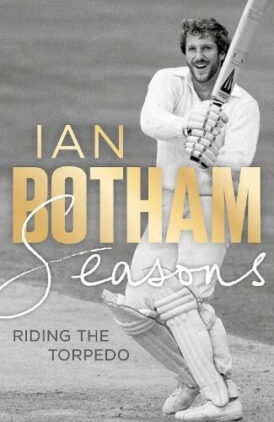
I will start with what I have no doubt will be the best selling cricket book of the year, Ian Botham’s latest volume of autobiography, Seasons – Riding the Torpedo. Will his Lordship have much to say of interest given that his last autobiography appeared as recently as 2007? The publisher’s blurb certainly suggests it might; Beefy’s life has not been a quiet one and, through adventure and misadventure, he remains as forthright, honest and entertaining as ever. But now, as he considers his legacy, he is ready to reveal more of himself, more of who he is, than he ever has before.
There are few all-rounders in the history of the game who can compare to Botham, but the one who most would agree exceeded even his prodigious feats is Sir Garfield Sobers. The subject of a decent biography from David Tossell just last year this week we have seen the release of another book, The Man Who Walked out of the Sun. The author this time, Duncan Hamilton, has already written excellent biographies of, amongst others, Harold Larwood, Neville Cardus and Brian Clough, and I am confident this one will be right up there with them in terms of quality.
Although I am not aware of a release date I understand that another book that will sell well is in the course of preparation, that being an autobiography from Chris Woakes entitled The Wizard. Over the last decade or so Woakes has been a wonderful ambassador for the game, impossible to dislike and one of the most popular players to wear an England cap. It will be interesting to see who his ghost is, and whether or not he is prepared to express a view on any of the many controversies he has played through.
One of the most acclaimed cricket books by a current writer is Christian Ryan’s biography of Kim Hughes, Golden Boy. Ryan has a new book out now titled Eleven: We Burn Them in the Son which the publisher tells me is a wildly ambitious examination of 11 cricketers you’ve mostly never heard of, their lives and failings painstakingly, beautifully and compulsively reconstructed. This is not the slick, successful world of Shane Warne and Ian Botham; it’s a collection of misfits, outsiders and rebels who never quite made the cut, and the press release contains glowing endorsements from Michael Knox, Gideon Haigh and Michael Holding.
The important question is, of course, who are the eleven, and the short answer is I don’t know. That said there are a few clues around and I suspect one is the Lancashire wicketkeeper from the 1950s, Frank Parr*, and I know enough about him to be able to say that his is certainly a fascinating story.
Kit Harris has written 1864: The Year That Changed Cricket a slightly grandiose title but with the benefit of more than 160 years hindsight a not inappropriate one. The publisher is John Wisden, whose Almanack debuted in 1864, a year which also over-arm bowling legalised, the arrival of WG and the beginnings of the unofficial county championship, and that is just in England.
Tim Wigmore is following up his magnum opus on Test cricket with The Pantheon – Test Cricket’s Best 50 Players Of All Time. It is the sort of book that will always stimulate conversation amongst those who have read it as to who should and should not have been included, but then who is it aimed at? It will doubtless contain some excellent material and quality writing, but probably nothing groundbreaking given that all of the subjects will almost certainly have been the subject of books before.
In January I mentioned a number of books due from Fairfield Books, some of which have not yet been published but which will be in the coming weeks. I have also been tipped off as to some of their schedule for 2027, and there are certainly some interesting titles to come, but I will save those for January.
Similarly with Pitch I mentioned most of their books in January, but they do have a couple more. The first is entitled The Zen of Ben: Cricket in the Moment. The book is written by Jim Green, who is described as an acclaimed wellness writer, and the publisher’s blurb describes the book as A fresh, surprising portrait of England’s Test captain Ben Stokes – and a revelatory exploration of Bazball and the joyful, shape-shifting game of cricket itself which, I have to say, would sound a bit far-fetched to me were it not for one thing, the foreword to the book coming from none other than cricket’s best known psycho-analyst, Mike Brearley.
Pitch are also publishing Far from Lord’s: England’s Cricketers and Correspondents on Tour by Richard Knott, looking at England tours between 1953 and 1969. In recent years we have had books from Mark Peel and Simon Wilde covering much the same ground so I hope this one will be less about the cricket that was played than the scribes who wrote about it. Men like ‘Lyn’ Wellings, John Woodcock and John Clarke will be interesting subjects, not to mention their only female colleague, Margaret Hughes.
There are four books due from the ACS, two in the Lives in Cricket series and two others. First of the others is a work of general history, A History of Oxfordshire County Cricket by Julian Lawton Smith. Never a First Class county the game in Oxfordshire can nonetheless be traced all the way back to 1779, yet this is the first comprehensive history to be written.
The second ‘other’ is First-Class to Harrogate: A Celebration of First-Class Cricket in Harrogate by Stephen Blades. Harrogate Cricket Club celebrates its 150th anniversary in 2027. Their St George’s Road ground staged first-class cricket in most years from 1882 to 1996. To mark this significant anniversary Blades tells the story of all these matches, from the early days of touring Australian teams, through successive eras of Yorkshire triumph and turmoil, and as fixtures at the popular Harrogate Cricket Festival. Visits by WG Grace, record-breaking performances, Championship victories and suspected interference with the pitch all feature in the match reports.
Staying in Yorkshire the first of the Lives in Cricket is number 66 in that splendid series, Richard Letby: Ebor’s Champion and early Yorkshire Cricket by a man who knows as much about that subject as anyone, Jeremy Lonsdale. Letby was one of the best-known cricketers in the north of England in the 1830s and 1840s. A star batsman and bowler, he played a key role in establishing York Cricket Club as a force in Yorkshire club cricket in the days before regular county matches. A champion single-wicket cricketer for 15 years, he also served the York club for several decades as secretary and treasurer, and was a trusted umpire and coach. A tireless advocate for the game, in the mid-1840s Letby organised what are possibly cricket’s first ever club knock-out competitions when, in 1844 and 1845, York hosted a four-team contest in an attempt to generate fresh interest.
Lonsdale tells the story of a man whose contributions on and off the field helped drive cricket forward at a time when the spread of round-arm bowling, more aggressive batting and more effective fielding were making the game a greater spectacle. But Richard Letby also played other public roles as a city councillor and campaigner for civic improvements and against electoral corruption. A publican for forty years, he was an influential local voice at a time of moral panic about the effects of alcohol. His story also helps explain why York, for so long the popular social and administrative centre of Yorkshire, failed to play a leading role in the establishment of county cricket, and shines a light on how class distinctions shaped early English cricket.
And then there will be Lives in Cricket 67, Greville Stevens: The Prodigy by one of Cricketweb’s favourites, Max Bonnell who, following his superb biography of Charles ‘Father’ Marriott I am delighted to see turning his prodigious skills towards English subjects.
As for Stevens in the summer of 1926 he was a member of the England team that regained the Ashes. He had already, six years earlier, played a key role in winning a County Championship for Middlesex. He had won his Blue at Oxford, captained the University, and bowled his team to victory over Cambridge at Lord’s. He had been named as one of Wisden’s cricketers of the year, and had represented the Gentlemen against the Players at Lord’s while still at school. Within a few years, he would captain England, score a Test match half-century and take ten wickets in a Test. He toured the West Indies with MCC, and South Africa twice. It is a record of formidable achievement yet after Stevens faded quietly from the game, when he was barely thirty, he left behind a faint impression of underachievement. For all that he had accomplished, much more had been expected, but until now his story has never been told.
Together with Andrew Hignell David Battersby has just co-written the Museum of Welsh Cricket’s seventh monograph, on the subject of futures between Glamorgan and South Wales and the Gentlemen of Philadelphia in 1903 and 1908. Two more forthcoming monographs from the museum will deal with a history of a club side, the Glamorgan Nomads, and the life of Roy Gabe-Jones who, in 1922, made his First Class debut for the county at 15. The youngster produced a stubborn and more importantly unbeaten 6 in his only innings but despite that and his fielding leaving a good impression he never made a second appearance.
As for Battersby the self-publisher he has two ongoing projects the first being his monograph on the life of the eldest Mohammad brother, Wazir, which sounds like it is developing into a full biography. The second is particularly worthwhile being a look at the visit of the Pakistan team to the USA and Canada for a month after their series in the West Indies in 1957/58. There is a short chapter on the trip at the end of AH Kardar’s tour account, Green Shadows, but that apart the visit is a forgotten one only one of the 13 matches having anything like a full scorecard on Cricketarchive. Fortunately for all however David has enlisted the help of a survivor of the visit, SF Rehman, now 91, to assist him in telling the story.
Red Rose Books are due to publish three more Stephen Musk titles. One is Westray in Portugal – Cricket and England’s Oldest Ally which must, I am assuming, relate to a short tour that took place in 1898 with, amongst the England tourists, Plum Warner. I recall seeing a collection of photographs from the visit appearing in an auction a couple of years back – I suspect I now know where they ended up!
Musk also has two books due on his favourite subjects, Norfolk and Philadelphia, being Falcon’s Fiefdom and its Financing – International Cricket at Lakenham Between the Wars and The Near Death and Resurrection of Cricket in Philadelphia in the 1880s.
In addition Musk will be continuing his series of Monographs on North American, which will include at some point, though not all necessarily this year a selection of intriguing titles; Dr Cameron’s Casebook – Globetrotting Allrounders and Black Captains in Early West Indian Cricket, An Englishman in New York – The Remarkable Statistics of Merton Rayleigh Cobb; A Very Tall Story – Bart King at Old Trafford, 1903, Forty Years an International Cricketer – Dyce Willcocks Saunders, Canada’s Incorrigible Triple Hatter, Near Death in the Darkness – The Collapse of Old-Time Cricket in Philadelphia, Rudi Waad, Absent Dead, No Score – The Story of Frankford’s Tireless Paceman.
Red Rose will also be publishing the author and playwright Mike Claughton’s first cricket book, One Step Away, in which he selects a cricketer from each county who he believes was just one step away from Test cricket. The book will also have a foreword by Alec Stewart and, if successful, could doubtless give rise to any number of sequels.
Lastly from Red Rose will be Bats, Balls, and Goals by Roy Cavanagh MBE, in which he writes about Lancashire CCC cricketers ho have played in the Football League, of whom there have been plenty.
Not so very long ago Chris Smith published the first ever book on the subject of England’s trip to Australia under Archie MacLaren in 1901/02, the last such venture not carried out under the auspices of MCC. Unsurprisingly, given that that one was a worthwhile read Smith has decided to publish an another book on an Ashes tour, the 5-0 drubbing suffered by England in 1920/21. This is by definition a much more ambitious project given that there was a contemporary account, one of the finest of all tour books, Defending the Ashes by Surrey skipper and member of the English side, Percy Fender.
In Australia I am delighted to learn of a new series of monographs from an excellent writer. That of James Merchant is a name already familiar to us for a number of quality books on subjects like Arthur Mailey, Clarrie Grimmett, Donald Bradman, Charles Dickens, Cricketing Ceramics and most recently Johnny Mullagh and cricket in rural Victoria in the late 19th Century.
This time James has decided to embark on a series of monographs in signed and numbered limited editions of 35 copies, and the first three will see the light of day this year. The first will be the story of Frank Allan, a left arm fast medium round arm bowler who appeared in the single Test match played against Lord Harris’s England side in 1878/79.
Allan’s story will be followed by Cricket Pottery – Made in Australia and then a monograph on the subject of Bradman’s first tour with New South Wales which was back in December 1927 and took in his first two First Class matches. Starting as he meant to go on I probably don’t really need to say that The Don began it all with a century.
A much longer established Australian cricket publisher is Ronald Cardwell’s Cricket Publishing Company who have a number of titles complete and, as ever, many more at various stages on the road to completion. I mentioned in January Cricketers in Print titles about Rex Sellers and Trevor Chappell as well as Stephen Walters book about scorecards. All are complete and should be with us soon.
Signs of Ownership – Exploring Australian Cricket Bookplates and their owners by Michael Saunders is one of the quirkier titles due from the Cricket Publishing Company. The collectors amongst us always value an acquisition with the plate of a previous owner and there are some very good ones around. Whether Mick has managed to find one more impressive than that of Roger Hancock I rather doubt, but I am looking forward to finding out.
Also on an unusual subject is Wood Shavings and Sawdust: The Story of Sydney Cricket Bat Makers Alfred and Walter Dye by Rob Franks and Ronald Cardwell. Franks has written books about bats of the cricketing variety in the past, and this one looks at the first cricket bat manufacturing firm in Sydney, who opened their doors in the early 1890’s.
There are also two titles due in the Cricket in Lives series, books which aren’t quite full biographies but are somewhat more than extended monographs. Mystery Morrison by Bill Francis is a title that looks at the interesting and varied pursuits of the former NZ Test cricketer and broadcaster John Morrison, and A Character in More Ways Than One – Murray Webb by Ronald Cardwell himself concerns the story of the former New Zealand Test cricketer who survived the Wahine shipping disaster in 1968, played cricket for Otago and New Zealand, and became one of the world’s finest caricaturists.
Finally from Mr Cardwell I will briefly mention a couple of titles that might sneak in this year, but more likely in 2027. They are both biographies, one of an Australian Test cricketer, Alan Fairfax, and the other of a much lesser known cricketer whose three First Class appearances were for the 1919 AIF team and South Australia but whose later life was spent in Scotland. The working titles are Alan Fairfax – A Schoolboy Cricketing Prodigy and Henry Francis Trafford Heath – The Cricketing Parson.
And that is about it from Australia, at least insofar as news that has reached me is concerned. We are still waiting for a few of the titles mentioned in my last preview, and I am also told that Gavin Gleeson’s biography of Alan Kippax is well underway and, I dare say, there may be a few books with a more modern theme in the course of preparation.
And finally, for once a plea for my own purposes. I am one of a dwindling number of cricket tragics who remain fascinated by the late writer/historian Major Rowland Bowen. For those who have never heard of him you can get a flavour of the man here.
Back in 1991 Murray Hedgcock, the Australian born but UK based journalist, started work on a biography of Bowen, the research for which he had still not completed to his own satisfaction when he died in May of 2021 at the age of 90.
Earlier this summer I learned that Murray’s research had been bequeathed to the MCC whose librarian, Alan Rees, kindly allowed me to study the material one afternoon. I have since been in contact with the family and Murray’s daughter has kindly send me copies of all his electronic material as well.
Bowen’s biography needs to be put together and I have decided to give it my best shot so, my request is, if anyone out there knew the Major, knows of someone who did or has any memorabilia relating to him that has not already been shared with Murray please get in touch.