
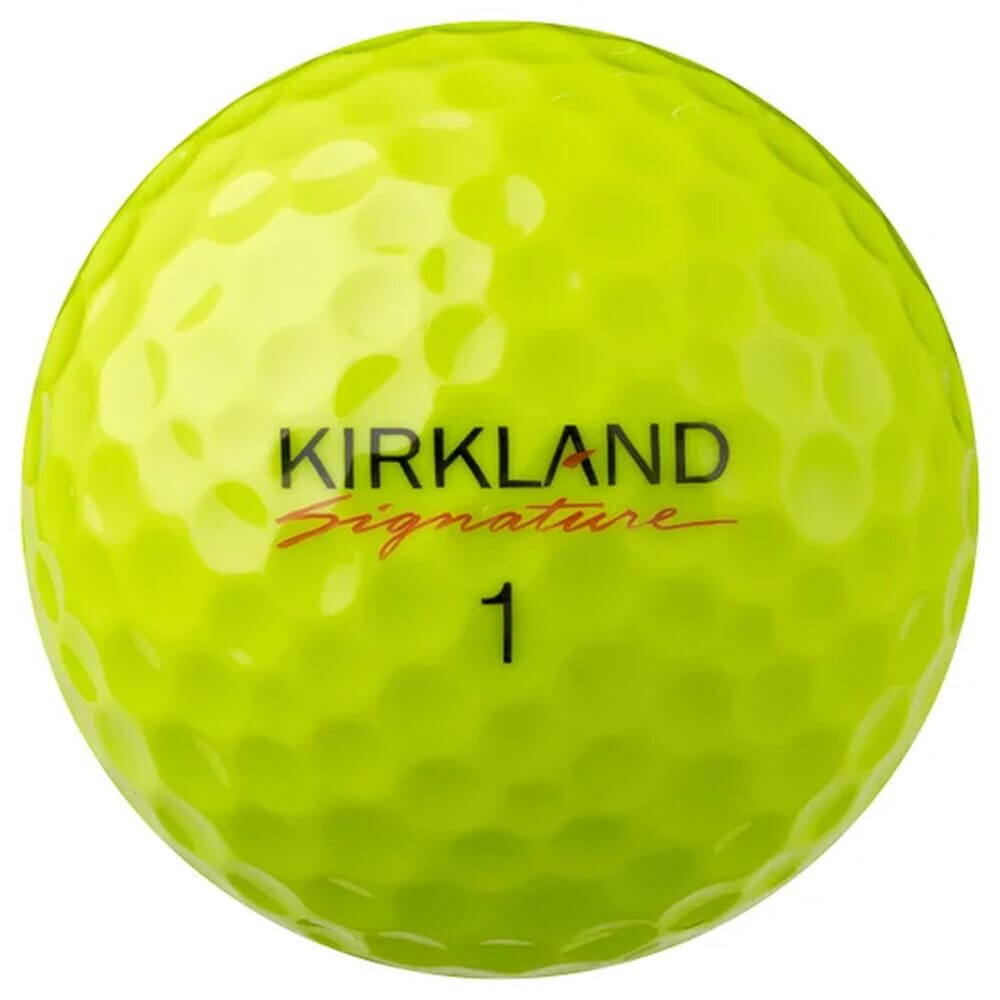

Ball Lab: Kirkland Performance + v3.0 Yellow Review (2025)
The Kirkland Performance + v3.0 Yellow is a urethane ball made in the same factory that produces balls for Snell and Vice. We measured weight, diameter, compression, roundness and balance across 36 balls and three boxes to give you an objective look at what you’re getting when you buy the Kirkland.
Here’s what the 2025 Kirkland Performance + v3.0 Yellow looks like under the microscope.
Kirkland Performance + v3.0 Yellow
 Pros
Pros
- Perfect 100% Good Ball rate — zero defective balls across all 36 tested
- Top-quartile compression consistency — better than some premium balls
 Cons
Cons
- Diameter consistency rated C — the weakest category on the card
- Compression Symmetry rated C+ — ball-to-ball shape uniformity lands in average territory
 Our Verdict
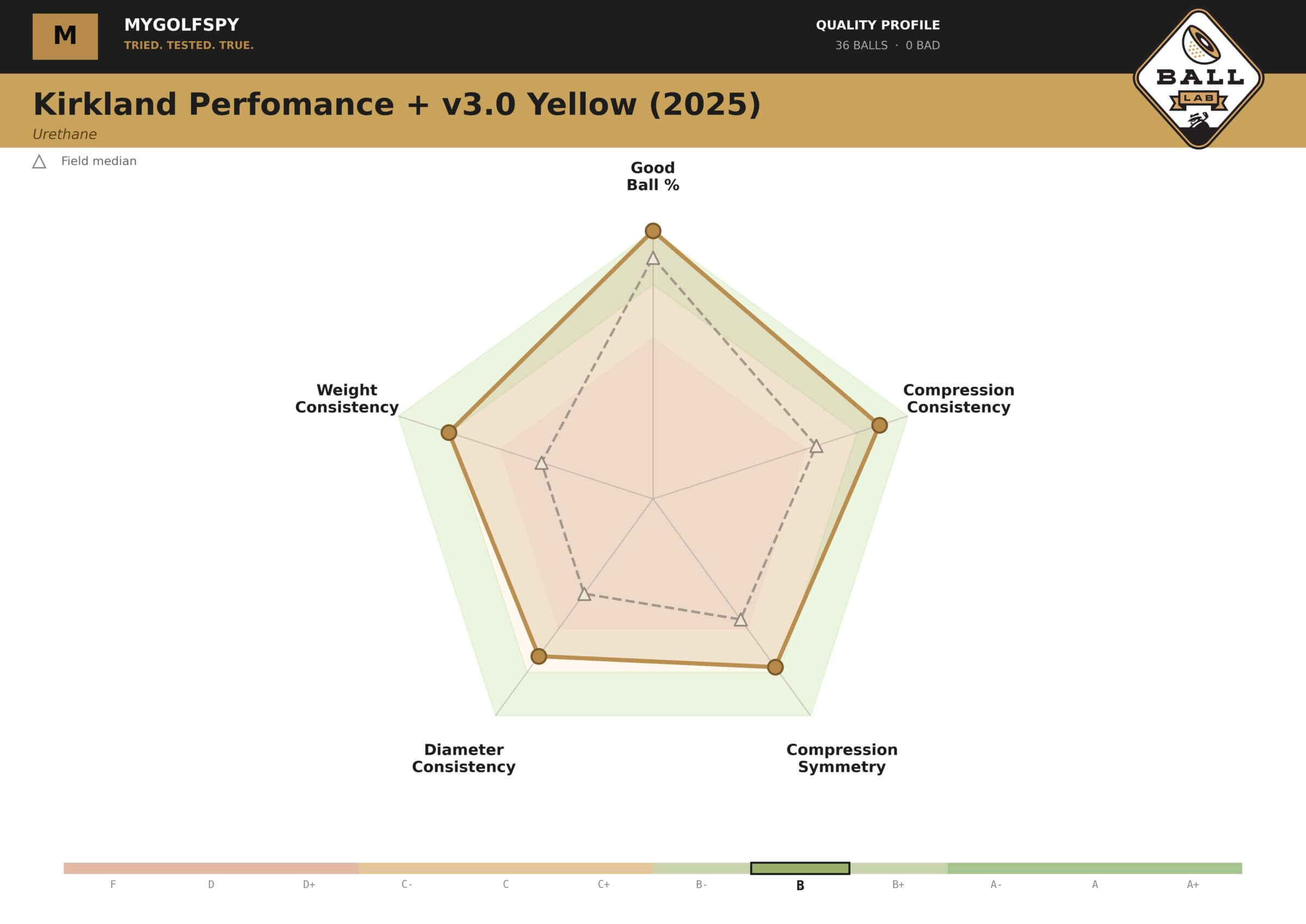
The 2025 Kirkland Performance + v3.0 Yellow earns a Quality Score of 84 and a grade of B. It’s built on a foundation of zero defects and compression consistency that ranks in the top quartile of the entire Ball Lab database. Diameter consistency rated C and Compression Symmetry came in at C+, which is what kept this ball from scoring higher. It’s also worth noting that by urethane standards this ball runs large and light.
Kirkland Performance + v3.0 Yellow
jQuery(document).ready(function($) {
(function() {
// If on template with siderail sticky
if ($(‘.rail-sticky’).length > 0) {
// TEMPORARILY DISABLED: ads are now injected into the .rail-sticky rail,
// so we no longer clone the product summary into the sticky side rail.
// var html = $(‘.mgs-product-summary-block__side’).clone();
// $(‘.rail-sticky’).first().prepend(html);
} else if ($(‘body’).hasClass(‘mgs_buyers_guide-template-default’)) {
// If on full width buyers guide
var contentContainer = $(‘.mgs-product-summary-block__side’).closest(‘.buyers-guide-content’);
if (contentContainer) {
var html = $(‘.mgs-product-summary-block__side’).clone();
var outerHtml=”
‘;
//var outerHtml=”
‘;
contentContainer.append(outerHtml);
contentContainer.waypoint({
handler: function(direction) {
if (‘down’ === direction) {
contentContainer.find(‘.mgs-product-summary-block__side_rail_fixed’).fadeOut(‘fast’);
} else {
contentContainer.find(‘.mgs-product-summary-block__side_rail_fixed’).show();
}
},
offset: ‘bottom-in-view’
});
}
}
$(‘.mgs-product-summary-block__waypoint’).waypoint({
handler: function(direction) {
if (‘down’ === direction) {
$(‘.rail-sticky’).find(‘.mgs-product-summary-block__side’).addClass(‘show’);
} else {
$(‘.rail-sticky’).find(‘.mgs-product-summary-block__side’).removeClass(‘show’);
}
},
offset: ‘0’,
});
})();
});
Product details
- Price: $39.99/two dozen
- Construction: 3-piece urethane
- Compression: 91 (Firm)
- Factory: SM Global, China
- Diameter: 1.6851 in.
- Weight: 1.6078 oz.
- Bad Balls: 0
MyGolfSpy Ball Lab measures the quality and consistency of golf balls, giving golfers insight into what’s happening beneath the cover. Use Ball Lab as a starting point in your search for the right golf ball. Quality Scores are based on five key metrics: defect rate, compression consistency, compression symmetry, diameter consistency, weight consistency. Scores are weighted toward the factors that most affect performance and defective balls reduce the final score to reflect real-world quality.
Test results
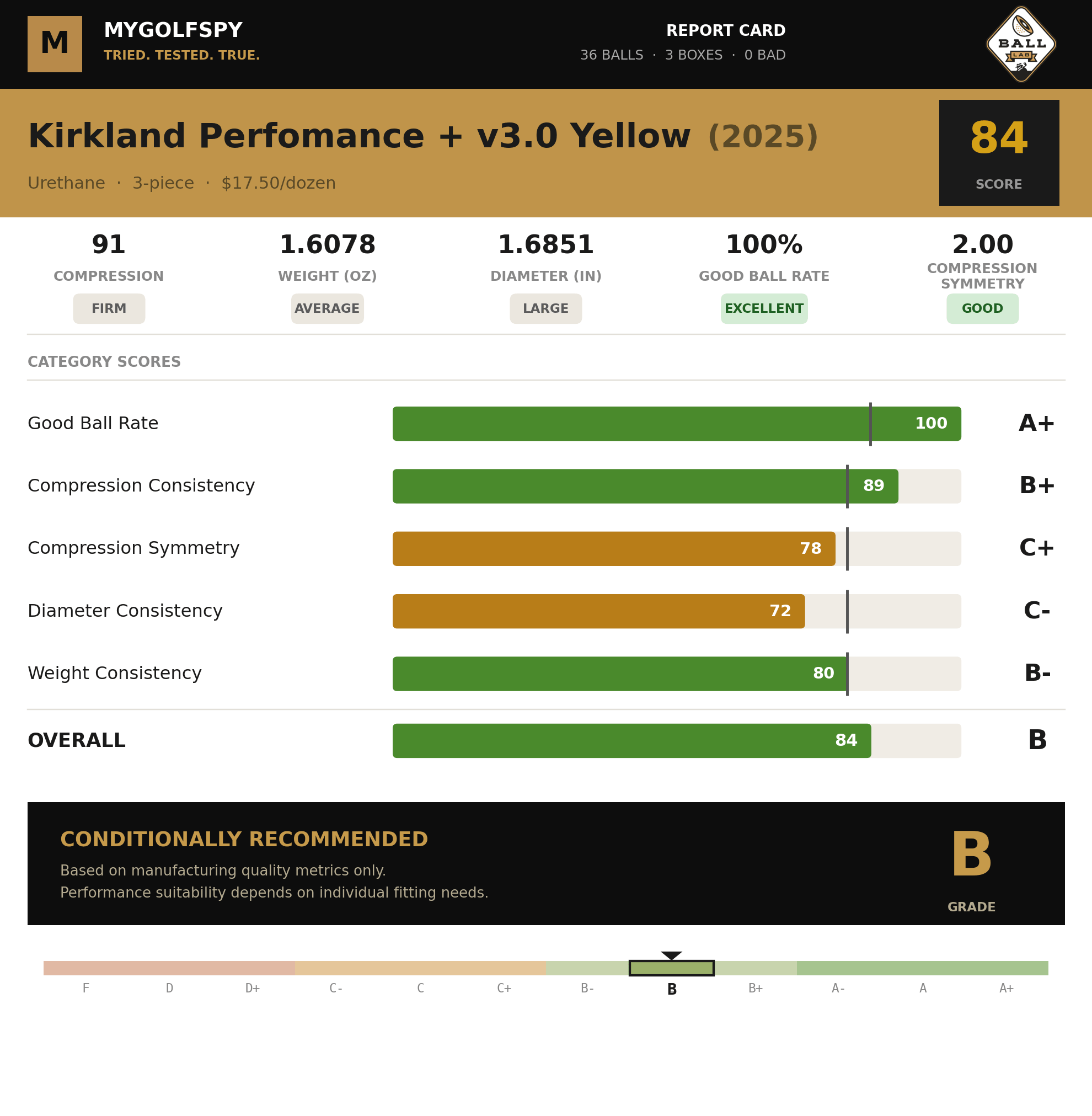
The 2025 Kirkland Performance + v3.0 Yellow scored 84/100 and earned a grade of B. The headline number is built on a clean defect record and compression consistency that ranks in the top quartile of the Ball Lab database. Diameter consistency and compression symmetry were the soft spots that kept the score from climbing higher.
Good Ball Rate came in at 100 percent. All 36 balls passed inspection with zero flagged defects across cores, layers and covers. That’s the best possible outcome in this category.
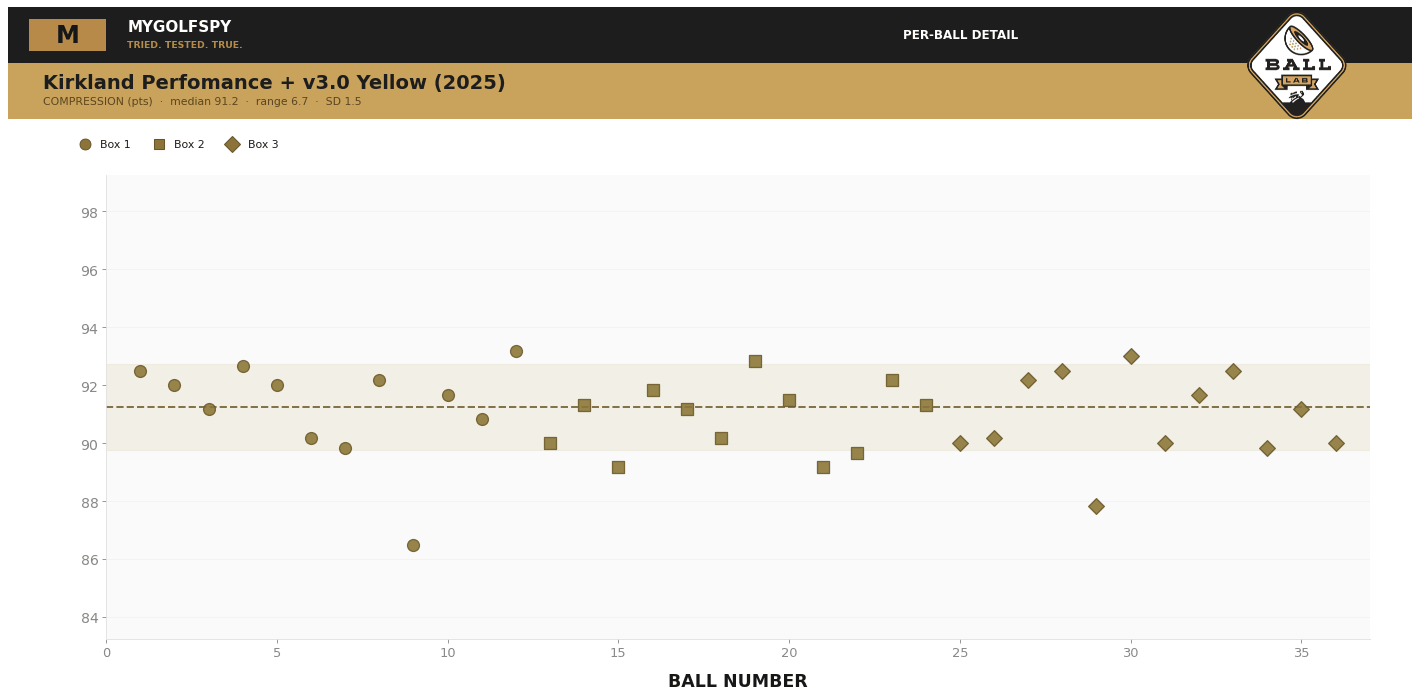
Compression consistency graded at B+ with a delta of 6.7 points across the sample; better than the database average of 9.7. Ball to ball, you’re getting a product that performs consistently.
Where the Kirkland gives some ground is diameter consistency which graded at C and compression symmetry which came in at C+. Those aren’t disqualifying numbers but they are the reason this ball lands at 84 rather than pushing into B+ territory.
Compression
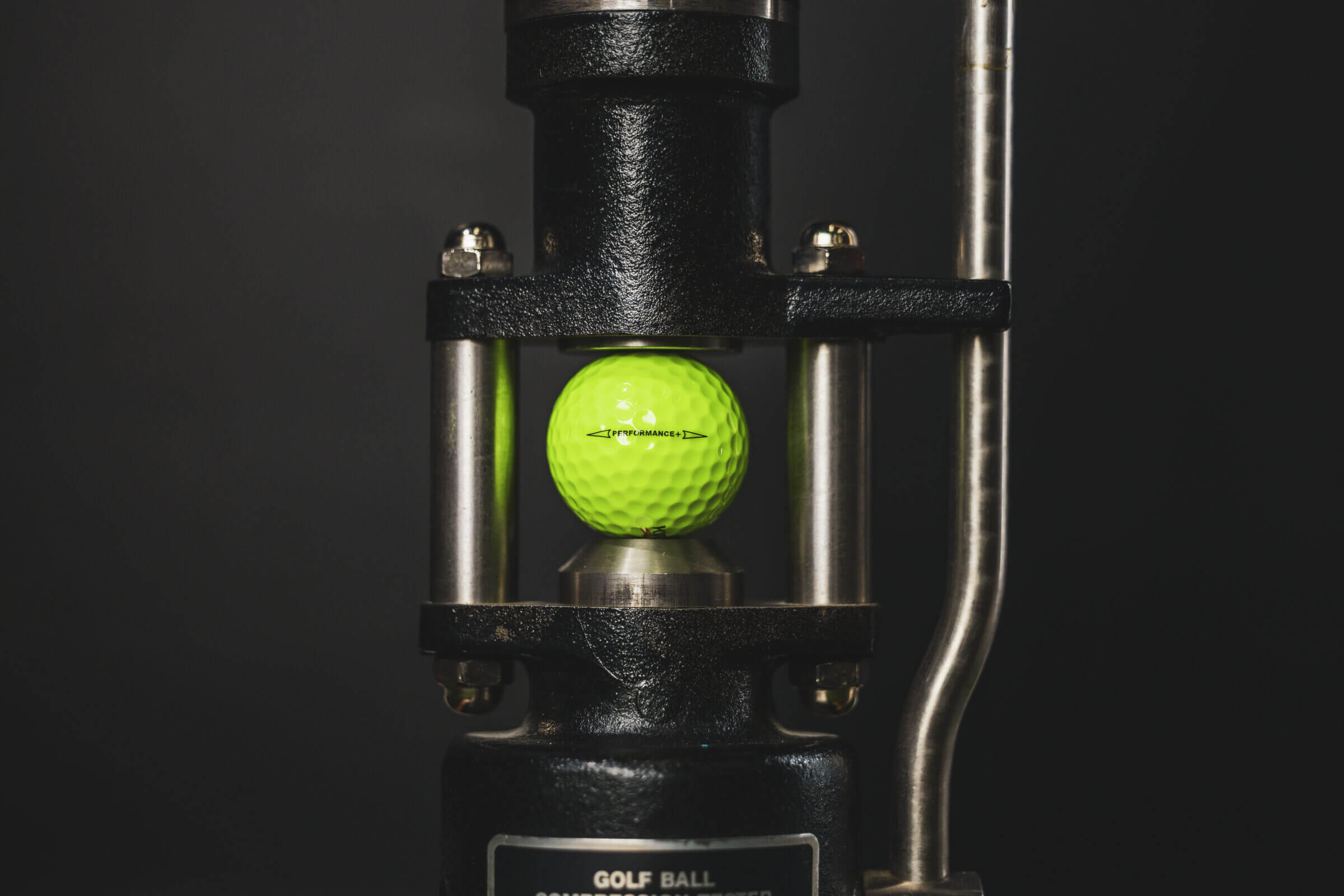
Compression is a measure of how much force is required to deform a golf ball. The higher the compression value, the more force required. Consistency in that value matters because a ball that compresses differently from shot to shot produces different results from shot to shot. Ball Lab measures every ball individually and tracks the average and the spread across the sample.
The 2025 Kirkland Performance + v3.0 Yellow averaged 91.0, putting it in the firm range of our database. Compression consistency graded out at B+ with a delta of 6.7 points and a spread running from 86.5 to 93.2. That delta is better than the database average of 9.7.
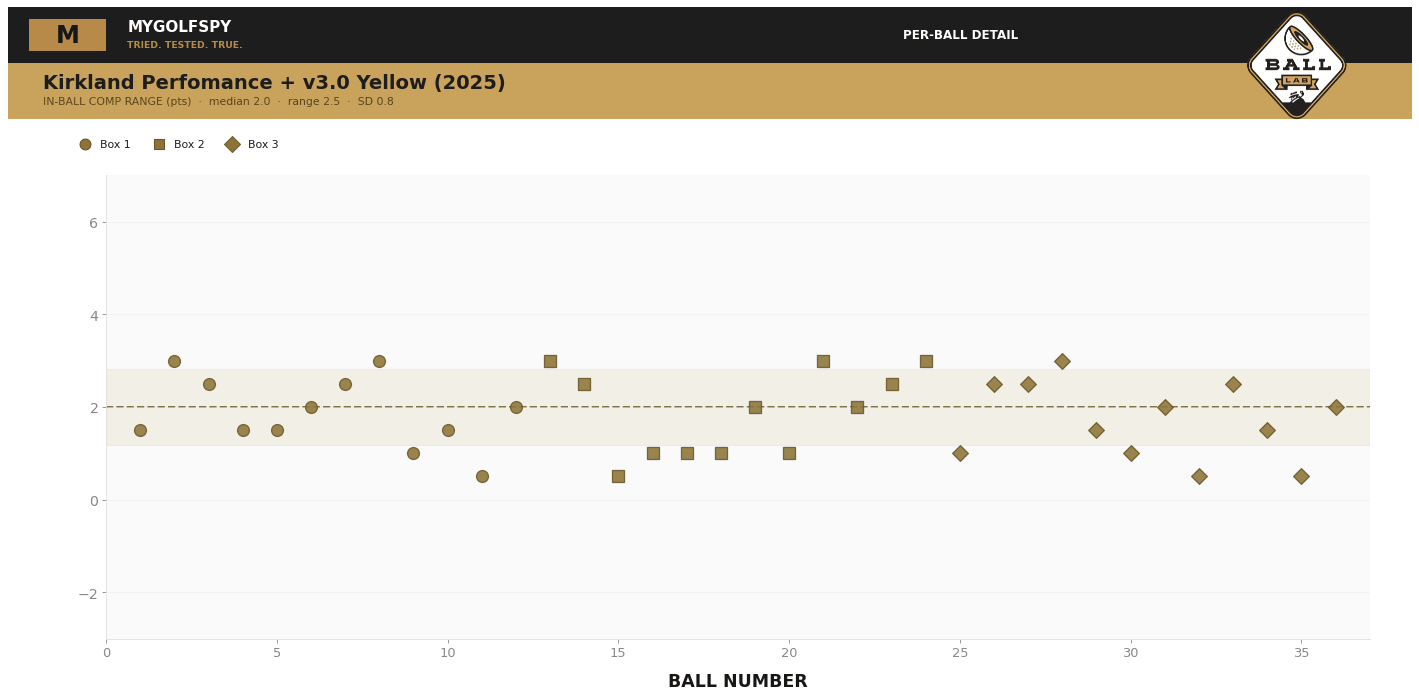
Ball Lab also measures compression symmetry which is distinct from the delta measurement. Where the delta tracks variation across all 36 balls, symmetry tracks how evenly compression is distributed across three points on each individual ball. The Kirkland averaged 2.0 points of symmetry deviation, in line with the field average. Each ball is reasonably internally consistent, though symmetry was not the standout category here: compression consistency across the sample was the stronger of the two numbers.
The charts below detail the compression measurements in our sample.
Weight
Weight is another metric we analyze in these Ball Lab tests. Even small differences in weight across a dozen can translate to inconsistent ball flight. Ball Lab weighs every ball to four decimal places.
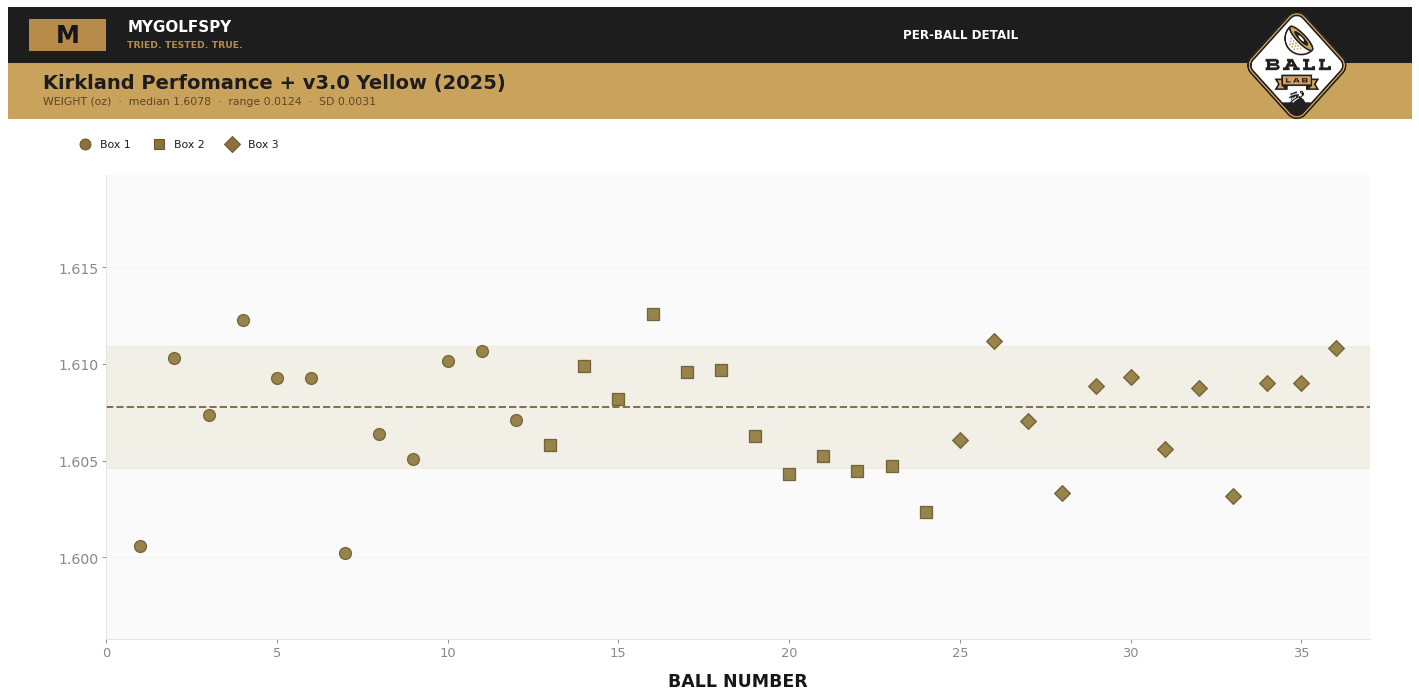
The 2025 Kirkland Performance + v3.0 Yellow averaged 1.6078 ounces across 36 balls, in the average range of the database. Every ball came in under the USGA maximum of 1.6205 ounces, with a range running from 1.6002 to 1.6126 and a standard deviation of 0.0031. No individual ball was flagged as an outlier.
Weight consistency grades out at B−.
The charts below detail the weight measurements in our sample.
Diameter
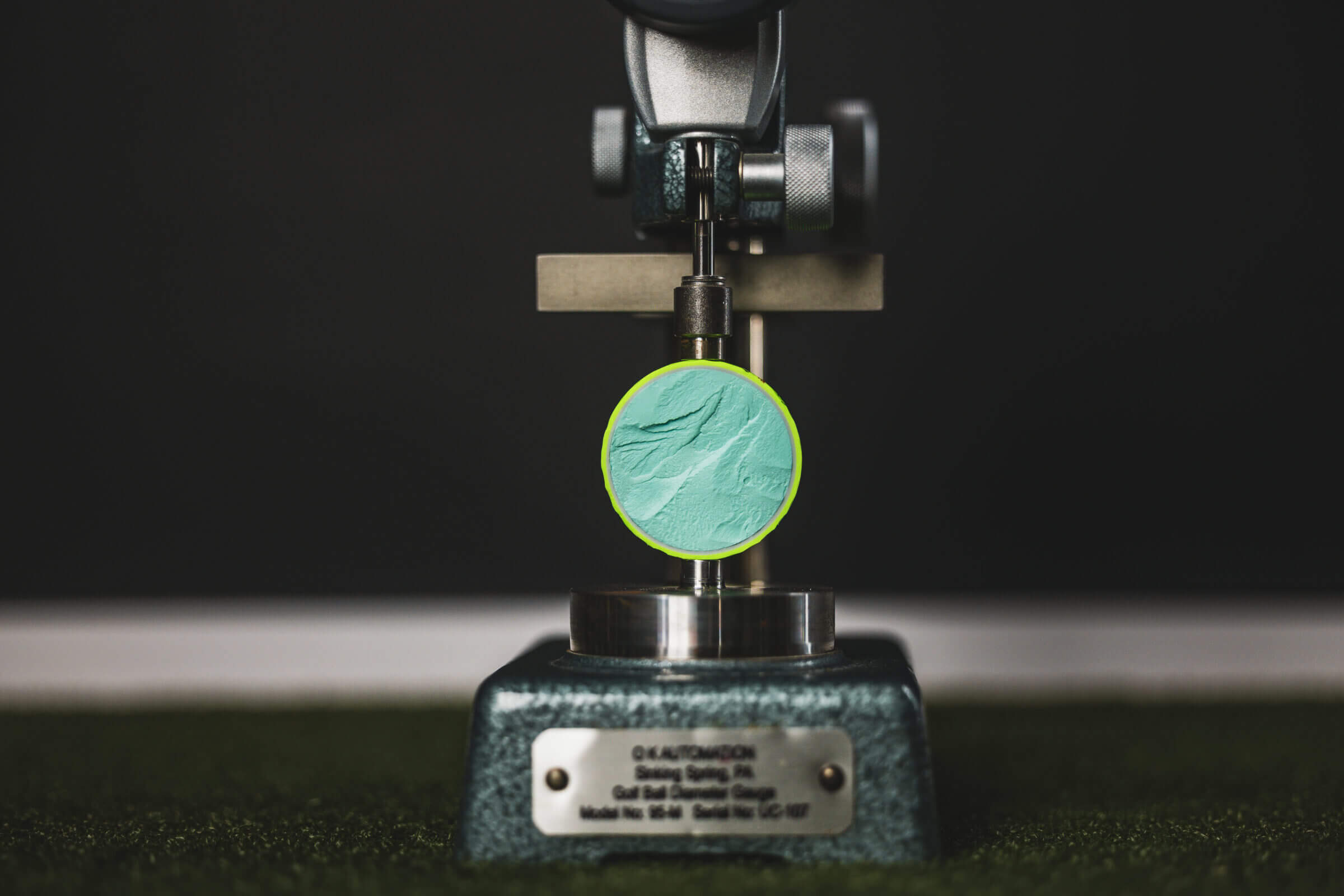
Roundness of a golf ball matters. A ball that isn’t truly uniform in shape can track off line on the putting green or produce inconsistent flight patterns in the air. Ball Lab measures each ball across multiple axes to get a true picture of its shape.
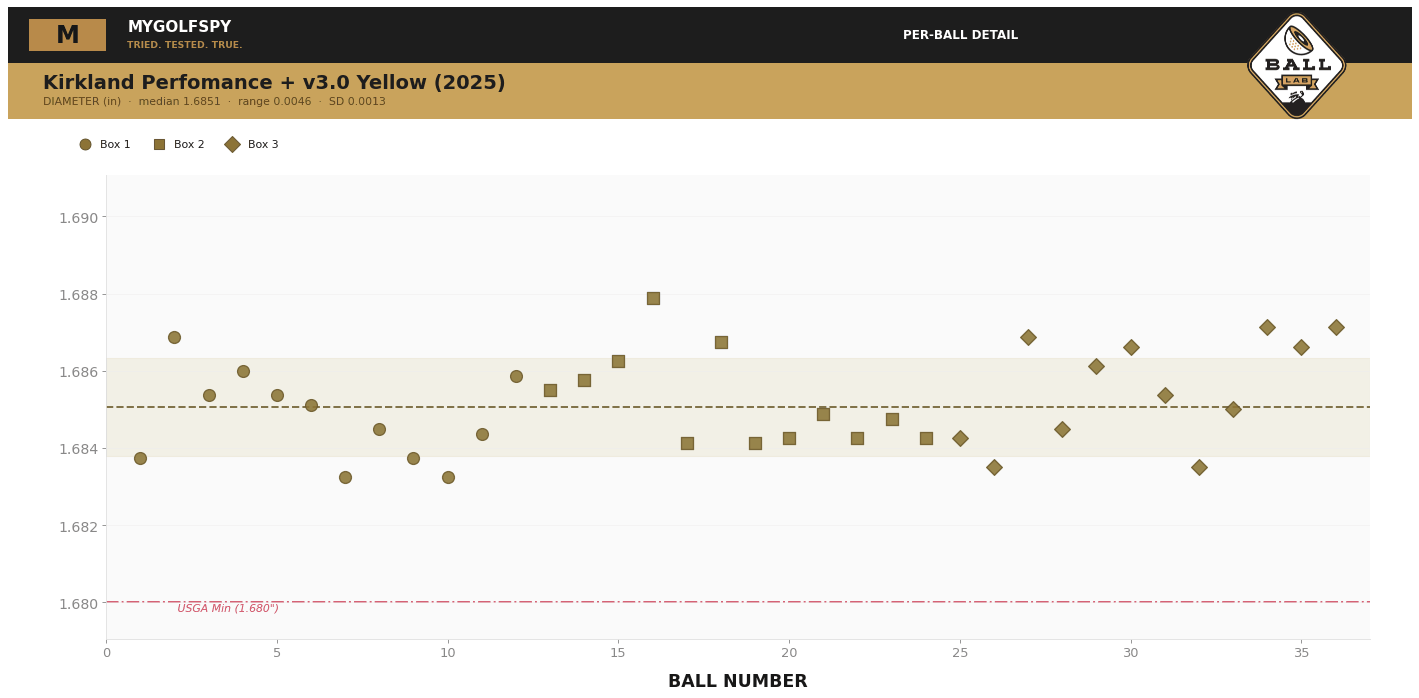
The 2025 Kirkland Performance + v3.0 Yellow averaged 1.6851 inches, above the USGA minimum of 1.680, with a standard deviation of 0.0013 inches. Every ball cleared the minimum although the sample did show a slight pole bias on average. Seventeen of 36 balls measured thicker at the pole, two at the seam, and 17 fell within gauge noise, meaning no clear lot-wide pattern was present.
It’s worth noting that 1.6851 inches is on the large end by urethane standards and, combined with the lighter weight, this ball’s physical profile sits outside the norm for the category.
Diameter consistency graded out at C, the weakest category on the card and the primary reason the Kirkland didn’t score higher.
The charts below detail the diameter measurements in our sample.
Ball Lab report card
Each Quality Score is a weighted average of five grades: good ball rate, compression consistency, compression symmetry, diameter consistency, weight consistency. Our scoring system punishes defective balls more severely while giving greater weight to compression metrics than to weight and diameter. This is a reflection of how much compression variation actually matters to ball flight and feel.
The post Inside Costco’s Golf Ball: Better Than You’d Expect? appeared first on MyGolfSpy.