
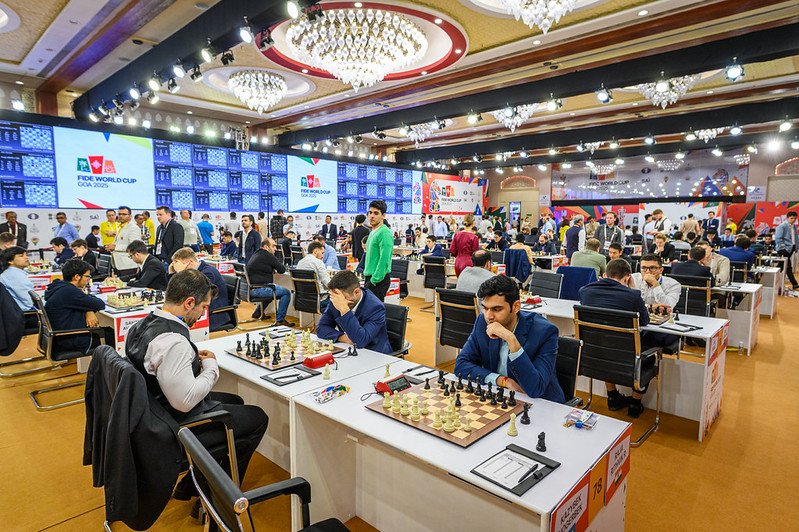

The International Chess Federation has announced a big shake-up in the format for the 2027 FIDE World Cup and Women’s World Cup. Instead of huge 206 and 107-player knockouts, the last stage will now involve only the final 16 players in each event, with the qualifiers decided by a Swiss group stage where all participants play nine games. The overall numbers and prize fund have grown, however, to 224 (Open) and 128 (Women) players, with a total of $3.3 million up for grabs.
The FIDE World Cup is one of the biggest, longest, and most dramatic tournaments in chess, with the field traditionally getting cut in half every three days. In the 2025 FIDE World Cup in Goa, India, 78 players had already been knocked out before the top-50 seeds even began their event. With 24 playing days and two rest days, the tournament had lasted 26 days before GM Javokhir Sindarov overcame GM Wei Yi to be crowned World Cup winner and take home the $120,000 top prize.
That’s all set to change, as FIDE announced today that a new format has been adopted for 2027. The players will first be split into four groups of 56 players (two groups of 64 players for the Women’s event), and play a nine-round Swiss tournament. The top-four (top-eight for the Women) will qualify to the Round of 16, when the format switches back to the same two-game classical matches plus rapid-and-blitz playoffs used in previous World Cups.
The Swiss tournament will be held over five days, with double rounds on four of those days. That’s possible because of the adoption of a “fast classical” time control, where players have 45 minutes in total, plus a 30-second increment added each move. A full week will be shaved off the run-time of the tournament.

In some ways it’s a return to the origins of the first World Cup events, which were held with just 24 players, split into four groups of six players. The top-two qualified for the Quarterfinals, with GM Viswanathan Anand winning both events. It should be noted, however, that at the time there were also huge and controversial knockout tournaments being held for the FIDE World Championship title, before the format was adopted for the almost universally approved World Cup we’ve witnessed since 2005.
FIDE World Cup Winners
| Year | Venue | Players | Knockout | Winner | Runner-up |
| 2000 | Shenyang, China | 24 | 8 | Viswanathan Anand | Evgeny Bareev |
| 2002 | Hyderabad, India | 24 | 8 | Viswanathan Anand | Rustam Kasimdzhanov |
| 2005 | Khanty-Mansiysk, Russia | 128 | 128 | Levon Aronian | Ruslan Ponomariov |
| 2007 | Khanty-Mansiysk, Russia | 128 | 128 | Gata Kamsky | Alexei Shirov |
| 2009 | Khanty-Mansiysk, Russia | 128 | 128 | Boris Gelfand | Ruslan Ponomariov |
| 2011 | Khanty-Mansiysk, Russia | 128 | 128 | Peter Svidler | Alexander Grischuk |
| 2013 | Tromso, Norway | 128 | 128 | Vladimir Kramnik | Dmitry Andreikin |
| 2015 | Baku, Azerbaijan | 128 | 128 | Sergey Karjakin | Peter Svidler |
| 2017 | Tbilisi, Georgia | 128 | 128 | Levon Aronian | Ding Liren |
| 2019 | Khanty-Mansiysk, Russia | 128 | 128 | Teimour Radjabov | Ding Liren |
| 2021 | Sochi, Russia | 206 | 206 | Jan-Krzysztof Duda | Sergey Karjakin |
| 2023 | Baku, Azerbaijan | 206 | 206 | Magnus Carlsen | Praggnanandhaa Rameshbabu |
| 2025 | Goa, India | 206 | 206 | Javokhir Sindarov | Wei Yi |
| 2027 | TBD | 224 | 16 | TBD | TBD |
So why the change? FIDE’s announcement explains: “By combining a Swiss qualification stage with the traditional knockout finals, FIDE preserves the excitement and prestige of the World Cup while providing every participant with significantly more games and a better overall tournament experience.”
Let’s look at some of the factors:
1. Reducing The Tournament Length
A four-week event is a challenge for all involved. FIDE calls it “increasingly difficult to fit into the international chess calendar,” while you need a venue that can go from accommodating hundreds of players and officials to the handful that remain at the end.
For players, there’s the challenge of planning their calendars not knowing how long they’ll stay at the event, as well as the sheer length. GM Alireza Firouzja, explaining why he skipped the event in 2023, commented, “I didn’t see myself playing one month every day chess.”

Many have pointed out in the past, however, that it’s appealing that either you’re successful and earn a good prize with a longer stay, or your misery is cut short as you go home. For the top players, the new format makes less difference, as they were in any case given a bye through the first three days of round one, but FIDE may hope to tempt the likes of 2025 absentees GMs Magnus Carlsen, Hikaru Nakamura, and Fabiano Caruana back into the event.
2. Guaranteeing Everyone At Least Nine Games
For many players the World Cup was short and sweet—short, as they were knocked out in two days, but sweet, as they headed home with a healthy guaranteed prize. For the world’s best, however, the lack of margin for error over two games could mean a bitter early exit.

This time, all participants will spend at least five days in the venue, get to play nine games, and potentially face off against the world’s very best. The atmosphere may feel more like the Olympiad, at least for the first week, though it’s likely that only the very best will make it through to the Round of 16.
3. More Participants And Higher Prize Funds
The inclusion of a Swiss stage makes it easy to include more players, and has allowed FIDE to add 18 places to the Open event and 21 to the Women’s, while increasing the Open prize fund from $2 million to $2.3 million and the Women’s prize fund from $0.676 million to $1 million. That increased prize fund will keep providing guaranteed prizes for all players, while the top prizes—$120,000 for the Open and $50,000 for the Women’s World Cup, are set to stay the same (but for fewer days of work!).
FIDE President Arkady Dvorkovich explains: “We are making the FIDE World Cups more inclusive than ever before. The increased number of places, including additional qualification spots for Africa and the Americas, will provide more opportunities for talented players from every continent to compete on one of the biggest stages in world chess.”
4. Combining The Two Events?
One possibility not mentioned in the announcement is hosting the two events together, which clearly becomes easier than ever before, since both will follow exactly the same schedule, instead of the Women’s event having one round less.

The changes are likely to divide chess players and fans. One top player to give his stamp of approval was U.S. GM Hans Niemann, who was glad to see the adoption of a faster time control.
Great initiative by FIDE, especially the inclusion of 45+30. Chess is adapting and growing! https://t.co/7PHj0f0pVS
— Hans Niemann (@HansMokeNiemann) July 13, 2026
Latvian GM Arturs Neiksans also approved of the time control, but wondered why the faster games couldn’t have been used to hold the same big knockout at a faster tempo.
While I find the fast classical to be a good idea, IMHO the swiss pools feel weird for a knockout tournament. With the fast classical, FIDE could have organized early stage matches in just one day, also shortening the length of the tiebreak. https://t.co/GHCM8J6aMX
— Arturs Neiksans (@GMNeiksans) July 13, 2026
GM Anish Giri predicted a backlash: “I understand the reasoning behind all of these changes, but dropping this on the chess community without any warning is bound to lead to some backlash.”
What do you think of the change? Was the format broken, and do you approve of the fix? Let us know in the comments below!